
Propaganda Girls
By Lisa Rogak
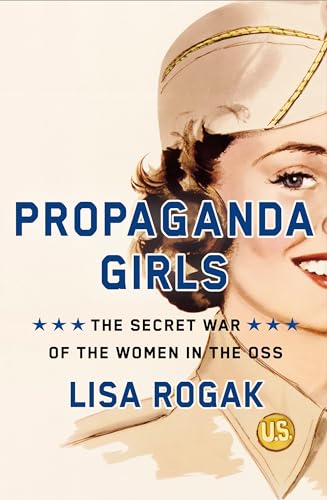
Writing a biography about a small group of women must be quite challenging. Lisa Rogak divided her task into four main parts. First, she gives background separately on each of the four ladies: Betty MacDonald, a journalist who was living in Oahu when Pearl Harbor was bombed; Zuzka Lauwers, a bored, multilingual lawyer from the Czech Republic; Jane Smith-Hutton, wife of a naval attaché in Tokyo; and Marlene Dietrich, German-born actress and singer.
In the next section of the book, Rogak describes individually their early introduction to the Office of Strategic Services (OSS)—recruitment, training, and assignments. Then, in the section titled “Believable Lies,” the author describes the actual work the women did. They put in long, hard days, sometimes in less than ideal living and working conditions, but they loved the independence they had in accomplishing their tasks. Their branch was Morale Operations (MO) where they produced “black propaganda.” Always based on at least a kernel of truth, they created media with the goal of demoralizing enemy soldiers and also citizens in occupied areas. They learned as much as they could about the affected country to make it appear that the flyer, broadcast, or whatever media was chosen originated in the enemy country. In “Back to Reality,” Rogak discusses the difficulties each woman had in finding her place in the world when the war ended.
Propaganda Girls was extremely well researched with an extensive bibliography and footnotes. There are many quotes from those who knew the four women and from written resources. These references give authenticity to the biography. The format Rogak chose for this book is fairly rigid resulting in characters who are well-defined in each progression. They are, however, never infused with personality. If you like your nonfiction to be so exciting that it could be mistaken for fiction or be a page turner, then this will not be a good match for you. If you want to learn about women making a difference in World War II, probably saving lives, and working for less pay and respect than their male counterparts, then you’ll be satisfied with this glimpse into a portion of World War II history that has not been well-publicized.
I received a complimentary copy of this book in exchange for an honest review. Opinions expressed in this review are completely my own.
Rating: 4/5
Category: Biography, Nonfiction, History
Publication: March 4, 2025—St. Martin’s Press
Memorable Lines:
Marlene loved the job, and between the cross-country bond tours, working at the canteen, and making an occasional movie, she was exhausted all the time, but here was a way that she could directly affect the lives of thousands of young men who were about to put their lives on the line. She had found her calling.
Betty had crammed a lot of living into her century of life. But like Zuzka, Jane, and Marlene, her war service was the highlight of her life. “There was a real reason for what we were doing in those days,” she said. “A lot of the things we tried didn’t work, but it was war, and it was important.”
But after more than five years of war, Paris wasn’t in much better shape than Tokyo. The city was impassable in many places; apartment buildings and homes were in disrepair and often uninhabitable. Most buildings in the city had gone unheated for the length of the war, except for those that had been occupied by the Germans.


 education pathways
I may need to check this one out.
LikeLiked by 1 person
Lots of facts in this one!
LikeLiked by 1 person
This could be a great book for our Book Club. Thanks for the review. You always do such a thorough job. Enjoy your week ahead.
LikeLiked by 1 person
Thanks, Nancy. For my Book Club, I am reading Doc Susie about a woman doctor in Colorado during the gold rush. You really can’t compare the two because of the time frame and the number of protagonists, but I think I like Doc Susie better than Propaganda Girls.🤷♀️
LikeLiked by 1 person
Thanks! I’ll remember that!
LikeLiked by 1 person
Thanks for the review. It sounds interesting.
LikeLiked by 1 person
I had no idea so much propaganda went on from the U.S./Allied side during the war. They always made sure there was a kernel of truth and then they got creative. It reminds me of current ad campaigns by various companies.
LikeLiked by 1 person
I agree. There was a blogger, can’t remember his name, who wrote about WWII, his father had been in the war. He mentioned the propaganda as well. He had a lot of stories from his dad, so interesting.
LikeLiked by 1 person
Sounds intriguing to me! I just learned about the OSS a few years ago while watching a documentary on TV. / My husband and I recently finished The War for Middle Earth by Joseph Loconte, detailing the roles J. R. R. Tolkien and C. S. Lewis played in World War II, providing information, persuasion, and encouragement through their writing. (C. S. Lewis also gave a number of addresses on radio.) Fascinating reading–I learned much about what England (particularly London) faced during the war. Also well-researched, with 33 pages of bibliography and notes in the back of the book!
LikeLiked by 1 person
Nancy, that sounds like a rabbit hole I would really enjoy going down! I’m going to look into getting a copy of that book.
LikeLike
I find this time fascinating and I love learning about people and events that I don’t know a lot about, but, I do prefer Narrative Nonfiction, so I’m not sure if this will be for me or not. Great review, Linda.
LikeLiked by 1 person
The author has a well-organized brain, great for reporting on 4 different people, but it is the kind of book that makes me think that I don’t like nonfiction. That is not true, however, as I very much enjoyed Seabiscuit and The Boys in the Boat. For someone studying the period or the use of propaganda, I think it would be very useful.
LikeLiked by 1 person
Yes, both of those are Narrative Non-fiction. You would probably love The Day the World Came to Town by Jim DeFede. The story of Gander Newfoundland on and after 911. It was so interesting and narrative, not facts.
LikeLiked by 1 person
I located that book in my library and on Thriftbooks so I have it saved now in two places. It is a part of recent history that was not on my radar. Thanks for the recommendation.
LikeLiked by 1 person