Deep Undercover–K-9 Suspense
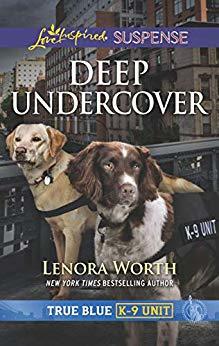
Deep Undercover
by Lenora Worth
narrated by Callie Beaulieu
- Clean romance? ✔️ Harlequin Love Inspired Suspense
- Christian themes? ✔️ but not preachy
- K-9 officers? ✔️ 2 bomb detection dogs, highly trained
- Likable protagonists? ✔️ 2 human officers who have to work at not falling in love
- Interesting setting? ✔️ NYC, the upper crust and the underbelly
- Realistic backdrop for crimes? ✔️ includes difficulties with traffic, use of various forms of urban transportation, gentrification of older neighborhoods, high real estate prices
- Complex plot? ✔️ Brianne and Gavin and their K-9 partners are initially assigned to investigate the death of the leader of their unit, but soon their attentions are directed to a serial bomber.
- Undercover? ✔️ Brianne and Gavin have to pretend to be married and have “money to burn” in their search for a building to renovate or demolish
- Suspense? ✔️ Absolutely, but not the kind that will keep you up all night
- Standalone? ✔️ Each book in the series is written by different author
- Narration? ✔️ Very good
- Recommend? ✔️ Absolutely!
I received a complimentary copy of this book in exchange for an honest review. Opinions expressed in this review are completely my own.
Rating: 4/5
Category: Romance, Christian, Suspense
Note: #4 in the True Blue K-9 Unit series
Publication: July 7, 2026—Harlequin Audio
Freshly Pressed by WordPress
I received an email today explaining WordPress’ selection of my blog post that reviews The Lion Women of Tehran:
| Your site has been selected for Freshly Pressed! |

| Congrats, we love your writing and want to share it with the world. Hi lghiggins, We’ve selected your post (The Lion Women of Tehran–power of friendship) for Freshly Pressed, a showcase where we feature editors’ picks and community favorites on WordPress.com. We are thrilled to share your post with our wider audience. Your post will appear at wordpress.com/discover/, where members of the WordPress.com community can read, comment, like your post, and subscribe to your site to get notified whenever you publish new content. Thank you for being part of the biggest and best community of bloggers around the world. We’re proud to be the platform that makes your voice heard. |
Thank you, WordPress for this honor. Thank you, readers, for your support of my blog.💜
Finlay Donovan Digs Her Own Grave–mystery with a lot of humor
Finlay Donovan Digs Her Own Grave
by Elle Cosimano

Having read the first book in this series, I was somewhat prepared for this one, but I had clearly missed a lot of character interaction between the first and the fifth. The main characters are still there: Finlay, a struggling single mom/author, and Vero, the family nanny and Finlay’s friend. Finlay does not get much writing done in this mystery as she is too wrapped up in trying to discover a murderer and prove it was not her philandering ex-husband. Along the way she uncovers other crimes and gets herself and Vero in trouble with law enforcement, including her boyfriend Nick, a detective.
There is a lot of humor that keeps this cozy mystery from being too dark. Finlay takes in her neighbor, Mrs. Haggerty, well known as a busybody, when she lost power and water. Adapting to sharing accommodations causes lots of issues in the household. Finlay’s preschool children Delia, suspended for taking care of a bully when the teacher didn’t, and Zach, a two-year old in need of potty training, are present throughout the book. Cam is a teenager who finds himself on his own in life, but uses his excellent computer hacking skills to Finlay’s advantage and manages to pay himself through deductions to her Venmo account and some home cooked meals.
I spent the first part of the book reorienting myself to the characters and background. Things got complicated in the middle with lots of tangled threads. It was not my favorite part of the book. The end was fantastic with lots of action and surprises. If you like the Finlay Donovan series, I think you will enjoy this one. Finlay learns to trust her boyfriend Nick. She and Vero get bogged down in a web of lies and crime—theirs and that of other characters in the story. There is a lot to like about this book, but if you are new to the series, I don’t suggest you start with Finlay Donovan Digs Her Own Grave.
I received a complimentary copy of this book in exchange for an honest review. Opinions expressed in this review are completely my own.
Rating: 4/5
Category: Mystery, Fiction, Humor
Notes: #5 in the Finlay Donovan series. This would be a good series to start at the beginning and read in sequence as there are so many continuing characters.
Publication: March 4, 2025—St. Martin’s Press
Memorable Lines:
I was sick of people talking about me and the kids as if Steven’s mistakes defined us. I didn’t want Delia to grow up as the cheater’s kid or the murderer’s kid.
I would never have recognized Mrs. Haggerty’s Mark V. The car’s body had been painted a garish shade of purple. Flecks of glitter sparkled in the finish, and the new chrome grille glistened in the sun. Eggplant Ecstasy had been hand-lettered across the hood in fancy looping script. The tires were brand new with wide, white walls, and a disco ball hung from the rearview mirror, spraying the interior of the car with rainbow-colored light.
“A boy named Cooper has been harassing Delia on the playground. She gave him six stitches and a couple of bruised ribs”….“And then I kicked him in the tentacles,” Delia said “just like Vero showed me.”
Blind Trust–suspenseful with Christian themes
Blind Trust
by Laura Scott
narrated by Emily Sutton-Smith
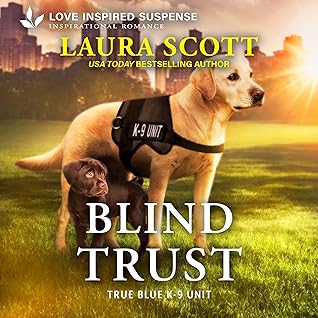
Eva Kendall is an accomplished dog trainer in Queens, NY. She is employed in a training facility where she works with Coco, a dog intended to be her future service dog when she loses her eyesight to a degenerative eye disease. She is accosted and Coco is dognapped, beginning a series of crimes as the dognapper wants his “package” back. This attack is how Eva meets Finn Gallagher and his K-9 partner Abernathy. Finn has a reputation as a charmer who dates a girl twice and moves on before anyone can develop feelings. Things are different when he encounters Eva. They both have issues to work through if they are going to have a relationship—Eva, her disability, and Finn, abandonment by his mother.
There are many complications in the plot and the mastermind behind the criminal network is not obvious. My favorite character is Mikey, Eva’s sweet, three-year-old nephew whose mother passed away only two weeks prior. The dog Abernathy (Ab to Mikey) is the perfect blend of comfort to Mikey and protectiveness and obedience in his role as Finn’s K-9 partner. Although Eva, to her embarrassment, can not provide visual descriptions of her attackers, her other senses are heightened. She can describe their voices and the odors she associates with them, valuable clues to their identities.
In this novel of faith, romance, action, and suspense, Finn is a man of faith and models prayer for Eva and Mikey. Eva recovers her dependence on God, despite her impending blindness, and begins to pray on her own.
Emily Sutton-Smith’s narration is very good with all of the voices. She brings the characters to life, especially little Mikey.
I received a complimentary copy of this book in exchange for an honest review. Opinions expressed in this review are completely my own.
Rating: 4/5
Category: Christian, Fiction
Notes: This book is part of the True Blue K-9 Unit, but I read it as a stand-alone with no problems.
Publication: June 23, 2026—Harlequin Audio
Roberts Ridge: A Story of Courage and Sacrifice on Takur Ghar Mountain, Afghanistan
Roberts Ridge
by Malcolm MacPherson
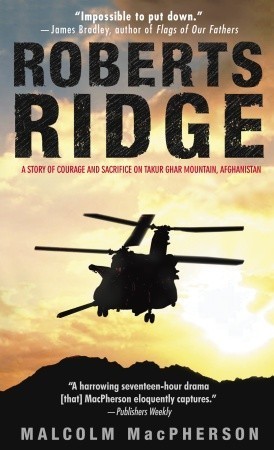
War stories are not part of my regular reading choices. In fact, this may be the first battle account I have ever read. Sure, I have read about various wars, but those narratives tend toward general descriptions and the impact of conflict on citizens. Roberts Ridge, however, describes in detail seventeen hours of hostilities involving multiple branches of the military, with SEALS, Rangers, and other special forces struggling at 10,240 feet to take a strategic position. Intel had not advised the warriors that Takur Ghar was already occupied by the enemy. Al-Qaeda had two established and camouflaged bunkers with equipment and food.
Communication problems and technology issues compounded the difficulties, highlighting in retrospect the need for backup skills and equipment like “map-reading,…, basic rifle marksmanship, and fire and maneuver.” Sometimes, orders were delayed or conflicting. Frustration occurred when the commanders did not seem to understand what the men on the ground were seeing and needed. The author gives his personal analysis in the Afterword: “The fog and friction of war will continue to be ubiquitous. One must understand that fog, friction, and chance dictate limitations. To survive on future battlefields, U.S. military commanders should understand war for what it is—a complex and unpredictable endeavor that requires warriors, educated and prepared to encounter uncertainty. Such warriors must understand not only the capabilities of the latest technologies, but also their limitations.”
Roberts Ridge did not set out to “bash” anyone. MacPherson, although not helped in his research by official military sources, persisted in telling a story he felt needed to be told. He made some contacts who connected him with others who could provide first-hand information. He conducted a lot of interviews and extended his research to books and articles. He follows his account of events with an Executive Summary, a ten page version of the events at Takur Ghar provided by the Department of Defense.
Roberts Ridge is a page turner, but between the tension the soldiers experienced and the emotional impact of soldiers dying, watching their friends die, and enduring pain for hours on end, I sometimes needed a break. I was frustrated along with the leaders on site when they were not given all the information they needed to make good decisions in what turned out to be a very complicated assault and rescue situation.
The inclusion of maps and photos was a great help, but even more photos would have been better. As a non-military reader, I did not know most of the military acronyms that were used frequently in the book. Some were explained; others were not. With the Internet’s help, I got most of them defined. A glossary of these terms would have been very helpful for quick reference. Similarly, there were a lot of people involved in this mission. Although they were generally well-introduced, a listing of these individuals with a brief descriptor and grouping by the part of the mission they participated in would be beneficial for the reader. There is a handy index.
Although outside my usual genre, Roberts Ridge is a book I am glad I read. It not only told about a battle and some heroes I needed to know about, but it broadened my understanding of the Afghan war.
Rating: 5/5
Category: Nonfiction, War
Notes: As this is a nonfiction account of tough, courageous men engaged in life-threatening conflict, expect swearing.
Publication: 2005—Dell
Memorable Lines:
The guy out in the snow could be anybody, Mack was thinking. Friendly Afghans roamed these mountains, some of them allies of the coalition forces. Christ, they lived here; this was their patch. Neither Mack nor anybody else knew at any given time exactly where to expect them to appear. And whether they were enemy or friendly, they all looked the same.
For special operators…leaving a teammate in the lurch and not returning was far more serious than breaking any social vow, in a fundamental, even atavistic way, because it entailed death, and the dead man easily could be you. Returning for a lost brother required no thought, no decision. It was an ingrained reaction, not an idea.
The Rangers’ movement up the hill was a physically demanding 2-hour effort under heavy mortar fire and in thin mountain air. They climbed the 45-70 degree slope, most of it covered in three feet of snow, weighted down by their weapons, body armor and equipment.
The Lion Women of Tehran–power of friendship
The Lion Women of Tehran
By Marjan Kamali

No one can summarize the fascinating story told in The Lion Women of Tehran better than Marjan Kamali who says in her Author’s Note: “I follow the friendship between two girls who come from very different families and stations in life but who forge an indestructible bond when they are seven. Together they share the joys of childhood, the ups and downs of adolescence, the fractures of betrayal when they are young women, and the relief of redemption as their fate takes them across oceans and borders. All along, one of them, Homa, fights tirelessly for Iranian women to be free.”
The Lion Women of Tehran tells the story of multiple regime changes in Iran along with the hope for a better life and the disappointment when each new ruling class results in more hardship for the citizens than the one before. The novel’s setting is a powerful backdrop to this tale of the repression of women. Minor, even accidental, infractions such as a hair that escapes a hijab could result in imprisonment and torture. Men were not immune to jailing by the security police, either, with political prisoners receiving long, harsh jail sentences.
Ellie and Homa meet as children and despite difficulties over the years, they remain friends. These two characters capture the interest of the reader immediately and hold it as the novelist spins out a tale with many twists and turns. A chapter will end with a poignant line that lets you know that something important will happen in the next chapter or with a hook that grabs and won’t let go. I read this page turner quickly because I had to keep reading in hopes of discovering resolution to the various problems. The main final action occurs in 1982, but the author jumps ahead in time to 2022 to a concluding chapter and an epilogue. That technique seems rather abrupt, but it answers many questions satisfactorily without drawing the novel out needlessly with details that would detract from the main themes of the book—friendships that last and the strength of women in the face of adversity.
The chapters are well labeled to show whether the point of view is Homa’s or Ellie’s. Perhaps more importantly, the year and sometimes the month are noted. This notation is significant because there are gaps in the timeline and events are not always sequential in the storytelling.
The Lion Women of Tehran is a powerful work of fiction that deserves a top place in literary discussions. The prose is well-written and the plot is well-crafted. Marjan Kamali brings Iranian culture to life and presents an Iran that is not shared in news reports.
Rating: 5/5
Category: Historical Fiction
Publication: July 2, 2024—Gallery Books
Memorable Lines:
In the middle of the schoolyard with everyone watching, with the lunch break ticking away and stomachs grumbling, with the leaves on the ground fragile and breakable beneath our feet, my old friend wrapped her arms around me. She hugged me as though seven years had not passed…it was she Homa. The girl who was always her full self without apology, without explanation, without shame.
I walk in a city now littered with burning cars and trash cans ablaze, a city boiling in fury, a country desperate for change and freedom. My heart is heavy. I am once again cloaked in grief. As I walk, the voice in my head whispers again. And I cannot help but be chilled from head to toe: If the revolution succeeds, what if what follows is worse?
We are tired. Tired of the many ways we are continually told to shut up and obey. Tired of being worried about constant arrest because a strand or two of our hair might peek out. Because a patch of our skin might show. Tired above all—above all in God’s almighty planet—of being bombed. Night after night after night.
Doc Susie: The True Story of a Country Physician in the Colorado Rockies
Doc Susie
By Virginia Cornell
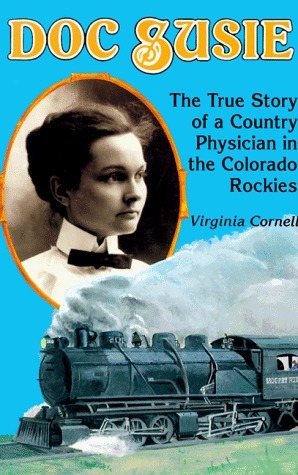
Life was hard, very hard, for the residents of Fraser, Colorado, according to Virginia Cornell’s biography of Doc Susie. Most of the year was extremely cold, and some peoples’ bodies never adjusted to the high altitude. Men were employed in low paying, dangerous lumber jobs or in higher paying, but even more dangerous work, digging out and constructing a tunnel to make faster passage west out of Denver on Moffat Road and across the Continental Divide. When finished, it replaced a treacherous railway route that connected Tolland to Fraser. Lives were lost through accidents and illnesses resulting from bad working conditions. The owners of the railroad and tunnel project were anxious to achieve success along with accompanying fame, prestige, and money, without regard for the people who did all the hard work and took the risks.
Doctors were needed in Fraser, but few wanted to stay long. Doc Susie moved there in 1907 as a cure for her own tuberculosis and to escape an unhappy home life. A petite lady, she had graduated from the University of Michigan. Despite being a woman doctor, she gradually earned the respect of the residents. She made a lot of “house calls,” often to the scene of an accident—deep woods or remote, snowy roads. Frequently, she answered pleas for help for sick patients in isolated areas of Grand County. When she arrived, she examined the patient and took charge, giving orders to the family members. She had a “no drug, no alcohol” policy which meant some painful treatments, but she did use ether for surgery. Going to the patient’s home gave Doc Susie the opportunity to teach the families, by word and by example, the importance of cleanliness so that a wound would not become infected or a disease spread. This spunky lady was not afraid to stand up to railroad bosses or any other man who challenged her personally or professionally.
Doc Susie would have enjoyed being a wife and mother, but those roles never worked out as possibilities for her. This book gives a good picture of what life was like in the Rockies during the first half of the 1900’s for both men and women. The information in the book is well-researched. The author brings Doc Susie’s tale to life in a well-written narrative style. She also includes reproductions of many period photos, including some of Doc Susie. The courageous Doc Susie and her friends are historical figures that I cared about as I envisioned their place in the development of Colorado and of the United States.
Rating: 5/5
Category: Biography, Nonfiction
Publication: 1991—Manifest Publications
Memorable Lines:
Doc Susie looked into a sea of sincere blue eyes. She knew these men, knew their word was as good as money in the First National Bank in Denver, knew that trying to change their minds—well, some said it would have been easier for the Captain to turn the Titanic around before it hit the iceberg than to change a Swede’s mind. If these men said they were going to move a building, you might as well stand back because you might get hurt if you stood in the way.
Mountain life was so harsh; a woman’s waking hours had to be spent keeping the family fed, warm and clean. The same drudgeries awaited them week after week: boil the clothes on Monday and hang them on the line to be showered by cinders raining from the sky each time a train passed, iron on Tuesday, bake on Wednesday, mend on Thursday, split kindling, split kindling, split kindling. The only recognitions these drudges got for their efforts was to be yelled at if things didn’t get done.
Sometimes it seemed there were handsome, strong, beautiful men behind every tree. Unfortunately, the pastoral illusion vanished the moment these he-mountains opened their mouths. After an evening of trying to make conversation with some muscle-brain she found herself yearning for the stimulation of a good book. Sometimes she found herself attracted to raw masculinity; usually the man in question vanished from the scene very quickly, intimidated by her authoritative ways and superior education.
The Alchemist: A Modern Classic Fable of Spiritual Healing, Self-Discovery, and the Power of Dreams
The Alchemist
by Paulo Coelho
illustrated by James Noel Smith
translated by Alan R. Clarke
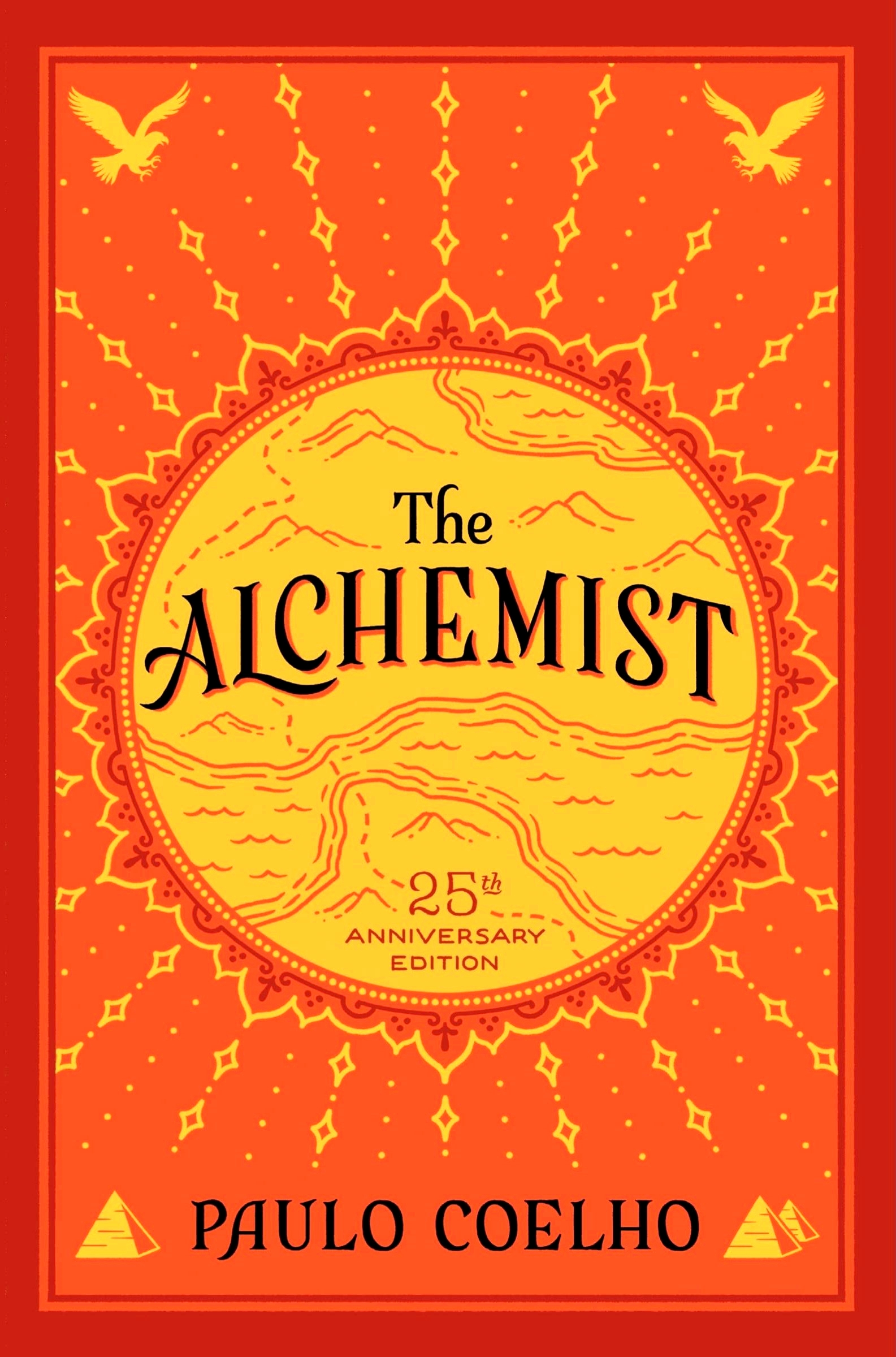
In this fictional account of an Andalusian shepherd, you will find a hodgepodge of philosophy, spirituality, and a variety of religions. Both the writer and the main character Santiago have their childhood roots in Catholicism, but both add in a blend of mysticism, Islamic beliefs, magic, and omens cloaked in a veil of wisdom. The Alchemist is the kind of book that readers will love or hate depending on their backgrounds and what they are searching for—in life and in a good book. The story is an adventure as Santiago goes on a pilgrimage of sorts, trying to live out his Personal Legend. In the process, he learns about the Language of the World, which all things, animate and inanimate, speak, and the Soul of the World in which everyone is a part of everyone else. The goal of his Personal Legend, treasure at the Egyptian pyramids, introduces him to a wise man who calls himself a king, a gypsy, a crystal glassware dealer, caravan operators, thieves, an English seeker of wisdom, and an actual alchemist. He learns first-hand about the desert, oases, love, and tribal warfare.
The Alchemist is fairly short (175 pages) and mildly interesting, but well-written. I don’t consider it a “treasure” or “masterpiece” as some readers describe it. The main attraction of the book, for me, is the beautiful artwork. From tiny sketches to a few full-color, two-page spreads, the art echoes the text with atmosphere that draws me in, keeps my attention, and enhances my enjoyment of the book.
Rating: 4/5
Category: Philosophy, Fiction, Spirituality, Self-Help
Publication: 1988—first published in Portuguese
1993—Harper One (translated to English)
Memorable Lines:
He was sure that it made no difference to her on which day he appeared: for her, every day was the same, and when each day is the same as the next, it’s because people fail to recognize the good things that happened in their lives every day that the sun rises.
“I’m like everyone else—I see the world in terms of what I would like to see happen, not what actually does.”
“When a person really desires something, all the universe conspires to help that person realize his dream.”

