
Home » Posts tagged 'Japan'
Tag Archives: Japan
Propaganda Girls–lies to win the war
Propaganda Girls
By Lisa Rogak
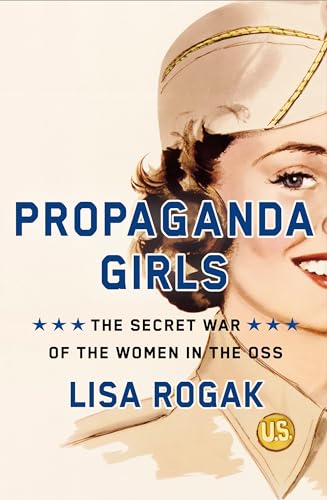
Writing a biography about a small group of women must be quite challenging. Lisa Rogak divided her task into four main parts. First, she gives background separately on each of the four ladies: Betty MacDonald, a journalist who was living in Oahu when Pearl Harbor was bombed; Zuzka Lauwers, a bored, multilingual lawyer from the Czech Republic; Jane Smith-Hutton, wife of a naval attaché in Tokyo; and Marlene Dietrich, German-born actress and singer.
In the next section of the book, Rogak describes individually their early introduction to the Office of Strategic Services (OSS)—recruitment, training, and assignments. Then, in the section titled “Believable Lies,” the author describes the actual work the women did. They put in long, hard days, sometimes in less than ideal living and working conditions, but they loved the independence they had in accomplishing their tasks. Their branch was Morale Operations (MO) where they produced “black propaganda.” Always based on at least a kernel of truth, they created media with the goal of demoralizing enemy soldiers and also citizens in occupied areas. They learned as much as they could about the affected country to make it appear that the flyer, broadcast, or whatever media was chosen originated in the enemy country. In “Back to Reality,” Rogak discusses the difficulties each woman had in finding her place in the world when the war ended.
Propaganda Girls was extremely well researched with an extensive bibliography and footnotes. There are many quotes from those who knew the four women and from written resources. These references give authenticity to the biography. The format Rogak chose for this book is fairly rigid resulting in characters who are well-defined in each progression. They are, however, never infused with personality. If you like your nonfiction to be so exciting that it could be mistaken for fiction or be a page turner, then this will not be a good match for you. If you want to learn about women making a difference in World War II, probably saving lives, and working for less pay and respect than their male counterparts, then you’ll be satisfied with this glimpse into a portion of World War II history that has not been well-publicized.
I received a complimentary copy of this book in exchange for an honest review. Opinions expressed in this review are completely my own.
Rating: 4/5
Category: Biography, Nonfiction, History
Publication: March 4, 2025—St. Martin’s Press
Memorable Lines:
Marlene loved the job, and between the cross-country bond tours, working at the canteen, and making an occasional movie, she was exhausted all the time, but here was a way that she could directly affect the lives of thousands of young men who were about to put their lives on the line. She had found her calling.
Betty had crammed a lot of living into her century of life. But like Zuzka, Jane, and Marlene, her war service was the highlight of her life. “There was a real reason for what we were doing in those days,” she said. “A lot of the things we tried didn’t work, but it was war, and it was important.”
But after more than five years of war, Paris wasn’t in much better shape than Tokyo. The city was impassable in many places; apartment buildings and homes were in disrepair and often uninhabitable. Most buildings in the city had gone unheated for the length of the war, except for those that had been occupied by the Germans.
Code Girls–The Untold Story of the American Women Code Breakers Who Helped Win World War II
Code Girls
by Liza Mundy

Nonfiction has the potential to be deadly boring or magnificently interesting. Liza Mundy’s Code Girls without a doubt falls into the latter category. It is not an easy read, but it is fascinating. Code Girls tells the tale of the essential role the code breakers, who were mostly women, played in the eventual Allied defeat of the Axis nations in World War II. If you are envisaging a handful of young women holed up in a room in D.C., think again. The Army’s code breakers numbered 10,500 with 70% of them women and most working out of the Arlington Hall campus in Virginia. The Navy’s group numbered 10,000 with half of those stationed in D.C. of which 80% were female. Both groups rose to those numbers from a mere 200 code breakers each in a short amount of time. These women came from all walks of life and backgrounds. Among the first recruited were college educated, low paid, school teachers at a time when a low priority was placed on education for women. Many of these women had a background in math and science, and all had a good memory. They were analytical and could approach problems in novel ways.
The code breakers’ stories went untold for most, if not all, of their lives because they were sworn to secrecy. They considered the work they did a duty of honor to their country and to the men in their lives. They understood that their work could literally save lives, perhaps even of their own loved ones, by intercepting and decoding enemy messages. It is a testament to their trustworthiness that Germany and Japan never knew that their transmissions had been intercepted. Even roommates and spouses could not speak of their work outside of their assigned workplace.
The author, Liza Mundy, had two hurdles to jump, both of which she accomplished with finesse. The first was her thorough research which is documented through 39 pages of notes and bibliography. Then she wove the hard facts into a narrative with a very personal touch derived from many interviews. She doesn’t just write that Washington, D.C. was inundated with uninitiated girls pouring in from all over the country needing housing, food, transportation, and training. She presents the scenario through the eyes and voices of the “girls” who lived it. Not everyone, of course, had the same experiences, and those experiences varied according to many factors including whether they were working for the Army or the Navy. They arrived with no assignments, just the promise that they would be helping their country.
The war period (1939-1945) was a time of great social upheaval. For most people, a woman’s place was in the home. Suddenly men were going overseas and their jobs needed to be filled along with positions created by the manufacturing needs of the war machine. There were many stereotypes that were broken down, and others that were not put to rest so willingly or easily.
Code Girls is masterfully written and a wonderful tribute to those women whose secrets can now be told. It should be “required reading” for all Americans who don’t want history to repeat itself, for readers who want to understand what previous generations endured to stand against tyranny, and for men and women interested in the societal changes that occurred as a result of World War II.
Rating: 5/5
Category: History, Nonfiction
Notes: The author sets the stage for the reader through her own notes as to how the book was written, information on the initial recruitment of women, and an introduction that discusses society in the U.S. at that tine and the military’s “bold” decision to recruit women. My copy of the book has an “Afterword for the Paperback Edition” in which the author shares the overwhelming response her book received from the code breakers and their families. The book also includes photographs of some of the women interviewed and more generic photographs of the code breakers at work. There is also a “Glossary of Code-Breaking Terms,” a very valuable “World War II Timeline,” and a “Reading Group Guide” of discussion questions.
Publication: October 20, 2017—Hachette Books
Memorable Lines:
Successful code breaking often comes down to diagnostics—the ability to see the whole rather than just the parts, to discern the underlying system the enemy has devised to disguise its communications. The Japanese, Agnes diagnosed, were encoding their messages and then using something called columnar transposition, which involves writing the code groups out horizontally but transmitting them vertically, aided by a grid with certain spaces blacked out, whose design changed often.
It was the first time many of the women had spent time in a bona fide workplace—apart from a classroom—and they discovered what workplaces are and have been since the dawn of time: places where one is annoyed and thwarted and underpaid and interrupted and underappreciated.
She and the other women knew that ship sinkings were the logical and desired consequence of their concerted efforts. They did not feel remorse. America was at war with Japan; Japan had started the war; the lives of American men were at stake, not to mention America itself. It really was that simple.
When We Were Young and Brave–kindness in the midst of despair
When We Were Young and Brave
by Hazel Gaynor
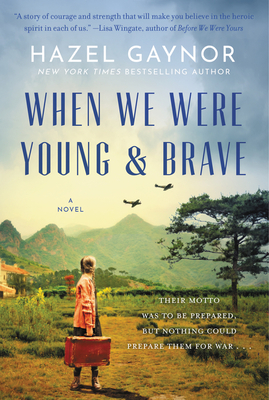
During our current tumultuous times, When We Were Young and Brave was somewhat of a difficult read for me, but I’m glad it is now a part of my personal reading journey. Hazel Gaynor’s latest book relates a fictional version of the events following Japan’s bombing of Pearl Harbor as they play out for the students and teachers at the China Inland Mission School in Chefoo, China. With Japan’s invasion of China, the Japanese seize and occupy the school, later interning the residents in the much larger prison camp known as the Weihsien Civilian Assembly Center where sanitation facilities are disgusting and meals are meager, nutritionally inadequate for growing children, and almost inedible. Despite the harsh conditions, the teachers protect the children as best they can while rallying them with insistence on routines, cleanliness, and a hearty “chin up” attitude. Of particular note is the role of their Girl Guide troop and standards that help the students in maintaining a positive outlook.
The last sections of the book, “Liberation” and “Remembrance,” are remarkable in the beauty of the skillful writing that describes the impact of the American liberation on the camp residents. They gain relief from the fears that haunted them daily, but endure the substitution of new anxieties and questions for the future. Where will they go and what will they do? Is anyone waiting for them at home?
The story is told by alternating narrators. Elspeth is a competent, well-organized, and kind teacher who has a special motherly feeling for Nancy, the daughter of missionaries in China. Their relationship is always teacher and student, but as months of internment become years, Elspeth takes on increasingly more of the commitment for safe care that she made to Nancy’s mother as they departed by boat to sail to the school, both as first-timers. We view their ordeals from both Elspeth’s and Nancy’s points of view.
There are a lot of themes in the book including resilience, relationships, releasing the past, and looking to the future. Symbolism is also important in the kingfisher that becomes the emblem of the new Girl Guide patrol and the sunflower which holds a special meaning for teacher and students.
The characters emerge as three dimensional figures as they are well developed. Realism comes into play with descriptions of the harsh conditions; no one’s story is fairytale like or even positive. The setting is well-executed with vivid word pictures. As the Chinese workers slosh through the camp, the odor of the filth of “honey-pot” buckets they pull from the latrines makes an unforgettable olfactory experience. There are also more pleasant descriptions of the beauty outside the camp, but glimpses are rare for those interned. The last two sections make the book a winner for me, but the first sections are also well written and essential to the success of this historical novel.
Rating: 5/5
Category: Historical Fiction
Notes: There is a very informative section at the end of the book that describes the author’s research and thought processes and some historical background. The author has also included a brief history of the Girl Guides as that organization plays an important role in the girls’ lives. Other additions are a list of books and websites for further reading, including original source documents found at weihsien-paintings.org, and some questions for discussion.
Publication: October 6, 2020—Harper Collins
Memorable Lines:
When she was cross, Miss Kent spoke in a way that reminded me of brittle twigs snapping underfoot on autumn walks. I felt my cheeks go red. Without giving me a ticking-off, she’d done exactly that.
I knew the smile she gave us that morning was the sort of “we must be brave” smile adults use when they’re trying to pretend something awful isn’t happening.
But, as I’d come to realize about life during a war, nothing stayed the same for long. Just when you thought you’d adjusted and adapted and found a way to cope, the situation changed.
Unbroken: A World War II Story of Survival, Resilience, and Redemption
Unbroken: A World War II Story of Survival, Resilience, and Redemption
by Laura Hillenbrand
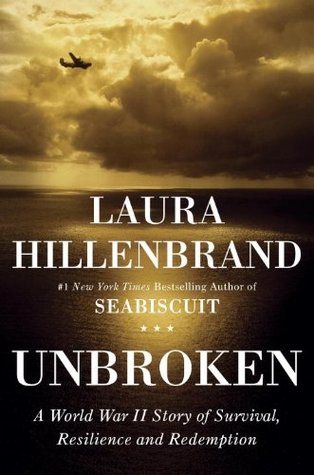 How much can the human body, the human spirit, endure? Unbroken is the story of Olympic track contender Louie Zamperini as he is tested past the limits of endurance during World War II. His running career is cut short as he becomes a bombardier. The characteristics that made him a difficult child, always testing the limits, become the foundation of an unrelenting resilience in the face of life challenging circumstances. He endured horrors, but he was miraculously saved from death several times. Did God have a plan for Louie’s life? Could he be saved from his own destructive behaviors and the hatred dwelling in his heart?
Unbroken is a biography and so much more. It reads like a fascinating work of fiction. In fact, if more nonfiction maintained the interest level of Unbroken, there would be a lot more readers of nonfiction. This book is engaging and fast paced. Unbroken was thoroughly researched over seven years using archives and many interviews including seventy-five interviews with Louie himself. Very importantly, author Laura Hillenbrand found few discrepancies among the various reports.
I read and review a lot of books. I mentally gauge my review comparing each book within its genre. A five star cozy mystery is not compared to a five star book of poetry, for example. I must state, however, that Unbroken rises above a star rating system. Although emotionally difficult in places, it is a book that everyone should read.
Rating: 5/5
Category: History, Biography
Notes: Thanks to my brother Don Lyons who insisted I borrow his copy of Unbroken. It was every bit as powerful as you said it would be!
Publication: November 16, 2010—Random House
Memorable Lines:
In a childhood of artful dodging, Louie made more than just mischief. He shaped who he would be in manhood. Confident that he was clever, resourceful, and bold enough to escape any predicament, he was almost incapable of discouragement. When history carried him into war, this resilient optimism would define him.
“The other pilots act as though nothing has happened and speak of sending the other fellow’s clothes home as though it were an everyday occurrence. That’s the way it has to be played because that’s the way it is—it’s an everyday occurrence!”
This self-respect and sense of self-worth, the innermost armament of the soul, lies at the heart of humanness; to be deprived of it is to be dehumanized, to be cleaved from, and cast below, mankind…Without dignity, identity is erased. In its absence, men are defined not by themselves, but by their captors and the circumstances in which they are forced to live.

