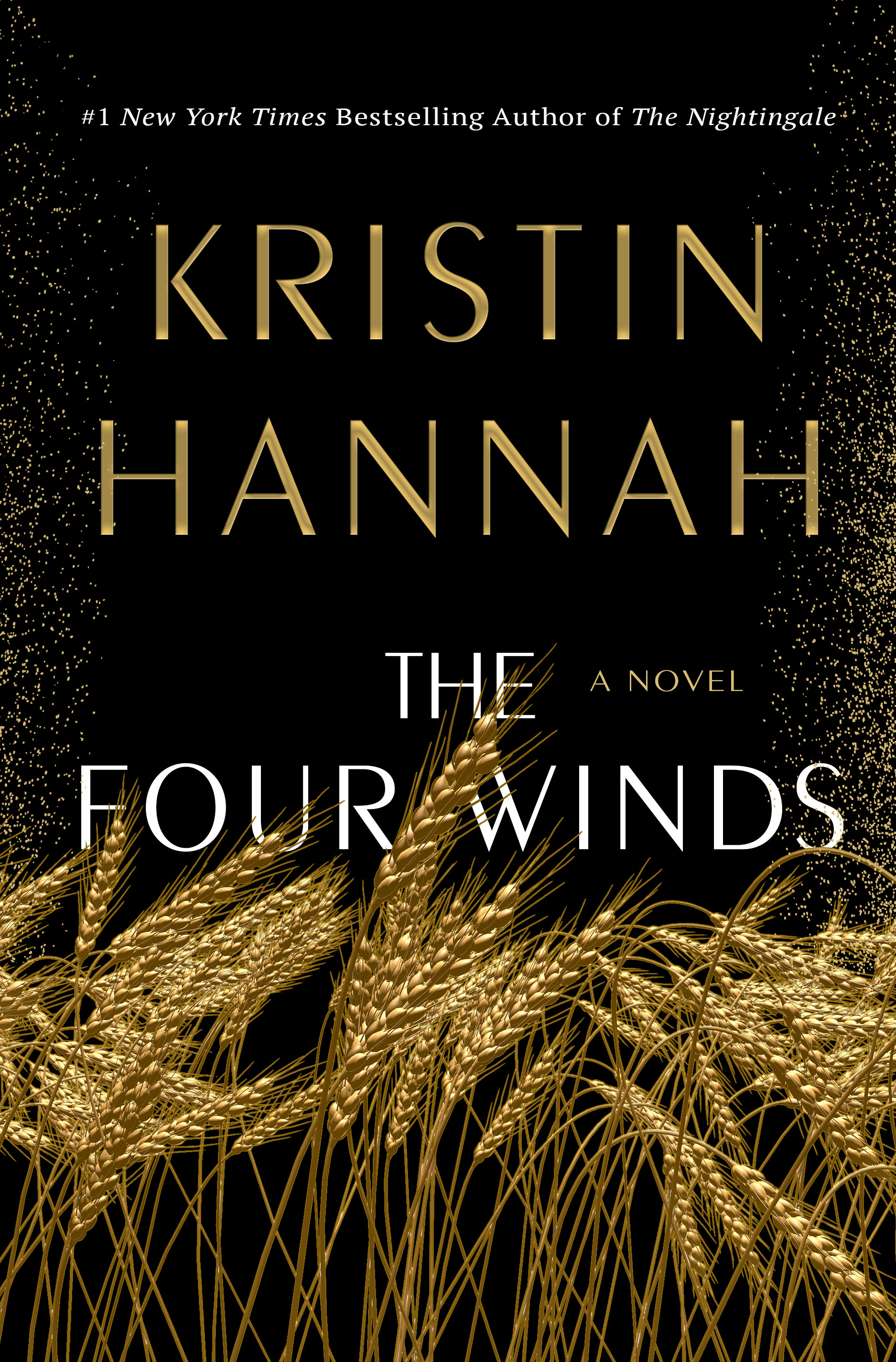
The Four Winds
By Kristin Hannah
From prosperity to devastating poverty, The Four Winds takes the reader on a journey across time and across the United States. Since childhood, Elsa has been told she is unattractive, physically weakened by an illness, and ineligible for marriage. Her brief search for adventure and love in her small town leads her to Italian immigrants Tony and Rose and their son Rafe. The Martinellis take Elsa under their wing, connect her to the land, and love her as their own.
The Great Depression rips away the hopes and dreams of the generations who endured the struggle, but Tony and Rose are strong and refuse to give up their land. Then come years and years of drought and dust storms. The government says the farmers are to blame and provides minimal help. Millions of citizens leave Texas and surrounding states to find what is billed as a “land of milk and honey” where they will surely find work so they can support their families. Instead they find difficult work on large farms if they are lucky. They live in filthy conditions on subsistence wages or less. Each day they have to walk miles both ways from muddy tent cities to the fields where there is no guarantee of a job. Those seeking work are maligned by the residents who view them as dirty and lazy. If they manage to get on at a farm that supplies housing, a few toilets, and some running water and electricity, they soon discover that they are paid with credit at the expensive company store. There is a fee for everything, even obtaining pay in cash. When they dig deeper, the workers find that the whole setup, including where they live and when they work is completely set up to satisfy the greed of the owner. A worker is always indebted to the company.
Communists, at physical danger to themselves, work to organize the farm workers to strike for better working conditions. It is an uphill battle because the workers have safety concerns if they protest in addition to the possibility of losing their opportunity for work—such as it is. California is not the “Promised Land” after all.
Elsa is not just the main character of The Four Winds: she is the heroine. She is a strong, strong woman living out a difficult life with perseverance and determination. Come what may, she would do her best for her children whether eking out survival in a formerly rich land where cattle died with bellies full of sand or traveling across the desert in an unreliable vehicle praying that there was enough water and gas to get the family to their destination. She proves to be a good friend to others in need. She compromises when necessary for the sake of her children, but she reaches a limit where she stands up to greedy business people who deserve to be shamed.
The Four Winds exposes a sad part of our history showing a period in time that was devastating to people. Through no fault of their own they found themselves unable to care for their families. Many were proud and refused government aid. Some of that help from the government was commendable putting men to work in respectable jobs, but some was too little, too late and unreliable in execution. The people of California were depicted as mean-spirited and unwilling to help those who needed help. They looked down on the laborers with contempt. The one exception that stood out for me was an understanding librarian who checked out books to Elsa’s daughter and then gave Elsa a library card which Elsa presented to her daughter as her Christmas gift. It was treasured.
This work of historical fiction concludes nicely, but there is not a happy ending for everyone. The book is more realistic than that. Overall it is well written and kept me wanting to read more. It is a sad book, however. It has to be—it is about sad times.
Rating: 5/5
Category: Historical Fiction
Publication: March 14, 2023—St. Martin’s Griffin
Memorable Lines:
“Believe me, Elsa, this little girl will love you as no one ever has…and make you crazy and try your soul. Often all at the same time.” In Rose’s dark, tear-brightened eyes. Elsa saw a perfect reflection of her own emotions and a soul-deep understanding of this bond—motherhood—shared by women for millennia.
“Girls like that, unkind girls who think it’s funny to laugh at another’s misfortune, are nothing. Specks on fleas on a dog’s butt.”
Once, Elsa would have said, God will provide, and she would have believed it, but her faith had hit the same hard times that had struck the country. Now, the only help women had was each other. “I’ll be here for you,” Elsa said, then added, “Maybe that’s how God provides. He put me in your path and you in mine.”
Winter hit the San Joaquin Valley hard, a frightening combination of bad weather and no work. Day after day, rain fell from steel-wool-colored skies, fat drops clattering on the automobiles and tin-can shacks and tents clustered along the ditch bank. Puddles of mud formed and wandered, became trenches. Brown splatter marks discolored everything.
Poverty was a soul-crushing thing. A cave that tightened around you, its pinprick of light closing a little more at the end of each desperate, unchanged day.


Very nice review, Linda. I’ve heard of this book but never knew what it is about. (I always hear so much more about The Great Alone and more recently, The Women.) I’m glad I know now because I’ve always been intrigued by the dust bowl. I saw a documentary about it and what a phenomenon that was.
Thanks for reviewing.
LikeLiked by 1 person
Laurie, it was an eye opener for me. I knew a little about the events in the book, but not on a deep level, not really understanding how it impacted so many people.
LikeLiked by 1 person
This sounds like a story with a lot of emotion. I can’t imagine trying so hard to keep your own land.
LikeLiked by 1 person
Rose and Tony had come to the U.S. with nothing. They worked hard and became one with the land.
LikeLike
I like Kristin Hannah, and I grew up in the OK panhandle. I’m adding this one to my list.
LikeLiked by 1 person
Then you certainly know about the OK winds! I hope you find it a good read.
LikeLiked by 1 person
I also read this book and gave it 5 stars, Linda. I hate to say I enjoyed it, as the topic is so tragic and the times so bleak. I’m glad I read it, as it gave me a real eye opening regarding the dustbowls and the depression. You picked out some very poignant quotes to highlight. Excellent review.
LikeLiked by 1 person
Thanks, Carla. One member of my book club stopped reading it because it “was just so sad!” She was right, but was convinced to finish it and was glad she did.
LikeLiked by 1 person
It was very bleak, but so well written and probably very close to what it was really like.
LikeLike