Home » Posts tagged 'Writing'
Tag Archives: Writing
The Little Books of the Little Brontës–creativity in childhood
The Little Books of the Little Brontës
by Sara O’Leary
illustrated by Briony May Smith

This little book of historical fiction introduces children to the famous Brontë family. The girls, Charlotte, Emily, and Anne, and their brother Branwell are raised by their father who is a vicar, their aunt, and a housekeeper. They grow up in relative poverty, but have a fun life with much time to exercise their creativity as they are homeschooled and spend a lot of time exploring the moors. Almost anywhere they go would be by foot.
The Little Books of the Little Brontës tells how they loved to read and as children they made tiny books for each other and for their toy soldiers. As they grew older, their reading passion was turned to writing. The sisters died young, but their books are still eagerly read today.
I enjoyed this fictional view of the Brontës’ childhood. It is easy for children to follow. I particularly liked the illustrations; they are delicate, detailed, and whimsical. After explaining that the sisters had short lives, the author takes the reader back to their happy early years which is a sweet ending and very appropriate to a children’s book.
I received a complimentary copy of this book in exchange for an honest review. Opinions expressed in this review are completely my own.
Rating: 5/5
Category: Children’s Fiction, Historical Fiction
Notes: 1. Includes directions on how to make a little book.
2. There are Author’s Notes containing information about the family for adults.
3. The book ends with an extensive Bibliography.
4. Ages 5-9, Grades K-4
5. Print length: 40 pages.
Publication: October 17, 2023—Tundra (Penguin, Random House Canada)
Memorable Lines: (which is also the first sentence)
Many years before you were born,
sometime in the long ago,
a child named Charlotte Brontë
made a little book for her little sister Anne.
A Pho Love Story–kitchens in conflict
A Pho Love Story
by Loan Le
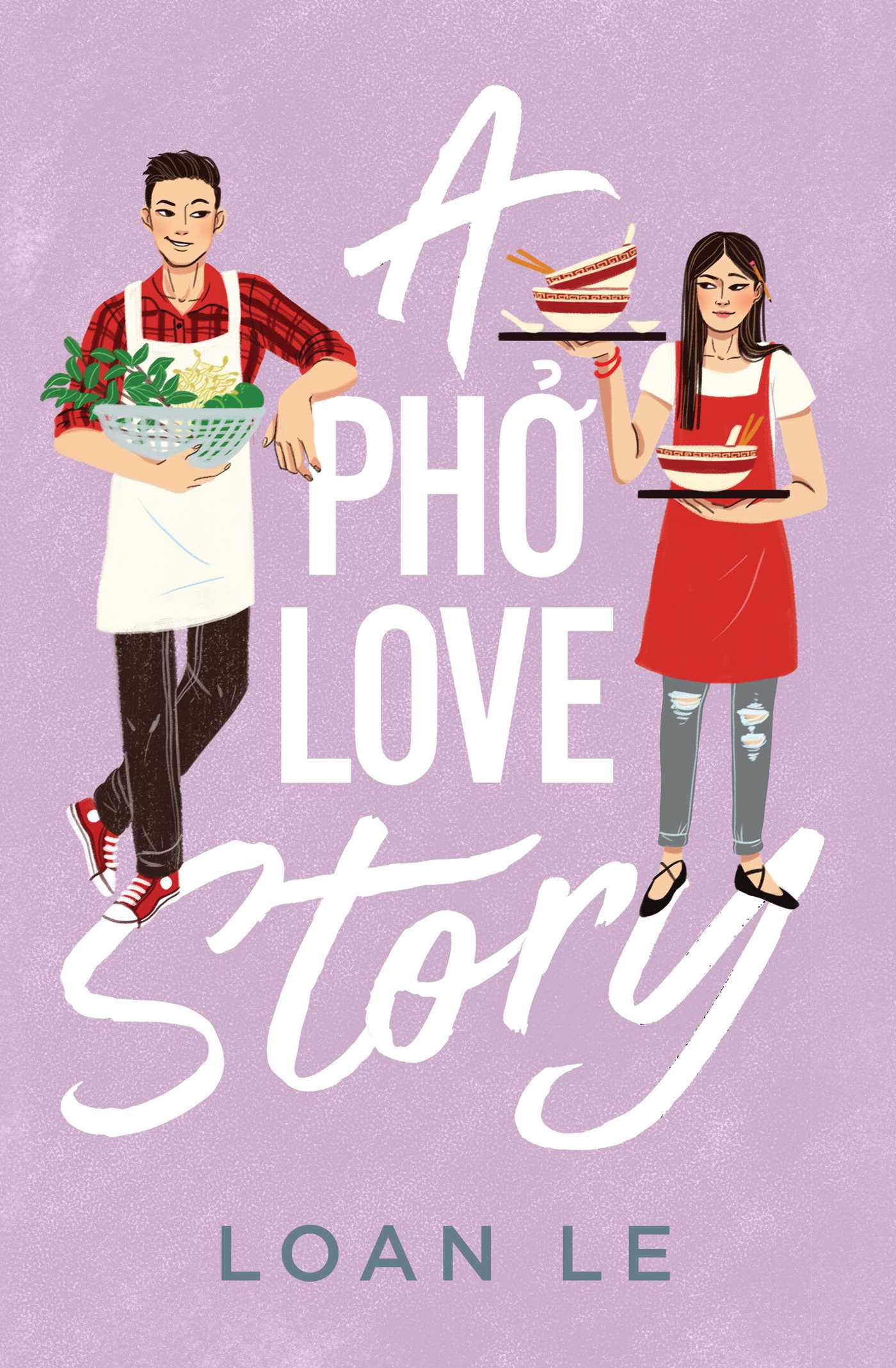
Perfect for Valentine’s Day—or any day for that matter! Loan Le’s A Pho Love Story, written with a teenage or young adult audience in mind, is a modern day Vietnamese-American “Romeo and Juliet” tale. Báo and Linh, seniors in high school, do not understand the family conflict that has gone on for as long as they can remember. Their families’ restaurants, serving authentic Vietnamese dishes, are situated on opposites sides of the same street. The parents, however, clearly dislike each other. In fact, the children are not allowed to talk or play together. Is this conflict a result of competition for economic survival or is there a deeper reason going back to their days in Vietnam and the dangerous boat trips to safety and freedom? Cultural norms for showing respect to their parents prevent both Báo and Linh from questioning them about the deeply felt social boundaries in the neighborhood.
Báo and Linh are sympathetic characters; Báo is trying to decide on a career and Linh wants to make her passion and talent for painting acceptable to her parents. The Vietnamese flavor throughout is authentic and reflective of the author’s family heritage. Because both families own restaurants, food plays an important role. Vietnamese culture is also prominent in descriptions of the parents and the family dynamics. As someone familiar with Spanish, French, and Latin, I can usually read expressions from those languages when added to the text for authenticity, but the phrases included in this book sent me scurrying to a translation app. Most meanings could be divined from context, but I really like to know the exact meaning of words, whether in English or another language, for a deeper reading experience. A Pho Love Story was enriching in that respect.
I am sure most readers can predict the outcome, but not how the characters will arrive there. The journey is bumpy, but fun, as the author weaves literary magic within the plot. The story is told by the teenagers from alternating points of view by chapter, a technique which works really well in this book. There are several interesting adults who act as mentors to the pair without telling them what to do. This would be an engaging read for teenagers and young adults.
I would like to extend my thanks to NetGalley and to Simon & Schuster Children’s Publishing for giving me the opportunity to read this book in exchange for an honest review.
Rating: 4/5
Category: Teen and Young Adult
Notes: There is some bad language sprinkled throughout the book.
Publication: February 9, 2021—Simon & Schuster Children’s Publishing
Memorable Lines:
My parents—my mom, really—has now perfected the art of non-encounters; knowing their schedule right down to when they close and when they leave. In a way, their schedule has become ours. We’re background characters in each other’s stories.
She trusts Viet to do his job, as well as make sure I do mine. The concept’s not perfect: We’re the same age, and letting him watch over me makes as much sense as letting a horse and a pony run the show. But somehow it works.
I like the writer’s style. One person can say something that’s been said before but in a way that’s completely different; their unique experiences and personality infuse their words, their sentences.
A Field Guide to Homicide–writing retreat you’d love to attend
A Field Guide to Homicide
by Lynn Cahoon
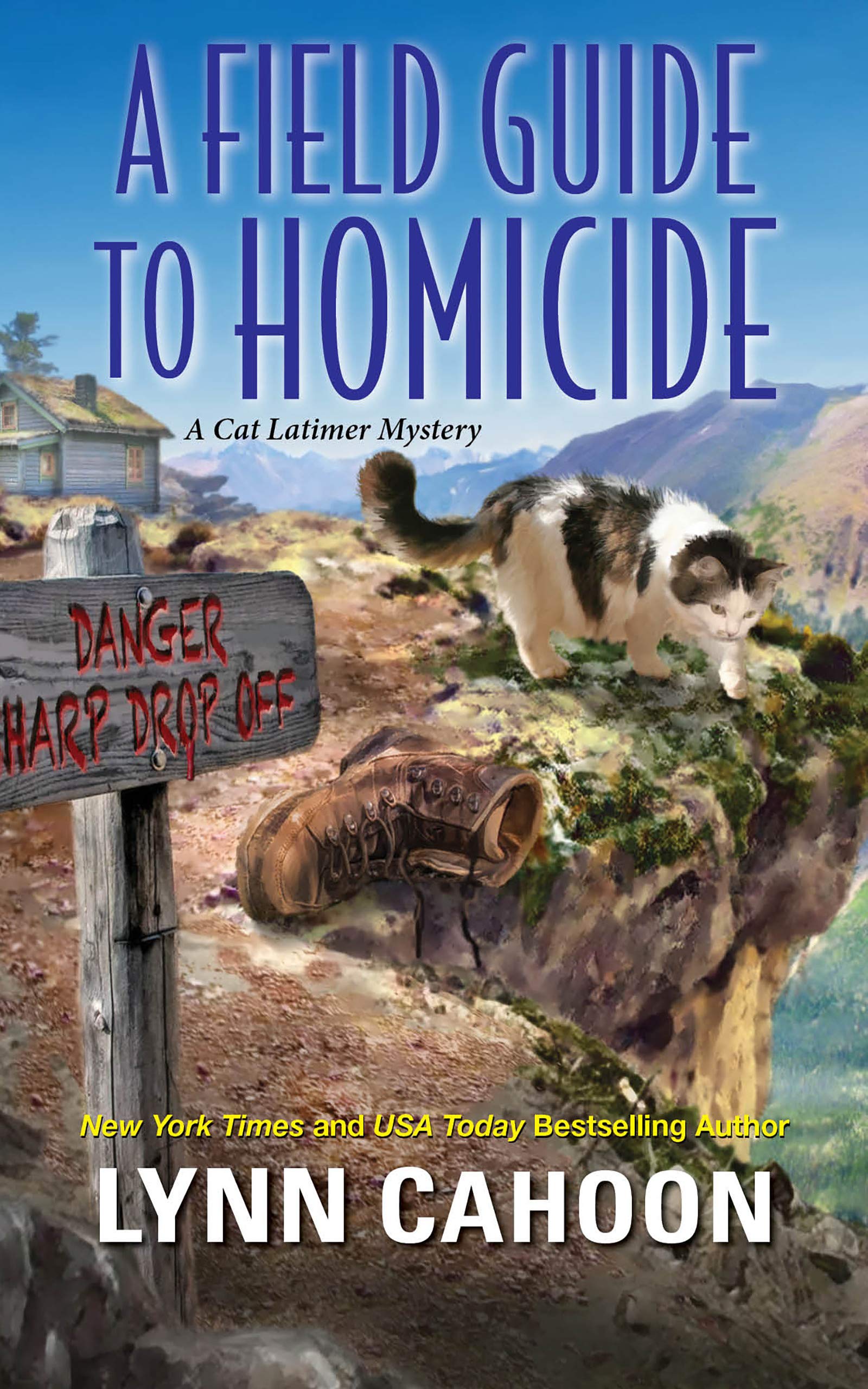 As a book lover, to hear an author’s thoughts on writing embedded in a cozy mystery is a special experience. Lynn Cahoon provides just such an opportunity through her Cat Latimer Mystery Series, but there is even more sharing of the writing process in the latest installment of the series. Cat Latimer, a former professor, conducts writers’ retreats in her restored Victorian mansion one week per month while she continues her own writing. She appreciates that she has the best of both worlds, authoring her own books while helping other writers develop their unique potential.
In A Field Guide to Homicide, Cat is hosting an unusual group that has two writing couples and a rather awkward college student. She is just beginning to recognize the different dynamics of this group and attempt to mesh them into a working team, when they have to cut an outing short due to a gruesome discovery. Seth is Cat’s boyfriend. He restores old homes and helps out with the retreats. Suddenly he finds himself in the middle of a mystery that seems to revolve around some old army buddies who are gathering for a reunion. Cat’s Uncle Pete plays a role too; as chief of police, he attempts to solve the crime and keep everyone safe. At the same time, he tries to entertain his girlfriend Shirley, a retired Alaskan deputy and aspiring writer, who is in town for the week.
A Field Guide to Homicide is structured so that as you finish one chapter, you absolutely must keep reading into the next. The characters are likable. The relationships are complicated, but not overly so. Although the writing process is a major theme, the all-important mystery takes the lead as it heads in unexpected directions. The setting is a writer’s dream come true with Cat having her special writing space on the third floor with both a view and privacy. Her best friend and business partner, Shauna, cooks for the trio of Cat, Seth, and herself as well as providing breakfast and delicious snacks for the retreat group. This is a bookish mystery you won’t want to miss.
I would like to extend my thanks to Netgalley and to Kensington Books for giving me the opportunity to read this book in exchange for an honest review.
Rating: 5/5
Category: Mystery
Notes: #6 in the Cat Latimer Mystery Series, but holds up well as a standalone. Cahoon has a talent for jumping right into the plot while bringing readers up to speed on the characters.
Publication: January 28, 2020—Kensington Books
Memorable Lines:
…she settled onto a living room couch and got lost in a futuristic world where good did conquer evil, even if it took three hundred pages.
She was sitting in the living room, in what she liked to call a good book coma or hangover. Where her mind didn’t want to leave the magic of the world she’d just created as she read the story.
Some people never found their true voice because they want to write what they think will sell or worse, what they think they should write. People needed to realize that writing is all about telling the story. And if you don’t like the story you’re writing, write something different.
The Library of the Lost and Found–family secrets
The Library of the Lost and Found
by Phaedra Patrick
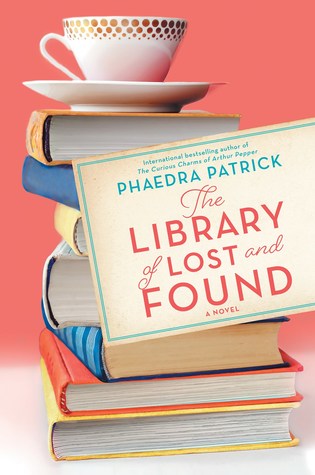 The Library of Lost and Found is Martha’s story woven by author Phaedra Patrick into a tapestry of several generations of women trying to survive, to see their way through. The background is emotional abuse and family secrets. Martha devotes her life to caring for her aging parents, Betty and Thomas, and later trying to please her contacts at the library where she volunteers. Because Martha does not value her own contributions, no one else appreciates her. As a child, Martha is imaginative and creative and her flamboyant nana, Zelda, encourages her to be a storyteller. Unfortunately Martha’s inventiveness is in direct conflict with the wishes of her overbearing father.
The basic plot line-up to this point in the story appears fairly straight forward, but much more conflict brews beneath the surface. There are past romantic entanglements that affect Martha and her sister Lilian. Zelda disappears from Martha’s life and is proclaimed dead. The past and its secrets affect the present and the future.
One of the fun characters is Suki, a young, single, pregnant co-worker with a tendency to misuse words. For example, speaking of her baby’s father she says “He says he can’t make up his mind between us. I’ll have to give him a culmination.” “Do you mean an ultimatum?” She may not always use words correctly, but she believes in Martha and ends up being an encourager for her as Martha takes steps to find her independence.
There are lots of surprises along the way as figurative skeletons in the closet are revealed and as Martha finds herself again. The Library of Lost and Found is appealing to book lovers as books, libraries, bookstores, writing and reading all play important roles. Its appeal spreads wider though as it addresses universal issues of power and control, love, whimsy, family, and self-worth, and their emotional impact.
I would like to extend my thanks to netgalley.com and to Harlequin (Park Row) for giving me the opportunity to read this book in exchange for an honest review.
Rating: 5/5
Category: General Fiction (Adult)
Publication: March 26, 2019—Harlequin (Park Row)
Memorable Lines:
She often felt like there was an electrical storm around him, and she could sense it crackling now, between him and Zelda.
She didn’t usually feel jealous, but as she watched her mother and daughter, it crept over her now like winter frost across a window.
“Why does something have to last forever to be classed as successful? Surely it’s okay to give things a try.”
Fatality by Firelight–writers’ retreat, readers’ delight
Fatality by Firelight
by Lynn Cahoon
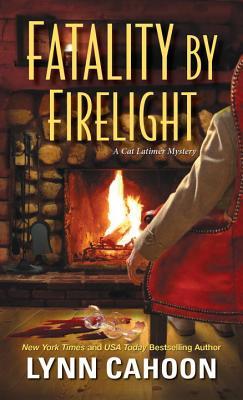 Fatality by Firelight, the second book in the Cat Latimer Mystery Series, is appealing in so many ways, but primarily because it is an all round good mystery with twists and turns and abundant surprises. I had many interruptions during my reading of this book, but I was always anxious to return to the story and I always remembered where I had left off. Both signs of a good book.
The main character is Catherine (Cat) Latimer, a young, widowed, former professor. Her ex-husband’s apparent betrayal and death form an underlying mystery that ties in with strange current occurrences. Other important folks you’ll meet are Shauna, Cat’s longtime friend turned business partner and chef for the retreat, and Seth, Cat’s high school sweetheart who has entered her life again and also has a major role in the writers’ retreat.
The book deviates from a typical cozy in two ways. Although Cat does want to solve the mysteries that present themselves to her, that is not her main mission in life. She is a writer and tries to pay for upkeep on a Victorian mansion she inherited by hosting a weeklong writers’ retreat once a month. The other deviation is the male romantic interest in the book. Usually that role is filled by some type of legal professional–a sheriff, detective, private investigator, etc. No so in Fatality by Fire. There are attractive men in her life, but her legal connection comes in the form of her Uncle Pete, a likable and supportive college town police chief.
I recommend this book for its plot with mysteries on two levels, its snowy Colorado setting, some quirky characters who attend the retreat, and its writer’s theme which is appealing to readers. Fatality by Firelight delivers an interesting story, a strong female lead, and a dose of humor as a bonus.
I would like to extend my thanks to netgalley.com and to Kensington Books for giving me the opportunity to read this book in exchange for an honest review.
Rating: 5/5
Category: Mystery
Notes: Second book in series, but worked well as a standalone
Publication: February 28, 2017–Kensington Books
Memorable Lines:
No matter what kind of turmoil Cat was experiencing in her real life, typically writing made her forget everything and concentrate of the story.
[talking about a writer’s retreat] …the magic is in the process, not the accommodations or the distance you travel from home.
Okay, so this was all conjecture, but that was her job. As a fiction writer, she filled in holes, and this story had more holes than a pasta strainer.
“Well, you know what they say: if it doesn’t kill you, and you’re an author, you use it in a book.”
How Do You Prefer to Write?
 When you write a blog entry, do you go straight to the keyboard or do you put it down on paper first? If the latter, where do you do your editing?
I’m curious if recording your thoughts is affected by age. I would think that digital natives (those who grew up with computers in the home) might be more likely to compose directly on the computer. Research shows that people who take notes, in a meeting or in class, directly on the computer retain less than those who use longhand. I have not seen research on how computer versus manuscript affects original writing. If you do other writing (i.e. professional documents, short stories, books), do you approach that writing differently?
If you would like to weigh in on this topic, to avoid revealing your age, just say whether you are a digital native or not and how you prefer to write. If you want to give more details, go for it!
I am not a digital native. I did get in on personal computers with the Apple IIe and have always had some kind of computer ever since. I was an elementary school tech teacher for 14 years out of my 34 years of teaching. I write my blog entries in a notebook and do first editing there as well. This preliminary editing can vary from changing a few words to a major rewrite. My final editing is done on the computer and does not usually involve major changes (i.e. the thinking has already mainly occurred and what’s left is grammar, flow, and typographical errors. When I wrote professional documents for work, I composed most of them on the computer and I am not sure why. Currently my only writing in retirement is blogging and informal digital communication which is, of course, written directly into whatever app I am using.
 education pathways