
Home » Historical Fiction (Page 11)
Category Archives: Historical Fiction
Smoke and Mirrors–P.T. Barnum’s American Museum
Smoke and Mirrors
by Casey Daniels
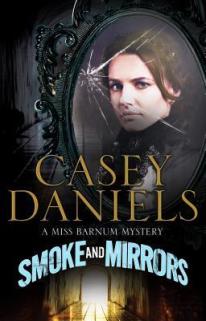 P.T. Barnum’s American Museum, stocked with the odd, unusual, and exotic from around the world, is the setting for the mystery Smoke and Mirrors by Casey Daniels. It’s the fall of 1842 in New York City when we are introduced to the fictional heroine Evangeline Barnum, a sister of Phineas T. Barnum.
Although Evangeline lives in a time of severe restrictions on women in the United States, thanks to her forward thinking brother, she works at the museum with many responsibilities. She has more freedom to pursue her investigations than most women would have. Problems begin with the appearance of an old family friend, Andrew Emerson, soliciting her help. Evangeline turns him away because his presence could cause the discovery of secrets she has worked hard to hide. The plot becomes ever more complex as Evangeline becomes involved in a murder, attempts on her life, and the disappearance of young ladies in New York City.
This was a fascinating book of historical fiction. It is well researched, has interesting characters, and provides a different perspective on the lives of the “human oddities” in live exhibits. These are the kinds of people, like the bearded lady, that one used to commonly find in fair exhibits, but are hopefully not exhibited as freaks anymore.
I would like to extend my thanks to netgalley.com and to Severn House for giving me the opportunity to read this book in exchange for an honest review.
Rating: 5/5
Category: Historical Fiction, Mystery
Notes: #1 in the Miss Barnum Mystery Series
Publication: November 1, 2017—Severn House
Memorable Lines:
Her words were not light and airy, more like a cloud that foretells a coming rain; not so threatening in and of itself—not at that moment—but simply a reminder that there is a chance there are darker things to come.
It was difficult to explain how such groups of people made me feel. In the museum, whether I was talking to one or one hundred, I was at ease. Yet in such social situations, when I was expected to talk of nothing more interesting than the weather or the latest fashions from Paris, I often felt awkward and tongue-tied.
The more mysterious a thing, the more likely it is that people will pay money for it.
Miss Kopp’s Midnight Confessions–moral turpitude in 1916?
Miss Kopp”s Midnight Confessions
by Amy Stewart
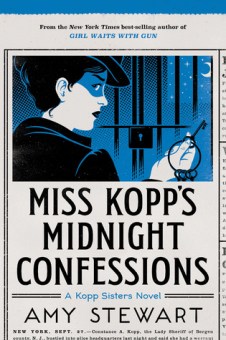 Amy Stewart has taken the real story of three sisters in the U.S. in 1916 and fleshed it out as a fictional tale based on her research. The rights of women are so limited in this book that is it hard to conceive of it in the twenty-first century.
Constance Kopp is the first female deputy sheriff in New Jersey and one of the first in the U.S. Many of the problems she deals with involve moral issues which can result in very stiff penalties, especially for women. As the U.S. prepares to enter World War I (1917), girls and women are starting to be employed outside the home working long hours under difficult conditions in factories where they are paid much less than men for the same work. One indicator of the status of women’s rights is that the nineteenth amendment to the Constitution giving women the right to vote was ratified on August 18, 1920.
With this setting in mind, know that there is nothing pedantic about Miss Kopp’s Midnight Confessions. It is composed of very short chapters that make you want to turn the page and keep reading. It deals with cultural and social issues of the time and demonstrates that there can be flexibility, based on reasonableness and sensitivity, within the law. Deputy Sheriff Constance Kopp encounters young women with various problems; she must view them through the prism of the potential for similar issues in her own family.
I would like to extend my thanks to netgalley.com and to Houghton Mifflin Harcourt for giving me the opportunity to read this book in exchange for an honest review.
Rating: 5/5
Category: Historical Fiction
Notes: #3 in the Kopp Sister Novel Series, but can be read as a standalone
Publication: September 5, 2017—Houghton Mifflin Harcourt
Memorable Lines:
Whatever discomforts she might endure, they couldn’t compare to the hardships of a trench in the Argonne. The idea stayed with her, as she grew more accustomed to the tedium of a factory job, the long hours on her feet, her red and swollen fingers, and the dull ache behind her eyes from staring at those spinning threads all day. Her brothers were eager to go overseas and endure far worse. Surely she could bear it for their sake.
She was such a slight, mousy girl, with so little to say, but a steel cable of resolve ran through her. The notions of duty and service and country came as naturally to her as breathing.
Edna had an endless reservoir of determination, and all the high ideals in the world, but she didn’t know how to bluff, or play a trick, or talk her way into a room where she wasn’t invited. She was constitutionally unable to lie or cheat or hide anything—money, jewels, the truth. Minnie could do all of that, and while she didn’t know much about war, she was fairly certain that something in that line might be called for.
Murder in Montparnasse–an astounding plot
Murder in Montparnasse
by Kerry Greenwood
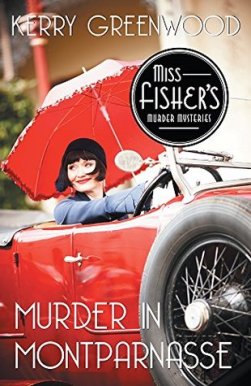 It is said that one should order soup in a fine restaurant as it is a predictor of the quality of the meal to come. The first chapter of Murder in Montparnasse was my “soup.” I knew upon sampling the book, that the descriptive language was worth savoring on the tongue. The introduction of three major plot threads provided delicious flavors evocative of a mystery worth reading.
Phryne Fisher has her hands full in this fast-paced mystery which focuses on a group of Bert and Cec’s friends from the war who seem to be targeted for death, the disappearance of a young lady, and strange occurrences at a delightful French restaurant. Along the way, various other puzzling circumstances need to be examined. Phryne’s past also becomes important as her time spent in Paris in an art community returns to haunt her. Domestic issues involve the marriage of her Chinese lover and the employment termination of her beloved Mr. Butler. Phryne’s daughters, Jane and Ruth, are pleased to take on detective roles, and Constable Hugh Collins shows his skills in some independent police work. Murder in Montparnasse is an altogether satisfying mystery.
I would like to extend my thanks to netgalley.com and to Poisoned Pen Press for giving me the opportunity to read this book in exchange for an honest review.
Rating: 5/5
Category: Historical Fiction, Mystery
Notes: #12 in the Phryne Fisher Mystery Series
Publication: September 5, 2017—Poisoned Pen Press
Memorable Lines:
The remedy for anything short of an outbreak of cholera in a French kitchen was “Add more cream!”
The waiter, who had clearly graduated magna cum laude from Cheeky French Waiter School, made a face which suggested that a chef who had dinners to cook ought not to be slugging down cognac at lunch, but he slapped down another glass and the bottle of cognac. He then flounced away, turning an ostentatious back.
Dot always worried about Phryne. There had been raised male voices in the refined parlour, and Dot didn’t like it one bit. Raised male voices, in Dot’s experience, preceded raised male fists. And then Miss Phryne might have to hurt someone.
Murder in Disguise–murder in the golden age of movies
Murder in Disguise
by Mary Miley
 Murder in Disguise opens with a murder set in Hollywood in the golden theater/movie days of Charlie Chaplin, Mary Pickford, and Douglas Fairbanks. During the course of the murder investigation, we learn about movie production, vaudeville, prohibition, corrupt law enforcement, gangsters, and the plight of orphans and women workers.
Jessie Beckett, working as an assistant script girl, has a knack for noticing things that others don’t, a talent which she attributes to her vaudeville background. This ability enables her to solve crimes, and she solves this one with the help of one of the few honest cops in L.A., Detective Carl Delaney, who is interested in getting to know Jessie better.
Jessie comes from a difficult background, but wants to leave mistakes of the past behind. Will her boyfriend David stick with his promise to do the same? Can the murderer stop with one crime? How does Jessie relate to a deaf and dumb girl left with one of Jessie’s roommates? The action keeps the plot moving; the characters and setting maintain a high interest level. The time period is well researched and the author includes words such as “copacetic” from the period adding to the authenticity. She follows up the novel with an “Acknowledgments” section that adds notes about the era and several interesting YouTube links.
I would like to extend my thanks to netgalley.com and to Severn House for giving me the opportunity to read this book in exchange for an honest review.
Rating: 5/5
Category: Historical Fiction, Mystery
Notes: #4 in the Roaring Twenties Mystery Series, but good as a standalone
Publication: August 1, 2017—Severn House
Memorable Lines:
Rumors were passed around like Christmas candy and devoured with the same enthusiasm.
La Grande was one of the largest depots of the Atchison, Topeka, and Santa Fe line, a great cavern of a place where the footsteps and shouts of a thousand rushing people echoed from the polished floor to the ceiling before being drowned out by the snakelike hiss of steam and the earsplitting squeal of brakes as the monstrous engines pulled into their tracks.
“There’s always another job on the horizon,” my mother used to say. I looked up the street toward home. Unfortunately, I couldn’t see the horizon from where I stood.
Away with the Fairies–not a fairy tale
Away with the Fairies
by Kerry Greenwood
 Away with the Fairies begins immediately with the discovery of Miss Lavender’s body in a fairytale setting. There are many possible suspects from the residents of the apartments to coworkers at the women’s magazine that Miss Lavender writes for. Maybe even a disgruntled reader who has solicited help from the magazine’s advice column.
In the midst of this complicated investigation, Lin Chung, Phryne Fisher’s Chinese lover, goes missing and it is up to Phryne to cross the cultural barriers set up by his family. She needs to find him and rescue him if needed.
Dot, Phryne’s assistant, and Bert and Cec, socialist taxi-drivers and part-time employees of Phryne, get major roles. We are also introduced to another interesting character, Li Pen, a Shao Lin monk and bodyguard of Lin Chung.
Away with Fairies is an interesting mystery, full of adventures and intrigue, set in 1928. Phryne, as always, is brave and defiant. The plot is complicated, and the book has a satisfying, but unexpected resolution.
I would like to extend my thanks to netgalley.com and to Poisoned Pen Press for giving me the opportunity to read this book in exchange for an honest review.
Rating: 5/5
Category: Historical Fiction, Mystery
Notes: #11 in the Phryne Fisher Mystery Series. This one would work as a standalone, but is probably more enjoyable if the reader has been previously exposed to the characters.
Publication: August 1, 2017—Poisoned Pen Press
Memorable Lines:
The case was breaking. She knew the feeling. The matter would be as obdurate as a big stone block for ages, utterly resisting all chipping and tapping. Then just when you were about to give up and take to it with a sledgehammer, it cracked into a lot of pieces and fell away, revealing the gold egg of the solution in the middle. Feeling that she had extended her metaphor beyond its coefficient of expansion, she blew idle smoke rings all the way to the city.
Bert, who was about to call upon his maker to deliver him from unconscionable demands from stroppy sheilas, decided not to on receipt of a fifty megawatt glare from those strange green eyes. He felt a moment of gentle Christian pity for whoever tried to stop Miss Fisher…
She stood so still that a questing rat paused in its passage across her foot, whiffling its whiskers, wondering if the engineer was dead enough to provide a late-night snack. Loathing washed over Phryne so strongly she was afraid that she would retch. The clammy tail was across her bare ankle. It was cold. It was one of the vilest things she had ever felt in her whole life and if it had gone on for another second she might have flinched.
Unnatural Habits–Phryne at her best
Unnatural Habits
by Kerry Greenwood
 Kerry Greenwood created a much more complex mystery in Unnatural Habits than others of the Phryne Fisher Mystery Series that I have read. There are several significant investigations occurring simultaneously as well as some minor threads to be unravelled. I remember viewing the movie version of this book years ago. With this series, I usually like the movie better than the book, but in this case I must insist that the book is, in fact, light years past the movie which can not begin to do justice to the intricate plot or character development.
Greenwood, through Phryne Fisher, takes up the cause of girls and women who are treated like sexual property in a time when most women receive little respect and the Catholic church ignores various kinds of ill treatment of girls, women, and boys. Phryne is unable to rest until all of the immediate problems are solved, and she puts her own life at risk to rescue less fortunates.
This particular tale is enhanced by the frequent inclusion of her “minions” as she calls her willing helpers—Tink, her apprentice; Dot, her assistant and companion; Jane and Ruth, her adopted daughters; Burt and Cec, socialist taxi drivers; and Mr. and Mrs. Butler, providers of specialty drinks and food. Each character is called upon to use their unique skills to aid in the investigations.
Australia of the 1920’s comes to life with descriptions of dress of various levels of society, examinations of attitudes, laws, and customs, and use of unique terms. Some of the moral issues examined in the book would be considered reprehensible by most people today. Others are still being debated. There are some actions taken in the novel by Miss Fisher and others that are illegal, but are ignored because ignoring them promotes the general good and provides food for thought for the reader.
I would like to extend my thanks to netgalley.com and to Poisoned Pen Press for giving me the opportunity to read this book in exchange for an honest review.
Rating: 5/5
Category: Historical Fiction, Mystery
Notes: All of the Phryne Fisher books may be enjoyed as standalones, but the characters are more interesting if you have read a few of the books in the series.
Publication: July 4, 2017—Poisoned Pen Press
Memorable Lines:
She was pursuing a very perilous line of enquiry and appeared to have the sense of self-preservation of a chocolate Easter egg in a blast furnace.
“Assume the rules do not apply to you, and they don’t.”
The tone of voice could have been used in the fishing industry for freezing prawns.
“Government reports are like that,” Phryne told her. “Not altogether meant to be understood, thus easily denied.”
The Trouble with Harriet–what is in that urn?
The Trouble with Harriet
by Dorothy Cannell
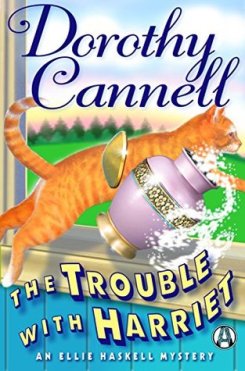 The Trouble with Harriet is different from many cozy mysteries that start with a crime to immediately draw the reader in. Instead the reader is enticed with more personal events—a chance meeting with a gypsy, a prospective getaway trip to France, and the appearance of a surprise visitor.
Replete with quirky characters displaying a flair for the dramatic, this book reads like a play from the era of Arsenic and Old Lace. I can picture cousin Freddy climbing with little ado through the living room window to make his entrance. Ellie’s father possesses a penchant for the dramatic. The Hoppers, who resemble stacking Russian dolls, are the things comedy is made of. The vicar in his dotage who rarely remembers what he should be doing provides all kinds of interesting possibilities. This book is quite enjoyable and would make an amusing theatrical production, featuring a play within a play.
The mystery develops gently during the course of the book, but with the reader unaware of it. It begins simply, but adds complexity as the book progresses. The Trouble with Harriet is an enjoyable book in an enjoyable series.
I would like to extend my thanks to netgalley.com and to Random House (Alibi) for giving me the opportunity to read this book in exchange for an honest review.
Rating: 5/5
Category: Mystery, Historical
Notes: #8 in the Ellie Haskell Mystery Series (which currently has 13 books). In spite of having previously read only #7, I found this book delightful. I’m sure reading the whole series would be fun, but not necessary.
Publication: June 13, 2017—Random House Publishing Group (Alibi)
Memorable Lines:
She had a fatal flaw as a listener. She enjoyed the sound of her own voice.
And the world is filled with qualified interior designers, although possibly not in Chatterton Fells, where people tend to consider switching a picture from one side of the room to another a major renovation.
“You can’t go through life being an irresponsible charmer and not expect impressionable females to fall all over you.” “Sometimes I feel like a pound of bacon during wartime rationing.”
Murder Between the Lines–mystery with a backdrop of women’s suffrage
Murder Between the Lines
by Radha Vatsal
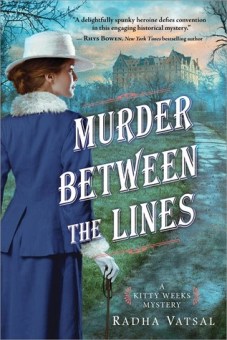 Murder Between the Lines is the second novel by Radha Vassal about Kitty Weeks, a beginning journalist in an age when the rare female journalist is by default a writer for the women’s pages. The setting is 1915-1916, the U.S. has not yet entered the Great War, Woodrow Wilson is president, and women do not have the right to vote.
The “Kitty” in the first third of the book is a flat, undeveloped character. At first I thought this problem was a reflection of the way women were treated by men and by other women as a social norm. Later in the book, however, Kitty takes on some depth as the plot picks up its pace.
There are several plot threads. They deal with women’s suffrage, political intrigue and an anti-war movement, women as journalists, women’s education, Edison’s inventions, and several deaths. The author manages to tie the threads together, but some resolutions seem forced.
The author researched the era well, and the information was interesting. Of particular note was the apparent frailty of the “weaker sex” and doctors’ views on women’s health and recovery from accidents.
It is difficult to sort out attitudes about the characters given the freedoms and responsibilities women in the U.S. have today. Are the women in the book weak or are they victims of the time? I think the answer may be a little of both. Women were generally dependent financially on men, but there have been women of every era who were powerful and knew how to wield that power. In Kitty’s case, she has to break down social barriers to achieve financial independence.
I would like to extend my thanks to netgalley.com and to Sourcebooks (Landmark) for giving me the opportunity to read this book in exchange for an honest review.
Rating: 3/5
Category: Mystery, Historical Fiction
Notes:
1. At the end of the book, the reader will find Author’s Notes that stress the author’s use of primary sources as well as suggestions for further reading.
2. Beautiful cover art!
Publication: May 2, 2017—Sourcebooks (Landmark)
Memorable Lines:
“Half of our population cannot be treated as less than the other. The cause requires publicity as well as a definite program. My program is to champion a federal amendment to the constitution and to use my wealth and my position in society—for in the end, no one turns their back on money—to create news, to create publicity for us all.”
As far as Kitty could tell, men were just as petty as women, but when they didn’t get their way, they didn’t resort to intrigues—they started wars.
When it came to matters he cared about, the president didn’t hesitate for a moment to campaign around the country to sway hearts and change minds. But when it came to woman suffrage, he took refuge behind states’ rights. Somehow, war warranted the exercise of his powers of persuasion, while campaigning for half his citizens’ rights did not. No wonder so many women were enraged. No wonder so many felt they must browbeat and threaten, take matters into their own hands.
Murder in the Dark–at the “Last Great Party”???
Murder in the Dark
by Kerry Greenwood
 I read Murder in the Dark intermittently in the midst of traveling and chaos, but I always looked forward to returning to it and was never disappointed. Invariably, the character of Phryne Fisher as a sleuth is delightful. In this book, the regulars of the series play a role, but a minor one, as little action occurs in Phryne’s home setting, but at an old rented estate where a rich and magnetizing brother and sister are holding what they bill as the Last Great Party of the year. Phryne has been invited to stop a threatened murder of the host. She has also been personally warned away from the affair. Anyone who knows Phryne understands that such threats only serve to ensure her attendance.
These mysterious warnings are entwined with other puzzling events once the weeklong party begins. Phryne must use her deductive and social skills to solve the mysteries. She also enlists the help of a variety of people she encounters, both servants and other guests. The resolutions of the mysteries are surprising and not without action scenes. I love that Phryne spends her spare time at the event reading an Agatha Christie novel.
I would like to extend my thanks to netgalley.com and to Poisoned Pen Press for giving me the opportunity to read this book in exchange for an honest review.
Rating: 4/5
Category: Mystery, Historical Fiction
Notes:
- heavy doses of drug use, sex, and gender transposition
- #16 in the Phryne Fisher Mystery series
Publication: May 2, 2017—Poisoned Pen Press
Memorable Lines:
“Dot has a talent for being happy.”
Phryne didn’t believe in rigid routines. They robbed the day of spontaneity.
Her childhood had been so poor that Phryne still got a vague thrill when she turned on a tap and hot water came out.
Ruddy Gore–a mix of Chinese, Welsh, and Australian
Ruddy Gore
by Kerry Greenwood
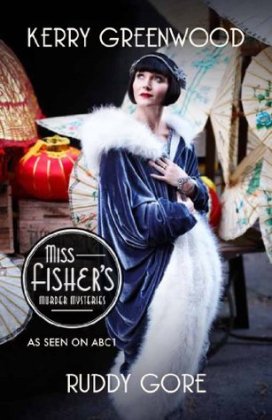 The inimitable Phryne Fisher and her friend Bunji find themselves in the middle of a very physical Chinese family dispute, which is only a subplot in this tale, as they are on their way to the theatre to enjoy a presentation of Gilbert and Sullivan’s comic opera Ruddigore. Following that initial conflict, they make their way to His Majesty’s Theatre in Melbourne, and the reader is presented with the one weak portion of the novel. In the guise of encouraging Bunji, a very minor character in the book, to stay and enjoy the opera, Phryne summarizes the plot of the opera for her. Greenwood is attempting to share background for her unfolding story which centers around an old and a new murder and mysterious occurrences at the “Maj.” Both the cast and the characters they play are important in Ruddy Gore’s storyline, but this portion of the book, really only part of a chapter, was more extensive than necessary.
With the background sufficiently established, the plot moves quickly as Phryne is initially mystified, and then gradually peels off the layers of this puzzle. As always with a Phryne Fisher novel, there are descriptions of her delightful ensembles and her romantic encounters. Dot, her companion, is called in to help with the investigation. Detective Inspector Jack Robinson views Miss Fisher as more likely to obtain information from the cast than he is, and so they cooperate and share information.
The Chinese connection through her love interest, Lin Chung, presents the thread of racial intolerance and prejudice from both sides. Lin and Phryne discuss the history of the Chinese in Australia and how the Chinese have adapted and coped. Phryne is the subject of discrimination herself from the Chinese and handles it well.
Phryne Fisher is undoubtedly rich as evidenced by her spending and lifestyle. She is not selfish, however, and her magnanimity occurs on a personal level. In this story she identifies a situation in which a stage boy with few options but much promise is being abused by his alcoholic father. Phryne doesn’t try to change the world, but she does change this boy’s world by providing him with opportunities. She doesn’t make him a charity case, suggesting that he repay her at a future date. She is also resourceful in engaging the cooperation of others in helping him.
Ruddy Gore is a wealth of incidental information about the theatre, actors, technical people, and management. All of these play a role in the mysteries which are resolved in the end, quite satisfactorily, leaving the reader anticipating further adventures starring Phryne Fisher.
I would like to extend my thanks to netgalley.com and to Poisoned Pen Press for giving me the opportunity to read this book in exchange for an honest review.
Rating: 4/5
Category: Mystery, Historical Fiction
Notes: #7 in Miss Fisher’s Murder Mysteries but reads well as a standalone
Publication: April 4, 2017—Poisoned Pen Press
Memorable Lines:
“He will always get everything that he wants and never get the one thing which he really desires—that’s how it works with bounders,” observed Phryne.
No harm in him but as self-centred as a gyroscope.
“Have you ever heard of hiraeth?” he asked, his eyes staring sadly across endless seas. “No, what is that?” “A Welsh thing, hard to translate. ‘Yearning,’ perhaps. ‘Longing’ is more like it. All of us have it, however happy we are. The yearning for home, even if we shook the dust off our shoes in loathing and swore never to return to the cold damp streets and the cold narrow people and the flat beer and the chapels fulminating endlessly against sin.”
 education pathways