
Home » Historical Fiction (Page 12)
Category Archives: Historical Fiction
In Farleigh Field–World War II spy novel
In Farleigh Field
by Rhys Bowen
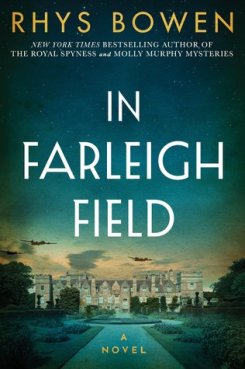 I was late coming to the TV series Downton Abbey, but it is now a fait accompli, and I enjoyed it very much. I found In Farleigh Field by Rhys Bowen to be reminiscent of Downton Abbey in its focus on the titled upper class during the hardships and upheavals of World War II. The plot is not highly complex, but it is interesting as characters of various social ranks use their skills to help England survive the Nazi onslaught.
I have two criticisms of the book. The character of Lady Diana (Dido) repeatedly whines about the war’s hampering her coming of age social season. I suppose a young woman could be that self-centered, but I kept wanting to tell her to grow up and look at the devastation surrounding her. Even her younger sister, Lady Phoebe (Feebs), seems mature, especially in times of crisis, at age twelve compared to her eighteen year old sibling. My other issue with In Farleigh Field is the ambivalence over secrets that are crucial to national security. The rules were emphasized over and over again and then broken on several occasions. At the same time, it seemed that more would be accomplished if branches of government cooperated.
The book does give insight into what it must have been like during World War II in England to work as a civilian for the government. Women were assumed to have secretarial jobs and men were thought to have bravery issues because they were not in the military.
I enjoyed the book, including the spy intrigue. There were surprises that kept the reader engaged, the setting was interesting, and the characters were appropriately either agreeable or unlikable.
I would like to extend my thanks to netgalley.com and to Lake Union Publishing for giving me the opportunity to read this book in exchange for an honest review.
Rating: 4/5
Category: General Fiction (Adult), Women’s Fiction
Notes: World War II era
Publication: March 1. 2017–Lake Union Publishing
Memorable Lines:
“Nasty Americanism, the word ‘weekend,’ ” Lord Westerham remarked. Although he had known Clementine Churchill for many years, he still hadn’t quite forgiven her for being American.
“I said she should have Margot’s bedroom, since she’s not likely to need it, but Pah said that standards had to be kept up, and it was not right for the staff to sleep on the same floor as the family, even if there was a war on.”
It was such a typical thing for someone like Lord Westerham to say. Not admitting that anything was allowed to change, even when the whole world was disintegrating around him.
Blood and Circuses–the smell of the greasepaint, the roar of the crowd…and a murder
Blood and Circuses
by Kerry Greenwood
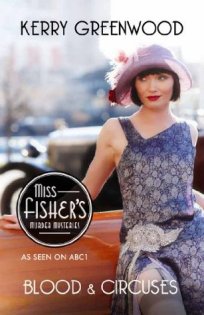 Blood and Circuses is my second foray into Kerry Greenwood’s Miss Fisher’s Murder Mysteries. Phryne Fisher is recruited by some carnival workers to investigate mysterious problems with the circus they work for, a failing endeavor named Farrell’s. The mystery begins commonly enough, but as Phryne goes undercover as a bareback rider, she learns about the stratified and well ordered world of the circus. There, the trapeze artists have the most prestige, carnival workers are second class citizens, and Gypsies are low life.
Meanwhile, Detective Inspector Jack Robinson, Sargeant Terence Grossmith, and Constable Tommy Harris are up to their necks with gangster warfare and the disturbing murder of a circus member known as both Christopher and Christine. The source of these crimes seems to connect with the troubles of the circus, but it is hard to discover just how they are related.
In the process of these investigations, the reader learns more of Phryne’s background–some of the things that helped form her character. Several moral issues are addressed: an audience’s hunger for disaster in the circus ring, the need of people to order their society in classes and then discriminate based on the labels they attach to each group, the disparagement of people who are different with the label of “freak,” and the emotions and needs of those born with a physically inconclusive gender. Phryne faces personal issues when she chooses to live in deprivation, giving up her creature comforts, her safety, and her status in the name of relieving her boredom and helping others.
Blood and Circuses is a convoluted mystery, but all of the plot lines are explained in the end. It is not just an exciting tale of adventure. There are philosophical elements which invite Miss Fisher and the reader to engage in a bit of self-examination without even a touch of preachiness.
I would like to extend my thanks to netgalley.com and to Poisoned Pen Press for giving me the opportunity to read this book in exchange for an honest review.
Rating: 5/5
Category: Mystery, Historical Fiction
Notes: 1. #6 in the series, but could be read as a standalone
2. some bad language and a number of sexual encounters, but the emotions are described more than the physical aspects of the encounters.
Publication: March 7, 2017–Poisoned Pen Press
Memorable Lines:
Sargeant Terence Grossmith was huge. His expanse of blue tunic was as wide as a tent. He had thinning brown hair and large limpid brown eyes, which seemed to hold an expression of such placid benevolence that hardened criminals had occasionally found themselves confessing to him out of a sense of sheer incongruity.
[speaking of Detective Inspector Jack Robinson]…always at the start of a case, he felt downhearted and tired. There was so much evil in the world. “O cursed spite! That ever I was born to set it right,” he quoted to himself. The Mechanics’ Institute English literature classes which his wife had taken him to, much against his will, had been very useful. A man could always rely on Shakespeare to hit the nail on the head. Robinson wondered how he had done without him.
Phryne speaking: “…what’s fascinating about the circus is the people. And I don’t expect you to like them, Dot. They aren’t respectable.” “That’s why you like them,” commented Dot. Phryne looked at her companion’s reflection in the mirror and grinned.
We Were the Lucky Ones–Jewish Family in Poland, WWII
We Were the Lucky Ones
by Georgia Hunter
 We Were the Lucky Ones tells the story of a family of Polish Jews during what was arguably the most difficult time for Jews in European history. This work of historical fiction is written by Georgia Hunter, a descendant who spent years researching, traveling, and interviewing family members to uncover this amazing story of rare survivors. As the author notes, “By the end of the Holocaust, 90 percent of Poland’s three million Jews were annihilated; of the more than thirty thousand Jews who lived in Radom, fewer than three hundred survived.” Although it is fiction, it has been closely based on facts. The author also intersperses short paragraphs summarizing the historical events of World War II as they relate to this family and notes at the beginning of each chapter the date and location of the events in that section. We Were the Lucky Ones begins in March 1939 and concludes in 1947.
The novel moves through history by telling the story of each family member at various times through an excruciating eight year period. Some experience prison and the torture of interrogation; others endure Siberian work camps, life in a Polish ghetto, extermination by pogrom. The family members are subjected to various extremeties: death, disease, starvation, persecution, betrayal. Through all of these trials, one of their greatest pains is not knowing the fate of their loved ones. A constant theme is their unending love of family.
I would like to extend my thanks to netgalley.com and to the Penguin Group (Viking) for giving me the opportunity to read this book in exchange for an honest review.
Rating: 5/5
Category: Historical Fiction, General Fiction (Adult)
Publication: February 14, 2017–Penguin Group (Viking)
Memorable Lines:
But after a few days, they found they had little left to talk about. The chatter ceased and a funerary silence settled upon the train car, like ash over a dying fire. Some wept, but most slept or simply sat quietly, withdrawing deeper into themselves, encumbered by the fear of the unknown, the reality that wherever they were being sent, it was far, far away from home.
And suddenly, the consequences of this war were undeniably real–an understanding that sent Halina spiraling as she wrestled with the knowledge she both feared and loathed: she was powerless.
Nechuma used to reassure herself that they had lived through pogroms before, that in time, the fighting, the bloodshed would pass. But with the news from Lodz she’s come to understand that the situation they are in now is something entirely different. This isn’t just being subjected to profound hunger and poverty. This isn’t persecution. This is extermination.
The Green Mill Murder –witty, sexy, intrepid private eye
The Green Mill Murder
by Kerry Greenwood
 I am delighted to belatedly discover that Miss Fisher’s Murder Mysteries were novels before they were films. Usually I find that in such cases the book is better than the movie. This is true in The Green Mill Murder which is the fifth in the series by this prolific, award winning Australian author. I should add, however, that I have very much enjoyed the films and having seen them added to my ability to visualize the setting and beautiful dresses and accessories that the heroine, Phryne Fisher, wears.
Phryne Fisher is quite a character. She is rich, but down to earth. She shares her wealth and offers personal help to those in need. Her morals are outrageous (in the 1920’s); and although she is clearly a lady, she never lets her gender limit her actions.
The Green Mill Murder has a basic mystery: a man is killed by unknown means in a dance hall during the waning hours of a dance marathon in plain sight. Phryne is there and so is able to help the detective Jack with his investigation. In the process, several more mysteries arise, which include issues of a missing husband, blackmail, and inheritance.
I so enjoyed this mystery starring a witty private investigator who can conceal a flask or a small gun as needed in a sexy outfit one day and fly a Gipsy Moth the next. The Australian English (e.g. collywobbles) and the 1920’s laws and customs add to the interest.
Phryne’s independence is exhilarating, and I look forward to more of her adventures. Greenwood says she will keep writing Miss Fisher mysteries as long as readers want more. Currently there are twenty mysteries in this series, thirteen of which have been made into movies for television.
I would like to extend my thanks to netgalley.com and to Poisoned Pen Press for giving me the opportunity to read this book in exchange for an honest review.
Rating: 5/5
Category: Mystery & Thrillers
Notes: There were various earlier publications of this book
Publication of Current Edition: February 7, 2017–Poisoned Pen Press
Memorable Lines:
“She enjoys bad health, Dot. the woman hasn’t been well since 1915, and she’s as strong as a horse.”
Vic had been delightful, but he and his surroundings were a passion to be indulged in sparingly, like absinthe, which sooner or later sent the drinker mad.
“Oh, how clean I am and how lovely hot water is! Great invention. No wonder the Romans ruled the world.”
The Angels’ Share–Is this homeless man Jesus?
The Angels’ Share
by James Markert
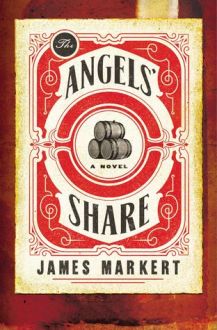 It is hard to pigeonhole The Angels’ Share in the sense of literary category, theme, or purpose. The author, James Markert, has a history degree and categorizes The Angels’ Share as “commercial fiction set during historical times.” The publisher classifies it as both General Fiction (Adult) and Christian. Four major threads compete for attention–the Depression, Prohibition, the bourbon industry, and a confusing Christlike figure.
Times are particularly hard in the fictional town of Twisted Tree where Prohibition has raised unemployment levels due to the closing of the distillery. The family that owned the distillery mysteriously seems to fare well financially, but there are dark tones to their story.
Homeless people play a major role in this novel, as in almost any tale of this era. One, in particular, stands out: Asher Keating, who has already passed away when the story begins. A much decorated war hero who saved the lives of hundreds of fellow soldiers, he quietly accumulates a following as he roams around healing, feeding the hungry, and providing clothing. Is he Jesus fulfilling the second coming? Is he a guardian angel? Is he a lunatic?
The title The Angels’ Share emphasizes both the process of making bourbon and the religious and philosophical questions posed. According to the author, angels’s share is “the quantity of whisky lost to evaporation during the aging process.” Tradition says that distillers share their bourbon with the angels as an offering so they will protect the distillery from fire.
The Angels’ Share is a very different book and a worthy read. The characters and their struggles are interesting. The setting, both locale and time, are essential to the plot. I don’t consider it to be a “Christian” book because it doesn’t follow Biblical tenants and prophecies. It does have religion and relationship to God as thematic elements, and it does provoke thought about God, the homeless, and gifted individuals. The Angels’ Share is well-written with its complex threads telling a story with depth. The dialogue is appropriate to the era with lots of slang that has fallen out of popular usage, giving a realistic touch to conversations. The relationships of the various characters result in an interesting web as they move in and out of each others’ lives. There is even a romance that is integral to the plot, but does not dominate it. As The Angels’ Share concludes, many questions are answered about the characters, but others are appropriately left to the reader to ponder.
I would like to extend my thanks to netgalley.com and to Thomas Nelson for giving me the opportunity to read this book in exchange for an honest review.
Rating: 4/5
Category: General Fiction (Adult)
Publication: January 17, 2017 — Thomas Nelson
Notes: I was intrigued, but not surprised, that the passages I highlighted as I read this book mostly deal with Asher Keating, the Christlike figure. There are many selections that made comparisons with or echoed Biblical text; they lead the reader to pose questions about Keating and his purpose on Earth.
Memorable Lines:
Hope can change even the most stubborn of men.
In the author’s historical notes: …there are now more barrels of bourbon aging in Kentucky than people.
Good News and More Good News!
Good News:
Congratulations to “doraquilts” who won the book giveaway for The Other Einstein. I’ll be contacting her to make arrangements for the publisher to send her a copy of the book.
More Good News:
For a limited time the ebook version of The Other Einstein is on sale.

Last Day for The Other Einstein Book Giveaway!
 This is indeed the last day to participate in the “no strings attached” giveaway for a copy of The Other Einstein.
The Other Einstein is a really good historical novel. The author uses research to fill in the gaps of what might have occurred in developing the theory of relativity. Einstein’s first wife was also a brilliant scientist in an age where women were not encouraged to use their brains. How much influence did she have? Click here to read the review if you missed it.
Click here for details on the giveaway and to enter.
The Other Einstein–Book Giveaway!
 I reviewed a book in mid-October that I enjoyed so much that I decided to host a book giveaway. The publisher, Sourcebooks, is giving away a copy of The Other Einstein to one of my readers.
Here are the guidelines for this giveaway:
- You must be a resident of U.S. or Canada.
- You must be 18 years or older.
- Winner will be selected by random drawing.
- Only one entry per person.
- The closing date is Sunday, Nov. 20, 2016, at 6:00 P.M. CST.
One winner will be chosen and announced on November 21, 2016 on this blog using the winner’s blogging name. The winner will also be notified via email. - If after 10 days the winner has not responded, a second random drawing will occur.
- The book will be shipped by the publisher, Sourcebooks, after the winner has provided shipping details (name and shipping address) which I will forward to Sourcebooks.
The fine print: No purchase necessary. Void where prohibited by law. Sourcebooks is providing this product and shipping free of charge. I was not recompensed in any way for posting this giveaway on my blog.
To participate in the giveaway all you need to do is add a comment below. Seriously, it’s that easy! Thank you for participating.
If you want to read my review of The Other Einstein, just click here!
(In the coming week, I will also publish a question and answer I posed to the author, Marie Benedict. I found her response enlightening and I think you will too.)
The Girl from Venice–WWII setting
The Girl from Venice
by Martin Cruz Smith
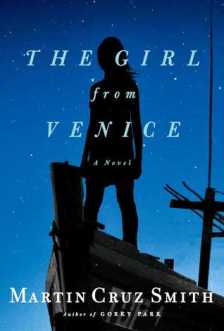 The Girl from Venice is the tale of Cenzo, a very versatile and capable Italian fisherman, and Giulia, a young Jewish lady. Their lives intertwine in World War II in 1945 in Venice in the midst of conflicting players: Nazi soldiers, Mussolini’s Blackshirts, and the equally deadly Partisans. This work of historical fiction is a combination of thriller and mystery with a little romance thrown in.
I had conflicting feelings about The Girl from Venice. The plot has some interesting twists and turns. Part of this novel revolves around the many different ways of fishing in the lagoons near Pellestrina. I thought the story was a little slow in its extended descriptions of the art of fishing, but many of the details were essential in the plot progression. They explain how Cenzo and Giulia were able to deceive the Nazis searching for Giulia as well as how Giulia transformed from a wealthy, highly educated Italian Jew into a skilled fisherman in her own right.
The author had a lot of decisions to make about the reader’s background knowledge concerning Italy and its politics in 1945. He did a good job of supplying necessary details without oversimplifying or being pedantic.
The setting varies between city and fishing village. There are complicated family relationships involving Cenzo, his mother, two brothers and sister-in-law, and through those relationships we discover more about each character. The character of Giulia, however, is mostly undeveloped. We want to know more but are left unsatisfied.
As the story ended, so did its unfulfilled promise. The idea was a good one, the setting was interesting, but none of the characters were particularly engaging or well-developed. There was one major twist in the plot, but otherwise it seemed to just keep plodding along. It took me many days to read it just because nothing kept drawing me back. Not one to usually comment on a book’s cover, I must say the cover was outstanding–dramatic and perfect for this book.
I would like to extend my thanks to netgalley.com and to Simon & Schuster for giving me the opportunity to read this book in exchange for an honest review.
The Other Einstein–Did Albert Have Help with his Theory of Relativity?
The Other Einstein
by Marie Benedict
 Fascinating! I found the story of The Other Einstein to be a very different and fascinating reading experience: this historical novel is like none other I have read. The author, Marie Benedict, examines the facts that exist about Albert Einstein’s first wife, Maleva Marić, an outstanding physicist and mathematician in a time when women were rarely admitted to universities. Some speculate that her contributions to Einstein’s Nobel Prize winning theory of relativity may have been significant.
The book traces Maleva’s journey from Serbia to the Polytechnic campus in Zürich where, as a woman, she must struggle to be recognized as a serious and capable student. To that end she tries to maintain a collegial relationship with fellow student Albert Einstein who has more romantic inclinations. The author is able to weave a convincing tale of how this dedicated female student deviated from her professional goals as a result of various circumstances, including the death of their daughter born out of wedlock, Maleva’s physical health, her lack of acceptance (because of a physical disability, her intelligence, and her ethnicity) by many in society including Albert’s family, and the self-centered behaviors of Albert Einstein himself. Maleva struggles to be everything Einstein wants–totally devoted to his needs, the perfect housewife and mother, and a scientific collaborator. She finds the task impossible, especially in the face of Einstein’s professional and personal betrayals of her.
The Other Einstein ends with an epilogue which gives Maleva a chance to reflect upon her life and gives the reader a few details about her life after she and Einstein are divorced. The author adds an interesting and helpful section on her own motivations in writing the book, her research, and the extent of fictionalization. She includes sources for readers who want to pursue the story further, including original correspondence discovered in the 1980’s. She follows with a Reading Group Guide of questions that could be the catalyst for excellent discussions. The book ends with an author interview which provides more background information on the writing of The Other Einstein.
Although there are a lot of references to various specific theories of physics, a physics background is definitely not necessary for full enjoyment of this book. As a personal opinion, I think women would tend to relate better to Maleva’s difficulties and struggles than men. This book enthusiastically receives my highest recommendation.
This book is scheduled for publication on October 18, 2016.
I would like to extend my thanks to netgalley.com and to Sourcebooks for giving me the opportunity to read this book in exchange for an honest review.
 education pathways