
Home » Historical Fiction (Page 10)
Category Archives: Historical Fiction
Where the Fire Falls–Yosemite National Park
Where the Fire Falls
by Karen Barnett
 Themes abound in Karen Barnett’s work of historical fiction, set in Yosemite National Park, and they intertwine and work together well. In Where the Fire Falls, the Park itself almost seems like a character as it and its God-created beauty are central to the book. The novel has the Christian focus of man’s relationship with God through His grace. The two main characters have pasts they are struggling to both hide and overcome: Olivia, a rising watercolor artist, and Clark, a former pastor and currently a guide for tourists who want to mule pack into the wilderness.
The main characters are likable and the plot is surprisingly complex with some chaste romance throughout. Supporting characters include socialite patrons, an art agent, rangers at the park, other workers at Yosemite, a hermit, and Olivia’s two younger sisters and her Aunt Phyllis. Olivia has to overcome fears of the past, her inexperience with the outdoors, and her own naiveté. She has to peel off the mask she has created as a shield for herself and as a tool to promote herself in the art world. Clark seeks God’s guidance and direction but is unable to hear it because he feels unworthy.
The descriptions in this book are so well written that I can imagine standing at the various scenic spots as I am taken in by the beauty. Likewise, I can almost picture Olivia’s priceless watercolors that attempt to evoke an emotional response rather than provide a realistic depiction.
I enjoyed this book even more than the first in the series as the plot held more puzzles and surprises. The characters in the two books do not overlap so each actually is a standalone. It is my hope that the author will continue the Vintage National Park Series with new characters in a different national park.
I would like to extend my thanks to Edelweiss and to WaterBrook (Random House) for giving me the opportunity to read this book in exchange for an honest review.
Rating: 5/5
Category: Historical Fiction, Christian
Notes : A Vintage National Parks Novel
Publication: June 5, 2018—WaterBrook (Random House)
Memorable Lines:
The impulsive decision now hung on her like a dress two sizes too large.
“Scripture says faith can move mountains, but I’ve found time spent in the mountains sometimes moves us toward faith.”
“God saved up the best bits of creation and spent them here.” Viewing it from this angle, she could almost imagine a divine artist smiling as He carved the valley away from the giant monoliths.
“Dis-grace is a human term, Clark. God invented grace. No one can take it from you.”
Sold on a Monday–grab your heart
Sold on a Monday
by Kristina McMorris
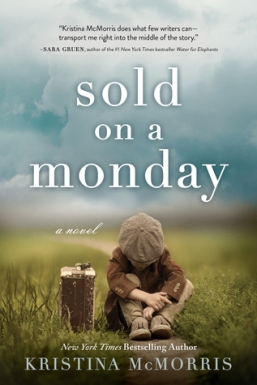 Sold on a Monday is one of those books that keeps returning to your thoughts—sad and soul crushing, but at the same time hopeful. Even the book’s title has a haunting echo: Sold on a Monday. What would it take for a mother to give up her children or further to sell them? Just how precious is a child to a mother and how can she survive when her child is gone? Sold on a Monday contains this theme within the story of a reporter’s drive for success, a secretary’s desire for secrecy, and families’ difficult relationships.
Sold on a Monday is set in the financial desolation of 1931 in Pennsylvania where Ellis, a reporter, snaps a photo of a sign “2 children for sale.” This one picture sets in motion the events contained in Kristina McMorris’ work of historical fiction that incorporates many elements of the Depression. It shows a poverty that brings out the best and the worst in people. Orphans are “adopted” to become forced workers. Mobs control cities, and Prohibition is for those without connections. Neighbors help neighbors, and shopkeepers set aside unsold goods for for the hungry, helpless, and homeless.
I was a little troubled by the romantic triangle in Sold on a Monday. At some points I felt the secretary with reporter aspirations, Lily, is being unfair to the two men interested in her. In fairness to her, however, although she has a four year old son, she is very young. At a time when being an unwed mother is a disgrace, she is attempting to make a living, take care of her child, and help her parents without whose support she would be in desperate straits. The author works out the triangle satisfactorily, if perhaps a bit too tidily, in the end.
I do recommend Sold on a Monday. It would be especially good for book clubs as it lends itself well to discussion. In fact, the author includes a section of questions for that purpose at the end of the book.
I would like to extend my thanks to netgalley.com and to Sourcebooks Landmark for giving me the opportunity to read this book in exchange for an honest review.
Rating: 5/5
Category: Historical Fiction, General Fiction (Adult)
Publication: August 28, 2018—Sourcebooks Landmark
Memorable Lines:
“Even when life’s downright lousy, most kids are still so resilient because…well, I guess ‘cause they don’t know any different. It’s like they only realize how unfair their lives are if you tell them. And even then, all they need is the smallest amount of hope and they could do just about anything they set their minds to…”
He dared to ask for a repeat of a point and instantly saw his mistake in the man’s hardened face. Everything about him—his eyes and nose, his build and demeanor resembled a watchful owl. Just biding his time until he swooped in for the kill.
Then she heard. “Can you tell me how it all started?” It was a standard question that blended the reporter in Lily’s head with the detective before her, and she wasn’t entirely certain which of them had asked.
The Road to Paradise–climbing new heights
The Road to Paradise

Karen Barnett’s The Road to Paradise is a delightful visit through time to Mount Rainier National Park in Washington. Set in 1927, the story tells of young Margie Lane, the socialite daughter of Senator Thomas Lane. A naturalist at heart, Margie is hired for the summer, as a political favor, into the male dominated environment with the expectation that she will only last a few days. Margie, lacking practical experience, brings with her determination, enthusiasm, a sense of wonder at God’s creation, and an academic background in botany and zoology.
This book has a villain, Phillip Carmichael, who has been manipulating Margie since childhood, and it has a hero, Chief Ranger Ford Brayden, Margie’s new boss. By the end of the story the reader has learned the motivations of each character and how their backgrounds and experiences set the stage for their actions.
Maggie is attracted to Ford, but realizes they have no future together because he does not share her faith in God. Calling God “the greatest Artist ever known,” Margie sees Him all around her in His amazing creation in Mount Rainier National Park and asks God to use her to share His love with others.
As Margie struggles in her new job and relationships with co-workers at the Park, Phillip is always a force as he tries to convert the Park from wilderness to super tourist entertainment center—by any means necessary. Margie’s parents also play a role with their expectations for their daughter’s social and media status.
I would like to extend my thanks to Edelweiss and to Waterbrook (Random House) for giving me the opportunity to read this book in exchange for an honest review.
Rating: 5/5
Category: Fiction, Christian, Historical Fiction
Notes: a Vintage National Parks novel
Publication: June 6, 2017—Waterbrook (Random House)
Memorable Lines:
Ridgeline after ridgeline of deep green rose to meet the jagged edges of the enormous peak, tucked into its rumpled blanket of white.
Her smile added to the graceful beauty of her face. “I love seeing God’s creation laid out in front of us. ‘The earth is full of thy riches.’ How anyone can look at this natural order and not see the Maker’s hand, I’ll never comprehend.”
“God wants me broken and miserable?” She shook her head. “I don’t think I’d go that far, Ford, but when we’re weak He is strong. It’s in His strength that we find victory.”
Auschwitz Lullaby–a mother’s amazing love
Auschwitz Lullaby
by Mario Escobar
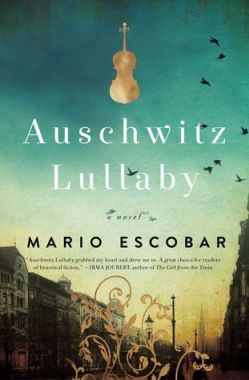 Auschwitz Lullaby is a sad book based on the life of Helene Hannemann, a German woman married to a talented Gypsy violinist. As an Aryan she could have saved her own life, but she chooses instead to accompany her five mixed-blood Gypsy children to Auschwitz. There she is chosen by the infamous Doctor Mengele to establish and run a nursery school at the concentration camp. Knowing that Mengele would only perform this “kindness” to the children for his own ends, she agrees anyway to provide the starving children with more nutritious food, several hours a day in a cleaner, healthier environment, and some mental respite from the stressful deprivations and horrors of the camp.
Without graphic descriptions, the author Mario Escobar uses a first person format, having Helene tell her own story through a journal which she supposedly left behind in the camp. Her writing is encased in a Prologue and Epilogue in Mengele’s voice. As I read this work of historical fiction, I wondered how much was true. I was gratified to discover a section called “Historical Clarifications” at the conclusion of the tale that explains clearly the aspects of the book that are nonfiction. The author is a historian so he also adds a “Chronology of the Gypsy Camp at Auschwitz” and acknowledgements of his sources of research.
Although the publisher categorizes the book as “historical fiction” and “Christian,” there are not a lot of overt references to Christianity, but there is an underlying thread of faith, hope,and love available through the power of God. The school holds a meager Christmas celebration which attempts to “give these children back a little bit of their faith.” Helene notes “that night we were celebrating life, the birth of the Christ child” and she ponders the message of the manger: “Glory to God in the highest, and on earth peace, goodwill towards men.” There are other Christian themes throughout of love, forgiving one’s enemies, God’s plan for Helene’s life, and the existence of evil.
I received a complimentary copy of this book from Thomas Nelson through NetGalley. Opinions expressed in this review are completely my own.
Rating: 5/5
Category: Historical Fiction, Christian
Publication: August 7, 2018 — Thomas Nelson
Memorable Lines:
“From the first time I saw you, I knew God had brought you here to ease our pain somehow. You were so lost, confused, and scared, but I could see a fierce determination in the back of your eyes.”
Death seemed like a gift from heaven, but I knew that it was not yet for me. I was an old ship in the middle of a storm, and my children anchored me to life. I had to keep fighting for them, trying to hold on to hope, looking each day in the face, praying for this nightmare to finally be over.
“God sent you here to guide us. We needed a breath of hope, and you showed up with your beautiful family. I’ve never known anyone as brave and determined as you.”
I tried to fill my heart with love. I did not want hatred to eat away my insides. I had to love even my enemies. It was the only way to keep from becoming a monster myself.
How to Stop Time–historical fiction with a science fiction twist
How to Stop Time
by Matt Haig
 The typical work of historical fiction takes a character from a specific time and place and imagines, hopefully based on some research, what life would have been like for that person. How to Stop Time is not a “typical work of historical fiction.” Author Matt Haig dares to explore what would happen if certain people were naturally genetically designed to age slowly, to live hundreds of years. What would life be like for that person? What would the response of others be to them? How do you form a relationship with someone who will certainly age at a different rate? What if one of these “albatrosses” becomes powerful enough to use various means to control the others?
How to Stop Time follows Tom Hazard as he negotiates life in the twenty-first century and reflects on events in his past spanning multiple centuries, locations, careers and aliases. He is musically inclined and along the way discovers an aptitude for teaching history.
Tom is a likable character whose situation is in some ways different from the circumstances of “normal” human beings. In many aspects, however, his struggles are the same as he tries to fit in, decides how open to be with those he meets, and battles with opening his heart. We all on occasion want to stop time to savor the moment, to revisit past decisions, and to look ahead into the future.
How to Stop Time is an excellent work of fiction, well-written and interesting. It introduces historical characters such as Shakespeare and Captain Cook, but there are equally fascinating fictional characters who convincingly embody the everyday men and women of past generations. With its fast-moving storyline, this book is one I recommend you add to your To Be Read list.
I would like to extend my thanks to netgalley.com and to the Penguin Group (Viking) for giving me the opportunity to read this book in exchange for an honest review.
Rating: 5/5
Category: Historical Fiction
Publication: February 6, 2018—Penguin Group (Viking)
Memorable Lines:
I had no idea I had been looking for her, but now I had found her, I had no idea what would happen. I felt like I was spinning fast and out of control, like the seed of a sycamore, traveling on a changing wind.
I kept going cross the desert and over dry hills and mountains and past a large quarry that seemed to my delirious mind like the blackness of death itself calling me towards it like the River Styx.
I can’t right now think of a better purpose in life than to be a teacher. To teach feels like you are a guardian of time itself, protecting the future happiness of the world via the minds that are yet to shape it.
Murder on a Midsummer Night–no sparkle to this mystery
Murder on a Midsummer Night
by Kerry Greenwood
 In Murder on a Midsummer Night, there are two major non-connected mysteries and one minor mystery. A man with no apparent reason to commit suicide is found drowned, and Phryne Fisher is hired to discover what really happened to him. Simultaneously she takes on a case to find a person who was given up for adoption many years prior. A mother has died and her will indicates that this person should be included in receiving monetary benefits. At the end of each chapter is a brief part of yet another tale. It appears very disconnected from the main plot lines until the very end of the book at which time it is tied into one of the threads. Rather than being clever, I found it distracting.
This is the first Phryne Fisher mystery that I have not totally enjoyed. In addition to the dangling mini-mystery, the characters did not have the pizazz that they normally have. The author relates the actions the characters take rather than allowing the reader to watch the action, participating vicariously. I regretted that Phryne’s family members as well as other regulars in the series are present but not very active. The result is a flat feeling to the story. In addition there are a number of truly distasteful characters in this book. Phryne doesn’t like them, and the reader has no reason to like them.
I am a big fan of the Phryne Fisher Mystery Series, but this mystery was disappointing. If this were my first experience with the series, it would probably be my last. Knowing the usual quality of the books in this series, however, I will be back.
I would like to extend my thanks to netgalley.com and to Poisoned Pen Press for giving me the opportunity to read this book in exchange for an honest review.
Rating: 3/5
Category: Historical Fiction, Mystery
Notes: #17 in the Phryne Fisher Mystery Series
Publication: February 6, 2018—Poisoned Pen Press
Memorable Lines:
There was never any point being cross about weather, it was like politicians: to be born patiently, because it was compulsory.
She didn’t care what anyone said about the association of Phryne and Lin Chung, especially James, who was leaning against the white-painted wall, looking exquisite and drinking his third glass of the revolting port. That appeared to be the sum total of his social skills but Phryne supposed that he might have hidden depths.
But then, every country has its mistral, its meltemi, its own terrible wind.
The Tattooist of Auschwitz–tribute to human resilience and the power of love
The Tattooist of Auschwitz
by Heather Morris
 When a book reads like fiction but is a union of memories and history, it is literary work that is destined to engage and move the reader. The Tattooist of Auschwitz is such a tale, related by Lale Sokolov to Heather Morris over a three year period. It is a horrific story of desperation in the worst of circumstances and of Lale’s confidence that he would survive and marry his beloved fellow sufferer Gita.
The Tattooist of Auschwitz displays the best and worst of mankind. It shows the incredible resilience of the human spirit. Throughout, the reader witnesses people doing whatever it takes to survive as does Lale who is innovative, multilingual, charming, and determined that in the end his tormentors would not get the best of him. There are many books written about the Holocaust. Each addresses the events from a different perspective. This is another valuable contribution, adding to our understanding and reinforcing the sentiment of “never again.”
 I would like to extend my thanks to netgalley.com and to Bonnier Zaffire for giving me the opportunity to read this book in exchange for an honest review.
Rating: 5/5
Category: General Fiction (Adult), Historical Fiction
Notes: Despite the nature of the events being retold, the writing has a respectful tone without graphic descriptions of violence or swearing. I highly recommend this book.
Publication: January 11, 2018—Bonnier Zaffire
Memorable Lines:
Lale has witnessed an unimaginable act. He staggers to his feet, standing on the threshold of hell, an inferno of feelings raging inside him.
How can a race spread out across multiple countries be considered a threat?
“I know it’s a strange thing for me to say, but you will honor them by staying alive, surviving this place and telling the world what happened here.”
He knows they will never grow to be the women they were meant to be. Their futures have been derailed and there will be no getting back on the same track. The visions they once had of themselves, as daughters, sisters, wives and mothers, workers, travelers, and lovers, will forever be tainted by what they’ve witnessed and endured.
Carnegie’s Maid–sacrificing for family
Carnegie’s Maid
by Marie Benedict
 Carnegie’s Maid, a work of historical fiction, attempts to explain what could have caused Andrew Carnegie, a ruthless businessman, to become a philanthropist and founder of the Carnegie Libraries. As a former impoverished Scottish immigrant, he fights his way to the top echelons of America’s monied, sometimes stepping on the backs of other immigrants to get there. Author Marie Benedict has created a lady’s maid from Ireland who is on a mission to support her Irish Catholic Fenian family. Her Clara is hard-working, smart, and focused. An opportunist, she takes the place of another Clara becoming a lady’s maid rather than a scullery maid making herself privy to the family’s secrets and business machinations.
As seen in Benedict’s other excellent work of historical fiction, The Other Einstein, the novel Carnegie’s Maid demonstrates the author’s intensive research and attention to detail. As I read I found myself wishing for a main character based on an actual person as in The Other Einstein. I assume the details and records of Carnegie’s life are just too sketchy to provide such a character. Benedict has taken the immigrant culture of the times, the certainty that Carnegie’s mother would have had a lady’s maid, the mystery of Carnegie’s altruism, and his delay in marriage as the basis for her fictional Clara. There is much more supposition in this book, but it is well written and not outside the realm of possibility.
I enjoyed the tale with its details about the difficult lives of the Irish both in Great Britain and in the United States. It paints a picture of the U.S. as a very difficult land of opportunity, with no handouts, and even fewer options for women. Gender, ethnic background, religion, money, family, and education all play a role in the highly stratified, unofficial class systems of the time.
I would like to extend my thanks to netgalley.com and to Sourcebooks Landmark for giving me the opportunity to read this book in exchange for an honest review.
Rating: 5/5
Category: Historical Fiction
Notes: by the author of The Other Einstein
Publication: January 16, 2018—Sourcebooks Landmark
Memorable Lines:
“These Catholic Irish running from the havoc wreaked by their famine and pouring onto American shores are not like the hard-working Protestant Irish who immigrated in earlier years. This new Catholic crop is rough and uneducated, and they’ll destroy the fabric of this country’s shaky democracy if we let them, especially in these days of Civil War unrest, just like they did back home in Scotland when they stole factory jobs away from Scottish men and women. An Irish Catholic servant might suffice as a scullery maid but not as my personal maid.”
For whom was I crying? for all the immigrants like the Lambs, who came to America seeking a better life but settled instead for a soot-infested home and dangerous work in the mills and gave thanks for it?
For the first time, I realized how alike my situation was to that of Mr. Carnegie. Although the scale was quite different, the stakes were not. The well-being of both our families rested on our success.
Dead Man’s Chest–beach holiday turns dangerous
Dead Man’s Chest
by Kerry Greenwood
 Dead Man’s Chest deviates in a delightfully surprising way from the typical Phryne Fisher mystery with a change of setting. Most occur in St. Kilda near Melbourne, Australia, but in this work of historical fiction, detective Phryne Fisher takes her family to Queenscliff for a holiday while her home in St. Kilda is undergoing renovation. The vacation turns into work as they arrive at the home an acquaintance has loaned her only to find the Johnsons, who serve as butler and cook, have disappeared and the house has been emptied. Along with this mystery is a tale of a “pigtail snipper” who cuts off the braids of local young girls.
Ruth gets to try out her culinary skills, Jane delves into ancient bones and movie making, and Dot gets to spend some time with the strong and handsome Constable Hugh Collins. A young ne’er-do-well, Tinker, becomes a devout follower of his mentor, Miss Fisher, whom the whole family holds in high regard. Throw in some smuggling, tales of pirate treasure, a snoopy neighbor, insight into the impoverished lives of the serving classes and fishermen, and a taste of Surrealism, and you have a lively story beckoning the reader to discover the answers to some fascinating Australian mysteries.
I would like to extend my thanks to netgalley.com and to Poisoned Pen Press for giving me the opportunity to read this book in exchange for an honest review.
Rating: 5/5
Category: Historical Fiction, Mystery
Notes: #18 in the Phryne Fisher’s Murder Mysteries; adequate as a standalone but more interesting with some background on the main characters
Publication: December 5, 2017—Poisoned Pen Press
Memorable Lines:
Phryne was getting out of the car. Dot closed her eyes. Miss Fisher was about to happen to someone again.
Dot had been training her in Suitable Topics for a Lady’s Dinner Table, which did not include Rat Dissection for Beginners or Beastly Customs of the Heathen, which was a pity because Jane knew a lot about both of these.
“We’re on a case again, aren’t we?” asked Dot gloomily. “Well, yes, but this time it really isn’t my fault, Dot dear. I was dropped right into this one.”
He was terrified. Not of the task, but that he might let the guv’nor down. She had trusted him. No one had ever trusted Tinker before.
Queen of Flowers–so many elements
Queen of Flowers
by Kerry Greenwood
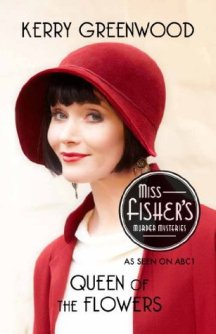 Queen of Flowers opens with Phryne Fisher’s extensive fitting for a dress to be worn in a Melbourne parade as the chosen Queen of Flowers based on her charitable support. The whole household is turned on end for the fitting, an elephant makes an appearance in her yard, and that day turns out to be the most tranquil in the book.
Queen of Flowers is a masterpiece of complex plot. The carnival and circus are in town along with a violin player from Phryne’s past. Adopted daughter Ruth begins to wonder about her parents. Phryne takes her four flower girls (young ladies) in hand and discovers interesting aspects of their backgrounds. As usual, Phryne shows herself as a force to be reckoned with in dealing with some of St. Kilda’s shadiest characters. My one problem with the book was that when one of her daughters goes missing, Phryne is much calmer than one would expect.
All of Phryne’s “minions” are called in to help with the various mysteries that are amazingly connected. I felt like standing up and clapping with a loud “Well done!” as Greenwood tied up the plot threads successfully and delivered justice as deserved.
I would like to extend my thanks to netgalley.com and to Poisoned Pen Press for giving me the opportunity to read this book in exchange for an honest review.
Rating: 5/5
Category: Historical Fiction, Mystery
Notes: #14 of the Miss Fisher’s Murder Mysteries; could be a standalone but better if you have some background on the characters
Publication: November 7, 2017—Poisoned Pen Press
Memorable Lines:
Phryne, the fiddler remembered, always existed as a still, self-possessed point in a maelstrom. Usually she had created the maelstrom herself.
Phryne…climbed the stairs in search of copious hot water to wash the Weston house off her skin. She had been in houses which ran black with fleas. She had been in rural cottages where the soot gloved the beams and the vulcanized grease on the kitchen walls had been classified by the National Trust. But she had never felt quite this grimy, and she didn’t like it.
He was a slick, hard-faced man with a chin on which one could break rocks, and thin red lips. His eyes were as compassionate and kind as chips of flint.
 education pathways