Home » Historical Fiction (Page 11)
Category Archives: Historical Fiction
Away with the Fairies–not a fairy tale
Away with the Fairies
by Kerry Greenwood
 Away with the Fairies begins immediately with the discovery of Miss Lavender’s body in a fairytale setting. There are many possible suspects from the residents of the apartments to coworkers at the women’s magazine that Miss Lavender writes for. Maybe even a disgruntled reader who has solicited help from the magazine’s advice column.
In the midst of this complicated investigation, Lin Chung, Phryne Fisher’s Chinese lover, goes missing and it is up to Phryne to cross the cultural barriers set up by his family. She needs to find him and rescue him if needed.
Dot, Phryne’s assistant, and Bert and Cec, socialist taxi-drivers and part-time employees of Phryne, get major roles. We are also introduced to another interesting character, Li Pen, a Shao Lin monk and bodyguard of Lin Chung.
Away with Fairies is an interesting mystery, full of adventures and intrigue, set in 1928. Phryne, as always, is brave and defiant. The plot is complicated, and the book has a satisfying, but unexpected resolution.
I would like to extend my thanks to netgalley.com and to Poisoned Pen Press for giving me the opportunity to read this book in exchange for an honest review.
Rating: 5/5
Category: Historical Fiction, Mystery
Notes: #11 in the Phryne Fisher Mystery Series. This one would work as a standalone, but is probably more enjoyable if the reader has been previously exposed to the characters.
Publication: August 1, 2017—Poisoned Pen Press
Memorable Lines:
The case was breaking. She knew the feeling. The matter would be as obdurate as a big stone block for ages, utterly resisting all chipping and tapping. Then just when you were about to give up and take to it with a sledgehammer, it cracked into a lot of pieces and fell away, revealing the gold egg of the solution in the middle. Feeling that she had extended her metaphor beyond its coefficient of expansion, she blew idle smoke rings all the way to the city.
Bert, who was about to call upon his maker to deliver him from unconscionable demands from stroppy sheilas, decided not to on receipt of a fifty megawatt glare from those strange green eyes. He felt a moment of gentle Christian pity for whoever tried to stop Miss Fisher…
She stood so still that a questing rat paused in its passage across her foot, whiffling its whiskers, wondering if the engineer was dead enough to provide a late-night snack. Loathing washed over Phryne so strongly she was afraid that she would retch. The clammy tail was across her bare ankle. It was cold. It was one of the vilest things she had ever felt in her whole life and if it had gone on for another second she might have flinched.
Unnatural Habits–Phryne at her best
Unnatural Habits
by Kerry Greenwood
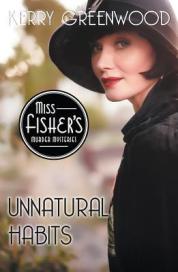 Kerry Greenwood created a much more complex mystery in Unnatural Habits than others of the Phryne Fisher Mystery Series that I have read. There are several significant investigations occurring simultaneously as well as some minor threads to be unravelled. I remember viewing the movie version of this book years ago. With this series, I usually like the movie better than the book, but in this case I must insist that the book is, in fact, light years past the movie which can not begin to do justice to the intricate plot or character development.
Greenwood, through Phryne Fisher, takes up the cause of girls and women who are treated like sexual property in a time when most women receive little respect and the Catholic church ignores various kinds of ill treatment of girls, women, and boys. Phryne is unable to rest until all of the immediate problems are solved, and she puts her own life at risk to rescue less fortunates.
This particular tale is enhanced by the frequent inclusion of her “minions” as she calls her willing helpers—Tink, her apprentice; Dot, her assistant and companion; Jane and Ruth, her adopted daughters; Burt and Cec, socialist taxi drivers; and Mr. and Mrs. Butler, providers of specialty drinks and food. Each character is called upon to use their unique skills to aid in the investigations.
Australia of the 1920’s comes to life with descriptions of dress of various levels of society, examinations of attitudes, laws, and customs, and use of unique terms. Some of the moral issues examined in the book would be considered reprehensible by most people today. Others are still being debated. There are some actions taken in the novel by Miss Fisher and others that are illegal, but are ignored because ignoring them promotes the general good and provides food for thought for the reader.
I would like to extend my thanks to netgalley.com and to Poisoned Pen Press for giving me the opportunity to read this book in exchange for an honest review.
Rating: 5/5
Category: Historical Fiction, Mystery
Notes: All of the Phryne Fisher books may be enjoyed as standalones, but the characters are more interesting if you have read a few of the books in the series.
Publication: July 4, 2017—Poisoned Pen Press
Memorable Lines:
She was pursuing a very perilous line of enquiry and appeared to have the sense of self-preservation of a chocolate Easter egg in a blast furnace.
“Assume the rules do not apply to you, and they don’t.”
The tone of voice could have been used in the fishing industry for freezing prawns.
“Government reports are like that,” Phryne told her. “Not altogether meant to be understood, thus easily denied.”
The Trouble with Harriet–what is in that urn?
The Trouble with Harriet
by Dorothy Cannell
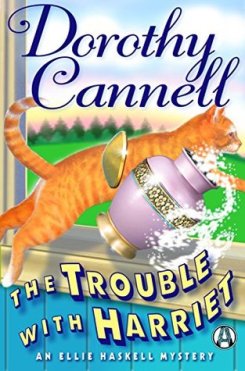 The Trouble with Harriet is different from many cozy mysteries that start with a crime to immediately draw the reader in. Instead the reader is enticed with more personal events—a chance meeting with a gypsy, a prospective getaway trip to France, and the appearance of a surprise visitor.
Replete with quirky characters displaying a flair for the dramatic, this book reads like a play from the era of Arsenic and Old Lace. I can picture cousin Freddy climbing with little ado through the living room window to make his entrance. Ellie’s father possesses a penchant for the dramatic. The Hoppers, who resemble stacking Russian dolls, are the things comedy is made of. The vicar in his dotage who rarely remembers what he should be doing provides all kinds of interesting possibilities. This book is quite enjoyable and would make an amusing theatrical production, featuring a play within a play.
The mystery develops gently during the course of the book, but with the reader unaware of it. It begins simply, but adds complexity as the book progresses. The Trouble with Harriet is an enjoyable book in an enjoyable series.
I would like to extend my thanks to netgalley.com and to Random House (Alibi) for giving me the opportunity to read this book in exchange for an honest review.
Rating: 5/5
Category: Mystery, Historical
Notes: #8 in the Ellie Haskell Mystery Series (which currently has 13 books). In spite of having previously read only #7, I found this book delightful. I’m sure reading the whole series would be fun, but not necessary.
Publication: June 13, 2017—Random House Publishing Group (Alibi)
Memorable Lines:
She had a fatal flaw as a listener. She enjoyed the sound of her own voice.
And the world is filled with qualified interior designers, although possibly not in Chatterton Fells, where people tend to consider switching a picture from one side of the room to another a major renovation.
“You can’t go through life being an irresponsible charmer and not expect impressionable females to fall all over you.” “Sometimes I feel like a pound of bacon during wartime rationing.”
Murder Between the Lines–mystery with a backdrop of women’s suffrage
Murder Between the Lines
by Radha Vatsal
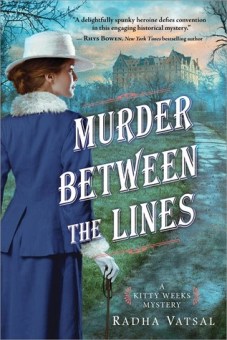 Murder Between the Lines is the second novel by Radha Vassal about Kitty Weeks, a beginning journalist in an age when the rare female journalist is by default a writer for the women’s pages. The setting is 1915-1916, the U.S. has not yet entered the Great War, Woodrow Wilson is president, and women do not have the right to vote.
The “Kitty” in the first third of the book is a flat, undeveloped character. At first I thought this problem was a reflection of the way women were treated by men and by other women as a social norm. Later in the book, however, Kitty takes on some depth as the plot picks up its pace.
There are several plot threads. They deal with women’s suffrage, political intrigue and an anti-war movement, women as journalists, women’s education, Edison’s inventions, and several deaths. The author manages to tie the threads together, but some resolutions seem forced.
The author researched the era well, and the information was interesting. Of particular note was the apparent frailty of the “weaker sex” and doctors’ views on women’s health and recovery from accidents.
It is difficult to sort out attitudes about the characters given the freedoms and responsibilities women in the U.S. have today. Are the women in the book weak or are they victims of the time? I think the answer may be a little of both. Women were generally dependent financially on men, but there have been women of every era who were powerful and knew how to wield that power. In Kitty’s case, she has to break down social barriers to achieve financial independence.
I would like to extend my thanks to netgalley.com and to Sourcebooks (Landmark) for giving me the opportunity to read this book in exchange for an honest review.
Rating: 3/5
Category: Mystery, Historical Fiction
Notes:
1. At the end of the book, the reader will find Author’s Notes that stress the author’s use of primary sources as well as suggestions for further reading.
2. Beautiful cover art!
Publication: May 2, 2017—Sourcebooks (Landmark)
Memorable Lines:
“Half of our population cannot be treated as less than the other. The cause requires publicity as well as a definite program. My program is to champion a federal amendment to the constitution and to use my wealth and my position in society—for in the end, no one turns their back on money—to create news, to create publicity for us all.”
As far as Kitty could tell, men were just as petty as women, but when they didn’t get their way, they didn’t resort to intrigues—they started wars.
When it came to matters he cared about, the president didn’t hesitate for a moment to campaign around the country to sway hearts and change minds. But when it came to woman suffrage, he took refuge behind states’ rights. Somehow, war warranted the exercise of his powers of persuasion, while campaigning for half his citizens’ rights did not. No wonder so many women were enraged. No wonder so many felt they must browbeat and threaten, take matters into their own hands.
Murder in the Dark–at the “Last Great Party”???
Murder in the Dark
by Kerry Greenwood
 I read Murder in the Dark intermittently in the midst of traveling and chaos, but I always looked forward to returning to it and was never disappointed. Invariably, the character of Phryne Fisher as a sleuth is delightful. In this book, the regulars of the series play a role, but a minor one, as little action occurs in Phryne’s home setting, but at an old rented estate where a rich and magnetizing brother and sister are holding what they bill as the Last Great Party of the year. Phryne has been invited to stop a threatened murder of the host. She has also been personally warned away from the affair. Anyone who knows Phryne understands that such threats only serve to ensure her attendance.
These mysterious warnings are entwined with other puzzling events once the weeklong party begins. Phryne must use her deductive and social skills to solve the mysteries. She also enlists the help of a variety of people she encounters, both servants and other guests. The resolutions of the mysteries are surprising and not without action scenes. I love that Phryne spends her spare time at the event reading an Agatha Christie novel.
I would like to extend my thanks to netgalley.com and to Poisoned Pen Press for giving me the opportunity to read this book in exchange for an honest review.
Rating: 4/5
Category: Mystery, Historical Fiction
Notes:
- heavy doses of drug use, sex, and gender transposition
- #16 in the Phryne Fisher Mystery series
Publication: May 2, 2017—Poisoned Pen Press
Memorable Lines:
“Dot has a talent for being happy.”
Phryne didn’t believe in rigid routines. They robbed the day of spontaneity.
Her childhood had been so poor that Phryne still got a vague thrill when she turned on a tap and hot water came out.
Ruddy Gore–a mix of Chinese, Welsh, and Australian
Ruddy Gore
by Kerry Greenwood
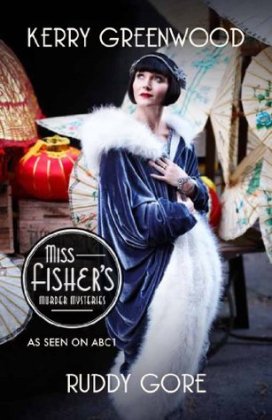 The inimitable Phryne Fisher and her friend Bunji find themselves in the middle of a very physical Chinese family dispute, which is only a subplot in this tale, as they are on their way to the theatre to enjoy a presentation of Gilbert and Sullivan’s comic opera Ruddigore. Following that initial conflict, they make their way to His Majesty’s Theatre in Melbourne, and the reader is presented with the one weak portion of the novel. In the guise of encouraging Bunji, a very minor character in the book, to stay and enjoy the opera, Phryne summarizes the plot of the opera for her. Greenwood is attempting to share background for her unfolding story which centers around an old and a new murder and mysterious occurrences at the “Maj.” Both the cast and the characters they play are important in Ruddy Gore’s storyline, but this portion of the book, really only part of a chapter, was more extensive than necessary.
With the background sufficiently established, the plot moves quickly as Phryne is initially mystified, and then gradually peels off the layers of this puzzle. As always with a Phryne Fisher novel, there are descriptions of her delightful ensembles and her romantic encounters. Dot, her companion, is called in to help with the investigation. Detective Inspector Jack Robinson views Miss Fisher as more likely to obtain information from the cast than he is, and so they cooperate and share information.
The Chinese connection through her love interest, Lin Chung, presents the thread of racial intolerance and prejudice from both sides. Lin and Phryne discuss the history of the Chinese in Australia and how the Chinese have adapted and coped. Phryne is the subject of discrimination herself from the Chinese and handles it well.
Phryne Fisher is undoubtedly rich as evidenced by her spending and lifestyle. She is not selfish, however, and her magnanimity occurs on a personal level. In this story she identifies a situation in which a stage boy with few options but much promise is being abused by his alcoholic father. Phryne doesn’t try to change the world, but she does change this boy’s world by providing him with opportunities. She doesn’t make him a charity case, suggesting that he repay her at a future date. She is also resourceful in engaging the cooperation of others in helping him.
Ruddy Gore is a wealth of incidental information about the theatre, actors, technical people, and management. All of these play a role in the mysteries which are resolved in the end, quite satisfactorily, leaving the reader anticipating further adventures starring Phryne Fisher.
I would like to extend my thanks to netgalley.com and to Poisoned Pen Press for giving me the opportunity to read this book in exchange for an honest review.
Rating: 4/5
Category: Mystery, Historical Fiction
Notes: #7 in Miss Fisher’s Murder Mysteries but reads well as a standalone
Publication: April 4, 2017—Poisoned Pen Press
Memorable Lines:
“He will always get everything that he wants and never get the one thing which he really desires—that’s how it works with bounders,” observed Phryne.
No harm in him but as self-centred as a gyroscope.
“Have you ever heard of hiraeth?” he asked, his eyes staring sadly across endless seas. “No, what is that?” “A Welsh thing, hard to translate. ‘Yearning,’ perhaps. ‘Longing’ is more like it. All of us have it, however happy we are. The yearning for home, even if we shook the dust off our shoes in loathing and swore never to return to the cold damp streets and the cold narrow people and the flat beer and the chapels fulminating endlessly against sin.”
In Farleigh Field–World War II spy novel
In Farleigh Field
by Rhys Bowen
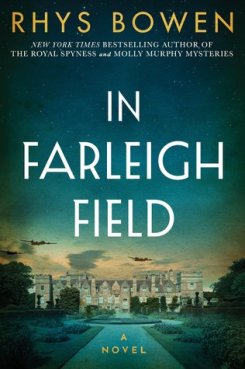 I was late coming to the TV series Downton Abbey, but it is now a fait accompli, and I enjoyed it very much. I found In Farleigh Field by Rhys Bowen to be reminiscent of Downton Abbey in its focus on the titled upper class during the hardships and upheavals of World War II. The plot is not highly complex, but it is interesting as characters of various social ranks use their skills to help England survive the Nazi onslaught.
I have two criticisms of the book. The character of Lady Diana (Dido) repeatedly whines about the war’s hampering her coming of age social season. I suppose a young woman could be that self-centered, but I kept wanting to tell her to grow up and look at the devastation surrounding her. Even her younger sister, Lady Phoebe (Feebs), seems mature, especially in times of crisis, at age twelve compared to her eighteen year old sibling. My other issue with In Farleigh Field is the ambivalence over secrets that are crucial to national security. The rules were emphasized over and over again and then broken on several occasions. At the same time, it seemed that more would be accomplished if branches of government cooperated.
The book does give insight into what it must have been like during World War II in England to work as a civilian for the government. Women were assumed to have secretarial jobs and men were thought to have bravery issues because they were not in the military.
I enjoyed the book, including the spy intrigue. There were surprises that kept the reader engaged, the setting was interesting, and the characters were appropriately either agreeable or unlikable.
I would like to extend my thanks to netgalley.com and to Lake Union Publishing for giving me the opportunity to read this book in exchange for an honest review.
Rating: 4/5
Category: General Fiction (Adult), Women’s Fiction
Notes: World War II era
Publication: March 1. 2017–Lake Union Publishing
Memorable Lines:
“Nasty Americanism, the word ‘weekend,’ ” Lord Westerham remarked. Although he had known Clementine Churchill for many years, he still hadn’t quite forgiven her for being American.
“I said she should have Margot’s bedroom, since she’s not likely to need it, but Pah said that standards had to be kept up, and it was not right for the staff to sleep on the same floor as the family, even if there was a war on.”
It was such a typical thing for someone like Lord Westerham to say. Not admitting that anything was allowed to change, even when the whole world was disintegrating around him.
Blood and Circuses–the smell of the greasepaint, the roar of the crowd…and a murder
Blood and Circuses
by Kerry Greenwood
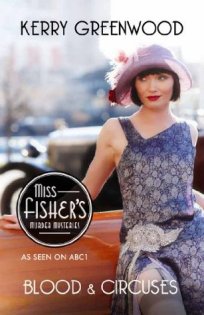 Blood and Circuses is my second foray into Kerry Greenwood’s Miss Fisher’s Murder Mysteries. Phryne Fisher is recruited by some carnival workers to investigate mysterious problems with the circus they work for, a failing endeavor named Farrell’s. The mystery begins commonly enough, but as Phryne goes undercover as a bareback rider, she learns about the stratified and well ordered world of the circus. There, the trapeze artists have the most prestige, carnival workers are second class citizens, and Gypsies are low life.
Meanwhile, Detective Inspector Jack Robinson, Sargeant Terence Grossmith, and Constable Tommy Harris are up to their necks with gangster warfare and the disturbing murder of a circus member known as both Christopher and Christine. The source of these crimes seems to connect with the troubles of the circus, but it is hard to discover just how they are related.
In the process of these investigations, the reader learns more of Phryne’s background–some of the things that helped form her character. Several moral issues are addressed: an audience’s hunger for disaster in the circus ring, the need of people to order their society in classes and then discriminate based on the labels they attach to each group, the disparagement of people who are different with the label of “freak,” and the emotions and needs of those born with a physically inconclusive gender. Phryne faces personal issues when she chooses to live in deprivation, giving up her creature comforts, her safety, and her status in the name of relieving her boredom and helping others.
Blood and Circuses is a convoluted mystery, but all of the plot lines are explained in the end. It is not just an exciting tale of adventure. There are philosophical elements which invite Miss Fisher and the reader to engage in a bit of self-examination without even a touch of preachiness.
I would like to extend my thanks to netgalley.com and to Poisoned Pen Press for giving me the opportunity to read this book in exchange for an honest review.
Rating: 5/5
Category: Mystery, Historical Fiction
Notes: 1. #6 in the series, but could be read as a standalone
2. some bad language and a number of sexual encounters, but the emotions are described more than the physical aspects of the encounters.
Publication: March 7, 2017–Poisoned Pen Press
Memorable Lines:
Sargeant Terence Grossmith was huge. His expanse of blue tunic was as wide as a tent. He had thinning brown hair and large limpid brown eyes, which seemed to hold an expression of such placid benevolence that hardened criminals had occasionally found themselves confessing to him out of a sense of sheer incongruity.
[speaking of Detective Inspector Jack Robinson]…always at the start of a case, he felt downhearted and tired. There was so much evil in the world. “O cursed spite! That ever I was born to set it right,” he quoted to himself. The Mechanics’ Institute English literature classes which his wife had taken him to, much against his will, had been very useful. A man could always rely on Shakespeare to hit the nail on the head. Robinson wondered how he had done without him.
Phryne speaking: “…what’s fascinating about the circus is the people. And I don’t expect you to like them, Dot. They aren’t respectable.” “That’s why you like them,” commented Dot. Phryne looked at her companion’s reflection in the mirror and grinned.
We Were the Lucky Ones–Jewish Family in Poland, WWII
We Were the Lucky Ones
by Georgia Hunter
 We Were the Lucky Ones tells the story of a family of Polish Jews during what was arguably the most difficult time for Jews in European history. This work of historical fiction is written by Georgia Hunter, a descendant who spent years researching, traveling, and interviewing family members to uncover this amazing story of rare survivors. As the author notes, “By the end of the Holocaust, 90 percent of Poland’s three million Jews were annihilated; of the more than thirty thousand Jews who lived in Radom, fewer than three hundred survived.” Although it is fiction, it has been closely based on facts. The author also intersperses short paragraphs summarizing the historical events of World War II as they relate to this family and notes at the beginning of each chapter the date and location of the events in that section. We Were the Lucky Ones begins in March 1939 and concludes in 1947.
The novel moves through history by telling the story of each family member at various times through an excruciating eight year period. Some experience prison and the torture of interrogation; others endure Siberian work camps, life in a Polish ghetto, extermination by pogrom. The family members are subjected to various extremeties: death, disease, starvation, persecution, betrayal. Through all of these trials, one of their greatest pains is not knowing the fate of their loved ones. A constant theme is their unending love of family.
I would like to extend my thanks to netgalley.com and to the Penguin Group (Viking) for giving me the opportunity to read this book in exchange for an honest review.
Rating: 5/5
Category: Historical Fiction, General Fiction (Adult)
Publication: February 14, 2017–Penguin Group (Viking)
Memorable Lines:
But after a few days, they found they had little left to talk about. The chatter ceased and a funerary silence settled upon the train car, like ash over a dying fire. Some wept, but most slept or simply sat quietly, withdrawing deeper into themselves, encumbered by the fear of the unknown, the reality that wherever they were being sent, it was far, far away from home.
And suddenly, the consequences of this war were undeniably real–an understanding that sent Halina spiraling as she wrestled with the knowledge she both feared and loathed: she was powerless.
Nechuma used to reassure herself that they had lived through pogroms before, that in time, the fighting, the bloodshed would pass. But with the news from Lodz she’s come to understand that the situation they are in now is something entirely different. This isn’t just being subjected to profound hunger and poverty. This isn’t persecution. This is extermination.
The Green Mill Murder –witty, sexy, intrepid private eye
The Green Mill Murder
by Kerry Greenwood
 I am delighted to belatedly discover that Miss Fisher’s Murder Mysteries were novels before they were films. Usually I find that in such cases the book is better than the movie. This is true in The Green Mill Murder which is the fifth in the series by this prolific, award winning Australian author. I should add, however, that I have very much enjoyed the films and having seen them added to my ability to visualize the setting and beautiful dresses and accessories that the heroine, Phryne Fisher, wears.
Phryne Fisher is quite a character. She is rich, but down to earth. She shares her wealth and offers personal help to those in need. Her morals are outrageous (in the 1920’s); and although she is clearly a lady, she never lets her gender limit her actions.
The Green Mill Murder has a basic mystery: a man is killed by unknown means in a dance hall during the waning hours of a dance marathon in plain sight. Phryne is there and so is able to help the detective Jack with his investigation. In the process, several more mysteries arise, which include issues of a missing husband, blackmail, and inheritance.
I so enjoyed this mystery starring a witty private investigator who can conceal a flask or a small gun as needed in a sexy outfit one day and fly a Gipsy Moth the next. The Australian English (e.g. collywobbles) and the 1920’s laws and customs add to the interest.
Phryne’s independence is exhilarating, and I look forward to more of her adventures. Greenwood says she will keep writing Miss Fisher mysteries as long as readers want more. Currently there are twenty mysteries in this series, thirteen of which have been made into movies for television.
I would like to extend my thanks to netgalley.com and to Poisoned Pen Press for giving me the opportunity to read this book in exchange for an honest review.
Rating: 5/5
Category: Mystery & Thrillers
Notes: There were various earlier publications of this book
Publication of Current Edition: February 7, 2017–Poisoned Pen Press
Memorable Lines:
“She enjoys bad health, Dot. the woman hasn’t been well since 1915, and she’s as strong as a horse.”
Vic had been delightful, but he and his surroundings were a passion to be indulged in sparingly, like absinthe, which sooner or later sent the drinker mad.
“Oh, how clean I am and how lovely hot water is! Great invention. No wonder the Romans ruled the world.”
 education pathways