
Home » Posts tagged 'God' (Page 4)
Tag Archives: God
Some Golden Daybreak–the Second Coming of Christ
Some Golden Daybreak
by Lee Roberson, D.D.
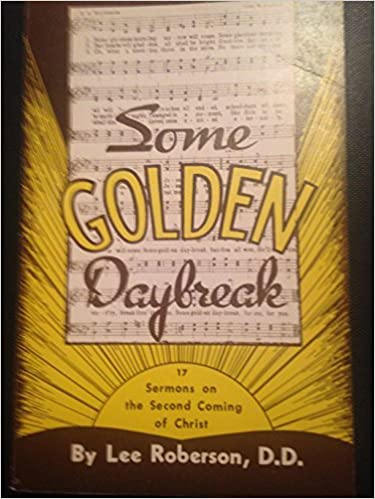
Having worked through two different current Bible studies on the book of Revelation, I came away with more questions than answers. I learned that there are three major perspectives that scholars adopt to address this New Testament book of prophecy. I remember clear teachings when I was a child at Highland Park Baptist Church in Chattanooga, Tennessee, so I searched online for a book by the pastor at that time. On a used book site, I found Some Golden Daybreak, a collection of 17 sermons on the Second Coming of Christ written by Dr. Roberson. Since then, I discovered that Amazon has both paperback and a Kindle version so this book has clearly passed the test of time.
I highly recommend Some Golden Daybreak. Its teachings are based on Scriptures found in both the New and Old Testaments and address such topics as the mark of the beast, Armageddon, and the much debated Great Tribulation. It answered many questions for me satisfactorily. If you have wondered about eternal life and salvation, this book will provide hope, inspiration, and answers.
Rating: 5/5
Category: Christian, Religion
Publication: 1957—Sword of the Lord Publishers
Memorable Lines:
He invites all sinners to come and to drink of the water of life. No one is excluded. All are invited. What is the water of life? It is salvation through faith in Christ. How do we take it? Freely, without money and without price. It is for everyone.
He is coming again. He is coming in power and great glory. The Christ who was prophesied to come as Saviour hundreds of years before He was born; the Christ who walked upon the earth and died upon a cross; the Christ who arose triumphant from the grave; the Christ who ascended back into Glory; the Christ who gave His promise before leaving this earth that He would come again—this Christ is coming.
The more we study the truth of His coming and the more we observe the trends of the times, the more we feel like fervently praying, “Even so, come Lord Jesus.”
Through Gates of Splendor–a call from God
Through Gates of Splendor
by Elizabeth Elliot

Five young men felt God’s call to share the good news of Jesus with an Ecuadoran Indian tribe that had never had positive encounters with outsiders. Their bad experiences date back to the ruthless rubber traders of the 1870’s—“civilized savages against unbaptized savages.” They had Stone Age technology, were feared by other Indians for their unprovoked ambushes, and had a language known only to themselves. The missionaries and their wives had a daunting task. They started by evangelizing more friendly local tribes and establishing bases, many refurbished from areas abandoned by Shell Oil Co. From these bases they did flyovers of the Auca land, first to find where in the jungle the Aucas were living and later to communicate with them by dropping gifts to demonstrate their friendly intentions.
When they felt the time was right, they finalized plans to land and meet with the Aucas in person. The book becomes very intense at that point. After an initial positive meeting, there is literally radio silence instead of the expected call back to the wives. A search and rescue team went in consisting of Ecuadorian military, volunteer missionaries and Indians, and U.S military. It was a dangerous mission.
Although the preparation and action are the basis of the story, the core of the book is faith in God. Elizabeth Elliot, the author of Through Gates of Splendor, was the wife of Jim Elliot, the first missionary of the group to respond to God’s call to contact this people group who had never heard of Him. Jim Elliot was willing to die if need be to share the good news of salvation to the Aucas. He said, “He is no fool who gives what he cannot keep to gain what he cannot lose.” The story of the lives of these young men and their dedication to God is inspiring and many of their notes and thoughts are recorded in this book. In its pages you will see a vivd picture of what God’s call can look like as well as how these missionaries and their wives responded.
Rating: 5/5
Category: History, Christian, Memoir
Notes: The 40th anniversary edition which I read included:
1. Maps
2. Photographs, many taken at great peril by a Life magazine reporter who chose to stay with the search party when he could have returned to the base and safety.
3. Two Epilogues. One was written in 1958 explaining the immediate aftermath of the first contact and one written in 1996 relating the lives of the families as they evolved over the next 40 years.
Publication: Originally 1956
40th anniversary edition in 1996—Living Books (Tyndale)
Memorable Lines:
“If that old engine had quit up there, God alone could have saved me. I might just as well admit it frankly right here; I don’t like to fly over stuff like that and I have to have a pretty good reason to be over it without a good position-check and a good river to identify my position by. But these are people for whom Christ died, and you have to find them before you can take the Gospel to them, so I was happy to have stumbled on them.”
Pete Fleming was one of those who could not be content while the Aucas remained in darkness. In his diary he wrote: “It is a grave and solemn problem; an unreachable people who murder and kill with extreme hatred. It comes to me strongly that God is leading me to do something about it, and a strong idea and impression comes into my mind that I ought to devote the majority of my time to collecting linguistic data on the tribe and making some intensive air surveys to look for Auca houses….I know that this may be the most important decision of my life, but I have a quiet peace about it.
September, 1955, was the month in which Operation Auca really started, the month in which the Lord began to weave five separate threads into a single glowing fabric for His own Glory. Five men with widely differing personalities had come to Ecuador from the eastern United States, the West Coast, and the Midwestern States. Representing three different “faith-missions,” these men and their wives were one in their common belief in the Bible as the literal and supernatural and perfect word from God to man. Christ said “Go ye”; their answer was “Lord, send me.”
Food Triggers–a Godly approach to healthy eating
Food Triggers
by Amber Lia

Amber Lia writes Food Triggers from the perspective of a certified health coach and a Christian. She began her journey to develop healthy eating habits when she was sixty pounds overweight. She views the journey to health as both a physical and a spiritual battle. She began her personal changes with a “medically designed plan” in consultation with a health coach for accountability. She combined that with examining her food triggers one at a time. This book does not tell you what to eat although she clearly avoids sugars and excessive carbs. She intends her book to be read one chapter per day for 31 days. Each chapter addresses a specific motivation or food trigger, some external and some internal.
Lia backs up the information with research and with Scriptures. She encourages the reader to “exchange unhealthy patterns for God-honoring habits.” Some of her chapters resonated with me and others did not apply. She addresses how others can try to sabotage your healthy eating plan and the temptations that may arise when you are in community settings that involve food. There are many difficult areas she addresses including travel, portion control, and boredom. Food Triggers is not a diet plan, but is another tool with insights and practical tips that those struggling with weight loss and/or healthy eating can add to their toolbox.
I received a complimentary copy of this book in exchange for an honest review. Opinions expressed in this review are completely my own.
Rating: 4/5
Category: Nonfiction, Christian
Notes: Although I am in support of portion control, I did not agree with the author’s emphasis on following the serving sizes indicated on packaging. I have always viewed those as the food industry’s efforts to simplify the nutritional labeling. The FDA, however, says that the goal for their newly revised labels is to “bring serving sizes closer to what people actually eat so that when they look at calories and nutrients on the label, these numbers more closely match what they are consuming.” In other words, the serving size is not what people should eat, but what the “average” person consumes. These revised figures have gone up for ice cream, but decreased for yogurt. The government in this case is not leading consumers to healthier eating. You know the old saying, “just because he jumps off a cliff, doesn’t mean you should too.” A good example of that is the marketing of soda in huge cups. Along with that we have a huge increase in obesity and diabetes.
Publication: January 4, 2022—Bethany House (Baker Publishing)
Memorable Lines:
In many ways, our culture has brainwashed us with massive portions and helpings that are, well, NOT helping.
Your health journey will present you with hard choices, and it won’t just be saying no to onion rings—but saying no to people or jobs or places that are not moving you toward God’s best for us.
[part of a prayer from the chapter on holidays] Transform my thinking so that I learn to focus on the people and meaningfulness behind times of celebration, instead of all the things to put in my mouth.
Made to Crave–not a diet plan
Made to Crave: Satisfying Your Deepest Desire with God, Not Food
by Lysa TerKeurst
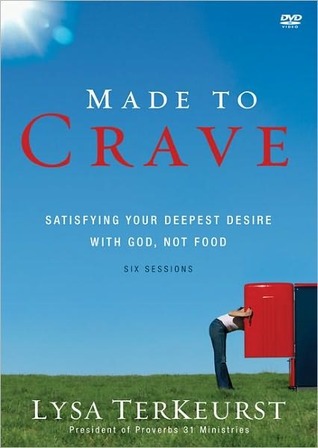
When Lysa TerKeurst decided to get serious about losing weight and keeping it off, she consulted a nutritionist, was given a food plan, had weekly weigh-ins for accountability, and learned a lot about food choices and portions, but all of that is not what her book, Made to Crave, is really about. TerKeurst uses the weight loss challenge as an opportunity to reexamine her relationship with God; what she learned can be applied to other addictions as well. In her introduction she says, “God made us capable of craving so we’d have an unquenchable desire for more of Him, and Him alone. Nothing changes until we make the choice to redirect our misguided cravings to the only one capable of satisfying them. Getting healthy isn’t just about losing weight. It’s not limited to adjusting our diet and hoping for good physical results. It’s about recalibrating our souls so that we want to change—spiritually, physically, and mentally.”
This book is not going to be right for everyone as it tells of TerKeurst’s personal journey. She addresses the problems she confronts like stress eating, being comfortable with your body regardless of your size, and overindulgence. She ties her thoughts into appropriate Scripture references and includes sections at the end that collate the verses into one area according to subject. She also has “Healthy Eating Go-To Scripts” that are self-talk and Scriptures you can use to encourage yourself to stay the course. Each chapter ends with Personal Reflections that reiterate TerKeurst’s theme in that chapter and has questions for thought.
Is this the right book for you? That is a question only you can answer for yourself. As anyone who has ever tried to break the pattern of yo-yo dieting knows, it is not an easy or simple task. I would suggest that it would be one more tool in a Christian’s toolbox when trying to address the complex problem of losing weight. It is not an eating plan or a book that will “fix” your problem. To really work through this process requires soul-searching and hard work.
Rating: 4/5
Category: Christian, Nonfiction, Health
Notes: There is some humor sprinkled through the book. My favorite is her reference to removing her ponytail holder in a desperate attempt to make those scales go down. I can identify in my attempt to attain “data collection consistency,” right?
Publication: 2010—Zondervan
Memorable Lines:
We need a power beyond our frail attempts and fragile resolve. A power greater than our taste buds, hormones, temptations, and our inborn female demand for chocolate. Yes, the truth of who we are and the power to live out that truth—that’s what we need.
But I’ve realized when the desire for treats is triggered by difficult emotions, it’s not really a desire for treats—it’s a thinly veiled attempt at self-medication.
But pity parties are a cruel way to entertain, for they leave behind a deeper emptiness than we started with in the first place.
Love in Plain Sight–learning to trust again
Love in Plain Sight
by Kathleen Fuller
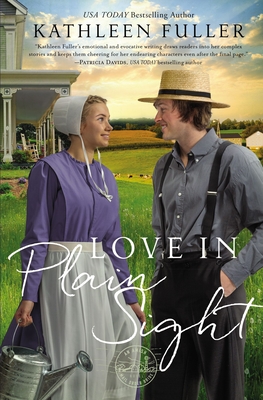
Although Love in Plain Sight is an Amish romance, it is not a sugar coated love story. It addresses two cases of physical and verbal abuse in two different Amish communities—how it affected the victims and how they reacted to it. Along the way though, the reader meets some noble and likable characters. They are people with standards, people you would want to meet. The book does not address abuse from a community standpoint, but from an individual one. The abusers have other character flaws or sins that are intertwined with their abuse—a hunger for money and power. They abound in self-interest and don’t care who gets hurt.
The plot is complex as Katharine decides to flee her abusing fiancée and lies to everyone to protect herself and her parents. She is Amish and finds a job at an Amish inn in a distant town where she is surrounded by loving people. One of them was abused by her husband who has been missing for nine years and is presumed dead. The two women recognize the backgrounds they see in each other. It is difficult for both to move on with their lives. Rhoda is still legally married, and Katharine has major self-esteem issues compounded by the stress of never being able to do anything the way her fiancée wants it done. As a result, she gains weight and her acne worsens causing even more criticism from him.
I started the book one evening and couldn’t wait to resume it the next day. The plot moves quickly, and both plot lines have dramatic conclusions. One of the major themes is forgiveness. Another is trusting God to work out things for good.
There is an amusing thread in the story. An ad has appeared in a number of Amish newspapers inviting young Amish women looking for bachelors to come to the little town of Birch Creek. Katharine chooses to “disappear” in that town, not because she wants a husband, but because there will be so many Amish women arriving that no one will question why she is there. The big question locally is the identity of the ad writer, and the surprising answer emerges at the end of the book.
Kathleen Fuller is not a new author, but this book is a first of her works for me. I recommend this book and look forward to reading more in this series and others by this author.
I received a complimentary copy of this book in exchange for an honest review. Opinions expressed in this review are completely my own.
Rating: 5/5
Category: Romance, Christian
Notes: 1. #3 in the Amish Mail-Order Brides of Birch Creek Series. Although I have not read the first books in the series, I had no problem reading this as a standalone.
- The abuse is not described graphically.
Publication: May 3, 2022—Zondervan Fiction
Memorable Lines:
Despite decades of practice stuffing down her thoughts and feelings to the point where she was numb, fighting the bitterness edging her heart was getting harder.
To cope with his verbal abuse she disappeared into herself until there was nothing but silence in her head replacing his voice. Blissful silence—
“Make sure that the man you marry is gut, kind, and true. Don’t let love blind you to his faults, and don’t compromise yourself to please him. If you do, you’ll lose the person you are, and you’ll live to regret it.”
Seeing Beautiful Again–encouragement
Seeing Beautiful Again
by Lysa TerKeurst

Are you going through a hard time, something that is devastating and you have no control over? Do you wonder if you’ll ever “see beautiful” again? Lysa TerKeurst experienced three of those, two physical and one relational, in a short period of time. She has written several books that describe her journey. In Seeing Beautiful Again, she has drawn from her experiences and writings to compose a devotional book to guide readers through fifty days of their struggle. The goal is to give hope and demonstrate that by clinging to God’s promises, readers can stay the course and trust God.
Seeing Beautiful Again is divided into sections and each section begins with a letter to the reader from author Lysa TerKeurst. Each devotional begins with Scripture and ends with a prayer. In between Lysa shares her thoughts on the topic. These passages sometimes include parts of her personal story and always draw the reader to God’s truth which can be applied to a personal situation.
TerKeurst’s other books like Forgiving What You Can’t Forget examine in depth our response to hurts. This devotional is a daily dose of encouragement to fight the good fight and to remember God’s love and His promises in the middle of the trauma.
I would like to extend my thanks to Edelweiss and to HarperCollins Christian Publishers for giving me the opportunity to read this book in exchange for an honest review.
Rating: 4/5
Category: Religion, Christian Life, Women’s Issues
Notes: Devotional
Publication: March 30, 2021—Harper Collins Christian Publishers
Memorable Lines:
Their victory never hinged on their ability or any of their well-thought-out plans. It was solely dependent on their unwavering obedience offered to a loving and mighty God.
My job is to be obedient to God. God’s job is everything else.
Father God, thank You for reminding me I can trust You in the waiting. I know I can entrust every season of my life into Your hands. Thank You for being present in every moment, strengthening me in the places that I feel inadequate to keep going. When I feel uncertain about what’s ahead, remind me of who You are. I know it will get me through. In Jesus’ name, amen.
The Last Battle–the end
The Last Battle
by C.S. Lewis
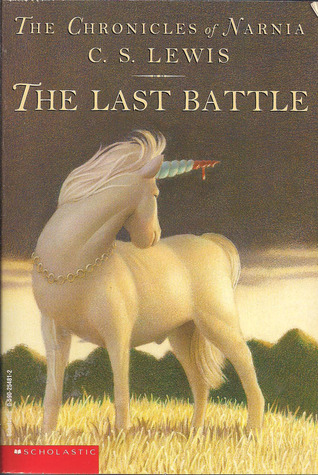
The final installment of The Chronicles of Narnia is as interesting, exciting, and thought provoking as the other six books. I read the last part slowly, eager to know what would happen next but not wanting to arrive at the end of the magnificent tale by C.S. Lewis, the consummate storyteller.
There are many important and timely themes including freedom vs. socialism, manipulation, deception, power and control, sacrifice, good vs. evil, and seeking God. Lewis brings together the characters and elements of all the books into a grand and surprising, but satisfying finale.
There are new characters added to the series. Shift is an ape who keeps Puzzle the donkey controlled by undermining his self-confidence. Old characters are present too as King Tirian calls out to Aslan the lion for help and “the seven friends of Narnia” from our world are whooshed into Narnia where they prepare to do battle against Shift, the Calormenes led by Rishda, and Tash the Calormene god. Shift devises elaborate schemes to deceive the Narnians and convince them that Puzzle, dressed in a lion’s skin and only appearing in the dark, is Aslan. This false Aslan through Shift’s directives is a cruel ruler, unlike the real Aslan. He enslaves the Dwarfs and Talking Horses making them work to accrue wealth for himself. Shift and Rishda convince the Narnian Talking Animals that Tash and Aslan are the same god and that they should now worship “Tashlan.”
Speaking further of the plot would disclose too many events that readers will surely want to discover on their own. The Last Battle is an adventure story replete with easy to understand symbolism and ageless themes. Quoting the last paragraph of the book would be the ultimate spoiler, but don’t fly to it first when you read the book. When you reach the ending, having experienced adventures alongside the characters and learned more of the attributes of the real Aslan, you will smile and savor the thoughts in that last beautifully composed paragraph.
Rating: 5/5
Category: Fiction, Christian
Notes: 1. #7 in The Chronicles of Narnia series. This is the final book in the series and should be read last.
2. This series is often listed as Children’s Fiction, but is really appropriate for all ages with adults reading it on a different level from children. It is perfect for a read-aloud.
3. I can’t believe I had never read the full series. If you are in a similar position, I urge you to delve into this treasure of a series. You will not regret it.
Publication: Original copyright is 1956. My copy was printed by Scholastic in 1995.
Memorable Lines:
“I was with him in his last hour and he gave me this message to your Majesty: to remember that all worlds draw to an end and that noble death is a treasure which no one is too poor to buy.” “So,” said the King, after a long silence “Narnia is no more.”
And then she understood the devilish cunning of the enemies’ plan. By mixing a little truth with it they had made their lie far stronger.
“They will not let us help them. They have chosen cunning instead of belief. Their prison is only in their own minds, yet they are in that prison; and so afraid of being taken in that they cannot be taken out.”
You Were Made for This Moment–the God of great reversals
You Were Made for This Moment
by Max Lucado

Most of us are experiencing the “winter of our discontent” with ever-changing health orders, lockdowns, divisiveness on all fronts, inflation, shortages, and politicians who promise much and do little. Max Lucado has written a book that is very appropriate for these times, You Were Made for This Moment. It focuses on Queen Esther in the land of Persia. Her story is found in the book of Esther in the Old Testament of the Bible. The heroine has concealed her Jewish heritage, but now her people are about to be annihilated. Esther is the only Jew with access, limited as it is, to the throne room of the powerful Xerxes.
In his book, Lucado takes us through this dramatic tale, giving background to make it very understandable and including contemporary anecdotes to point out the relevancy of this situation to crises we might find ourselves in. Sometimes they are humorous, sometimes sad, but always they are pertinent. Both the short book of Esther and You Were Made for This Moment should be on a “must read” list for all as they display how God is always working behind the scenes. Our omnipotent God has power over rulers. We need to be open to what He asks us to do in our circumstances whether the situation looms large or is seemingly minor.
Through fasting and prayer, Esther came to understand that “silence is a form of acquiescence.” Although approaching the throne room uninvited was a potential invitation to death, she followed through to save her people with the famous line, “And if I perish, I perish.” Esther was indeed called for such a time as this.
Long a fan of the courageous Queen Esther, I enjoyed revisiting her story. My faith was confirmed, my attitude refreshed, and my courage bolstered. This is an inspiring book, and Lucado, as always, is a riveting storyteller.
Rating: 5/5
Category: Christian, Inspiration
Notes: 1. Take the time to read Max’s humble “Acknowledgements.” As a writer, he turns a “blah-blah” moment into one that will bring smiles to the hardest heart.
2. The book ends with “Questions for Reflection” prepared by Andrea Lucado. They are designed to accompany each chapter as you read it.
3. I also purchased the study guide, written in workbook format, with different questions from the ones in the book. The guide contains a code that gives streaming access to five videos prepared to accompany You Were Made for This Moment and the study guide. The videos feature Max Lucado as he brings the Esther story to life through a cast of characters simulating a dramatic production of the Esther story. As always, when Lucado speaks, listeners feel like the words are directed at them and for their benefit.
Publication: 2021—Thomas Nelson
Memorable Lines:
Seasons of struggle can be a treacherous time for the human heart. We are sitting ducks for despair and defeat. We turn away from others, turn our backs on God, and turn into fearful, cynical souls. Despair can be a dangerous season. But it can also be a developing time, a time in which we learn to trust God, to lean into his Word and rely on his ways.
God is in the details. He works in the small moments. The insignificant becomes significant because he is ever orchestrating the day-to-day details of innumerable lives through a millennia of time to do what he has foreordained to do.
In God’s hands no script is predictable, no story line is inevitable, no outcome is certain. He is ever a turn of the page from a turn-on-a-dime turnaround….He is the God of grand reversals.
Don’t tell God how big your storm is. Tell the storm how big your God is. Your problem is not that your problem is so big but that your view of God is too small.
When GOD Winks at YOU: How God Speaks Directly to You Through the Power of Coincidence
When GOD Winks at YOU: How God Speaks Directly to You Through the Power of Coincidence
by Squire Rushnell

I used to be intrigued by coincidences, seemingly chance occurrences that draw you to ponder how an event could happen at a certain time and place. As I have experienced these coincidences over the years, I have come to recognize that they do not happen by chance, but are part of the bigger plan of an omniscient, omnipotent, loving God. That idea is what When GOD Winks at YOU is all about, and its subtitle is How God Speaks Directly to You Through the Power of Coincidence.
In this short, inspirational book, Squire Bushnell shares numerous examples of how “Every time you receive what some call a coincidence or an answered prayer, it’s a direct and personal message of reassurance from God to you—what I call a godwink.” The anecdotes feature strangers, family members, friends, and celebrities. They are tales of God working in people’s lives in amazing ways.
The godwink might be an arrangement of events that lead toward a goal or it might be a “message of reassurance” that God sees you, hears you, and is there to support you. It could be an answer to prayer or a guidepost giving you direction.
Some of the stories are sad, some are happy, but all are fascinating. Rushnell, a former television president and CEO, is an excellent writer, taking what could be a long story with a confusing timeline and recording it in a clear, concise, and compelling manner. After introducing the concept of godwinks, the author follows with eight more chapters based on instances of godwinks in various scenarios such as transitions, unanswered prayer, and quests. All are interesting, and I would be hard pressed to pick a favorite as each addresses a different area of concern. Rushnell adds his own brief commentary and interpretation to each chapter very unobtrusively. A feature I enjoyed is a scattering of quotes throughout the book as sidebars. They are short, closely related to the theme, and never interrupt or repeat the text. The content within each chapter flows. Although it could probably be read in one or two sittings, it could also be spaced out into a chapter or even part of a chapter per day. Any way you choose to read When God Winks at You, you will find inspiring reading that will lead you to look for the godwinks, past and present, in your own life.
Rating: 5/5
Category: Christian, Inspirational
Notes: This book is one of many “godwinks” books written by this author. There are ones that focus on specific topics like marriage and prayer and Christmas themed godwinks books. I am interested in reading Dogwinks: True Godwink Stories of Dogs and the Blessings They Bring.
Publication: 2006—Thomas Nelson
Memorable Lines:
Every godwink is another reminder—another small, still message from God—that everything is going to be okay. Someday you will see everything from His perspective, and you’ll understand.
Some people have a divine desire placed into their hearts at a very early age that becomes a beacon to follow like a medieval knight’s quest. God erects signs along the way to guide us on our journey—godwinks to assure us that we are indeed on the right path.
The chain of godwinks that showered peace and forgiveness on two families on opposite sides of the globe is a remarkable tribute to God’s power in each of our lives and how He places signposts of reassurance along the paths of each of our quests.
The First Christmas–Eastern philosophical take on the Nativity story
The First Christmas
by Stephen Mitchell
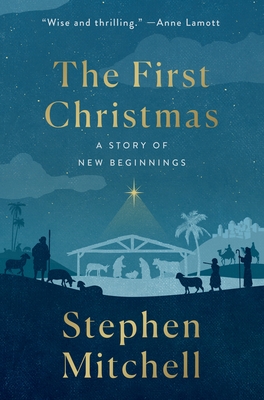
While I am not a theological scholar, I have been a Christian for over sixty years. Those are years in which I have studied the Bible, and God has grown my faith. When the author of this book gives an interpretation that I disagree with, I can accept that as a difference of opinion. An example in Stephen Mitchell’s The First Christmas is the angel Gabriel’s appearance to Mary. In the Bible this event is reported in chapter one of Luke. I believe this account literally, that the angel Gabriel appeared to Mary in a physical form and spoke to her in an audible voice. In fact, there is a dialogue recorded there. The author wants to interpret the appearance as a bright light (“the best I could come up with,” he says) and its communication as “empathy and telepathy,” nothing “so gross as speech.” Based on the writings in Luke, the author is creating a fiction that, though unconfirmed, could have happened. Many describe near death experiences as a comforting, blinding, white light. So, here, the author is using his imagination within the context of an angel visiting Mary.
What is more believable in his telling of the story are the extensive thought processes that Mary must surely have engaged in during the days and months following the angel’s announcement that she had been chosen to bear the Son of God as He comes to Earth in human form. The Bible doesn’t give details of all of her thoughts and feelings, but it does record her song of praise often called The Magnificat (Luke 1:46-55). Luke also shows us that her response is meditative.
There were shepherds who had an angelic visitation. After that they came to worship the baby Jesus, explaining how they found the little family in Bethlehem filled with visitors paying their taxes. “Mary treasured up all these things, pondering them in her heart” (Luke 2:19). Using common sense and based on Biblical evidence that Mary was a reflective person, the inner dialogue the author creates is believable, even if you don’t agree with all the fictional details.
There are some larger issues with this novel, however, that bother me. Mary says “No one had ever prophesied that the Messiah would never die.” This statement skirts the issue that there were many Old Testament prophecies which predict the Messiah would be resurrected to reign in His eternal kingdom. Her statement feels like a deliberate distraction in the text. Author Mitchell is clear that Mary would know the Jewish teachings. Therefore, she would have been aware of the many prophesies that Jesus would be resurrected and sit on the right hand of God the Father (Psalm 110:1). Psalm 49:15 says “But God will redeem my soul from the power of the grave, for He shall receive me.” Interpretations are acceptable, but contradictions are not.
The format of the book is interesting. The author states “my only agenda was to inhabit the characters.” He tries to put himself into an ancient time and experience it as each of the characters in the Nativity story might have. As he looks at the role each person or animal had in this pivotal moment, the author makes the decision to tell the story in the third person for the people and first person for the animals. He separates the chapters with an “Interlude” which is his opportunity to reveal his thoughts as an author and provide some background information. This format (which he explains in an Interlude is based on “the glorified sestet of an Italian sonnet) is a good choice for this book. Unfortunately, the author deviates in the second part of Mary’s story and interrupts the tale as he inserts his “authorial I” into her story rather than waiting for the Interlude. This happens again in Joseph’s story. In general I found Joseph’s tale more convincingly told. Oddly though, Mary and Joseph were approached in the book by angels who were totally different in appearance with Joseph’s angel not even culturally appropriate to the time period.
The section of The First Christmas that tells of the visit of the wise men is an elaborate fictional tale of two Jewish scholars who travel to the East studying Buddhism and other mystic philosophies that concentrate on meditation and finding the god within. It deviates from Scripture in many ways, most notably in the visions of the future of Jesus and his family that the men have as they sit with Mary, Joseph, and baby Jesus. (In the book, they visit the family in the stable whereas most Christians believe this visit occurred somewhat later as the Bible says the wise men or magi went to a house.) If you believe that Jesus is the Son of God and He was with God from before the creation of the world, as set forth in John 1:1-3, then much of this chapter is disturbing. They envision a confused young man, estranged from His family, and perhaps mentally deranged. A reading of any one of the four gospels shows anything but what they see for His future. He was fully man and fully God. Their supposed vision is not in character. They even shortcut and omit important parts of His death, fantasize his burial in a mass grave, and totally neglect His resurrection.
The last major section focuses on the donkey and is my favorite. The donkey tell the Nativity story from his perspective. Recalling ancient donkey traditions, he retells the Biblical story of Balaam’s donkey who could both see angels and could talk. He points out the good qualities of donkeys—intelligence, honesty, service, dignity, and trustworthiness.
I have an admiration for the author as a multi-lingual translator, well-versed in many Eastern religions and philosophies. He possesses a great imagination and makes connections from various works of literature. I hope that he will return to the Bible to connect with Jesus in a personal relationship. I don’t regret reading The First Christmas as an intellectual exercise, but I don’t recommend it as an Advent activity or as a pleasure read.
I would like to extend my thanks to NetGalley and to St. Martin’s Press for giving me the opportunity to read this book in exchange for an honest review.
Rating: 2/5
Category: Religion & Spirituality, General Fiction (Adult)
Publication: November 9, 2021—St. Martin’s Press
Memorable Lines:
[From the chapter Yosef (Joseph)] Where was the Lord now? Not here, not amid this swirling chaos. But if the Lord was not with him, it was his own fault. He knew that. God had not left him; he had left God. It could be no other way.
[From the chapter Yosef—speaking of Maryam (Mary)] She was graced with a quality he had been striving for all his life, ever since he had realized what his purpose, what the purpose of every Jew, was: to love God with all his heart and to fulfill His commandments as impeccably and with as much joy as he could summon.
[From the chapter The Donkey] …throughout the day angels from every order of the hierarchy descending to take a peek at the new little visitor. They don’t knock or announce themselves; they just fly in through the roof or the walls, without so much as a by-your-leave, and nobody greets or even notices them. When they see me, though, they nod to acknowledge my presence and to let me know that they know I know.

