Home » Posts tagged 'Book Review' (Page 6)
Tag Archives: Book Review
A Changed Agent–a good historical romance
A Changed Agent
by Tracey Lyons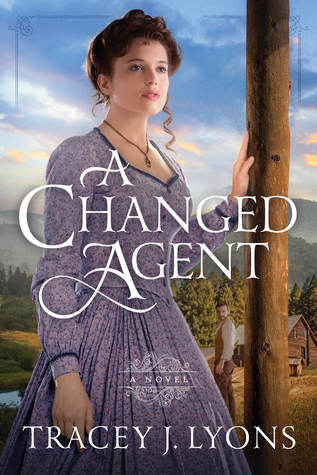
Waterfall Press, a Christian publishing branch of Amazon, released a new historical romance on July 19, 2016. A Changed Agent by Tracey Lyons, who has written a number of historical novels, is well-written and has an engaging storyline and characters. Set in the 1890’s in the Adirondack Mountains of New York, this tale draws together a beautiful and kind schoolteacher, a Pinkerton detective, and his recently orphaned niece and nephew.
The “spinster,” Miss Elsie Mitchell, has strong Christian values and faith and feels led by the Lord to help Will Benton with his new charges as he settles into what she believes is his new job as a lumber foreman in her hometown. There are, of course, relationship issues as these characters come together, and danger bubbles beneath the surface as Will hunts for an unknown railroad bond thief.
Grab a copy of this book if you are looking for a fast-paced read that you won’t want to put down. It has characters you will like, set in a time removed from our age of technology, with enough adventure to transport you out of the confines of your world and back in time to a small town with muddy streets, a saloon with ladies of questionable repute, and an annual church picnic.
I would like to extend my thanks to netgalley.com and to Waterfall Press for the opportunity to read this book in exchange for an honest review.
_________________________________________________________________
Admission: Yes, I left the book cover picture REALLY big because I am a PURPLE freak.
Collision of the Heart–good historical romance
Collision of the Heart
by Laurie Alice Eakes
 Collision of the Heart is a historical romance set in 1856 in frigid winter in Michigan, the author’s home state. Laurie Alice Eakes gives us a story in which the main characters have to ultimately decide if their love for each other is strong enough. Does Mia love Ayden more than the opportunity to become a professional writer? Does Ayden love Mia more than a successful, secure career surrounded by loving extended family? Just when all seems predictable, the author twists the plot twice with surprises.
In Collision of the Heart, Eakes uses words as brush strokes with her well written descriptions of cold winter nights that draw the reader in to experience the evenings as the characters do. For example, Eakes writes of an upset Ayden that “His footfalls crunched on the frozen snow, loud in the quiet of the night.” The author arouses our senses with “The wind carried the scent of wood smoke with its promise of warm fires, hot soup, and hotter coffee.” In another passage, the author uses repetition of “ached” to good advantage to drive home both the thoughts and emotions of Ayden as he tries to work through his feelings for Mia.
Collision of the Heart is an easy going, enjoyable romance which captures the reader’s interest immediately with a train wreck, leaving passengers hurt and stranded in a small town for many days. We witness the kind and generous responses of most of the townspeople and follow the intrigue of an abandoned child. I recommend this book which will be released by Waterfall Press on August 23, 2016.
I would like to extend my thanks to netgalley.com and to Waterfall Press for the opportunity to read this book in exchange for an honest review.
From the Sideline–chick lit for football illiterates
From the Sideline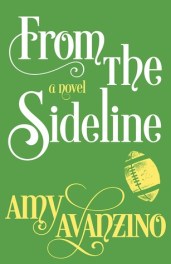
by Amy Avanzino
From the Sideline is the second book in The Wake-Up Series by Amy Avanzino. Many reviewers praised the first book, Wake-Up Call, as a very funny novel. This is confusing because From the Sideline has humorous notes and certainly moments I can relate to, but they are more than balanced out by the difficulties, past and present, of the main character, Autumn Kovac. In fact, the major problems in the lives of Autumn and her son Zachery are rather dark. My other point of confusion is that Wake-Up Call’s main character is Sarah Winslow, not Autumn Kovac. While it is fine to write a series based on a theme rather than a character, there is a supporting character named Sarah (no last name given) in From the Sideline. I guess I will have to read Wake-Up Call to find out if it is the same Sarah and to read a book with a more generous serving of humor.
From the Sideline combines a number of themes. It focuses on an overly protective single mom, a survivor of several abusive situations, whose awkward, intelligent, and bullied son wants to play football. Autumn Kovac receives an in-depth, rapid introduction to youth football: terminology that seems like a foreign language, coaches who range from caring mentors to frustrated men trying to recapture the glory days of promising sports careers, enthusiastic football moms and dads, and pressured players who are really just kids who want to play.
Another theme is, of course, one that most people experience–the wake-up call. Bad habits and ways of responding to others creep up on us, and Autumn learns to recognize that as well as how to disengage herself and make healthier choices.
Although circumstances vary, most women can probably identify with some parts of this story and engage with the main character who, like all of us, has some difficult choices to make. It’s “chick lit,” and while I enjoyed this book as an entertaining read, I came away with food for thought as well.
I extend my thanks to NetGalley and the publisher Henery Press for the opportunity to read this book in exchange for an honest review.
Blood Brothers–a Satisfying Read
Blood Brothers
by Rick Acker
Satisfying. Blood Brothers by Rick Acker is satisfying. That may not sound like much of a compliment, but it really is–the same way that an excellent meal is satisfying. When I finished the book, I found the ending had come at the right time and in the right way without being predictable. Through Acker’s writing I had experienced just the right amount of excitement and intrigue within a framework of our legal and investigative systems and a background of scientific research. There was even a touch of history and the romance of a foreign country.
When I reviewed Acker’s book Dead Man’s Rule, I mentioned that the main character’s wife, Noelle, had only a minor role and was not well-developed. That deficit was rectified in this novel as Noelle is presented as a three-dimensional character adding realism to the novel.
Blood Brothers deals to a great degree with relationships–mainly focusing on two rich brothers, Karl and Gunner, at odds over control of their pharmaceutical company and also on lawyer Ben Corbin and his spouse Noelle. Private investigator Sergei Spassky, who is a new Christian, has to confront his feelings for FBI agent Elena Kamenev, a nonbeliever who shares his Russian heritage. Together they have to face the ramifications of very different religious beliefs.
The intricacies of the lawsuit and countersuit were handled well including the reactions of a fairly new judge and the chosen jury. Insights into the science trials were also interesting and included one loose end (a mistake made by a summer intern) that surprisingly was not included in the book’s resolution. I appreciated the brief afterword containing nonfiction information related to some of the technical aspects of the book. I definitely advise reading it after you finish the book, however, as reading it in advance would spoil the story for you.
Rick Acker has written three legal thrillers for adults and two detective mysteries intended for a younger audience, but as is often the case with a well-written book for youth, several reviewers also recommend them for a fun read for adults. I definitely was not disappointed by Blood Brothers, the second of Acker’s engaging tales for me and certainly not the last.
I would like to extend my thanks to netgalley.com and to Waterfall Press for the opportunity to read this book in exchange for an unbiased review.
Reflections on What Comes Around–with Content Warning!
What Comes Around
by Adair Sanders
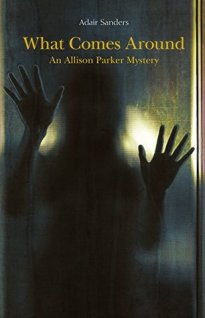 In the interest of full disclosure, I need to say that I went to school with the author and I really wanted to like this book as much as I did her two previous books: As Sick as Our Secrets, the first in the Allison Parker Mystery Series and Biologically Bankrupt…Sins of the Father, a sad, autobiographical work. What Comes Around is the second in her mystery series. I think Sanders is a good writer: in terms of plot, characters, etc, I can easily award this book four stars (out of five). The first chapter is particularly well written and drew me into the rest of the tale.
My reticence in wholeheartedly recommending What Comes Around centers on its graphic descriptions of sexual violence. Everyone has a personal tolerance level for various aspects of fiction–horror, violence, even romance. I personally find this level of detail disturbing, but another reader may see its role in What Comes Around as essential to character and plot development.
Kudos to Adair Sanders who completed a successful law career and has jumped into a second successful career as a writer. I look forward to reading more of the Allison Parker Mystery Series.
Review of The Discovery Saga Collection
The Discovery Saga Collection: A 6-Part Series from Lancaster County
by Wanda E. Brunstetter
At some point in time, I got on Wanda Brunstetter’s email list and received a free download of The Discovery Saga Collection which was initially released as a series of six books. It recently struck my fancy to read it. I found it to be basically a sweet book, focusing on the power of being kind to others.
The setting of The Discovery Saga Collection is “Amish country” as that culture and religion holds a fascination for the author. I found the first part of the saga very slow paced as Brumstetter tells the story alternately through the thoughts of the husband and wife and their reflections are very similar (i.e. repetitive). The plot picks up pace and interest at the end of the first part.
Brumstetter creates interesting characters and a fascinating, difficult situation that involves many characters and their relationships. I did want to read to the end to discover the resolution of the various conflicts, and I got the ending I wanted–sort of. Without spoiling the book, let me say that I liked the characters’ reliance on God and the book’s use of Scripture as well as a liberal sprinkling of Pennsylvania Dutch in the dialogues. I found many aspects of the book simplistic and unrealistic. If you long for a very clean novel with some romance, a tidbit of action, and a focus on the faith of the Amish as well as other Christians, you will be pleased with this laid-back novel.
A Killer’s Guide to Good Works–a cozy that tries too hard
A Killer’s Guide to Good Works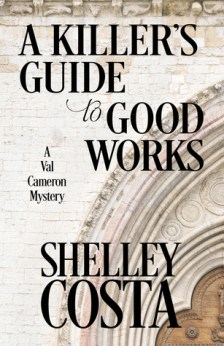
by Shelley Costa
I struggled a little with why I did not like the second book in the Val Cameron Mystery Series as much as I liked the first. Lest you dismiss this book out of hand, please hear me out. At no point did I entertain the idea of not finishing the book. I wanted to watch the main character, Val Cameron, discover who murdered her best friend Adrian. I could, however, put this book aside temporarily without regret–not a good sign.
A lot of A Killer’s Guide to Good Works seems forced (as does the title); I can see the author’s hand too much. I was put off by Shelley Costa’s too frequent usage of unfamiliar words or phrases, some of which are not used to best advantage. For example, the main character feels a “little frisson” three times in the course of the book. My distaste for the author’s application of her obviously extensive vocabulary is ironic because I love learning new words. Her manipulation of the characters within her plot structure are also too obvious.
I particularly enjoyed the character Tali, a young, orthodox Jewish teenage girl of independent and perceptive mind. Although her role is minor, she adds spice and a little humor. There is also a character who is a Jewish professor. In sections involving these characters, there are a number of Hebrew words. These references added interest for me and their usage seemed natural.
The weakest part of this plot is the cult that is the center of the mystery. The fifty handpicked, highly educated followers are known as the High Council. They seem unaware of the cult doctrine which, besides the basic principle, is never actually expanded on for the reader either. I find that an unbelievable scenario. Costa presented no persuasive information to convince me that these people would follow their leader Animus, the “soul of their secret organization,” without questioning the soundness of his unorthodox and esoteric philosophy.
There are definitely gaps in this story for the reader to complete. On the other hand, there are some interesting characters and good twists to the mystery. One of the perks of A Killer’s Guide to Good Works is the further development of Val Cameron’s persona and the introduction of Greta, the aunt who raised her. I liked the first book in the series well enough to give the author the benefit of the doubt and read a third before making a judgement about the series.
I would like to extend my thanks to netgalley.com and to Henery Press for the opportunity to read this book in exchange for an unbiased review.
Dead Man’s Rule–Great Legal Thriller
Dead Man’s Rule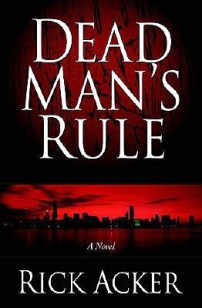
by Rick Acker
Some of the first comments I read about Rick Acker’s legal thrillers compared his work to that of John Grisham. I, along with many other more qualified critics, consider Grisham to be in the top in his genre. I snickered a little at this appraisal of Acker and said to myself, “Well, that’s a little overblown.” I am currently chewing away at my naysaying words. Grisham and Acker both write legal thrillers with interesting characters, exciting action, strong plot lines, and details arising from effective background research. The legal situations are integral to the plot, not inserted as an afterthought because the author is also a lawyer. Acker is not an imitator of Grisham; in fact, Acker is an excellent writer in his own right. There is always room for another good suspense writer!
Dead Man’s Rule had my attention right from the prologue, “A Relic of War,” which is not a typical background piece. It pushes the reader into the story, ready or not. The setting changes in the first chapter to Ben Corbin’s legal offices but the interest level doesn’t change, and immediately the reader begins mentally searching for the connection.
I like it when the main character is human (flawed but trying) and likable, and Ben Corbin fits into that category. If there is a weak character as far as the writing goes, it is found in the depiction of Ben’s wife, Noelle. She is two-dimensional in a world of three-dimensional characters, but her role in the novel is fairly small.
The archvillain, General Elbek Shishani, is fleshed out by Acker so that he is not just some “bad guy” to be dealt with by the hero and his CIA and FBI associates. The reader will probably not approve of Shishani’s actions, but the author does share how he became who he is.
Reader, be prepared to learn about legal procedures and an arcane law that becomes critical to one of Corbin’s cases. Acker avoids getting too technical so the read remains exciting, but the reader can understand all of the legal complications and how they affect both the innocent and the guilty. He also takes us into the world of bioterrorism and Russian and Chechen politics as well as the sometimes competing interests of the various law enforcement and investigative agencies in the U.S.
Dead Man’s Rule is my first experience with Rick Acker’s writing, but he has published four more suspenseful books. I can’t wait to try another. If it is like Dead Man’s Rule, I’ll have trouble putting it down.
I extend thanks to netgalley.com and to Waterfall Press for the opportunity to read this book in exchange for an unbiased review.
Leaving Independence–Western Romance
Leaving Independence 
by Leanne Wood Smith
Having just read and reviewed an emotionally difficult nonfiction book, I was ready for something lighter, but engaging. I found just what I was looking for in Leaving Independence by Leanne Wood Smith. Independence is the name of the town the Baldwyn family, composed of Abigail and her four children, travels to as the departure point for a wagon train going west. In an odd turn of events, the father of the family had been reported dead during the early days of the Civil War, but the war is now over and she receives word that he is serving at Fort Hall in the Idaho territory. Abigail is confused that he did not contact her personally, and the family is low on funds with the bank threatening repossession of their home. A woman of action, she takes her family in search of her missing husband.
There are background stories related to the social and political events surrounding the Civil War and Reconstruction. Abigail’s friend and former slave, Mimi, is unable to accompany the family on the trip. The author tells the story with third person narrative and through pieces of letters that Mimi and Abigail exchange during the trip. She creates an interesting tale with a combination of history, mystery, and romance. I found the dialogue to be reflective of the characters and the time except for one anachronism. As the family makes preparations to leave Independence, the teenage daughter, Corrine, is not happy about the trip. Her mother tells her “you’ll have a much better trip if you decide now to embrace this experience.” “Embrace this experience” strikes me as a modern phrase and not one that is typical of 1866. The use of this one expression does not ruin the novel for me, and I do recommend it to do what books do best–help you escape into a different time and place.
I would like to thank netgalley.com and Waterfall Press for the opportunity to read this book in exchange for an unbiased review.
Saving Graces–Review AND Reflections
Saving Graces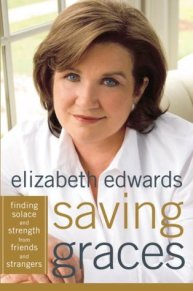
by Elizabeth Edwards
Elizabeth Edwards was the wife of John Edwards, a Democratic senator, an unsuccessful presidential primary candidate in 2004 and 2008, and running mate for John Kerry in the 2004 presidential election. Elizabeth was a popular and sympathetic public figure because of the death of her son at age sixteen in a car accident, her courageous battle with breast cancer, and revelations of her husband’s ongoing affair during her health struggles.
Elizabeth Edwards published the book Saving Graces in 2006, two years after she was diagnosed with cancer and the same year her husband began his infamous affair with Rielle Hunter, which he did not publicly admit to until August of 2008. I am laying out the dates carefully because I found it a bit confusing as Edwards begins telling her story at the same place in her life that she ends this book. Also, because she was such a family-oriented person, I had to wonder at what point in her painful saga was she unknowingly being betrayed by her husband. There is no foreshadowing of the affair.
No spoiler alert is needed on this review. Edwards in this memoir is sharing very personal insights into the events of her life up through the close of her treatment for the cancer that was discovered in November of 2004. The facts along with all the rumors of the time are readily available on the Internet.
I must warn potential readers that the first half of this book is a very difficult read. Most of it deals with the very raw grief which Edwards and her family experienced upon the sudden and unexpected death of her sixteen year old son Wade in a car accident. Although the distance of time helps, when she wrote the book she was still experiencing deep sorrow over his absence. Although Elizabeth Edwards worked as a lawyer, author and speaker, the job that was most important to her was that of mother. She loved the presence of her children and their friends filling her home. She loved interacting with them. When Wade died she seemed to lose a part of herself, of her reason for living. I hope the writing of this book proved cathartic for her. Her grief is so real and so painful that I had to put it aside for a few days.
Upon returning to Saving Graces I was relieved to find a turn of focus away from the pain of Wade’s death and toward the future as Elizabeth and John Edwards decide to extend their family and continue to be deeply involved in political races. Even reading about her first battle with cancer was not as painful as the discussion of the aftermath of her son’s death. Though fearful of losing to breast cancer, Edwards knew it was something she could fight. Speaking of the diagnosis she said “…it wasn’t, by a sad and huge distance, the worst news we had ever heard. Wade’s death had spared us that…”
As the United States is currently pushing toward presidential elections, I found glimpsing the campaigns from behind the scenes to be an interesting endeavor. It made me like Elizabeth Edwards better and most of the rest of the political players and the process even less. That outcome was certainly not Edwards’ intention or attitude in writing, but I am too jaded to view the political process through her rose-colored glasses of “John (Edwards) just wants to help people” (not a direct quote, but a phrase that certainly reflects her thoughts). In my opinion, based on later evidence available after this book was written, John Edwards had one goal–to enrich himself. His desires were for money, power, sex, and the flattery of younger women. During the last half of the book, I kept wanting to yell across the pages to Elizabeth that she was living in a house of cards about to collapse on her. I wanted to warn her that her wonderful family man was going to cheat on her, destroying the family she adored so much. I wanted to shout out a danger signal–this man you thought you could count on is going to pay you the ultimate disrespect while you are on the campaign trail telling others how wonderful he is.
Saving Graces has a very appropriate subtitle: Finding Solace and Strength from Friends and Strangers. In the first half of the book, the solace and strength come from others who have lost children. In the second part, she shares the outpouring of love and concern she received when she publicly announced her battle with cancer.
Elizabeth Edwards wrote another book, Resilience: Reflections on the Burdens and Gifts of Facing Life’s Adversities, which continues her story including the return of cancer and the Hunter affair. Although Edwards is a good writer and I sympathize with the tremendous pain she endured physically, mentally, and emotionally, I just don’t know if I will choose to read her detailing of it in Resilience. It seems bad enough that she had to live it.
 education pathways