
Badges
Review of The Discovery Saga Collection
The Discovery Saga Collection: A 6-Part Series from Lancaster County
by Wanda E. Brunstetter
At some point in time, I got on Wanda Brunstetter’s email list and received a free download of The Discovery Saga Collection which was initially released as a series of six books. It recently struck my fancy to read it. I found it to be basically a sweet book, focusing on the power of being kind to others.
The setting of The Discovery Saga Collection is “Amish country” as that culture and religion holds a fascination for the author. I found the first part of the saga very slow paced as Brumstetter tells the story alternately through the thoughts of the husband and wife and their reflections are very similar (i.e. repetitive). The plot picks up pace and interest at the end of the first part.
Brumstetter creates interesting characters and a fascinating, difficult situation that involves many characters and their relationships. I did want to read to the end to discover the resolution of the various conflicts, and I got the ending I wanted–sort of. Without spoiling the book, let me say that I liked the characters’ reliance on God and the book’s use of Scripture as well as a liberal sprinkling of Pennsylvania Dutch in the dialogues. I found many aspects of the book simplistic and unrealistic. If you long for a very clean novel with some romance, a tidbit of action, and a focus on the faith of the Amish as well as other Christians, you will be pleased with this laid-back novel.
Dual Purpose Blog?
 If you have been following my blog, you may have noticed a gradual transition from a focus on educational issues to a focus on book reviews. Actually I have not dropped my interest in developmentally appropriate education, and you will continue to see posts on that topic in the future.
I began “Education Pathways” when I retired from teaching and still had a lot to say about education. As I read the blogging efforts of others, I discovered many (mostly retired) educators saying a lot of the same things that I was saying. Suddenly I was not the lone voice speaking up for children. What happened? Part of the reason for this phenomena was certainly that I had more time to read when I was not wasting time trying to please administrators who had really strange ideas, provided for the most part by highly profitable businesses, about what is good for children. The other big factor is that a large number of frustrated teachers with lots of years of experience all said “No!” at about the same time: “No, we will not go down this insane path that is damaging to children any more.” With retirement, we found our voice because we no longer were threatened and intimidated by our employers. The result was a huge increase in the anti-CCSS (Common Core State Standards), anti-overtesting, anti-VAM (Value Added Model of teacher evaluation) blogging world.
At about the same time, I moved to Mexico (mostly) and discovered netgalley.com* which lets me preview books written in English, in an electronic format, for publishers in exchange for reviews. After a few rusty efforts, I began flexing my critiquing joints and discovered that I really like recording my thoughts about books. So, I set out on a different education pathway that involves reading and which I think intertwines quite nicely with my original focus of developmentally appropriate education.
 In the future you will see posts about education and reviews of books for children with discussions of how they might be used with children. You can also expect reviews of books for adults which are soon to be released as well as a few from my own collection or e-books from the Gutenberg Project. My reviews contain little in the way of summaries. Those are readily available from the publisher, online bookstores, and Goodreads. I prefer instead to present my personal reflections on and reactions to a book. Since I can choose my reading material, I will only choose books I think I will like. For example, I won’t be reading and reviewing a horror novel, but suspense and mystery will certainly have a place. Please join me in the world of books as I continue the education that never ends.
*Many thanks to my daughter Tara for introducing me to netgalley.com. She immediately recognized the problem I would have in Mexico of feeding my reading addiction and provided such a wonderful solution which has blossomed into reviewing as well.
A Killer’s Guide to Good Works–a cozy that tries too hard
A Killer’s Guide to Good Works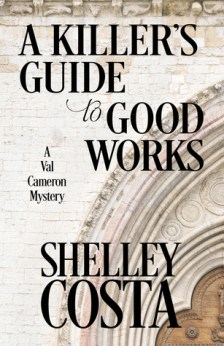
by Shelley Costa
I struggled a little with why I did not like the second book in the Val Cameron Mystery Series as much as I liked the first. Lest you dismiss this book out of hand, please hear me out. At no point did I entertain the idea of not finishing the book. I wanted to watch the main character, Val Cameron, discover who murdered her best friend Adrian. I could, however, put this book aside temporarily without regret–not a good sign.
A lot of A Killer’s Guide to Good Works seems forced (as does the title); I can see the author’s hand too much. I was put off by Shelley Costa’s too frequent usage of unfamiliar words or phrases, some of which are not used to best advantage. For example, the main character feels a “little frisson” three times in the course of the book. My distaste for the author’s application of her obviously extensive vocabulary is ironic because I love learning new words. Her manipulation of the characters within her plot structure are also too obvious.
I particularly enjoyed the character Tali, a young, orthodox Jewish teenage girl of independent and perceptive mind. Although her role is minor, she adds spice and a little humor. There is also a character who is a Jewish professor. In sections involving these characters, there are a number of Hebrew words. These references added interest for me and their usage seemed natural.
The weakest part of this plot is the cult that is the center of the mystery. The fifty handpicked, highly educated followers are known as the High Council. They seem unaware of the cult doctrine which, besides the basic principle, is never actually expanded on for the reader either. I find that an unbelievable scenario. Costa presented no persuasive information to convince me that these people would follow their leader Animus, the “soul of their secret organization,” without questioning the soundness of his unorthodox and esoteric philosophy.
There are definitely gaps in this story for the reader to complete. On the other hand, there are some interesting characters and good twists to the mystery. One of the perks of A Killer’s Guide to Good Works is the further development of Val Cameron’s persona and the introduction of Greta, the aunt who raised her. I liked the first book in the series well enough to give the author the benefit of the doubt and read a third before making a judgement about the series.
I would like to extend my thanks to netgalley.com and to Henery Press for the opportunity to read this book in exchange for an unbiased review.
Teaching: Hollywood Image vs. Reality
Get past the probably well deserved rant against TFA and read what teaching is REALLY like.

Dennis Ian, a regular reader and commenter on the blog, writes here about Teach for America:
Teach for America … little more than camp counselors without the pine trees on their shirts.
Imagine for a moment the instant promotion of butchers to surgeons … or deck builders to bridge engineers. Imagine Cub Scout troop leaders as military generals … or menu makers as the next classic authors.
Like any job, teaching is layered with misconceptions … and it’s further distorted by Hollywood fantasies.
Everyone is so seduced by Hollywood and tv-land that they actually think they could sail right into a classroom and every kid would sing the theme song of “To Sir, with Love”. And the world would cry because of their greatness.
Everyone seems to see that “To Sir, With Love” guy winning over the thuggery class and becoming a revered legend overnight. Or that Mr. Chips who…
View original post 688 more words
Dead Man’s Rule–Great Legal Thriller
Dead Man’s Rule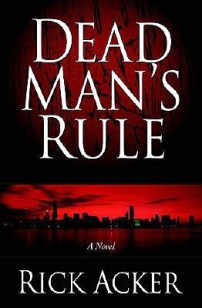
by Rick Acker
Some of the first comments I read about Rick Acker’s legal thrillers compared his work to that of John Grisham. I, along with many other more qualified critics, consider Grisham to be in the top in his genre. I snickered a little at this appraisal of Acker and said to myself, “Well, that’s a little overblown.” I am currently chewing away at my naysaying words. Grisham and Acker both write legal thrillers with interesting characters, exciting action, strong plot lines, and details arising from effective background research. The legal situations are integral to the plot, not inserted as an afterthought because the author is also a lawyer. Acker is not an imitator of Grisham; in fact, Acker is an excellent writer in his own right. There is always room for another good suspense writer!
Dead Man’s Rule had my attention right from the prologue, “A Relic of War,” which is not a typical background piece. It pushes the reader into the story, ready or not. The setting changes in the first chapter to Ben Corbin’s legal offices but the interest level doesn’t change, and immediately the reader begins mentally searching for the connection.
I like it when the main character is human (flawed but trying) and likable, and Ben Corbin fits into that category. If there is a weak character as far as the writing goes, it is found in the depiction of Ben’s wife, Noelle. She is two-dimensional in a world of three-dimensional characters, but her role in the novel is fairly small.
The archvillain, General Elbek Shishani, is fleshed out by Acker so that he is not just some “bad guy” to be dealt with by the hero and his CIA and FBI associates. The reader will probably not approve of Shishani’s actions, but the author does share how he became who he is.
Reader, be prepared to learn about legal procedures and an arcane law that becomes critical to one of Corbin’s cases. Acker avoids getting too technical so the read remains exciting, but the reader can understand all of the legal complications and how they affect both the innocent and the guilty. He also takes us into the world of bioterrorism and Russian and Chechen politics as well as the sometimes competing interests of the various law enforcement and investigative agencies in the U.S.
Dead Man’s Rule is my first experience with Rick Acker’s writing, but he has published four more suspenseful books. I can’t wait to try another. If it is like Dead Man’s Rule, I’ll have trouble putting it down.
I extend thanks to netgalley.com and to Waterfall Press for the opportunity to read this book in exchange for an unbiased review.
Leaving Independence–Western Romance
Leaving Independence 
by Leanne Wood Smith
Having just read and reviewed an emotionally difficult nonfiction book, I was ready for something lighter, but engaging. I found just what I was looking for in Leaving Independence by Leanne Wood Smith. Independence is the name of the town the Baldwyn family, composed of Abigail and her four children, travels to as the departure point for a wagon train going west. In an odd turn of events, the father of the family had been reported dead during the early days of the Civil War, but the war is now over and she receives word that he is serving at Fort Hall in the Idaho territory. Abigail is confused that he did not contact her personally, and the family is low on funds with the bank threatening repossession of their home. A woman of action, she takes her family in search of her missing husband.
There are background stories related to the social and political events surrounding the Civil War and Reconstruction. Abigail’s friend and former slave, Mimi, is unable to accompany the family on the trip. The author tells the story with third person narrative and through pieces of letters that Mimi and Abigail exchange during the trip. She creates an interesting tale with a combination of history, mystery, and romance. I found the dialogue to be reflective of the characters and the time except for one anachronism. As the family makes preparations to leave Independence, the teenage daughter, Corrine, is not happy about the trip. Her mother tells her “you’ll have a much better trip if you decide now to embrace this experience.” “Embrace this experience” strikes me as a modern phrase and not one that is typical of 1866. The use of this one expression does not ruin the novel for me, and I do recommend it to do what books do best–help you escape into a different time and place.
I would like to thank netgalley.com and Waterfall Press for the opportunity to read this book in exchange for an unbiased review.
Saving Graces–Review AND Reflections
Saving Graces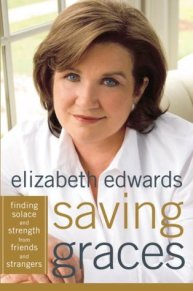
by Elizabeth Edwards
Elizabeth Edwards was the wife of John Edwards, a Democratic senator, an unsuccessful presidential primary candidate in 2004 and 2008, and running mate for John Kerry in the 2004 presidential election. Elizabeth was a popular and sympathetic public figure because of the death of her son at age sixteen in a car accident, her courageous battle with breast cancer, and revelations of her husband’s ongoing affair during her health struggles.
Elizabeth Edwards published the book Saving Graces in 2006, two years after she was diagnosed with cancer and the same year her husband began his infamous affair with Rielle Hunter, which he did not publicly admit to until August of 2008. I am laying out the dates carefully because I found it a bit confusing as Edwards begins telling her story at the same place in her life that she ends this book. Also, because she was such a family-oriented person, I had to wonder at what point in her painful saga was she unknowingly being betrayed by her husband. There is no foreshadowing of the affair.
No spoiler alert is needed on this review. Edwards in this memoir is sharing very personal insights into the events of her life up through the close of her treatment for the cancer that was discovered in November of 2004. The facts along with all the rumors of the time are readily available on the Internet.
I must warn potential readers that the first half of this book is a very difficult read. Most of it deals with the very raw grief which Edwards and her family experienced upon the sudden and unexpected death of her sixteen year old son Wade in a car accident. Although the distance of time helps, when she wrote the book she was still experiencing deep sorrow over his absence. Although Elizabeth Edwards worked as a lawyer, author and speaker, the job that was most important to her was that of mother. She loved the presence of her children and their friends filling her home. She loved interacting with them. When Wade died she seemed to lose a part of herself, of her reason for living. I hope the writing of this book proved cathartic for her. Her grief is so real and so painful that I had to put it aside for a few days.
Upon returning to Saving Graces I was relieved to find a turn of focus away from the pain of Wade’s death and toward the future as Elizabeth and John Edwards decide to extend their family and continue to be deeply involved in political races. Even reading about her first battle with cancer was not as painful as the discussion of the aftermath of her son’s death. Though fearful of losing to breast cancer, Edwards knew it was something she could fight. Speaking of the diagnosis she said “…it wasn’t, by a sad and huge distance, the worst news we had ever heard. Wade’s death had spared us that…”
As the United States is currently pushing toward presidential elections, I found glimpsing the campaigns from behind the scenes to be an interesting endeavor. It made me like Elizabeth Edwards better and most of the rest of the political players and the process even less. That outcome was certainly not Edwards’ intention or attitude in writing, but I am too jaded to view the political process through her rose-colored glasses of “John (Edwards) just wants to help people” (not a direct quote, but a phrase that certainly reflects her thoughts). In my opinion, based on later evidence available after this book was written, John Edwards had one goal–to enrich himself. His desires were for money, power, sex, and the flattery of younger women. During the last half of the book, I kept wanting to yell across the pages to Elizabeth that she was living in a house of cards about to collapse on her. I wanted to warn her that her wonderful family man was going to cheat on her, destroying the family she adored so much. I wanted to shout out a danger signal–this man you thought you could count on is going to pay you the ultimate disrespect while you are on the campaign trail telling others how wonderful he is.
Saving Graces has a very appropriate subtitle: Finding Solace and Strength from Friends and Strangers. In the first half of the book, the solace and strength come from others who have lost children. In the second part, she shares the outpouring of love and concern she received when she publicly announced her battle with cancer.
Elizabeth Edwards wrote another book, Resilience: Reflections on the Burdens and Gifts of Facing Life’s Adversities, which continues her story including the return of cancer and the Hunter affair. Although Edwards is a good writer and I sympathize with the tremendous pain she endured physically, mentally, and emotionally, I just don’t know if I will choose to read her detailing of it in Resilience. It seems bad enough that she had to live it.
Come Rain or Come Shine–love the book!
Come Rain or Come Shine 
by Jan Karon
After somewhat disappointing results in her last book (see my previous post, a review of Somewhere Safe with Somebody Good), Jan Karon has once more hit the mark in her Mitford tale Come Rain or Come Shine. Readers are all invited to the wedding of Dooley and Lace and get to participate in the preparations as well.
The novels in the Mitford series are kind and gentle and this one is no exception. The characters are not without problems, and realistic, unfortunate situations do arise. Karon effectively uses a technique in this novel of sharing some of Lace’s journaling to show the reader her attitudes and the process she and Dooley had to go through to get to the point of marriage.
A new character, Jack Tyler, is introduced. It seems he will be important in future books as Karon continues to spin her magic with words as the younger Mitford generation becomes the focus. If you are not already a Mitford/Father Tim/Jan Karon fan, begin with the first Father Tim novel, At Home in Mitford. I strongly recommend joining the many readers happily anticipating the next events in Mitford.
Somewhere Safe with Somebody Good–love the title
Somewhere Safe with Somebody Good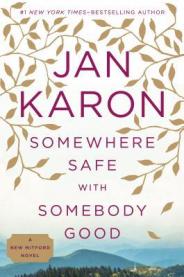
by Jan Karon
Continuing the saga of Father Tim, an Episcopal priest, the book Somewhere Safe with Somebody Good was eagerly awaited by fans of the Mitford series. I have lived out of the U.S. long enough for this book and another in the series both to be published in paperback. I say this to establish that the intervening time lapse has genuinely caused me to forget many of the details of the various subplots of the series. Karon tries to draw enthusiasm from people like me as well as perhaps those who pick up this book as their first taste of life in Mitford. Honestly, I think Karon has created too many characters to be able to update them all effectively. Perhaps she should have pared down the ones included in this book. That part of the book only earns two stars; I don’t fault Karon’s writing, just her taking on an impossible task.
When the reader gets past the clumsiness of character updates, Somewhere Safe with Somebody Good becomes the delightful tale that Karon’s readers have come to expect–interesting, but soothing; realistic, but attaining a moral high ground. I love to see how the characters deal with life; I delight in the carefully crafted words and the beautiful sentiments. It is a treat, as always, to watch Father Tim deal with people who are not always lovable and to sort out his own problems while supporting the community members who have grown to depend on his Godly wisdom.
As a teacher and book lover, I enjoy the focus on the local bookstore, Happy Endings, and the way people come together in the story to support it. Readers who love books (especially children’s literature) will be attracted to the many quotes encouraging reading that Mitford’s citizens post in the bookstore.
As the remainder of the book, including the raison d’être of the title, pleased to capacity, I award a full five stars to Somewhere Safe with Somebody Good.
Fixin’ to Die–Good Try, but…
Fixin’ to Die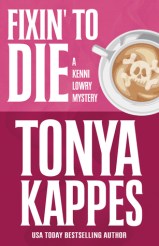
by Tonya Kappes
Fixin’ to Die is a murder mystery set in the small town of Cottonwood, Kentucky. It is the first novel in Tonya Kappes’ Kenni Lowry Mystery Series. My first impression as I was reading this tale is that I really liked the main character Kenni. She is the kind of person I could enjoy spending time with. That sense did not change as this young sheriff goes all out to solve her first murder case and the reader meets the quirky locals she interacts with.
Fixin’ to Die has many elements that aficionados of the cozy mystery genre relish–a strong feminine lead, a few handsome romantic interests, a plot with twists and turns, interesting townspeople, and a surprise ending. So why am I not a huge fan of this book? Mainly I attribute my attitude to a literary technique Kappes attempted: she creates the ghost of Kenni’s grandfather, a longtime Cottonwood sheriff himself, as a character who will aid in Kenni in her investigations. I applaud the effort, but it just didn’t work for me. Therefore I can not wholeheartedly recommend this book.
I would like to extend my thanks to netgalley.com and Henery Press for the opportunity to read this book in exchange for an unbiased review.

