Home » Nonfiction (Page 6)
Category Archives: Nonfiction
You Were Made for This Moment–the God of great reversals
You Were Made for This Moment
by Max Lucado

Most of us are experiencing the “winter of our discontent” with ever-changing health orders, lockdowns, divisiveness on all fronts, inflation, shortages, and politicians who promise much and do little. Max Lucado has written a book that is very appropriate for these times, You Were Made for This Moment. It focuses on Queen Esther in the land of Persia. Her story is found in the book of Esther in the Old Testament of the Bible. The heroine has concealed her Jewish heritage, but now her people are about to be annihilated. Esther is the only Jew with access, limited as it is, to the throne room of the powerful Xerxes.
In his book, Lucado takes us through this dramatic tale, giving background to make it very understandable and including contemporary anecdotes to point out the relevancy of this situation to crises we might find ourselves in. Sometimes they are humorous, sometimes sad, but always they are pertinent. Both the short book of Esther and You Were Made for This Moment should be on a “must read” list for all as they display how God is always working behind the scenes. Our omnipotent God has power over rulers. We need to be open to what He asks us to do in our circumstances whether the situation looms large or is seemingly minor.
Through fasting and prayer, Esther came to understand that “silence is a form of acquiescence.” Although approaching the throne room uninvited was a potential invitation to death, she followed through to save her people with the famous line, “And if I perish, I perish.” Esther was indeed called for such a time as this.
Long a fan of the courageous Queen Esther, I enjoyed revisiting her story. My faith was confirmed, my attitude refreshed, and my courage bolstered. This is an inspiring book, and Lucado, as always, is a riveting storyteller.
Rating: 5/5
Category: Christian, Inspiration
Notes: 1. Take the time to read Max’s humble “Acknowledgements.” As a writer, he turns a “blah-blah” moment into one that will bring smiles to the hardest heart.
2. The book ends with “Questions for Reflection” prepared by Andrea Lucado. They are designed to accompany each chapter as you read it.
3. I also purchased the study guide, written in workbook format, with different questions from the ones in the book. The guide contains a code that gives streaming access to five videos prepared to accompany You Were Made for This Moment and the study guide. The videos feature Max Lucado as he brings the Esther story to life through a cast of characters simulating a dramatic production of the Esther story. As always, when Lucado speaks, listeners feel like the words are directed at them and for their benefit.
Publication: 2021—Thomas Nelson
Memorable Lines:
Seasons of struggle can be a treacherous time for the human heart. We are sitting ducks for despair and defeat. We turn away from others, turn our backs on God, and turn into fearful, cynical souls. Despair can be a dangerous season. But it can also be a developing time, a time in which we learn to trust God, to lean into his Word and rely on his ways.
God is in the details. He works in the small moments. The insignificant becomes significant because he is ever orchestrating the day-to-day details of innumerable lives through a millennia of time to do what he has foreordained to do.
In God’s hands no script is predictable, no story line is inevitable, no outcome is certain. He is ever a turn of the page from a turn-on-a-dime turnaround….He is the God of grand reversals.
Don’t tell God how big your storm is. Tell the storm how big your God is. Your problem is not that your problem is so big but that your view of God is too small.
The Hour of Peril–The Secret Plot to Murder Lincoln before the Civil War
The Hour of Peril
by Daniel Stashower
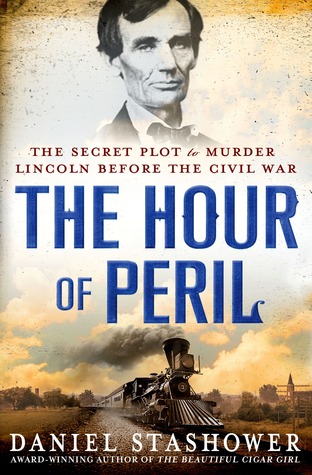
This nonfiction account of an assassination plot against President-elect Abraham Lincoln required extensive research as much was written about the plot at the time, but many of the primary source documents present conflicting perspectives. I don’t think the author of The Hour of Peril, Daniel Stashower, had any intention of creating a tome that parallels current events, but it is hard not to make comparisons as we watch history repeat itself.
The politics of the elite to gain money and power is certainly a theme as well as inciting ordinary people to take extra-legal actions. Good and bad, ethical and immoral, slave vs. free, states’ rights or federal control—they all play a role in the politics of that time.
The rights of men to live freely and the rights of states to determine their own laws clash as the Union begins to disintegrate. Lincoln’s position is that new territories being added must be free, but that he would not advocate changing the slavery laws as they currently existed in the various states in the Union. This position incited those who felt Lincoln went too far and those who decided he had not gone far enough. There were just too many people unwilling to compromise.
As Lincoln headed to Washington, he wanted to greet as many people as possible and was not concerned about his safety. When Allan Pinkerton, a detective with a reputation for being “fierce and incorruptible,” was hired to secure the rail lines the president would be traveling on through Maryland, he discovered that there was a plot to assassinate Lincoln. At that time the focus of his investigation changed. He used the same techniques he had used for years to infiltrate groups planning railway robberies, but his operatives had to intensify their efforts because the time frame for discovery was very short. Pinkerton devised an extremely complicated plot that was successful but did require some last minute changes.
A lot of The Hour of Peril was about Pinkerton and included some discussion of Kate Warne, the first female detective in the United States. Pinkerton requested absolute secrecy of the very few people who were informed of the plot and countermeasures. He was dismayed when he discovered that Lincoln and several people close to the president-elect had, in fact, disclosed information about the travel plans, possibly endangering Lincoln’s life.
The Hour of Peril is not a quick or easy read, but well-worth the time invested. There is much information about and insight into the Civil War era and politics in general to be gained.
Rating: 5/5
Category: History, Nonfiction
Publication: 2013—Minotaur Books
Memorable Lines:
Among those attempting to defuse the crisis was the recently defeated candidate, Stephen Douglas, who selflessly carried a message of unity to hostile audiences in the South, attempting to calm the secessionist fervor and broker a compromise.
He would have been wary of revealing too much in a letter, especially one sent to a politician. As Pinkerton had told Samuel Felton at the start of the operation, “on no conditions would I consider it safe for myself or my operatives were the fact of my operating known to any Politician—no matter of what school, or what position.”
As far as Pinkerton was concerned, there would be no future disclosures. He had sworn the main participants to secrecy, and arranged matters so that the minor players had no sense of the larger plan. In many cases, even those directly involved in carrying out crucial elements of the detective’s design were ignorant of the roles they had played. Once again, secrecy had been the lever of his success.
The Trouble with Reading (Part II)—Reading to Learn
I recently had some eye-opening experiences regarding reading that I want to share. I love to read, have a reading specialist credential, and am a retired educator of 34 years. I also love to learn, and I did just that this week in reading two different books. I gained a new appreciation of the struggles some readers have with reading. If you want to read Part I of The Trouble with Reading which deals with dyslexia, click here.

The other book I read that was a learning experience was a printed copy of a nonfiction book I purchased to read with my book club. It is a well-researched book that focuses on a part of my country’s history. Reading it was a great reminder of the differences in reading a fiction and a nonfiction work. “Work” is an appropriate word here, because of the extensive research effort of the author and the extra time and focus the reader needs to devote to reading the book. There are so many historical figures that play into the book along with settings of note. It is hard, but important, to keep track of them all. It is a very good and well written book and appropriate for book club discussion. I had to schedule reading it into my day so that I finished it by the time of our meeting. In other words, reading it was a chore; to do it justice, I took extensive notes and found the process tiring. Also, it did not focus on a subject that is my primary strength which makes the book intrinsically less interesting and more difficult to read. I brought less background knowledge to the table.
The book was not entertaining, but I am glad I read it. Although nonfiction varies widely, in general it is not my favorite genre. As all teachers should know, I was reminded that nonfiction, which is the foundation of most subject area texts, requires a different set of reading skills and those should be explicitly taught after students master the general reading process. Early elementary focuses on “learning to read” and grades above that should focus on “reading to learn.” Some middle and high school teachers believe that students leave elementary school with the skills they need for content area reading. This knowledge, however, is developmental; what is needed to process a middle grade text is not sufficient for comprehension of a high school text. Unfortunately, many students do not leave elementary school reading on grade level, making the gap even larger. To some degree, all teachers must be reading teachers.
When GOD Winks at YOU: How God Speaks Directly to You Through the Power of Coincidence
When GOD Winks at YOU: How God Speaks Directly to You Through the Power of Coincidence
by Squire Rushnell

I used to be intrigued by coincidences, seemingly chance occurrences that draw you to ponder how an event could happen at a certain time and place. As I have experienced these coincidences over the years, I have come to recognize that they do not happen by chance, but are part of the bigger plan of an omniscient, omnipotent, loving God. That idea is what When GOD Winks at YOU is all about, and its subtitle is How God Speaks Directly to You Through the Power of Coincidence.
In this short, inspirational book, Squire Bushnell shares numerous examples of how “Every time you receive what some call a coincidence or an answered prayer, it’s a direct and personal message of reassurance from God to you—what I call a godwink.” The anecdotes feature strangers, family members, friends, and celebrities. They are tales of God working in people’s lives in amazing ways.
The godwink might be an arrangement of events that lead toward a goal or it might be a “message of reassurance” that God sees you, hears you, and is there to support you. It could be an answer to prayer or a guidepost giving you direction.
Some of the stories are sad, some are happy, but all are fascinating. Rushnell, a former television president and CEO, is an excellent writer, taking what could be a long story with a confusing timeline and recording it in a clear, concise, and compelling manner. After introducing the concept of godwinks, the author follows with eight more chapters based on instances of godwinks in various scenarios such as transitions, unanswered prayer, and quests. All are interesting, and I would be hard pressed to pick a favorite as each addresses a different area of concern. Rushnell adds his own brief commentary and interpretation to each chapter very unobtrusively. A feature I enjoyed is a scattering of quotes throughout the book as sidebars. They are short, closely related to the theme, and never interrupt or repeat the text. The content within each chapter flows. Although it could probably be read in one or two sittings, it could also be spaced out into a chapter or even part of a chapter per day. Any way you choose to read When God Winks at You, you will find inspiring reading that will lead you to look for the godwinks, past and present, in your own life.
Rating: 5/5
Category: Christian, Inspirational
Notes: This book is one of many “godwinks” books written by this author. There are ones that focus on specific topics like marriage and prayer and Christmas themed godwinks books. I am interested in reading Dogwinks: True Godwink Stories of Dogs and the Blessings They Bring.
Publication: 2006—Thomas Nelson
Memorable Lines:
Every godwink is another reminder—another small, still message from God—that everything is going to be okay. Someday you will see everything from His perspective, and you’ll understand.
Some people have a divine desire placed into their hearts at a very early age that becomes a beacon to follow like a medieval knight’s quest. God erects signs along the way to guide us on our journey—godwinks to assure us that we are indeed on the right path.
The chain of godwinks that showered peace and forgiveness on two families on opposite sides of the globe is a remarkable tribute to God’s power in each of our lives and how He places signposts of reassurance along the paths of each of our quests.
In Case You Get Hit by a Bus: How to Organize Your Life Now for When You’re Not Around Later
In Case You Get Hit by a Bus: How to Organize Your Life Now for When You’re Not Around Later
by Abby Schneiderman and Adam Seifer

As a senior citizen, I realize I am each day closer to death than the day before and that no one, regardless of their age, knows when their time on earth will be over. With those things in mind, I agreed to review an advance copy of <i>In Case You Get Hit by a Bus: How to Organize Your Life Now for When You’re Not Around Later</i>. The first thing I noticed is that the digital copy provided was rather jumbled and therefore difficult to read. I am sure the final published copy will not have those issues. I plowed ahead, reading the Introduction, skimming the body of the text, and particularly noting the organization of the book.
This book provides timely advice and draws the reader’s attention to the multitude of decisions that should be made to help those responsible for end of life care and for the distribution of the estate. There are many decisions that, due to “advances” in technology, our ancestors would not have had to deal with (passwords, life support, etc.). This book both advertises and dovetails into their online planning system. In all fairness, though, they do refer readers to other companies besides their own, and by itself the book would be a good guide.
The authors differentiate between the critical issues that need to be done immediately (Plan of Attack), those items of lower priority, and other things that you might want to consider (Side Mission). They really do cover all the bases, for me anyway, and they recognize that even considering this project is difficult for many people in so many ways. Even as I write this review, my anxiety level has risen, but the idea is that if you make a plan you will not just feel, but actually be in control of, some aspects of your future and help those you care about during their time of grief.
I would like to extend my thanks to NetGalley and to Workman Publishing Co. for giving me the opportunity to read this book in exchange for an honest review.
Rating: 4/5
Category: Self Help, Relationships, Grief
Publication: December 22, 2020—Workman Publishing Co.
Memorable Lines:
In order to really make a difference for people at their time of greatest need, you had to help people get a plan in place ahead of time.
We all love instant gratification, but this type of planning forces you to look beyond your own personal gain and know your family has a well-lit path forward if you’re not around.
Tomboy Bride: One Woman’s Personal Account of Life in the Mining Camps of the West
Tomboy Bride
by Harriet Fish Backus
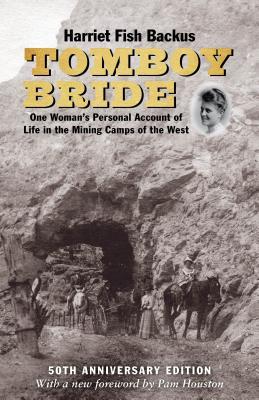
If you ever thought of memoirs as a boring genre, I encourage you to sample Harriet Fish Backus’ Tomboy Bride. It is anything but boring. “Tomboy” refers to the Tomboy Mine, located above Telluride, Colorado, and “bride” is the author Harriet who moved there in 1906 immediately after her wedding at the age of twenty with her mining engineer husband George Backus. The first half of the book describes the difficulties and adventures inherent in living in an almost impossible to reach area with only the barest necessities. Harriet was a city girl and had a big learning curve in basic survival skills in the remote, dangerous, high altitude mining camp—everything from baking at over 11,500 feet to how to wade in long skirts in the snow to an outhouse located quite a distance from the home.
The second half of the book relates a series of moves to various mines along with changes in mining fortunes. Not every mine was successful, and the country’s economic twists affected the mines as well. Their adventures took the couple to Britannia Beach, British Columbia; Elk City, Idaho; and Leadville, Colorado. They had several children and lived through World War I and the Great Depression. George’s mechanical ingenuity landed him a job in Oakland, California, which he held for 37 years, but Harriet’s fondest memories are not the ones of ease in the city, but of struggles, love, and friendship in the mountains.
Mining was a difficult and dangerous business. This was true even for college educated mining engineers who suffered from the cold, long hours and perils along with the miners. Mortality rates were high because of the distance to health care. Transportation was slow and uncomfortable along the treacherous snow packed mountain trails. Water and coal had to be carried by hand from dropping off points up slippery, snow-covered slopes to their homes by the residents. The only fruits and vegetables available were canned and brought up monthly on burros. Because of the isolation, residents tended to work as a community. As long as Harriet and George were together, they were happy despite, and sometimes perhaps because of, their shared hardships.
Rating: 5/5
Category: Memoir, History
Notes: 1. I recommend the 50th anniversary edition of Tomboy Bride because it includes many photographs that bring the story to life.
2. There is a timeline at the end of the book.
3. This is a great book for a book club to read as it is ripe with topics for discussion. Tomboy Bride includes thought provoking questions at the end of the book which our book club found quite helpful.
Publication: 2019—West Margin Press
First publication—1977
Memorable Lines:
On reaching his destination the rider tied the reins to the pommel of the saddle and turned the horse loose. Regardless of the distance, knowing the trails far better than most riders, the horse quietly and surely returned to the nearest stable, at the Tomboy or in Telluride.
Crash! What sounded like pounds of glass breaking into bits was only an old cigar box filled with nails that had fallen from a shelf. Even the rats laid low that night, at least we did not hear them. My chattering teeth kept time to the rattling of the old stovepipe fastened by wires to the rafters. The denim “carpet” rose and fell like ocean billows and wind crackled the newspaper padding.
…at the end of a month we both felt inwardly the call of the wild. Somehow, after the serenity of our mountains, the city seemed tawdry and confusing.
I’ll Be Seeing You–aging
I’ll Be Seeing You
by Elizabeth Berg
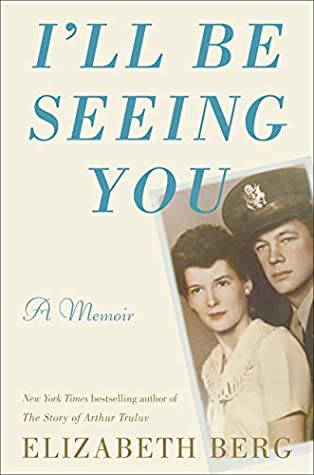
Aging. A theme as old as the passing of time. Elizabeth Berg addresses it in her memoir I’ll Be Seeing You. She describes the challenges of growing old while trying to help her aging parents as they grow even older. It’s tough. We all know that. And it’s different for everyone. Rather than unhelpful generalizations, Berg shares her very personal story—mostly stressful, often frustrating, and sometimes funny.
Berg’s parents, in their late 80’s, are faced with the need to downsize and move to accommodations that are safer and provide opportunities for a continued happy life, but with more constraints. Her father has Alzheimer’s, and her mother is angry and feels suffocated. Berg and her siblings try to help, to make the transition as easy as possible. In the almost year-long transition process she “learned a lot about them, and just as much about myself.”
Berg is an excellent writer. She explores her own aging, her relationship with her parents, and the couple’s love for each other with sensitivity and honesty. Berg turns a tale of aging, decline, and loss into a page turner that explores confronting the inevitable hurdles in life rather than being victimized by them. Although the most visible theme is aging, love permeates the tale with the kind of affection and devotion that lasts a lifetime.
I would like to extend my thanks to NetGalley and to Random House for giving me the opportunity to read this book in exchange for an honest review.
Rating: 5/5
Category: Memoir
Publication: October 27, 2020—Random House
Memorable Lines:
A kind of wild optimism that was in all of us that has eroded as it must with the tired realities of life, with the anvil of aging that has fallen on our parents and will fall on us, too, should we live that long.
I am, as is easy to see, full of hope. But I have to remember something I always forget: you can’t tell anyone else how to experience something. People live behind their own eyes. I’m not the one with the broken arm.
Yes, life is a minefield at any age. Sometimes we feel pretty certain that we know what’s coming. But really, we never do. We just walk on. We have to. If we’re smart, we count our blessings between the darker surprises. And hope for a fair balance.
God Will Help You–overcoming the hard times
God Will Help You
by Max Lucado
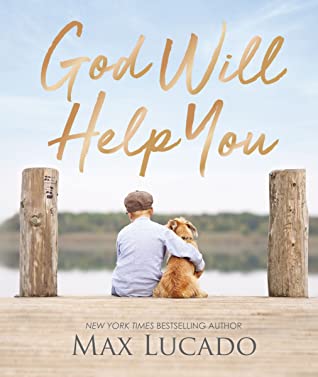
Even in the best of times, we all have troubles, difficulties to face. In this pandemic, many are overwhelmed by the chaos, the darkness, the isolation of lockdowns. For some, the depths of despair have led to suicide, but Max Lucado has a better answer for this “winter of our discontent”….God. In God Will Help You, Lucado says “No matter the challenge or the question, by God’s grace you can face it. He is up to the task. And he will help you.”
Lucado is, by nature, a storyteller, and he uses stories, both from the Bible and from encounters he has had with others, to demonstrate some of the ways God can intervene in our stories. In each chapter, he addresses a different issue and then provides questions for reflection and Bible verses to remind you of God’s help. He closes each chapter with a prayer that you can pray in those circumstances, because sometimes we are so overwhelmed that we just don’t even know how to frame our petitions. Lucado has a way with words. In talking, for example, about God’s grace, he says we have been “doused” with it. What a perfect description!
So, if you’re feeling anxious, fearful, stuck in your circumstances, lonely, sick, or filled with grief, Max Lucado can’t fix those problems, but he can direct you to Jesus. You see, God already knows about your unsolved problems and your struggles to negotiate everyday life. He sees your heart and understands your needs. He is there to give you guidance. In his book God Will Help You, Lucado shows how God will come alongside you each and every day.
I received a complimentary copy of this book. Opinions expressed in this review are completely my own.
Rating: 5/5
Category: Christian, Self-Help, Inspirational
Notes: Having gone through a lot of changes in my life, especially in the last twelve years, I found this statement particularly meaningful: “So make friends with whatever’s next. Embrace it. Accept it. Don’t resist it. Change is not only a part of life; change is a necessary part of God’s strategy. To use us to change the world, he alters our assignments.”
Publication: December 29, 2020—Thomas Nelson
Memorable Lines:
The presence of anxiety is unavoidable, but the prison of anxiety is optional. Anxiety is not a sin; it is an emotion. (So don’t be anxious about feeling anxious.)
…celebrate his goodness, faithfulness, and forgiveness. These characteristics of God remain true no matter what you are going through.
But if you see your troubles as opportunities to trust God and his ability to multiply what you give him, then even the smallest incidents take on significance.
Had Jesus chosen to do so, he could have proclaimed a cloud of healing blessings to fall upon the crowd. But he is not a one size-fits-all Savior. He placed his hands on each one, individually, personally. Perceiving unique needs, he issued unique blessings.
A Dream Called Home–search for happiness
A Dream Called Home
by Reyna Grande

Torn between two countries, immigrant Reyna Grande seeks to find herself. Is she Mexican or American? Will she ever fit into either culture? Is she destined to metaphorically straddle the border for a lifetime? When her first book was published in 2006, one of her dreams had come true and she had begun “a lifelong quest to advocate for the Mexican immigrant community by sharing our stories with the world.” What she found in the aftermath of its publication, however, is that her story resonates with other immigrant communities as well and even with Native Americans who feel the same struggles to maintain a dual identity, language, and culture.
Reyna’s difficult, abusive childhood is discussed at various points in her memoir A Dream Called Home as it plays a strong and recurrent role in her efforts to work through the emotions of her turbulent past through her writing. She makes mistakes along the way as a college student and as a young adult, but she learns from them and decides to experience them as a part of the growth that shaped her into “a unique individual with a unique voice.”
The memoir is filled with stories of her personal relationships. She realizes that she is subconsciously seeking out the love of her father that she never felt under his roof or when he left his family in poverty to earn money in the United States. Reyna and her siblings wrestle with so many decisions in the U.S., and Reyna has to accept that the pathway to healing and success for her is not the right one for them. Fortunately, she has Chicana professors that become lifelong mentors. Even though Reyna is a talented writer, she also has to learn the difficult business end of publication.
Her stint as an untrained middle school teacher in Los Angeles is both sad and predictable for those familiar with teaching in that climate. She experiences unsupportive parents, disrespectful students, and ever changing assignments and curriculum. A bright light for Reyna is her introduction to folklórico. It revives her own interest in her Mexican heritage and renews an enthusiasm in Mexican culture for her students, many of whom, like Reyna, feel displaced and unsettled.
Reyna’s story can not be summarized in a review. My job is to tell you that A Dream Called Home is a book you should read; it should be a part of your mental catalogue. Regardless of your position on the influx of immigrants currently overwhelming the U.S. and its broken political system, you will find Reyna Grande’s perspective both informative and enlightening if you want to understand the struggles of people desperate to emerge from poverty who are clinging to the hope of the American dream.
Rating: 5/5
Category: Memoir
Notes: Includes pictures that personalize Grande and her experiences
Publication: 2018—Atria
Memorable Lines:
My biggest virtue and my biggest flaw was the tenacity with which I clung to my dreams, no matter how futile they might seem to others. The dream of having a true relationship with my parents was the one I had clung to the most because it was the first dream I’d had, and the farthest from my reach.
“Being in a new country, learning a new language, a new culture, takes time. You will learn. It doesn’t feel that way now, but one day you will be just as comfortable speaking English as you are speaking Spanish. But no matter what, don’t ever forget where you came from, and don’t ever be ashamed of who you are.”
I was finally beginning to understand that it takes as much courage to leave as it does to stay, and that being a parent was way more complicated than I had ever imagined.
Little Heathens–Hard Times and High Spirits on an Iowa Farm During the Great Depression
Little Heathens
by Mildred Armstrong Kalish
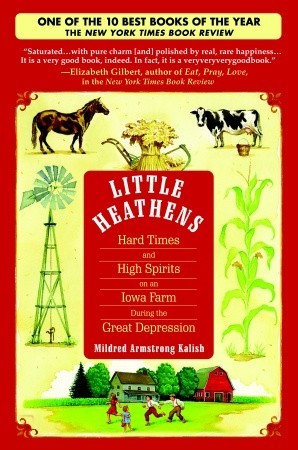
There are a variety of tales and anecdotes about life during the Great Depression, yet many who survived don’t want to talk about it. The experiences of those in the cities were quite different from those living in the country. Regardless of location, however, all but the very wealthy suffered and their lives and perspectives were formed or altered by their experiences.
In Little Heathens, Mildred Armstrong Kalish shares what life was like for herself and her extended family. It is somewhat difficult to distinguish between the normal trials of endless farm work and the efforts needed to reuse and repurpose items because of deprivation of money and resources. “Thrown away” was a foreign concept during this time and thrift was the champion of the day. Kalish shares the many saving and “make-do” tricks that were common during the Depression and some that were uncommon. Many of those have fallen out of use, but are still handy to know and good examples of the resourcefulness of our predecessors.
Kalish lays her memories out forthrightly, not concealing or varnishing the stories. Many are humorous and several are gasp-worth. Children worked alongside adults learning by example and experience. Farm life required the whole family to pitch in. Chores were divided by age and gender, but not strictly. For example, Monday Wash Day was a very physical, all-day task for which preparations began on Sunday night. Children and adults wore the same set of clothes all week, and everyone participated in wash day. The need for everyone to work together is apparent in the book over and over again.
Kalish addresses the many aspects of life at that time as seen through the eyes of a child who was an active participant. She has an incredible memory for detail right down to how to catch, kill, and prepare a snapping turtle for consumption. She also discusses the social aspects of community inside and outside the family unit. Her life was unique in that she lived in town during the winter and on a farm during the growing season because of her family situation. Her life was very different in each place, but the expectations of a good work ethic and attitude never changed.
The author viewed the hardships of her childhood as instrumental in her many achievements later in life. From success as a “hired girl” to working her way through college to her happy marriage and career as a professor, Kalish gives credit to her family, especially her mother: “Mama’s ability to meet challenges head-on and with a positive attitude created in us kids a sense of confidence that there was a way to solve every problem—just find it.” Although her life was hard, it was not unhappy and she prizes the memories of her past. I enjoyed her writing style, learned from the information she shared, and relived some of my past as I have memories of my Depression-era parents handing down wise sayings and thrifty values. Well done, Mildred Armstrong Kalish!
Rating: 5/5
Category: Memoir
Publication: May 29, 2007—Random House (Bantam)
Memorable Lines:
Mama, Aunt Hazel, Uncle Ernest, Grandma, and Grandpa had a real gift for integrating us children into farm life. Working alongside us, they taught us how to perform the chores and execute the obligations that make a family and a farm work.
An Old Maid (that’s what we called unmarried women in those days) was asked why she didn’t try to find a husband. Her reply was, “I have a dog that growls, a chimney that smokes, a parrot that swears, and a cat that stays out all night. Why do I need a husband?”
After our chores and household duties were done we were given “permission” to read. In other words, our elders positioned reading as a privilege—a much sought-after prize, granted only to those goodhardworkers who earned it. How clever of them.
She kept all of her needles stuck into a red felt pincushion which she had owned since just before God.
 education pathways