Home » Middle Grade
Category Archives: Middle Grade
The Teacher of Nomad Land–a child’s survival
The Teacher of Nomad Land: A World War II Story
by Daniel Nayeri
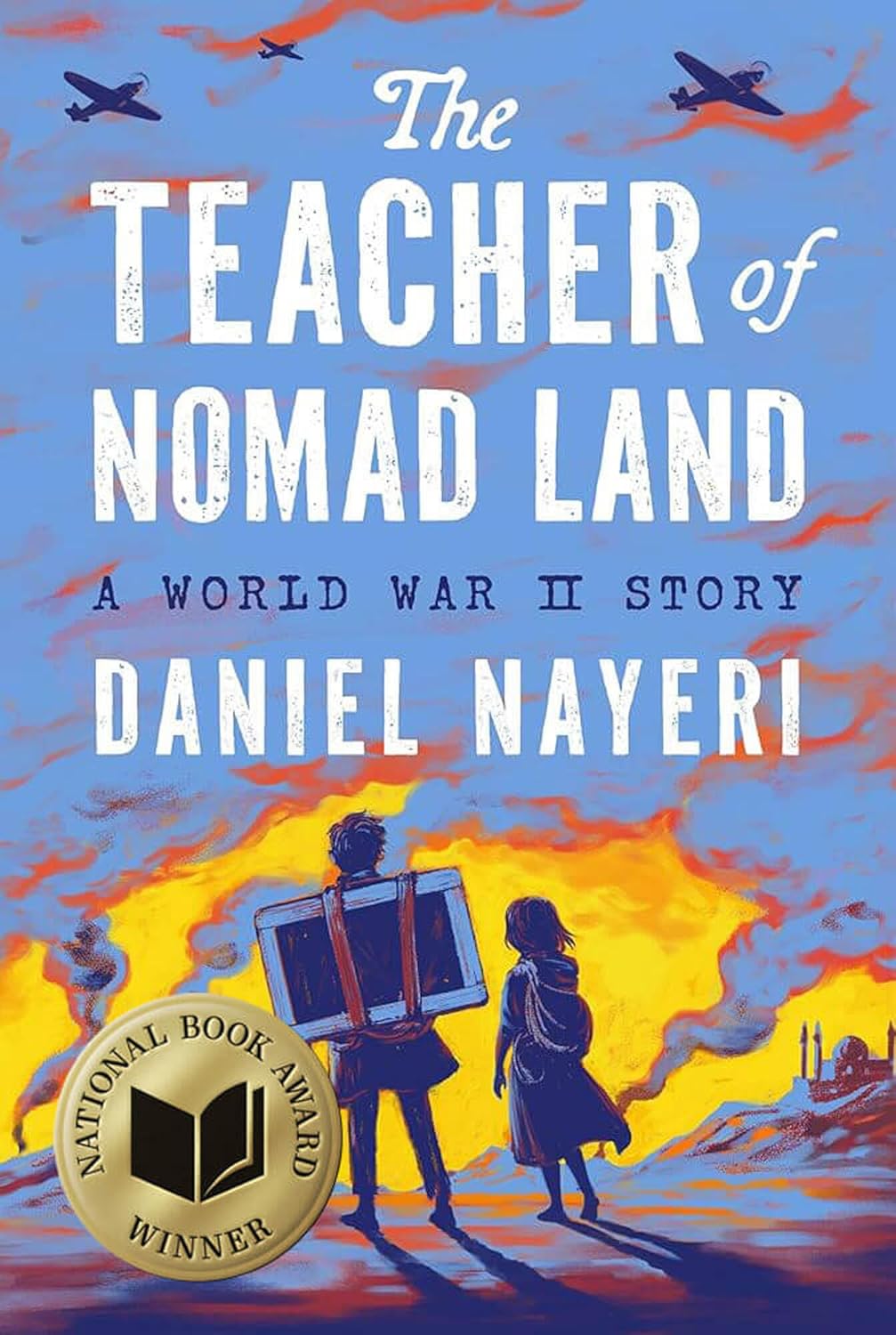
This is the story of two Iranian siblings, thirteen year old Babak and eight year old Sana, orphaned and separated during a time when their neutral country is being invaded by forces competing for Iranian oil—British, Soviet, and German. Add to that mix the Poles, the Jews, and the native nomads who don’t recognize any country as delineated on a map. Their various languages play an important role in this story. Babak has two goals—to become a teacher like his father and to take care of and stay with his sister.
Written for children, this is a fast read for adults. Instead of the horrors of concentration camps, The Teacher of Nomad Land focuses on the lives of the children as they to try to find “family” and dig within themselves to find what it takes to survive. In the Traveler, a friend of their father, they discover a kind man who tries to help. There is also a British soldier they bond with. Their lives are complicated by a mysterious man who is seeking a Jewish boy. All three children are put in danger by this situation. Babak’s resourcefulness is successful in dealing with the Soviets who halt the progress of the nomads in transitioning their herds to their winter home thus demonstrating his value to the nomads.
This is an age appropriate book that does not go into detail about concentration camps and home invasions. On the other hand, it does not shy away from the hunger the children suffer and the danger they face from other people. It highlights the communication problems when there are so many languages; and it shows how, despite being part of an army, individual soldiers can be nice to the local population. While Babak, as the older child, has much of the spotlight in this book, Sana also shines in certain situations with her creativity and ability to step up when things go bad. I was impressed by both characters at their positive attitudes, not allowing themselves to be overpowered by a victim mentality even when cold, hungry, tired or aching from long walks or sleeping on the hard ground.
Rating: 4/5
Category: Historical Fiction, Middle Grades
Notes: 1. Written for children Ages 8-12. Even though the reading level is for that age group, it may be too advanced in terms of understanding the political, geographical, linguistic, and social backgrounds. Discussion with an adult would be helpful for some children.
2. Included some helpful additions: a map, author’s notes about the political setting and the language barrier, and information on the Persian alphabet.
3. The book ends with “Further Reading” which lists nonfiction books for various ages.
Publication: 2025—Levine Querido
Memorable Lines:
“It might have been fair, but it wasn’t right.”
Everything is all at once. Our lives, these moments that change our lives, they all happen so fast.
Teaching is like sitting with a young person and encouraging them to only listen to the good angels in their mind and not the evil ones. But you can’t force them.
The Bletchley Riddle–young code breakers
The Bletchley Riddle

By Ruta Sepetys and Steve Sheinkin
Written specifically for Middle Grade students, The Bletchley Riddle will appeal to those interested in World War II but not ready for the torturous aspects of the conflict. This book deals with code breaking efforts that were a critical support to the military in winning the war.
Jakob, with mathematical talents, has been recruited from Cambridge and becomes part of the secretive code breaking team at Bletchley Park. His much younger sister Lizzie, who prides herself in being straight forward, escapes from Fleetword, her chaperone who is supposed to escort her from England to live with her Gram in Cleveland, Ohio. Lizzie wants to stay in England to investigate the death of her mother Willa as she does not believe that she died in an explosion in Poland.
This novel becomes very involved as the two youths form relationships with a variety of other interesting characters who live in the area. It’s hard to determine who is a spy and who is not, but Jakob also needs to restore his relationship with Lizzie.
The Bletchley Riddle deals with official decoding using the Enigma machine and with personal riddle solving of secretive messages the pair receives. The book is well written and appropriate for middle grades; the authors knew their audience. While some books written for young people can be captivating for older readers as well, The Bletchley Riddle is not one of them. I have enjoyed other books about Bletchley Park that are more interesting and engaging for adults.
I received a complimentary copy of this book in exchange for an honest review. Opinions expressed in this review are completely my own.
Rating: 4/5
Category: Fiction, Middle Grades, Historical Fiction
Notes: Appropriate for Ages 10+ and Grades 5+
Publication: October 8,2024—Penguin Group (Viking Books)
Memorable Lines:
“Do you always speak your thoughts aloud?” “I do. I’m half American. I’m straightforward. Does that make you uncomfortable?”
She looks with disapproval toward the crumpled papers on the floor. And she’s right. It’s sloppy. I get up to gather the scraps. Even our rubbish is secret here. All of it must be burned.
But the past months have shown that circumstance can be the thief of choice.
The Storyteller’s Tale–making words come to life
The Storyteller’s Tale
by Judith Bouilloc
translated from French by Madeline S. White
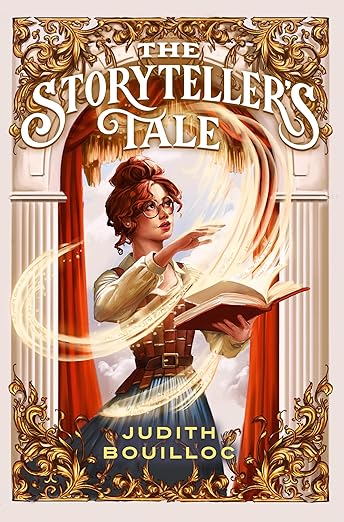
You’ve heard the expression “make words come to life”? In The Storyteller’s Tale, the librarian Iliad Livrani can do that. She is so talented that the queen invites her to come to the palace to perform. During this same period, a messenger arrives from the palace with an offer of marriage from Lord Tarlyn. The immediate complication to this generous offer is that there are several gentlemen at court with that name. Which one might he be? Iliad is chaperoned by her fire-breathing Granny Cassandra as they travel to the castle and have many adventures.
Iliad can create visible words that become images and this talent is useful to the king as he tries to transform his kingdom into a parliamentary monarchy. There is the usual infighting in the court and within the royal family. Magical creatures like a flying bird-deer populate this story. Lovers of literature will find pleasure in the various classical choices Iliad makes for her readings. Lord Tarlyn is a mystery man, and there are difficulties because of his character, abilities, and goals. There are reasons for his secrecy, but they are only gradually revealed.
I enjoyed the fantasy world the author created, especially the magic with words. The various creatures and plants were also interesting. There is a romantic hero and a villain, a mystery and a challenge. Iliad and her sisters are strong women with an equally strong sense of right and wrong. Democratic principles are important to them as are reconciliation and feelings. One of the themes is that character is more important than outward appearance.
I received a complimentary copy of this book in exchange for an honest review. Opinions expressed in this review are completely my own.
Rating: 4/5
Category: Middle Grades, Fantasy, Teens and Young Adult
Notes: All of Iliad’s book choices have footnotes to note the author and explain briefly what the work is about.
Publication: August 21, 2024—Rivka Publishing
Memorable Lines:
“The term snatchwords refers to a person who can make sentences detach themselves from paper by reading them aloud. They internalize each word turning them into moving figures and setting by sheer force of imagination.”
The Livrani women were known to express their feelings with great exuberance. Some might say it was their greatest weapon against ill-fortune.
“What I think is that Balthasar is an aristocrat by birth but a democrat by opinion, and as such, he is likely to change things.”
Kita–Part I: Princess of Orith
Kita
Art and story by William Brenner
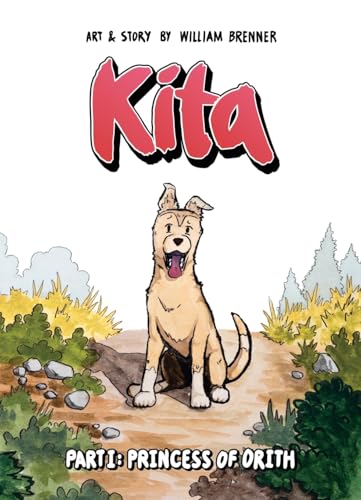
The protagonist of Kita is Tommy, a boy full of imagination. He fantasizes about the Kingdom of Orith. After school one day, he and his stuffed friend, Mr. Bear, head to the imaginary Green Root where they become involved in a conflict with wolves who are trying to take over the town. Mr. Bear is the last living Keeper, and Tommy is the last member of the King’s Guard. Their roles are to locate the rightful heir to Orith’s throne.
The divisions of the novel are:
Chapter 1: Kingdom in Crisis—attacks and a council meeting to determine Orith’s future
Chapter 2: Royal Lineage—Thaddius, Chief Librarian of the archives, leads the team on an adventure to prove there is a descendent of the previous leaders
Chapter 3: Adoption—the warrior princess Kita needs a home.
Kita is a graphic novel written and illustrated by the very talented Will Brenner. The story is told with an appropriate combination of drawings and text; sometimes only illustrations are needed to move the story forward. The graphics are very detailed and show well the expressions and moods of the characters. The story moves between Tommy’s real life and the life he creates in his dreams and in his imagination. Although those worlds are very different, they also overlap. For example, the wolves bully the other animal characters, and Tommy’s cousin Ricky and some of Tommy’s classmates bully Tommy. Some of the characters are likable, and others are villains. Kita’s original owner is a prime example of an uncaring pet owner. Tommy’s parents want to be supportive, but are not always successful at trying to understand him. Perhaps they are just overstretched in their responsibilities. I base that perception on the dinners served—mom brings home takeout for their meals.
This is a fun graphic novel that lets the reader escape into a fantasy world. I think middle graders, teens, and young adults would particularly enjoy this trip to Orith. The Epilogue has a great hook to attract readers to return to the series for Kita: Part 2 which is still in the preparation stages.
Rating: 5/5
Category: Graphic Novel, Fantasy
Notes: Middle Grades (ages 10+)
Publication: April 7, 2025—Great Bellows
Memorable Lines:
“Many things aren’t as they should be. But hang on to hope, young Guard of the King. It will be made right, even if it looks different than you expect. And how exciting that you may yet play a part in that.”
Hans Brinker, or The Silver Skates–historical look at Holland
Hans Brinker, or The Silver Skates
by Mary Mapes Dodge
illustrated by Edna Cooke

This children’s novel depicts life in Holland in the early 19th century and according to the author “aims to combine the instructive features of a book of travels with the interest of a domestic tale.” Dodge has done of lot of research so much of the book focuses on Dutch history and customs. Although Hans Brinker is the protagonist, he is not even a character in a large part of the book that describes a skating trip a small group of boys undertake traveling on frozen canals and rivers to various cities.
Hans and his family live in deep poverty because the father Raff had a work accident ten years prior that affected his brain. His wife also can not work because she has to stay home to look after her unpredictable husband. Hans and his sister Gretel are not always treated well because of their social standing. The author states that the circumstances of Raff’s situation were true.
Hans and Gretel have only inefficient wooden skates that Hans carved for them, but both are good skaters. Surprisingly, not much of the story deals with the race for silver skates. Hans is an honorable young man as is shown many times in the story.
The fictional part of Hans Brinker is interesting, even exciting, but the historical portions are less interesting. The boys visit museums on their trip and the history bounces from one item to another just as it would if you were visiting a museum. There are a lot of events referenced that students today do not have the historical background for (e.g. Prince William of Orange who freed Holland from Spain and became King of England). For further personal education on Dutch history or if working with homeschool students, Hans Brinker or the Silver Skates could be a valuable resource. Unless I were teaching a unit on Holland in a classroom, I doubt I would read this to or with Middle Grade students. I found the Preface to be a valuable introduction to what was to follow. I also liked the satisfying Conclusion which shared what happened to the characters as life moved on for them.
Rating: 4/5
Category: Children’s fiction, Historical fiction
Notes: 1. Intended for children 8-12 years old
2. I found this to be a slow read, but there were others in my book club who found the historical references very interesting.
Publication: 1865—George W. Jacobs & Co.
I obtained my copy from Gutenberg Press.
Memorable Lines:
“…the father and I saved and saved that we might have something laid by. ‘Little and often soon fills the pouch.’ ”
“We cannot say what we might have become under other circumstances. We have been bolstered up from evil, since the hour we were born. A happy home and good parents might have made that man a fine fellow instead of what he is. God grant that the law may cure and not crush him!”
Ten years dropped from a man’s life are no small loss; ten years of manhood, of household happiness and care; ten years of honest labor, of conscious enjoyment of sunshine and outdoor beauty, ten years of grateful life—One day looking forward to all this; the next, waking to find them passed, and a blank. What wonder the scalding tears dropped one by one upon your cheek!
Pax, Journey Home–repercussions of war
Pax, Journey Home
by Sara Pennypacker
illustrated by Jon Klassen
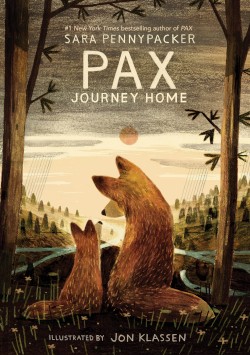
When you read Pax by Sara Pennypacker, you will probably want to have closure on several fronts. What happens to Peter? What happens to Pax? Will they ever unite? Will Peter ever return to live with Vola or will he return to his old home?
In Pax, Journey Home the focus is no longer the war, but the aftermath of the war—deserted towns, water poisoned with heavy metals, and animals who have died or fled. Peter joins the Water Warriors in a junior capacity and is able to help some of the adults with his survival skills. Peter’s story turns more tender here as he finally deals with grief and guilt.
Like the first book, Pax, this book provides many opportunities for discussion about war and its impact on families. It adds to that framework environmental topics related to war.
Rating: 5/5
Category: Children’s Fiction
Notes: 1. Ages 9-11
Grades 3-7
2. I liked this book better than the first. Although this book shows Peter confronting issues from his past, in Pax, Journey Home, he overcomes them. He learns how to be strong and brave in his decisions. There is more positivity and gentleness in this book. I do advise reading Pax first.
Publication: January 31, 2023—Balzer + Bray
Memorable Lines:
Memories were so treacherous. Always lurking under the surface, ready to bushwhack you with a blade to the heart when you weren’t careful.
“Well, that is not what I believe.” Vola said it in a completely neutral voice. No challenge, no judgement on someone who believed something else. Peter had come to appreciate Vola’s technique. It defused things, let the other person hold a different side without asking for a fight.
When they’d pulled into the outpost, she’d advised him again. “Fill your cup whenever you can,” and this time he’d understood that she wasn’t talking about water and his eyes had stung.
Pax–a boy and his fox
Pax
by Sara Pennypacker
illustrated by Jon Klassen
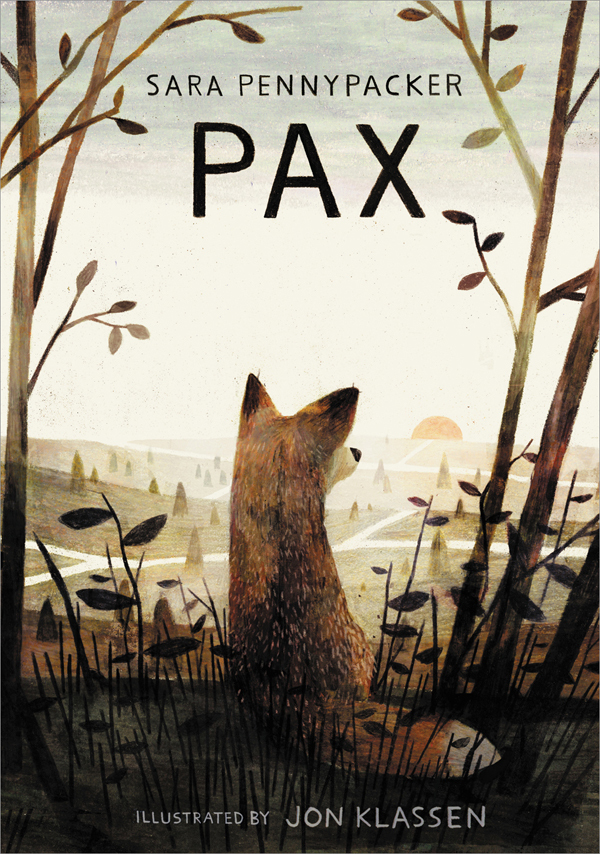
Pax is supposed to be a middle grade book, but its themes require more maturity than most young people of that age can muster. The costs of war are central to the book as the characters have to deal with its emotional effects on individuals and families. Trust and treachery, anger and emotional abuse, and love, promises, guilt and truthfulness are all issues that come into play in this book.
With a purposely vague setting in terms of location and time, the author uses two points of view to tell this story—that of Peter, a twelve year old boy whose mother has recently passed away and of Pax, the fox Peter rescued when Pax was just an orphaned kit. Peter’s father goes away to war leaving him with his grandfather, but making him desert his pet. That is so much grief for a boy!
Wracked with guilt and worry, Peter sets out to find Pax while Pax waits and then searches for Peter. The reader follows both characters through adventures and misadventures. Another interesting character is Vola, a wounded veteran who has difficulty recovering from the physical and emotional traumas of war, but tries to help Peter. Several characters in the book suffer from what we would call PTSD or shell shock. There are also generational issues as Peter’s father has difficulty with anger and Peter doesn’t want to follow in his footsteps.
The writing is excellent, and Pax is ripe with topics for discussion. Our book group debated various issues related to the book and reread passages to clarify our understanding of some underlying meanings. When it was time to close down our meeting, we still had concerns we could have pursued.
Rating: 4/5
Category: Children’s Fiction
Notes: 1. Ages 9-11
Grades 3-7
In looking at reviews in Amazon after I finished writing my review, I found that readers were mixed on the appropriate reading level for the subject matter. Whereas my book club of adults found it to be emotionally challenging, many readers in online statements thought it was appropriate. This is not the kind of book you want to hand to a child to read on their own. Instead, it needs to be read with an adult at home or in a classroom and include lots of discussion.
2. I was unhappy that some of the storylines seemed incomplete, but the author published a sequel: Pax, Journey Home in 2023 which I have checked out from my library to read.
Publication: 2016—HarperCollins (Balzer + Bray)
Memorable Lines:
“I have more than everything I need.” Vola sat. “I have peace here.” “Because it’s so quiet?” “No. Because I am exactly where I should be, doing exactly what I should be doing. That is peace.”
“So which is it? You going back for your home or for your pet?” “They’re the same thing,” Peter said, the answer sudden and sure, although a surprise to him. “And you’re going to do this no matter who tries to stop you? Because it’s the right thing for you, at your core?” Vola made a fist and thumped her chest. “Your core. Is that true?”
Peter remembered Vola asking him which side his father was fighting on. Peter had answered her, stunned that she would even have to ask. “The right side,” he’d added, indignantly. “Boy,” Vola had said, and then “Boy!” again, to make sure she had his attention. “Do you think anyone in the history of this world ever set out to fight for the wrong side?”
Zeus: Water Rescue
Zeus: Water Rescue
by W. Bruce Cameron

Do you know a kid who loves dogs? They just might be interested in Zeus: Water Rescue. Written for Middle Grade children, this book shares the story of Zeus, a puppy who watches his littermates find new homes while he is left desperately wanting a person of his own. It is charmingly told from Zeus’ point of view as the puppy tries to understand what the people are doing and to please them.
In Hawaii, Marco pieces a living together between jobs focusing on Search and Rescue and as an Emergency Responder. He especially needs the income he receives when he trains a dog in water rescue and sells it in Europe. Not many dogs are right for the job especially when they are given the final test—jumping from a helicopter.
Kimo lives with his dad Marco and his grandmother and wants a puppy of his own as much as Zeus wants a boy of his own. Because of the financial need to sell a trained dog, even if Kimo can train the rambunctious Zeus, there doesn’t seem to be a way forward for the pair to stay together. Kimo’s cousin Giana is smart and not intimidated by adults. She helps Kimo in his efforts to keep Zeus. Their banter is fun and lightens the sadness that naturally occurs as the impending separation looms on the horizon.
I received a complimentary copy of this book in exchange for an honest review. Opinions expressed in this review are completely my own.
Rating: 4/5
Category: Children’s Fiction
Notes: #1 in the series Dogs with a Purpose
Publication: September 26, 2023—Tor Publishing Group
Memorable Lines:
“Giana’s the only person in history to be kicked off the debate team for arguing,” Kimo informed me.
I could feel some of the fear leaving her as I lay there, so I didn’t try to change position. Having a dog nearby always makes things better.
I did not know why he had shouted Bear’s name. Bear obviously wasn’t here. Anyone could smell that.
The Secret Garden–delightful classic
The Secret Garden
by Frances Hodgson Burnett
Illustrated by Tasha Tudor
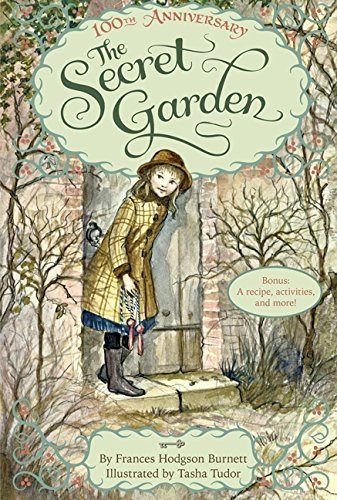
An avid reader as a child, I am surprised that I somehow missed out on the classic children’s tale The Secret Garden written by Frances Hodgson Burnett. For this reading with my book club, I chose an edition with delightful illustrations added to this 1911 book by Tasha Tudor in 1962. The Secret Garden is recommended by the publisher for ages nine and up, but I strongly recommend it for all readers. Please don’t relegate it to the “kiddie lit” genre.
The Secret Garden is the kind of book that instructs the reader in positivity without being preachy. Ten year old Mistress Mary (as in “quite contrary”) is a child who is both spoiled and neglected in her upbringing in India where she does not experience love. Things are not much better for her when her parents die, and she is shipped to Yorkshire to be under the care of her uncle. There she is still not loved as her uncle, Mr. Craven, has not dealt well with the death of his wife ten years prior and the illness of his son Colin who is physically cared for but also is not loved.
When Mary discovers that the mysterious crier in the night is Colin, she gradually creates a bond with her cousin. She is a curious girl who is given little freedom in the house, but almost total freedom in the gardens. She discovers the benefits of fresh air, sunshine, and natural exercise, and she explores the grounds looking for a secret garden that has been hidden away since Colin’s mother died.
Mary and Colin meet so many interesting people during the spring and summer. Dickon is a twelve year old who can converse with animals and plants. His older sister Martha is a sweet young lady who works at Misselthwaite Manor as a housemaid and helps take care of Mary. She has one day a month off, and she travels home by foot to help her kindly mother with laundry and baking. She gladly gives her mother her earnings to help support her large family of twelve happy siblings. Ben Weatherstaff is an elderly gardener who knew Colin’s mother and is eager to help restore the secret garden. While this tale is not full of goody two-shoes, it does have characters the reader will enjoy getting to know and in the cases of Mary and Colin watching their physical and emotional growth.
The Secret Garden is a pleasant read that begins with difficulties for the characters but progresses to a magical time in their lives. The author’s descriptions are wonderful to read as spring approaches in the garden. It is a book I would reread for the pleasure of the story and the language of the author.
Rating: 5/5
Category: Children, Fiction, Classics
Publication: 1911—Harper Collins
Memorable Lines:
The rainstorm had ended and the gray mist and clouds had been swept away in the night by the wind. The wind itself had ceased and a brilliant, deep blue sky arched high over the moorland. Never, never had Mary dreamed of a sky so blue. In India skies were hot and blazing; this was of a deep cool blue which almost seemed to sparkle like the waters of some lovely bottomless lake, and here and there, high, high in the arched blueness floated small clouds of snow-white fleece. The far-reaching world of the moor itself looked softly blue instead of gloomy purple-black or awful dreary gray.
“Half-witted!” said Colin angrily. “Who thought that?” “Lots o’ fools,” said Ben. “Th’ world’s full o’ jackasses brayin’ an’ they never bray nowt but lies.”
He had made himself believe that he was going to get well, which was really more than half the battle, if he had been aware of it.
The Girl Scouts at Rocky Ledge–a gem from 1922
The Girl Scouts at Rocky Ledge
by Lilian Garis
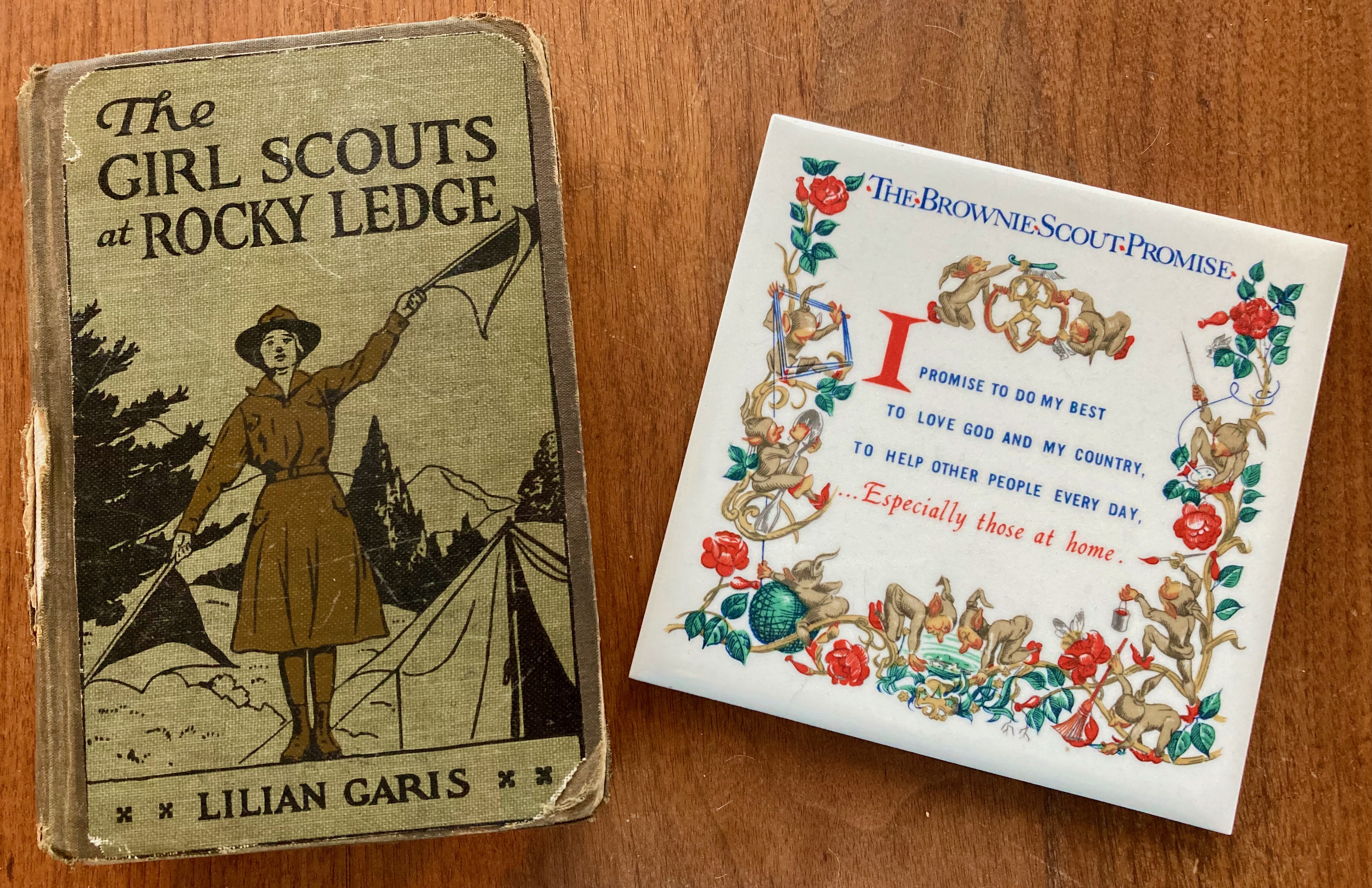
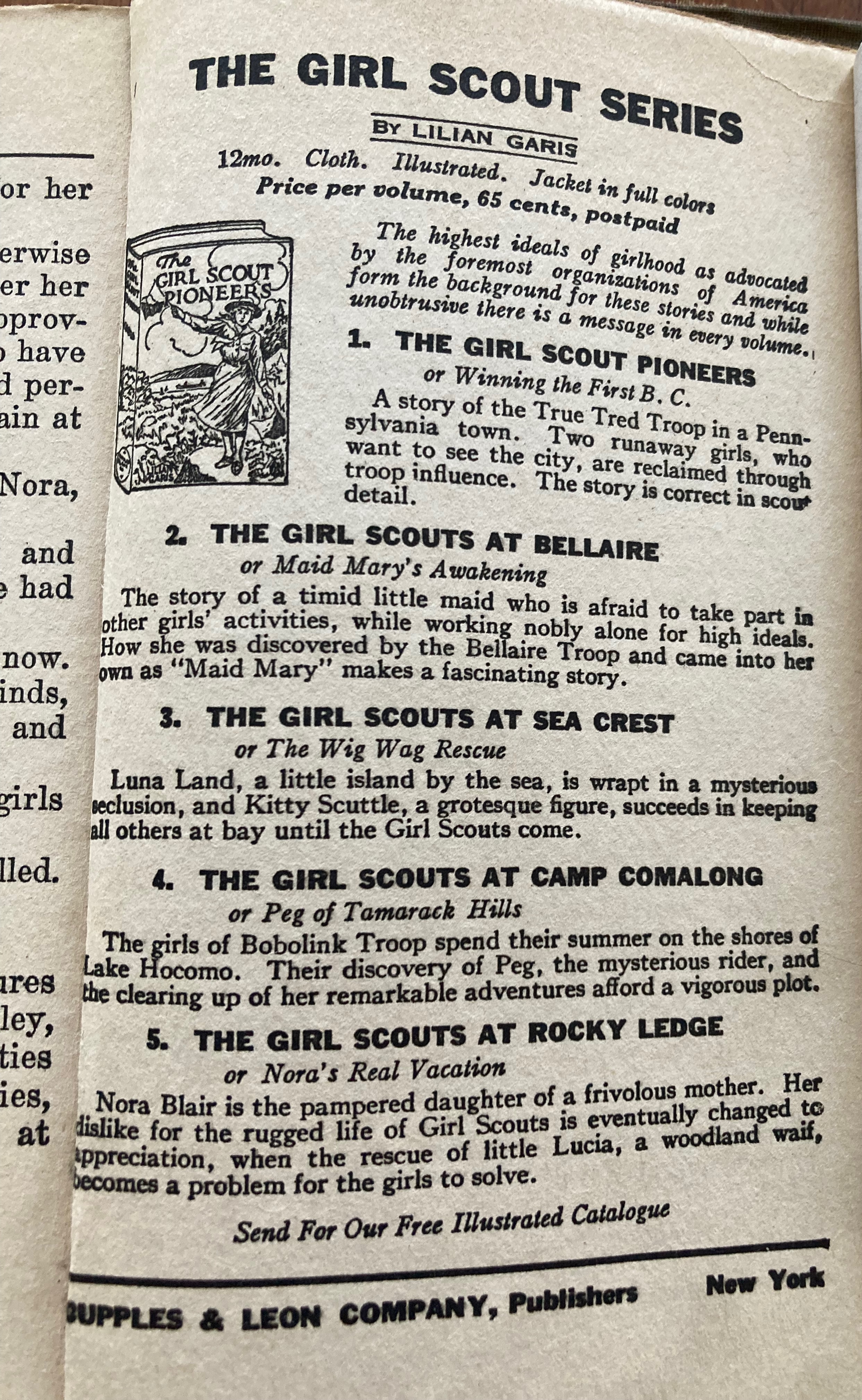
My sister-in-law, in downsizing, came across this book with my name written in the front. I was delighted when she offered to mail it to me. I remember buying it in sixth grade when the teachers opened up the book room and held a sale. From the markings, it appears that the local library had donated books to the school. This book with a copyright date of 1922 seems to have been formally checked out many times, but then informally checked out at the school in the 1948-1952 time period. I was born in 1952, so this book was sitting on a shelf, unread, for about 12 years before it landed in my hands and then literally a lifetime before it made it back to me.
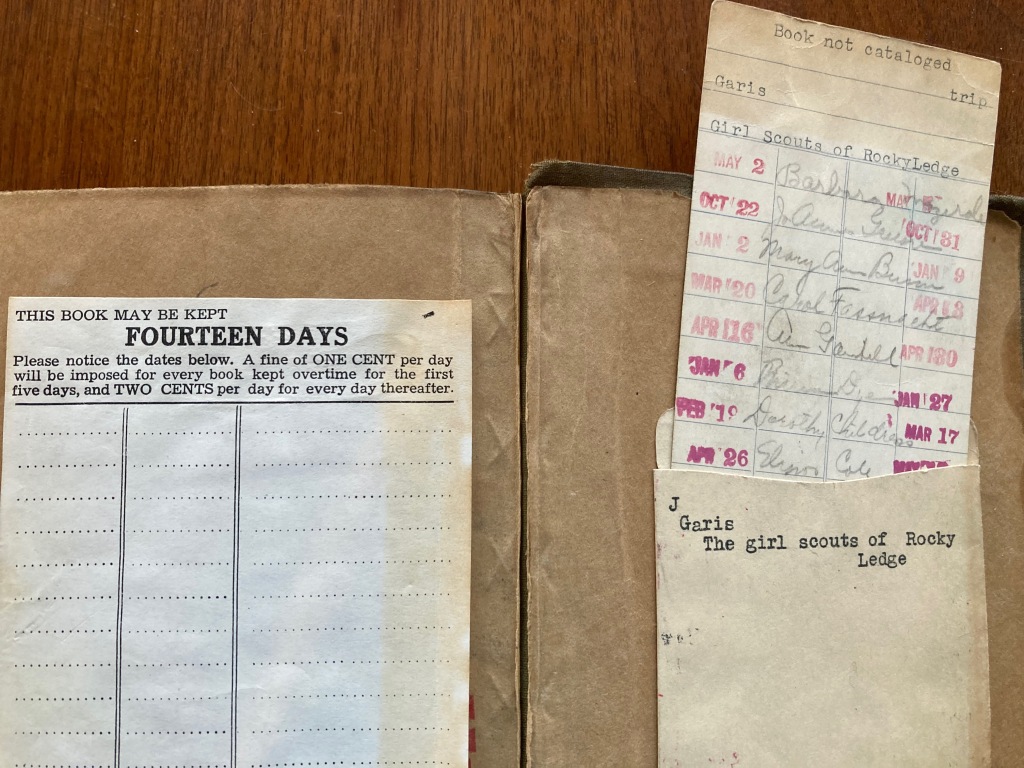
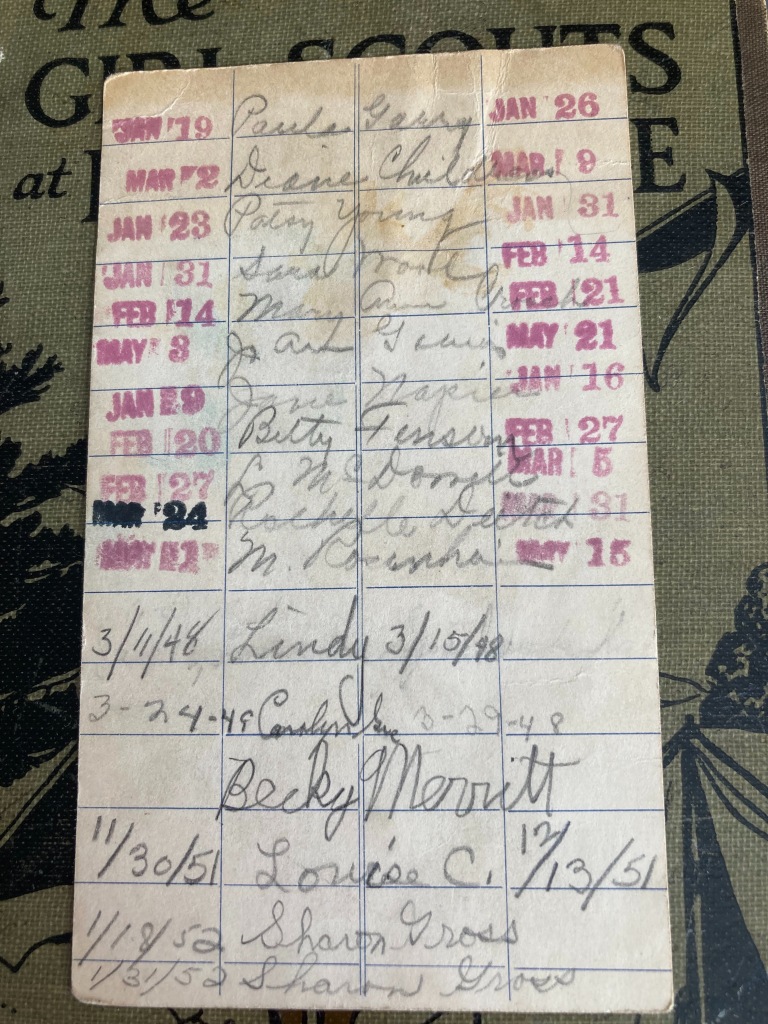
The Girl Scouts at Rocky Ledge is a delightful read. It is the tale of pretty little Nora, pampered with the best and most delicate of clothes. She has a vivid imagination that confounds most adults. She is sent for a month’s vacation with Jerry and Ted (Theodora). Jerry is a surveyor and Ted specializes in wildlife. They spend their days exploring the terrain around the house where they live. There are a group of Girl Scouts camping in their area, with khaki uniforms, rules, and lots of freedom. The Chickadee Patrol adopts Nora, and she discovers that there are many benefits to their way of passing the summer.
I would love to spend time with Jerry and Ted who are fun loving and accepting. The Girl Scouts are quite individualistic and indulge in friendly teasing. A mystery arises when Nora in her wanderings discovers Lucia, a frightened little girl and resolves to help her, leaving food for her until one day she disappears. Another mystery revolves around Vita, the Italian cook in the household. She engages in odd conversations with Nora about the attic as if she is trying to scare Nora.
I enjoyed the older but not stilted style of writing. The characters and narrator have a broader vocabulary than we are used to in children’s books, but it is quite understandable even to the modern ear. The first chapter is confusing because Nora wants to rename her hosts. They take it in good stride and then the story is in full swing. Cap (Captain) is a canine character who can be relied on to judge people well and to take care of Nora as she explores the woods.
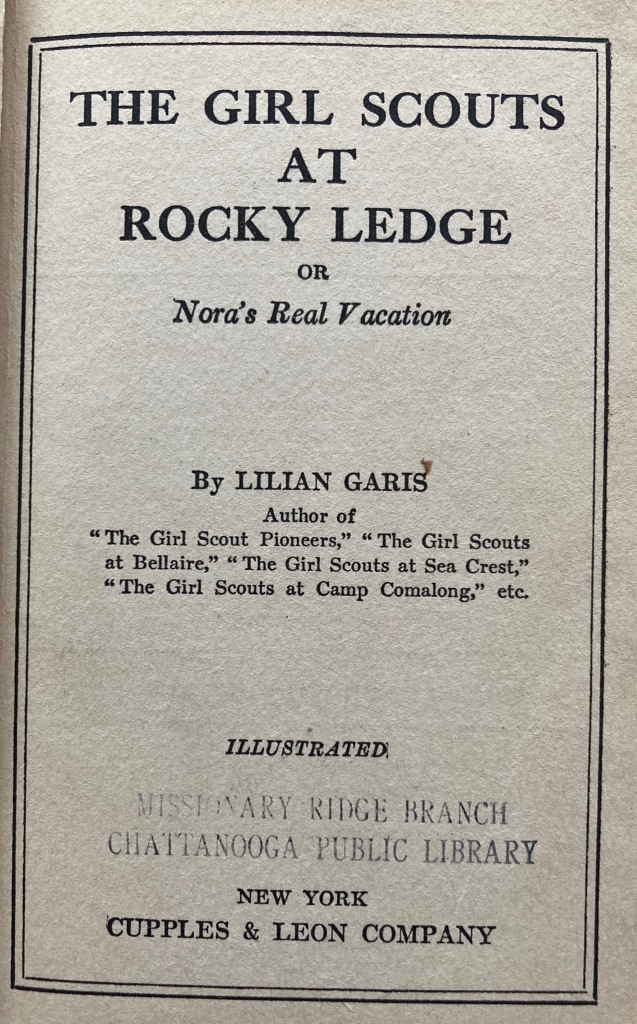
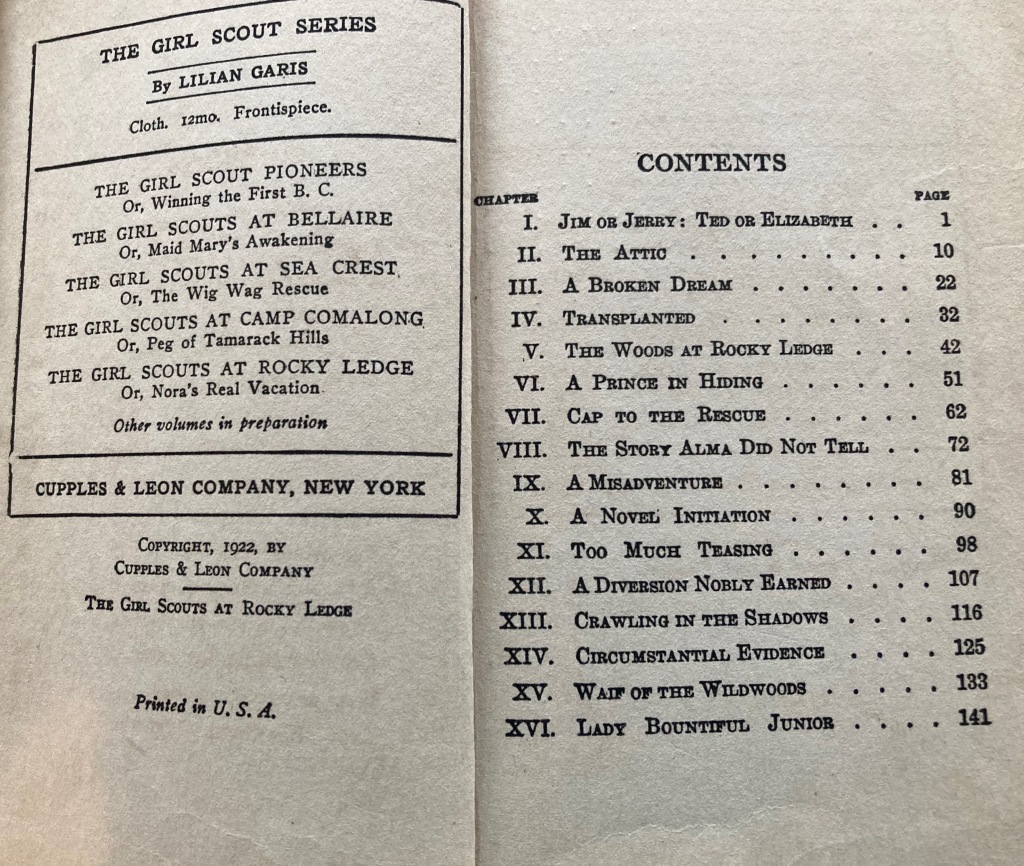
Lilian Garis (20 October 1873 – 19 April 1954) was a prolific American writer of juvenile fiction. She authored hundreds of books from 1915 to the early 1940’s. She was a newspaper reporter when she met her future husband Howard Garis, also a reporter. He was as prolific as his wife as he wrote the Uncle Wiggily Longears series. These stories first appeared daily in the newspaper, every day except Sunday, for almost 40 years—11,000 stories which were nationally syndicated and compiled into books. Both authors’ books have been reprinted over the years giving testament to their appeal and quality of writing.
Rating: 5/5
Category: Children’s Fiction
Notes: Part of the Girl Scout Series, but is a standalone. The intended audience is probably ages 8-12, but it would be fun for girls of all ages
Publication: 1922—Cupples and Leon Company
Memorable Lines:
If one could look pretty after a ducking in a strange lake, Nora did. Her curls liked nothing better, and her cheeks pinked up prettily, while her eyes—they were as blue as the violets that listened in the underbrush.
The day brings wisdom, and when Nora again dressed in the borrowed khaki suit (she had suddenly taken a dislike to her own fancy dresses), the glorious sunshine of the bright summer morning mocked the terrors of the night.
Nora was disconsolate. For two days the dainties left for Lucia had remained untouched. The bread box which Vita had given her to play with, and into which the food was deposited for Lucia, stood upon the tree stump with the sliced lamb, the piece of cake, and the big orange which comprised the last installment offered by the sympathetic Nora, just as she had left it.
 education pathways