
Home » Middle Grade (Page 2)
Category Archives: Middle Grade
The Secret Garden–delightful classic
The Secret Garden
by Frances Hodgson Burnett
Illustrated by Tasha Tudor
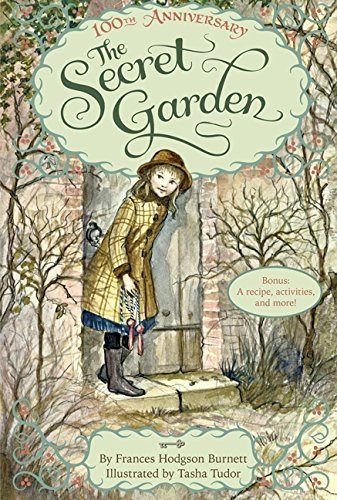
An avid reader as a child, I am surprised that I somehow missed out on the classic children’s tale The Secret Garden written by Frances Hodgson Burnett. For this reading with my book club, I chose an edition with delightful illustrations added to this 1911 book by Tasha Tudor in 1962. The Secret Garden is recommended by the publisher for ages nine and up, but I strongly recommend it for all readers. Please don’t relegate it to the “kiddie lit” genre.
The Secret Garden is the kind of book that instructs the reader in positivity without being preachy. Ten year old Mistress Mary (as in “quite contrary”) is a child who is both spoiled and neglected in her upbringing in India where she does not experience love. Things are not much better for her when her parents die, and she is shipped to Yorkshire to be under the care of her uncle. There she is still not loved as her uncle, Mr. Craven, has not dealt well with the death of his wife ten years prior and the illness of his son Colin who is physically cared for but also is not loved.
When Mary discovers that the mysterious crier in the night is Colin, she gradually creates a bond with her cousin. She is a curious girl who is given little freedom in the house, but almost total freedom in the gardens. She discovers the benefits of fresh air, sunshine, and natural exercise, and she explores the grounds looking for a secret garden that has been hidden away since Colin’s mother died.
Mary and Colin meet so many interesting people during the spring and summer. Dickon is a twelve year old who can converse with animals and plants. His older sister Martha is a sweet young lady who works at Misselthwaite Manor as a housemaid and helps take care of Mary. She has one day a month off, and she travels home by foot to help her kindly mother with laundry and baking. She gladly gives her mother her earnings to help support her large family of twelve happy siblings. Ben Weatherstaff is an elderly gardener who knew Colin’s mother and is eager to help restore the secret garden. While this tale is not full of goody two-shoes, it does have characters the reader will enjoy getting to know and in the cases of Mary and Colin watching their physical and emotional growth.
The Secret Garden is a pleasant read that begins with difficulties for the characters but progresses to a magical time in their lives. The author’s descriptions are wonderful to read as spring approaches in the garden. It is a book I would reread for the pleasure of the story and the language of the author.
Rating: 5/5
Category: Children, Fiction, Classics
Publication: 1911—Harper Collins
Memorable Lines:
The rainstorm had ended and the gray mist and clouds had been swept away in the night by the wind. The wind itself had ceased and a brilliant, deep blue sky arched high over the moorland. Never, never had Mary dreamed of a sky so blue. In India skies were hot and blazing; this was of a deep cool blue which almost seemed to sparkle like the waters of some lovely bottomless lake, and here and there, high, high in the arched blueness floated small clouds of snow-white fleece. The far-reaching world of the moor itself looked softly blue instead of gloomy purple-black or awful dreary gray.
“Half-witted!” said Colin angrily. “Who thought that?” “Lots o’ fools,” said Ben. “Th’ world’s full o’ jackasses brayin’ an’ they never bray nowt but lies.”
He had made himself believe that he was going to get well, which was really more than half the battle, if he had been aware of it.
The Girl Scouts at Rocky Ledge–a gem from 1922
The Girl Scouts at Rocky Ledge
by Lilian Garis
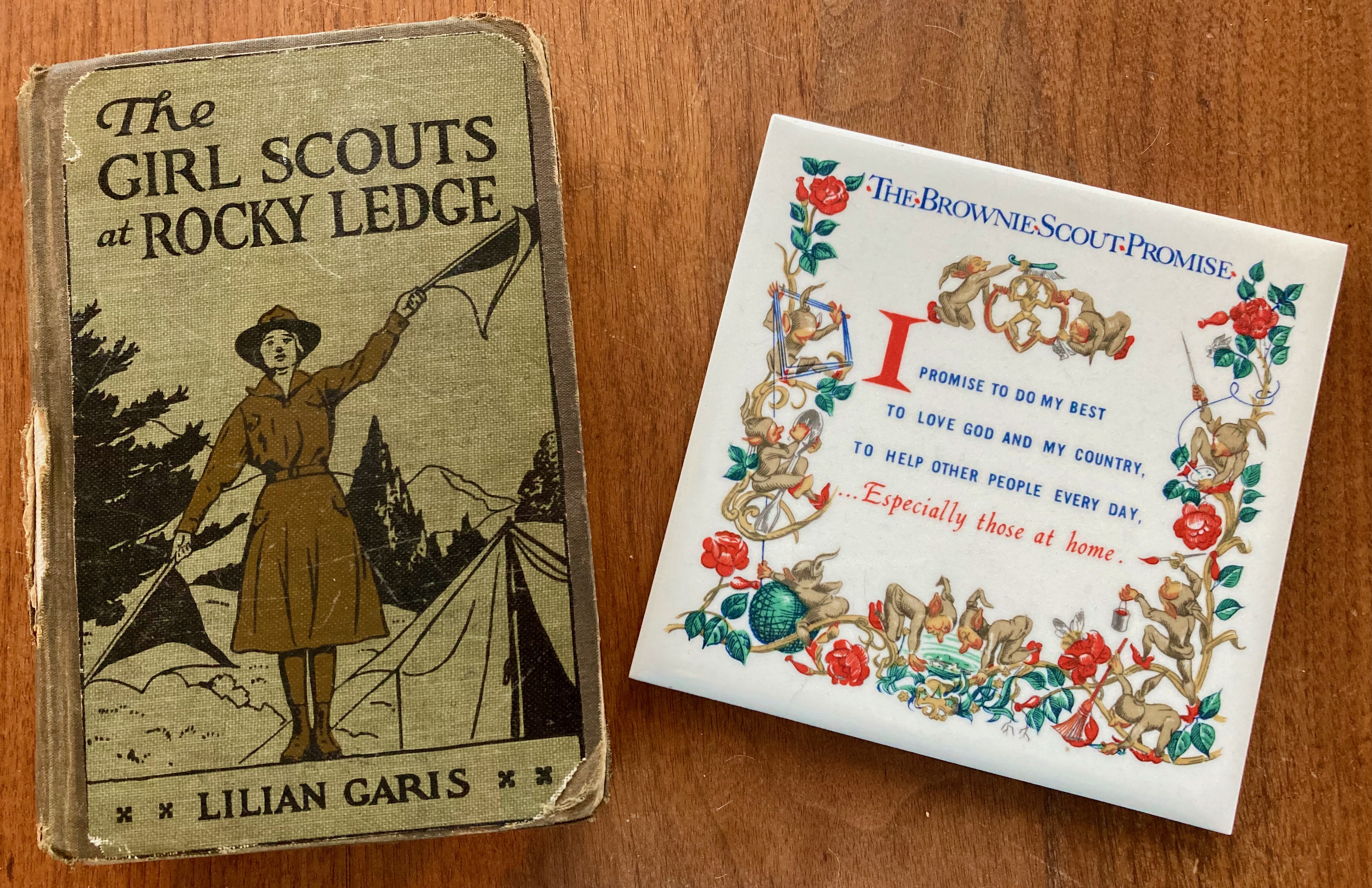
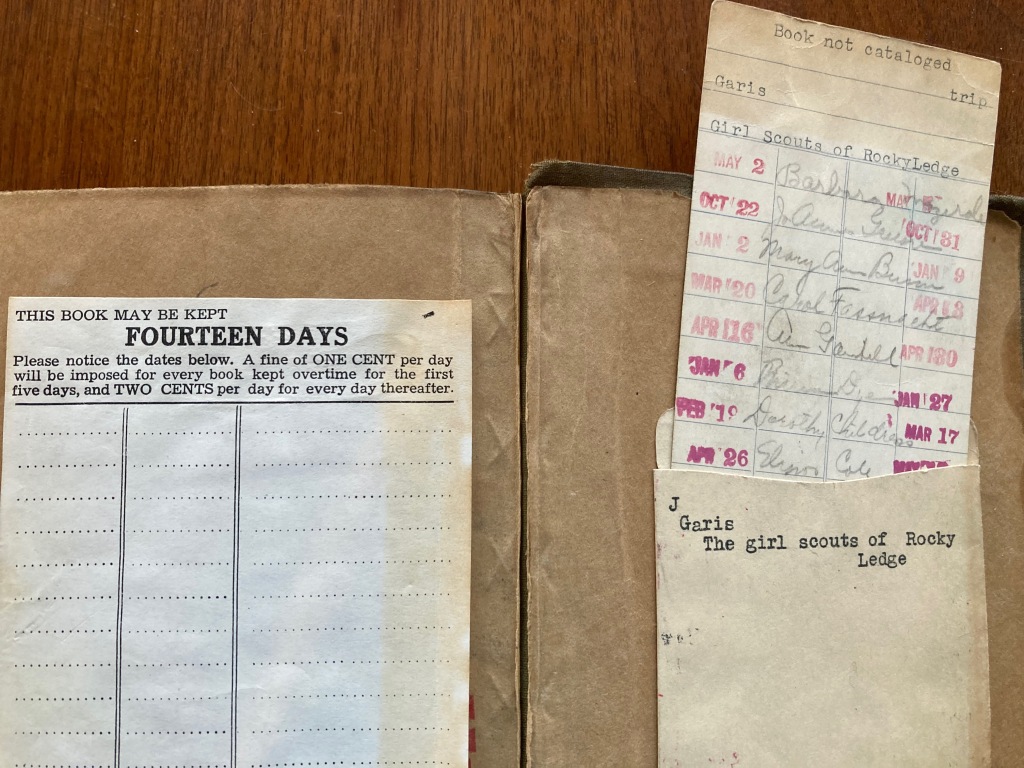
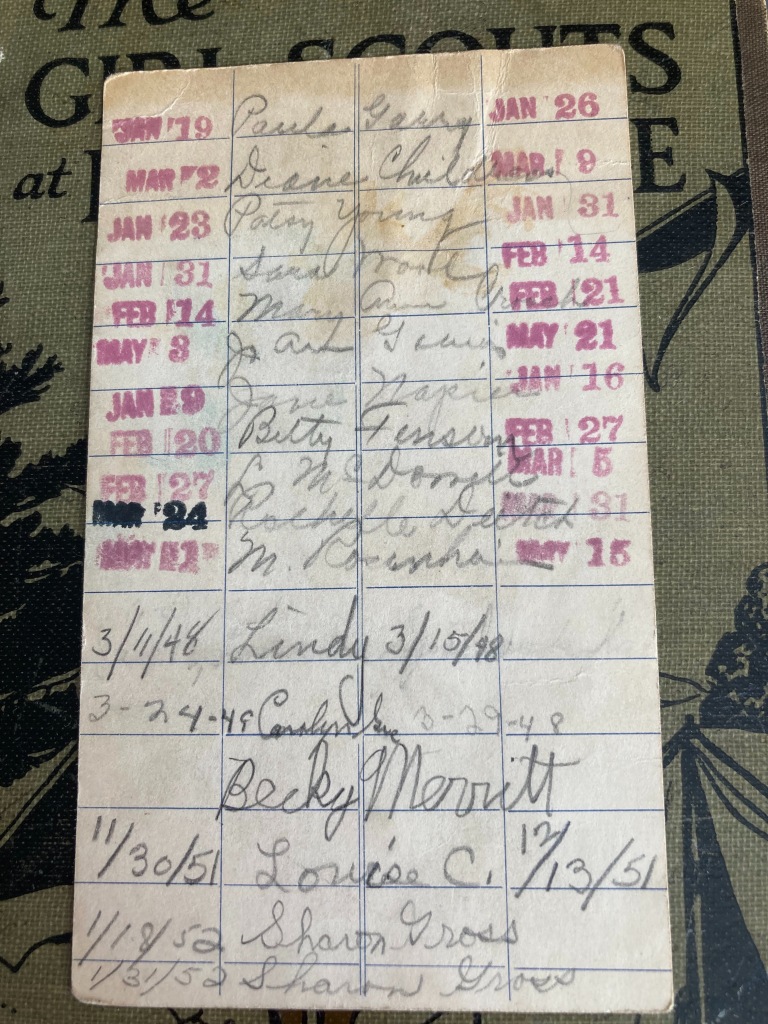
My sister-in-law, in downsizing, came across this book with my name written in the front. I was delighted when she offered to mail it to me. I remember buying it in sixth grade when the teachers opened up the book room and held a sale. From the markings, it appears that the local library had donated books to the school. This book with a copyright date of 1922 seems to have been formally checked out many times, but then informally checked out at the school in the 1948-1952 time period. I was born in 1952, so this book was sitting on a shelf, unread, for about 12 years before it landed in my hands and then literally a lifetime before it made it back to me.
The Girl Scouts at Rocky Ledge is a delightful read. It is the tale of pretty little Nora, pampered with the best and most delicate of clothes. She has a vivid imagination that confounds most adults. She is sent for a month’s vacation with Jerry and Ted (Theodora). Jerry is a surveyor and Ted specializes in wildlife. They spend their days exploring the terrain around the house where they live. There are a group of Girl Scouts camping in their area, with khaki uniforms, rules, and lots of freedom. The Chickadee Patrol adopts Nora, and she discovers that there are many benefits to their way of passing the summer.
I would love to spend time with Jerry and Ted who are fun loving and accepting. The Girl Scouts are quite individualistic and indulge in friendly teasing. A mystery arises when Nora in her wanderings discovers Lucia, a frightened little girl and resolves to help her, leaving food for her until one day she disappears. Another mystery revolves around Vita, the Italian cook in the household. She engages in odd conversations with Nora about the attic as if she is trying to scare Nora.
I enjoyed the older but not stilted style of writing. The characters and narrator have a broader vocabulary than we are used to in children’s books, but it is quite understandable even to the modern ear. The first chapter is confusing because Nora wants to rename her hosts. They take it in good stride and then the story is in full swing. Cap (Captain) is a canine character who can be relied on to judge people well and to take care of Nora as she explores the woods.
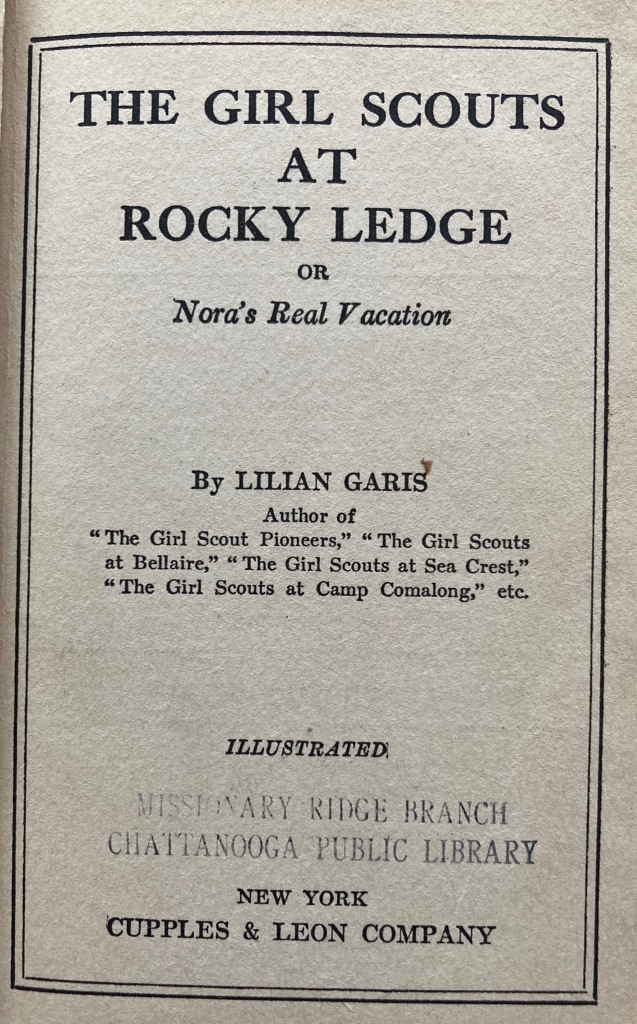
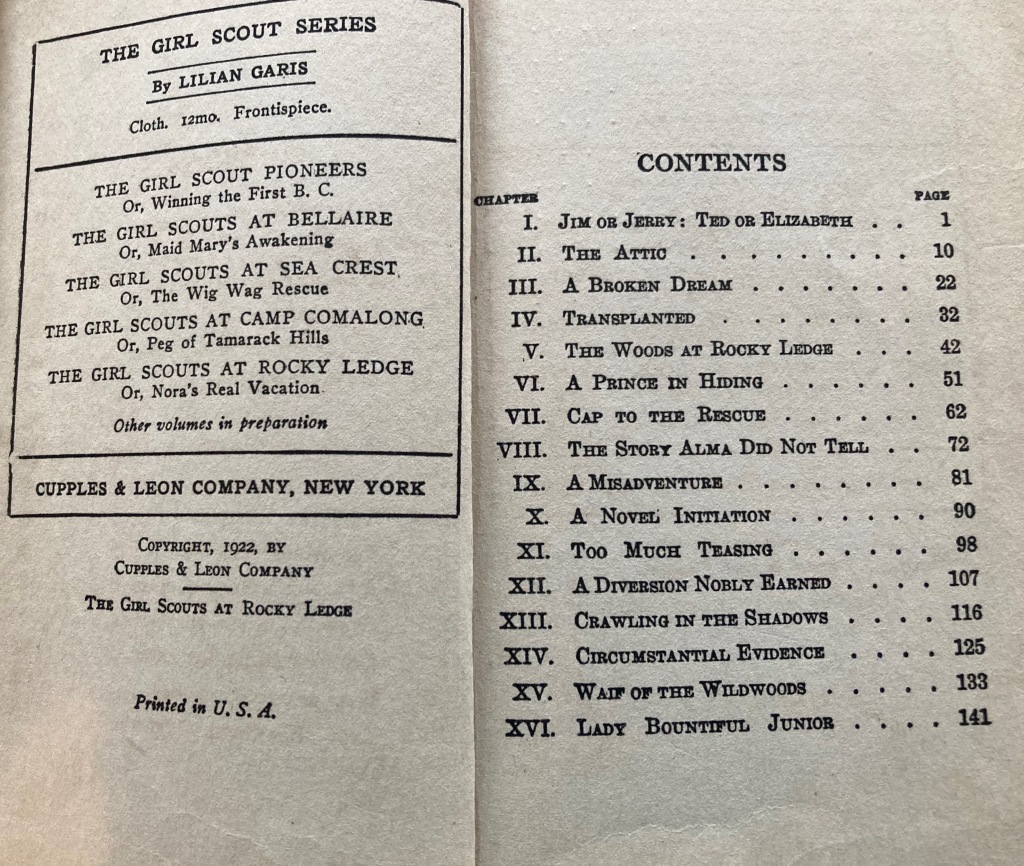
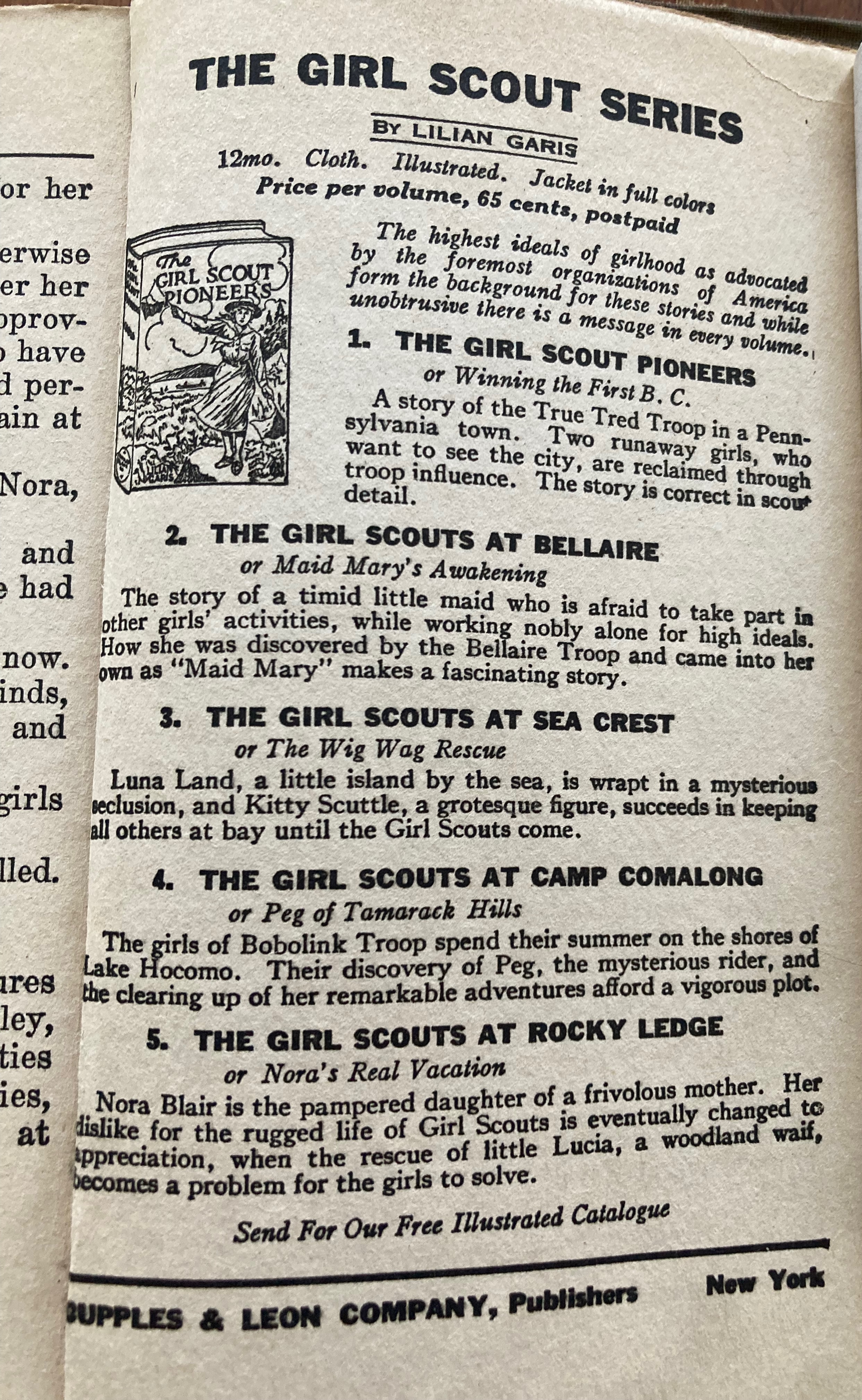
Lilian Garis (20 October 1873 – 19 April 1954) was a prolific American writer of juvenile fiction. She authored hundreds of books from 1915 to the early 1940’s. She was a newspaper reporter when she met her future husband Howard Garis, also a reporter. He was as prolific as his wife as he wrote the Uncle Wiggily Longears series. These stories first appeared daily in the newspaper, every day except Sunday, for almost 40 years—11,000 stories which were nationally syndicated and compiled into books. Both authors’ books have been reprinted over the years giving testament to their appeal and quality of writing.
Rating: 5/5
Category: Children’s Fiction
Notes: Part of the Girl Scout Series, but is a standalone. The intended audience is probably ages 8-12, but it would be fun for girls of all ages
Publication: 1922—Cupples and Leon Company
Memorable Lines:
If one could look pretty after a ducking in a strange lake, Nora did. Her curls liked nothing better, and her cheeks pinked up prettily, while her eyes—they were as blue as the violets that listened in the underbrush.
The day brings wisdom, and when Nora again dressed in the borrowed khaki suit (she had suddenly taken a dislike to her own fancy dresses), the glorious sunshine of the bright summer morning mocked the terrors of the night.
Nora was disconsolate. For two days the dainties left for Lucia had remained untouched. The bread box which Vita had given her to play with, and into which the food was deposited for Lucia, stood upon the tree stump with the sliced lamb, the piece of cake, and the big orange which comprised the last installment offered by the sympathetic Nora, just as she had left it.
Everything Sad is Untrue–memories are culture carriers
Everything Sad is Untrue
by Daniel Nayeri
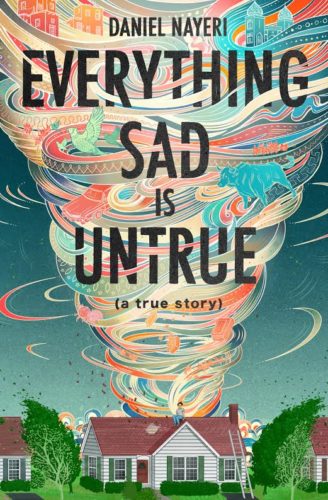
Daniel Nayeri’s Everything Sad is Untrue is part memoir and part storytelling where he fills in the things he doesn’t remember exactly from his childhood. The first part of the book is a mixture of three kinds of stories—myth, legend, and history—that attempt to place the reader in Daniel’s past and his ancestry as it happened and as he imagined it might have happened. He relates “story” in this way to help the reader understand the very different Persian culture he started his life in and which formed his beliefs and attitudes.
Although there are no chapters in this book, the reader can clearly tell when the story pivots from providing background to relating the events from the time his mother became a Christian on a visit to the West. She embraced Jesus and her faith in Him wholeheartedly. Christianity in Iran is a capital offense, so she had to take her children and flee. She traded a comfortable life as a respected physician married to a successful dentist for the life of an impoverished refugee, looked down on because of her language, menial job, and poverty. But she had Jesus, and no one could take that away from her.
Some of the book tells about the year they spent in a refugee camp in Italy. It was not actually a camp with tents, but a concrete building with small rooms and a bathroom. The residents were refugees from many countries, all waiting for the U.N. to find a place that would accept them. They had nothing and there was no access to books, media or recreation. It was made even harder by the refugees’ inability to converse with each other and by impatient workers who processed each refugee’s mound of paperwork.
A lot of Daniel’s story tells what life was like for him as a child in Edmond, Oklahoma, where they eventually settled. He experienced bullying, but came up with tricks for avoiding the worst of it. There was culture shock around every corner as he tried to fit into a very different mindset. Fortunately, he had an outstanding teacher in Mrs. Miller who encouraged him without babying him. The librarian in Edmond was kind too, and so Daniel spent many Saturdays there devouring books. His mom ended up in the emergency room several times thanks to his stepfather Ray, a black belt. Despite lots of difficult times, Daniel never seems to plead for sympathy from the reader and always points to his mother as the strongest person he knows.
Everything Sad is Untrue is a book I recommend. It is a challenging read as the author’s life is presented through the eyes of a child, but with some of the understanding of an adult. Memories are an important theme of this book as Daniel says, “Memories are always partly untrue.” and “A patchwork story is the shame of a refugee.” This is a book ripe with principles and beliefs worth pondering and a story and characters who will remain in the reader’s thoughts long after the last page is turned.
Rating: 5/5
Category: Autobiographical novel/fictionalized memoir
Notes: 1. This is a hard book to categorize which may, in part, be a critical factor in making it a very good book.
2. It has been rated for children 12+ on Amazon. Some readers refer to it as a Young Adult book. To me, it is probably more appropriate for adults. Some of the fascination with “poop,” however, in Daniel’s childhood classroom would attract the attention of middle school boys.
3. This book has won many awards.
4. I thought not having chapters would be a negative for me, but it does fit the style of Everything Sad is Untrue.
Publication: 2020—Levine Querido
Memorable Lines:
Memories are tricky things. They can fade or fester. You have to seal them up tight like pickles and keep out impurities like how hurt you feel when you open them. Or they’ll ferment and poison your brain.
And here is the part that gets hard to believe: Sima, my mom, read about him and became a Christian too. Not just a regular one, who keeps it in their pocket. She fell in love. She wanted everybody to have what she had, to be free, to realize that in other religions you have rules and codes and obligations to follow to earn good things, but all you had to do with Jesus was believe he was the one who died for you. And she believed.
Imagine you’re in a refugee camp and you know it’ll be a tough year. But for the person who thinks, “At the end of this year, I’m going somewhere to be free, a place without secret police, free to believe whatever I want and teach my children.” And you believe it’ll be hard, but eventually, you’ll build a whole new life….But if you’re thinking every place is the same, and there will always be people who abuse you, and about how poor you’ll be at first, the sadness overtakes you….But what you believe about the future will change how you live in the present.
How to Train Your Dad–the art of dumpster diving
How to Train Your Dad
by Gary Paulsen

Carl is the twelve year old narrator of this middle grade book which has a very conversational style. The vocabulary is somewhat advanced for a twelve year old, but that is because Pooder, Carl’s best friend who helps him write the story, goes through phases of interest (British, Navy seal, etc.). His various fascinations show up in his speech. Pooder admires Carl’s dad who, besides a few odd jobs, lives by bartering. Carl’s dad is very intelligent, mechanically inclined, and very kind. He trades energy (labor) for goods. He considers himself rich as he recycles from dumpsters or his neighbor Oscar’s junk piles. He built a whole truck from discarded spare parts. He prizes function over form; so if an invention works, it doesn’t matter how it looks.
His dad’s philosophy has been fine with Carl until he reaches middle grades and suddenly becomes aware of Peg as “the” girl. His summer goal is to become “lookatable” by the time school starts which is hard to do when your dad barters for XL camo T-shirts and pink bib overalls decorated with words like “juicy.”
The book explores Carl’s efforts to train his father using the methods in a puppy training pamphlet. His efforts are hilarious as are the contraptions his father builds and the objects he brings home. A lot of the dumpster diving food goes to the pigs and chickens. Carl and his dad have a rescue pit bull Carol who is an integral part of their family and, despite her stinky habit of shredding skunks, is allowed to accompany them everywhere.
How to Train Your Dad is a fun story that tweenagers will enjoy. Its casual style and over the top anecdotes are sure to appeal.
I received a complimentary copy of this book in exchange for an honest review. Opinions expressed in this review are completely my own.
Rating: 4/5
Category: Children’s Fiction, Middle Grades
Notes: Contains a very small amount of cussing
Intended ages: 10-14
Publication: October 5, 2021—Macmillan Children’s Publishing Group
Memorable Lines:
She’s in my grade at school and everyone likes her and I have never ever ever seen her be catty or crabby or phony to anyone ever which is something like a miracle in middle school, if you ask me.
Sometimes Pooder jumping from phase to phase without warning can be a little confusing. He might start things off an English lord before suddenly becoming an advertising mogul looking to make some coin and then turn into a Viking biting deep on a tomato-apple so the juice runs down into his beard-if-he-had-one while he’s thinking of pillaging a coast somewhere.
My father loved to barter. To trade, as he thought of it, energies, abilities, knowledge. Trade everything he could so as not to use money. “I have a widget,” he explained to me when I was very small, “and John Doe has an extra electric frying pan he doesn’t need, but he needs a widget and so we trade. We barter. Simple and clean. It’s the very best and purest way to do business.”
A Dream Called Home–search for happiness
A Dream Called Home
by Reyna Grande

Torn between two countries, immigrant Reyna Grande seeks to find herself. Is she Mexican or American? Will she ever fit into either culture? Is she destined to metaphorically straddle the border for a lifetime? When her first book was published in 2006, one of her dreams had come true and she had begun “a lifelong quest to advocate for the Mexican immigrant community by sharing our stories with the world.” What she found in the aftermath of its publication, however, is that her story resonates with other immigrant communities as well and even with Native Americans who feel the same struggles to maintain a dual identity, language, and culture.
Reyna’s difficult, abusive childhood is discussed at various points in her memoir A Dream Called Home as it plays a strong and recurrent role in her efforts to work through the emotions of her turbulent past through her writing. She makes mistakes along the way as a college student and as a young adult, but she learns from them and decides to experience them as a part of the growth that shaped her into “a unique individual with a unique voice.”
The memoir is filled with stories of her personal relationships. She realizes that she is subconsciously seeking out the love of her father that she never felt under his roof or when he left his family in poverty to earn money in the United States. Reyna and her siblings wrestle with so many decisions in the U.S., and Reyna has to accept that the pathway to healing and success for her is not the right one for them. Fortunately, she has Chicana professors that become lifelong mentors. Even though Reyna is a talented writer, she also has to learn the difficult business end of publication.
Her stint as an untrained middle school teacher in Los Angeles is both sad and predictable for those familiar with teaching in that climate. She experiences unsupportive parents, disrespectful students, and ever changing assignments and curriculum. A bright light for Reyna is her introduction to folklórico. It revives her own interest in her Mexican heritage and renews an enthusiasm in Mexican culture for her students, many of whom, like Reyna, feel displaced and unsettled.
Reyna’s story can not be summarized in a review. My job is to tell you that A Dream Called Home is a book you should read; it should be a part of your mental catalogue. Regardless of your position on the influx of immigrants currently overwhelming the U.S. and its broken political system, you will find Reyna Grande’s perspective both informative and enlightening if you want to understand the struggles of people desperate to emerge from poverty who are clinging to the hope of the American dream.
Rating: 5/5
Category: Memoir
Notes: Includes pictures that personalize Grande and her experiences
Publication: 2018—Atria
Memorable Lines:
My biggest virtue and my biggest flaw was the tenacity with which I clung to my dreams, no matter how futile they might seem to others. The dream of having a true relationship with my parents was the one I had clung to the most because it was the first dream I’d had, and the farthest from my reach.
“Being in a new country, learning a new language, a new culture, takes time. You will learn. It doesn’t feel that way now, but one day you will be just as comfortable speaking English as you are speaking Spanish. But no matter what, don’t ever forget where you came from, and don’t ever be ashamed of who you are.”
I was finally beginning to understand that it takes as much courage to leave as it does to stay, and that being a parent was way more complicated than I had ever imagined.
The Lion, the Witch, and the Wardrobe–a classic
The Lion, the Witch, and the Wardrobe
by C.S. Lewis

The Lion, the Witch, and the Wardrobe is the book most people think of when there is mention of C. S. Lewis’ The Chronicles of Narnia. It is, in fact, the first book he wrote in this popular series, although later he wrote a prequel. I had read the fantasy many years ago. Reading it again was an absolute delight. The erudite medieval literature professor (at Oxford and later at Cambridge) and Christian theologian was a premier storyteller. He engages the reader regardless of age, in the plot, characters, and setting from the first page where he explains that air-raids during the war send four children out of London to live with an old Professor. While playing hide-and-seek, the youngest discovers a magical world accessed through a wardrobe.
From there proceeds an enjoyable story centered around the forces of good and evil. The White Witch is the epitome of evil—beautiful, but cold and cruel. She is a mistress of trickery ensnaring Edmund, the next to the youngest, in a web of deceit, captivating him with delicious Turkish Delight. Aslan is a lion, and he stands for good, rescuing those turned into statues by the White Witch and sacrificing himself.
Part of the beauty of this masterpiece is that it can be read on several levels. C.S. Lewis says in his dedication of the book that “some day you will be old enough to start reading fairy tales again.” That is where I found myself during this reading, but I also read it for its theological underpinnings. Whatever your purpose in reading, you will find The Lion, the Witch, and the Wardrobe both entertaining and fulfilling.
Rating: 5/5
Category: Fantasy, Christian
Notes: I read the 50th anniversary edition of the book. The backline illustrations were by Pauline Baynes who was the first illustrator for The Chronicles of Narnia, and the cover art was by Chris Van Allsburg.
Publication: 1950—Harper Collins
Memorable Lines:
“And she has made a magic so that it is always winter in Narnia—always winter, but it never gets to Christmas.”
“…if, I say, she had got into another world, I should not be at all surprised to find that the other world had a separate time of its own; so that however long you stayed there it would never take up any of our time.”
I hope no one who reads this book has been quite as miserable as Susan and Lucy were that night; but if you have been—if you’ve been up all night and cried till you have no more tears left in you—you will know that there comes in the end a sort of quietness. You feel as if nothing was ever going to happen again.
No Vacancy–struggle with religious identity
No Vacancy
by Tziporah Cohen

Life is not always easy as Miriam, an eleven year old, discovers. As her family faces financial distress, she is uprooted and transplanted to a motel in upstate New York. She leaves behind her close friends and spends her summer days helping her family revive the failing motel. Success for the motel would also mean better times for the Whitleys, a generous and kindly couple next door whose granddaughter Kate becomes Miriam’s best friend. When Miriam’s Uncle Mordy suggests it might take a miracle to keep the businesses afloat, Kate and Miriam decide to provide one!
As she is dealing with challenges at the motel, Miriam is trying to understand what it means to be Jewish and why she is different from others in her new community. She also wrestles with a fear of swimming.
Tziporah Cohen’s No Vacancy is a gentle, but thoughtful look at religion, ethics, and community. This work of fiction is aimed at middle schoolers, but I enjoyed reading it. I like Miriam and find that her interactions with other characters as she struggles with being open about being a Jew and about her aquaphobia gives the book more depth. Uncle Mordy shares differences that exist among Jews in practicing their faith. The Catholic priest acts as a counselor without being intrusive or preachy. The interactions between Miriam and Kate demonstrate that differences in faith don’t preclude a happy and healthy friendship.
I would like to extend my thanks to NetGalley and to Groundwood Books for giving me the opportunity to read this book in exchange for an honest review.
Rating: 4/5
Category: Children’s Fiction, Middle Grades
Notes: As an adult, I enjoyed this book, so just use this information as the publisher’s intended audience:
Grades: 4-7
Ages: 9-12
Publication: August 4, 2020—Groundwood Books
Memorable Lines:
Miriam starts to ask herself some prickly questions. Is a lie always a bad thing, even if what comes out of it is good? Does our faith make us so different from one another? And when bad things happen, do we really all have a shared responsibility for the hate in the world?
“It’s not that we can’t get along. We just believe in different things. And while I can be friends with someone who believes in different things than I do, it’s a lot harder to be married to, and raise a family with, someone who is different in these big ways. Not everyone feels that way, and that’s okay. but I do.”
“When someone is different from us,” he says, “sometimes we jump to conclusions instead of taking the time to understand.”
State of the Stacks: Too Soon Edition
I’m reblogging this essay to share with my readers because it contains a great discussion on developmental reading and book choices. I hope you find it as interesting as I do.


As a child, reading is a constant period of transitions. A kid usually starts with someone reading picture or board books to them. From there, they might try to tackle wordier texts like easy readers and chapter books. Before long, there’s a pull for longer stories with more complex plots, and that’s when middle grade novels kick in. And as they grow and develop as readers, young adult works wait for them before they drift into the wild and untamed world of adult books.
Of course, every reader is different and, just because a kid moves toward a different style of book, it doesn’t mean they can’t return to an old, trusted format. So while each type of book represents a door for readers, it’s an open one— one they can pass back and forth to suit their moods. It’s how adults can still find joy in picture books.
However…
View original post 646 more words
The Library of Ever–unforgettable library adventures
The Library of Ever
by Zeno Alexander
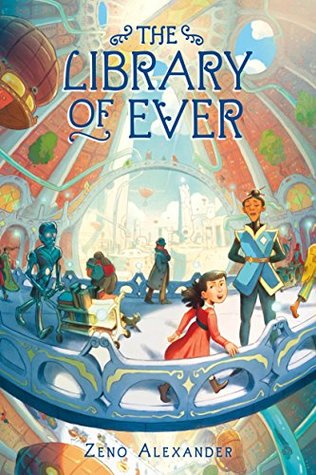 Lenora is a rich, privileged, eleven year old, cared for by a nanny in the absence of her vacationing, neglectful parents. With a nanny absorbed by shopping and tech devices, Lenora is understandably bored, but that changes quickly when she escapes the nanny’s unwatchful eye in the LIBRARY. To her delight, she is hired to work there. What follows is a series of magical librarian adventures. With each one of them, Lenora proves her worth and advances from Fourth Assistant Apprentice Librarian up through the ranks.
The adventures are fun and scary in this amazing library created by Zeno Alexander in The Library of Ever. Lenora is set on tasks by Malachi, the Chief Answerer, and she bravely confronts the Forces of Darkness who want to destroy Light in the world by destroying knowledge. The scary features are appropriate to Middle Grade readers with transporting by tubes, shrinking and unshrinking, dark caverns, holes that suddenly appear, evil men in bowler hats who can chill a room, and robots with spinning swords for arms. There are lighter moments too. Lenora becomes a cat in a diorama to rescue a lost kitten. Lenora is ever helpful, for as a librarian that is her job. Her good deeds include resettling a colony of penguins and helping a kindly robot find a lost memory. The plot moves quickly from adventure to adventure and is an appropriate length for Middle Grade readers. As an adult reader I enjoyed it too, smiling over antics and anticipating each new adventure along with each promotion for Apprentice Librarian Lenora who has always enjoyed the adventures to be found in books.
I would like to extend my thanks to netgalley.com and to Macmillan Children’s Publishing Group for giving me the opportunity to read this book in exchange for an honest review.
Rating: 4/5
Category: Children’s Fiction, Middle Grades
Notes: Ages: 8-11
Grades: 4-7
Publication: April 30, 2019—Macmillan Children’s Publishing Group
Memorable Lines:
Malachi burst onto the scene looking rather disheveled, meaning a wisp of hair had escaped from her bun and her badge was ever so slightly askew.
“This isn’t the Complaints Desk,” said Lenora shortly. “The Complaints Desk is down the stairs, across the hall, over the bridge, past the waterfall, then you take the fifth left after the third right and straight on ’til morning.” Lenora had no idea if there was a Complaints Desk. “You’ll also need ice skates.”
Remember, Lenora, you are not alone in this fight, even if it will feel like that sometimes. You have allies, and you can rely on them to help you with the battles you are not yet ready to fight.

