Home » Inspiration (Page 6)
Category Archives: Inspiration
We Were the Lucky Ones–Jewish Family in Poland, WWII
We Were the Lucky Ones
by Georgia Hunter
 We Were the Lucky Ones tells the story of a family of Polish Jews during what was arguably the most difficult time for Jews in European history. This work of historical fiction is written by Georgia Hunter, a descendant who spent years researching, traveling, and interviewing family members to uncover this amazing story of rare survivors. As the author notes, “By the end of the Holocaust, 90 percent of Poland’s three million Jews were annihilated; of the more than thirty thousand Jews who lived in Radom, fewer than three hundred survived.” Although it is fiction, it has been closely based on facts. The author also intersperses short paragraphs summarizing the historical events of World War II as they relate to this family and notes at the beginning of each chapter the date and location of the events in that section. We Were the Lucky Ones begins in March 1939 and concludes in 1947.
The novel moves through history by telling the story of each family member at various times through an excruciating eight year period. Some experience prison and the torture of interrogation; others endure Siberian work camps, life in a Polish ghetto, extermination by pogrom. The family members are subjected to various extremeties: death, disease, starvation, persecution, betrayal. Through all of these trials, one of their greatest pains is not knowing the fate of their loved ones. A constant theme is their unending love of family.
I would like to extend my thanks to netgalley.com and to the Penguin Group (Viking) for giving me the opportunity to read this book in exchange for an honest review.
Rating: 5/5
Category: Historical Fiction, General Fiction (Adult)
Publication: February 14, 2017–Penguin Group (Viking)
Memorable Lines:
But after a few days, they found they had little left to talk about. The chatter ceased and a funerary silence settled upon the train car, like ash over a dying fire. Some wept, but most slept or simply sat quietly, withdrawing deeper into themselves, encumbered by the fear of the unknown, the reality that wherever they were being sent, it was far, far away from home.
And suddenly, the consequences of this war were undeniably real–an understanding that sent Halina spiraling as she wrestled with the knowledge she both feared and loathed: she was powerless.
Nechuma used to reassure herself that they had lived through pogroms before, that in time, the fighting, the bloodshed would pass. But with the news from Lodz she’s come to understand that the situation they are in now is something entirely different. This isn’t just being subjected to profound hunger and poverty. This isn’t persecution. This is extermination.
The Simplest Way to Change the World–opening your home to others
The Simplest Way to Change the World
by Dustin Willis and Brandon Clements
Why would an introvert with no  gift for entertaining read a book on hospitality? True confession: when I clicked on a link in an email to see what the book was about, I was unknowingly requesting a review copy of the book. I have to admit I was intrigued by the subtitle: Biblical Hospitality as a Way of Life, and I had to wonder if maybe, just maybe, God was drawing me out of my comfort zone to show me a way that I could share the love of Jesus with others as a part of my daily life.
The Simplest Way to Change the World presents a biblical basis, both historically and scripturally, for hospitality: making your home, yard, and life open for engaging conversations with both non-Christians and other Christians. It shares the difference between entertaining (a high pressure show to convince others of your worth) and hospitality (opening your heart to others). A discussion of the rhythms of your life shows how to include others in what you and your family are already doing and also to intentionally create opportunities to include others. In addition, there are suggestions for “reverse hospitality”–how to share Jesus’ love with those who are uncomfortable with an invitation into your home or are physically unable to leave their own residence.
The authors include anecdotes from their own experiences as well as tales related by family and friends who are sharing their homes, lives, and hearts with others. They emphasize that hospitality can be planned or spontaneous, and they point out that Jesus’ ministry was not a three step plan, complete with PowerPoint, to bring people into a physical church building. Instead, He wandered from place to place, listening, sharing, and meeting people’s needs.
This is not a difficult read, not a philosophical or religious treatise. It is practical, sometimes humorous, and always interesting. It stimulates readers to think of ways they can use hospitality in their own circumstances, where God has located them, and with the people He brings into their lives. At the end of the book there is a helpful study guide for those who want to use this tool as a church or in a small group setting to learn about hospitality.
And as to the mouse click that brought The Simplest Way to Change the World to my iPad? No regrets here! Reading this book was a blessing.
I would like to extend my thanks to netgalley.com and to Moody Publishing for giving me the opportunity to read this book in exchange for an honest review.
Rating: 5/5
Category: Christian, Nonfiction
Publication: February 1, 2017–Moody Publishing
Memorable Lines:
And while the everyday use of our homes to welcome others may not feel like the most exciting cause in the world, we must remember that ordinary does not equal insignificant.
As you simply listen well, you practice Christ’s compassion. The world is full of people who halfway listen to others just so they can take their turn talking next.
But the voice of God sang a sanguine love song in the rubble of my world.
The end goal of hospitality is care and healing–we do the caring and Jesus does the healing.
The Angels’ Share–Is this homeless man Jesus?
The Angels’ Share
by James Markert
 It is hard to pigeonhole The Angels’ Share in the sense of literary category, theme, or purpose. The author, James Markert, has a history degree and categorizes The Angels’ Share as “commercial fiction set during historical times.” The publisher classifies it as both General Fiction (Adult) and Christian. Four major threads compete for attention–the Depression, Prohibition, the bourbon industry, and a confusing Christlike figure.
Times are particularly hard in the fictional town of Twisted Tree where Prohibition has raised unemployment levels due to the closing of the distillery. The family that owned the distillery mysteriously seems to fare well financially, but there are dark tones to their story.
Homeless people play a major role in this novel, as in almost any tale of this era. One, in particular, stands out: Asher Keating, who has already passed away when the story begins. A much decorated war hero who saved the lives of hundreds of fellow soldiers, he quietly accumulates a following as he roams around healing, feeding the hungry, and providing clothing. Is he Jesus fulfilling the second coming? Is he a guardian angel? Is he a lunatic?
The title The Angels’ Share emphasizes both the process of making bourbon and the religious and philosophical questions posed. According to the author, angels’s share is “the quantity of whisky lost to evaporation during the aging process.” Tradition says that distillers share their bourbon with the angels as an offering so they will protect the distillery from fire.
The Angels’ Share is a very different book and a worthy read. The characters and their struggles are interesting. The setting, both locale and time, are essential to the plot. I don’t consider it to be a “Christian” book because it doesn’t follow Biblical tenants and prophecies. It does have religion and relationship to God as thematic elements, and it does provoke thought about God, the homeless, and gifted individuals. The Angels’ Share is well-written with its complex threads telling a story with depth. The dialogue is appropriate to the era with lots of slang that has fallen out of popular usage, giving a realistic touch to conversations. The relationships of the various characters result in an interesting web as they move in and out of each others’ lives. There is even a romance that is integral to the plot, but does not dominate it. As The Angels’ Share concludes, many questions are answered about the characters, but others are appropriately left to the reader to ponder.
I would like to extend my thanks to netgalley.com and to Thomas Nelson for giving me the opportunity to read this book in exchange for an honest review.
Rating: 4/5
Category: General Fiction (Adult)
Publication: January 17, 2017 — Thomas Nelson
Notes: I was intrigued, but not surprised, that the passages I highlighted as I read this book mostly deal with Asher Keating, the Christlike figure. There are many selections that made comparisons with or echoed Biblical text; they lead the reader to pose questions about Keating and his purpose on Earth.
Memorable Lines:
Hope can change even the most stubborn of men.
In the author’s historical notes: …there are now more barrels of bourbon aging in Kentucky than people.
Let’s Change those Stereotypes!

The media in the U.S. often describes Mexicans with stereotypical terms–gangs, drugs, lazy. Let me shine a little light on the people who have shared their country with me for three years. I don’t know anyone in Mexico who fits into this stereotype, and why do we think we should throw people into a descriptive “basket” anyway? Are there people in Mexico who are unpleasant or criminal? Certainly, as there are the world over.
So, what kind of people have I encountered in Pátzcuaro, Mexico? Kind, generous, and family oriented. If you need a stereotype, try that one. In our town, people are so patient when we try to communicate in our broken Spanish. We had a lady take us across town to find a repair shop when she was clearly headed in a different direction. She even stopped several times to ask directions for us. A young man spent the day climbing up and down a ladder to clean the exterior windows of our two story house and then would not charge us anything. He only took some money when we insisted it was for “Navidad.”

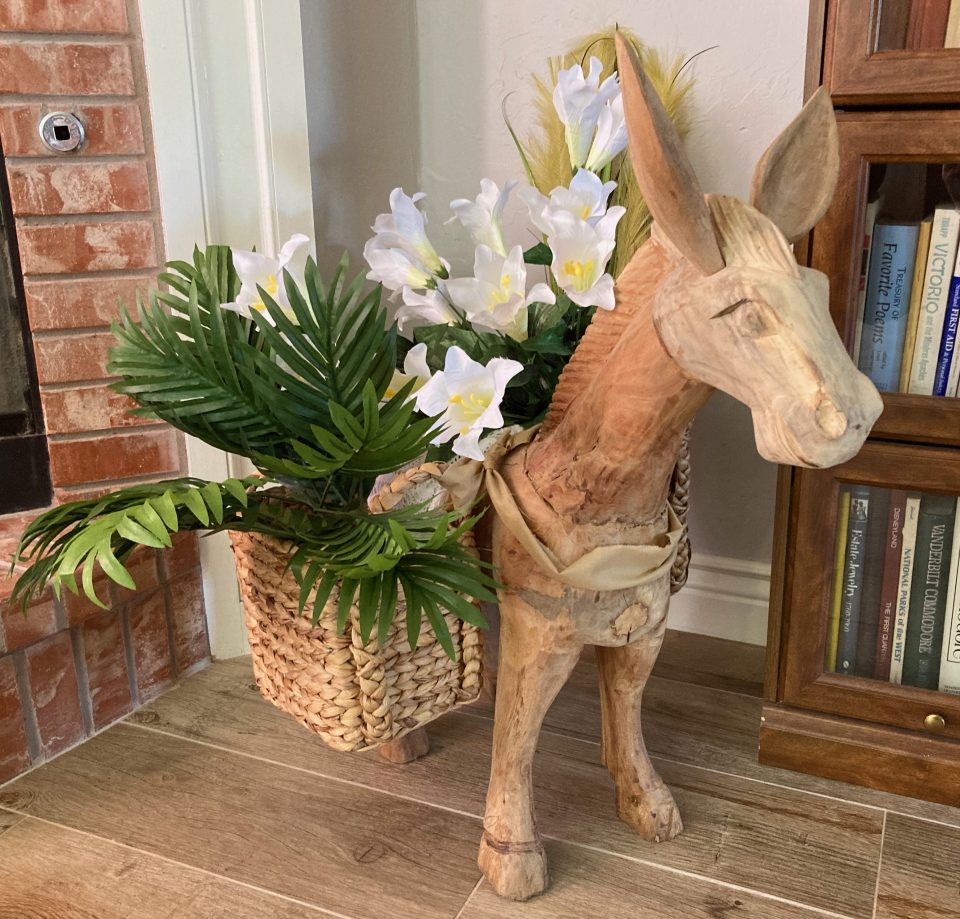
A beautiful plant called Alcatraz
The flowers were given to me by our hairdresser. She has a clean, but worn, little one room, one chair beauty shop with no apparent source of water. Parking is one slot on the side of a busy, curvy hill. Hours are indeterminate. But she is pleasant and does a great job of cutting our hair. When I asked her for the name of the plant explaining that I had one in my yard at home but would like to buy more, she insisted I take the vase of flowers home–“un regalo” (a gift).
We look different, talk different, and dress differently, but we experience kindness and generosity. This is my stereotype for Mexicanos.
Malala: Activist for Girls’ Education
Malala: Activist for Girls’ Education
by Raphaële Frier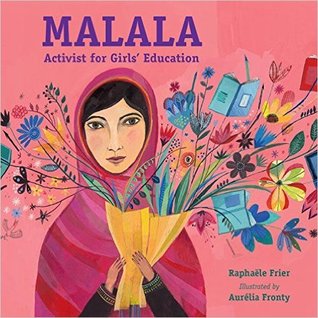
illustrated by Aurélia Fronty
The youngest recipient of the Nobel Peace Prize earned this award and world-wide acclaim through her activism in support of girls’ rights to education. Starting at age eleven, she began a courageous public battle against the Taliban and their destruction of girls’ schools in Pakistan. Malala: Activist for Girls’ Education, depicts Malala’s background and family support, her bravery in the face of Taliban violence, and her continuing efforts to bring light on rights’ issues for girls and women in particular, but including all downtrodden people.
The artwork is an essential part of this book, providing colorful symbolic images. At the end of the book there is a helpful timeline of events in Malala’s life as well as photographs of her. There is an added useful feature for parents and teachers who want to extend the study with information on Pakistan, education in Pakistan and the world, and Malala’s religion and inspiration. There are also brief discussions of other peacemakers: Gandhi, Mandela, and King. This section includes quotes from Malala as well as a listing of other sources of information about Malala including links to various important speeches she has made.
Teachers will find Malala: Activist for Girls’ Education a valuable teaching resource. It empowers both children and women to stand up for what is right and summarizes the religious and historical context in a way that is understandable and appropriate for children. This book could be used as an integral tool in many curricular units as well as to provoke thoughtful discussion by itself.
I would like to extend my thanks to netgalley.com and to Charlesbridge Publishing for giving me the opportunity to read this book in exchange for an honest review.
Rating: 5/5
Category: Younger Readers, Biography
Notes: recommended for ages 6-9
10 inches X 10 inches
48 pages
originally published in French
Publication: Charlesbridge Publishing–February 7, 2017
Memorable Lines:
One child, one teacher, one pen, and one book can change the world.
“Dear sisters and brothers, we realize the importance of light when we see darkness. We realize the importance of our voice when we are silenced. In the same way, when we were in Swat, the north of Pakistan, we realized the importance of pens and books when we saw the guns.”–Malala
“The extremists are afraid of books and pens. With guns you can kill terrorists; with education you can kill terrorism.”–Malala
An Open Apology To Dolly Parton
Dolly Parton has helped make readers one book at a time. Read this reblogged post if you do not know the story of Dolly Parton’s Imagination Library, her importance to the economy of Tennessee, or her generosity in the wake of the terrible fires.

Dear Dolly,
 I’ll be honest. I used to think you were a bimbo. I used to think you flaunted your big boobs, teased hair, tiny waist, and your syrupy-sweet southern accent to sell yourself and your brand as a country singer. Granted, I was raised in the Midwest and lived as an adult for many years in the Northeast. I didn’t get you, much less the South.
For example, I’d heard about your origins as a poor girl from the hills of East Tennessee, and when I learned you’d created a theme park in your native Sevier County I rolled my eyes. “Really, a theme park?” I thought. “As if rollercoasters will really help the people of rural Appalachia. Why not create something truly useful to give back to your community, like a library.”
Oh.
You have created a library, actually, and possibly in a bigger and more magical…
View original post 708 more words

The Bringer of Books and Smiles
Part teacher, part book lover, part entertainer–a true friend to homeless children!

For the last eight years, Colbert Nembhard has been bringing books (and smiles) to homeless children in The Bronx, New York.
Mr Nembhard, a librarian who’s been the manager of the Morrisania branch of the New York Public Library for 25 years, has been on a mission to making literacy a constant in their wandering and ever changing lives.
The New York Times reports:
“It’s a pleasure to come in here,” Mr. Nembhard began on that Wednesday, never removing his jacket during a presentation that was just short of a Mr. Rogers routine.
He began to sing, “Good morning to you,” and followed with “Wheels on the Bus.” The children joined in with a chorus of “round and round, round and round.”
Toddlers, fidgeting in their chairs or in their mothers’ arms, suddenly became fixated. They could not wait to flip open “Dear Zoo,” by Rod Campbell, a lift-a-flap book…
View original post 232 more words
Teenage Kindness–what a great idea
This may not be a typical education post, but ask any teacher how anxiety and isolation affect student learning.
SHERMAN OAKS, Calif. (CNN) – A California teen is sharing her high-tech way to handle lunch-room anxiety. Natalie Hampton, 16, struggled to make friends back in middle school. The hardest part of the day? Lunch time. “I ate along pretty much every day for the two years that I was there. And I have personally…
via California teen launches app to help others make friends at lunch — KRQE News 13
Escaping the Nazis on the Kindertransport–introduction to the Holocaust for younger students
Escaping the Nazis on the Kindertransport
by Emma Carlson Berne
 Many books have been written for middle school students about the Jews in Nazi Germany. In Escaping the Nazis on the Kindertransport, Emma Carlson Berne shares a piece of their story with children aged 8-12. As a teacher I could certainly see this book also being used as a resource for older students who are reading below grade level as it has an interest level appropriate to them as well.
The physical book is designed with the look and feel of an aging family picture album. There are seven chapters that focus on individual children who were part of the 10,000 children rescued from Nazi controlled areas and relocated to the United Kingdom prior to the beginning of World War II. Their story is told in the third person but from the child’s perspective.
The first chapter begins with a poem “The Leather Suitcase” written by Tom Berman who was saved as a 5 year old child by a Kindertransport. Some background is given as it describes what it must have been like for such a young boy to be separated from his parents for a long trip to an unfamiliar country with a different language, not knowing if he would ever see them again. This chapter captures the reader’s interest immediately.
The next chapter, “From Kristallnacht to Kindertransport,” gives more historical details about the increasing persecution of the Jews and their limited options for survival. Then the book returns to the stories of individual children, ending with a chapter that briefly recounts what happened to each child after the Kindertransport. It might be specifics of their time living with another family, further emigration, or an ultimate career, depending on their circumstances and the source documents available. There is also general statistical information about the 10,000 children of the Kindertransport.
There are study resources at the end of the book. The “Timeline” integrates important historical dates of the war with major events related to the Kindertransport and the seven children whose rescues are detailed in the book. The “Glossary,” of course, defines unfamiliar terms such as “haftarah” and “pogrom” which are used in the book. Next is a page which explains The Kindertransport Association (KTA), whose president was a consultant for the book. The KTA is comprised of the rescued Kinders, as they call themselves, and their descendants. “Read More” lists three more books on the topic for young readers. There is a page of discussion questions to evoke higher level thinking and several pages devoted to bibliography, source notes, and an index.
Escaping the Nazis on the Kindertransport is a valuable teaching resource, drawing from original sources. The length of the chapters is appropriate for this age level as well as for typical time periods in the school day. It could be used for independent reading or group study, but because of the difficult nature of the subject matter and the age of the intended reader, I definitely suggest adult support. The author handles the ugly reality of Nazi Germany with restraint without hiding the brutal truths of beatings, interments, and death. Being drawn into their stories will be troubling for some youngsters, especially those for whom this is their introduction to Holocaust studies.
I highly recommend Escaping the Nazis on the Kindertransport as an integrative teaching tool combining reading with social studies, especially history and geography. It abounds with possibilities for discussions to stretch young thinkers to make make new connections and offers opportunities for deep enrichment of vocabulary. Even as an adult, I found the book well written, interesting, and a source of new learning.
This book is scheduled for publication on February 1, 2017.
I would like to extend my thanks to netgalley.com and to Capstone Press for giving me the opportunity to read this book in exchange for an honest review.
My Pink Champagne Life–witty, autobiographical “must read”
My Pink Champagne Life
by Meredith Shafer

My Pink Champagne Life is an autobiographical work by Meredith Shafer who tries to celebrate all the big and little events that shape her life. The story touches on her first marriage and divorce, but focuses mainly on her marriage to Mr. Wonderful and on her blended multi-cultural family. I rarely read a book twice, but I probably will read this book again. It sparkles with wit and offers wisdom based in real experiences and a love of God.
Shafer pulls no punches about her life as she describes, often with tongue in cheek, what life is like in the (Mother) Hood—from the creativeness of her kids to the craziness of trying to juggle being a military wife, mother of four, public speaker, author, and lawyer who works from home directing a foundation.
With superlative turn of phrase, she injects humor into the telling of the messiness of everyday life and how God has carried her through. Shafer shares how God has molded her character through the good times and the bad. I wish this book had been around when I was a young mother. It will be an encouragement to women who want to be their best for God, who want to come to God without their Sunday mask on, ready to trust God to bring about changes in their lives.
Shafer has written another book which should hit the shelves on November 15, 2016. It is entitled Mad Cow: a PTSD Love Story. If you don’t want to wait until then, you can connect with the author on her website www.meredithshafer.com to buy it directly.
 education pathways