
Home » History (Page 4)
Category Archives: History
Putting It Together Again When It’s All Fallen Apart–rebuilding
Putting It Together Again When It’s All Fallen Apart
by Tom Holladay
 We all have times when we need to rebuild, whether it is a “church, a business, a relationship, or a purpose in your life” says Tom Holladay. He is the senior teaching pastor at Saddleback Church in Lake Forest, CA, and he uses the book of Nehemiah in the Bible as his foundation for teachings about “putting it together again when it’s all fallen apart.”
Do you, like me, need a reminder, a prod—who was Nehemiah anyway? Holladay says “Nehemiah was a government leader who rebuilt the wall of Jerusalem after it had fallen into ruin.” Actually, in the book I learned that Nehemiah also went on to reestablish the city, resettle its inhabitants, establish rules for commerce that aligned with God’s laws, and give thanks to God for completing the project which naysayers said couldn’t be done.
Holladay takes a book of the Old Testament that could be boring and makes it come alive. He analyzes the text well and applies it in a very practical way to a variety of situations from personal to business. He gives examples of how real people have used these principles successfully in their lives. I especially like that this is not a verse by verse study of Nehemiah; Holladay explains how Nehemiah worked through the problems of his building project and how we can apply the same Scriptures in our own lives.
I highly recommend this book for its interesting content and writing style and for its Scriptural insights and integrity. There are so many possible applications that I think every reader will come away enlightened and blessed in their daily walk with God.
I would like to extend my thanks to netgalley.com and to Zondervan for giving me the opportunity to read this book in exchange for an honest review.
Rating: 5/5
Category: Christian
Notes: This book ends with a Small Group Study Guide and references 10 minute videos available on YouTube to accompany each chapter.
Publication: February 6, 2018–Zondervan
Memorable Lines: (Just way too many—a sign of a book with a lot of wisdom—so I’ll just pull out a few of the first ones I highlighted.)
Gossipers love to destroy what others are building. It gives them a twisted sense of power.
Victory comes from your relationship with God. Nehemiah exemplifies dependence on God at every point in the battle: he talks to God in prayer, follows God in the changes, listens to God in his encouragement, and lives by means of God’s priorities through God’s Word.
Rebuilders must have thick skin because they’re going to face attack. That attack may come from an individual, but it can also come from within. One of the names for Satan in the Bible is “the accuser” (Revelation 12:10). He loves to ridicule your faith. So he’ll send a thought when you want to renew your faith, a relationship, a ministry, or a dream.
Road Trip to the South!
This summer I took a road trip from New Mexico to the South to visit friends and family. My route took me through the Texas Panhandle, Oklahoma, Missouri (going East), Kentucky, Tennessee, North Carolina, and Arkansas (going West). I was driving my appropriately designated “Desert Sky Blue” Ford Thunderbird, but going through my head was “See the U.S.A. in your Chevrolet.” I hope the people who came up with that ad campaign, tune, and lyrics were well compensated–now that was branding!


Most of my time was well spent reminiscing and catching up. I was treated to some sightseeing along the way.


Paducah, Kentucky, is restoring its downtown area. So much interesting history there! We had a delicious lunch at a bakery that survived a major flood and currently includes a café, walked the brick paved streets admiring period storefronts, viewed fantastic murals along the riverbank, and lingered in a local museum with fascinating memorabilia.


In Asheville, North Carolina, I enjoyed the Blue Ridge Parkway.

In Chattanooga, Tennessee, I went to the National Cemetery. It may seem like a strange place to visit, but I have memories of going there as a little girl with my father like you would go to a park. I had a fuzzy recollection of a “train statue” and was eager to make a better connection. There is a memorial there to Andrews’ Raiders and the Great Locomotive Chase, a military raid in 1862 during the American Civil War. The locomotive pictured below is a model of The General. The memorial is surrounded by tombstones of some of those involved and indicates which ones were executed, escaped, or exchanged.


A bit of history has been brought to life in the James County Courthouse which has been remodeled with a wedding chapel upstairs and a tearoom, which I highly recommend, beneath–wonderfully decorated, delicious food, and a friendly staff.

Always good to travel and always good to return to a place you call home. The New Mexico desert is a welcome sight as I head towards my mountain retreat.

Raisins and Almonds–even the title is a mystery
Raisins and Almonds
by Kerry Greenwood
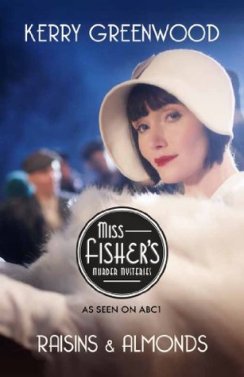 Raisins and Almonds is a typical Phryne Fisher mystery, but somewhat more cerebral. Evidence of that is found in the inclusion of a bibliography reflective of the author’s research and a glossary of Yiddish words. This mystery is strongly tied into the Jewish community that settled in Australia, the politics of Zionism, and a sub-sect focused on alchemy. Phryne has to do a lot of research in addition to her usual methods of sleuthing in order to find the murderer of a young Jewish scholar and free an innocent bookseller from prison.
Greenwood excels in this book in three ways. She uses the supporting characters to good advantage in solving the mystery as she sends her adopted daughters, her assistant Dot, and friends Bert and Cec out on different missions which play to their strengths. Phryne and Jack agree on the bookseller’s innocence enabling them to cooperate in their separate missions to solve the mystery. The ending of Raisins and Almonds is a fun surprise which wraps up the mystery and the title quite satisfactorily.
I would like to extend my thanks to netgalley.com and to Poisoned Pen Press for giving me the opportunity to read this book in exchange for an honest review.
Rating: 5/5
Category: Mystery, Historical Fiction
Notes: #9 of Miss Fisher’s Murder Mysteries
Publication: June 6, 2017—Poisoned Pen Press
Memorable Lines:
Phryne smiled guilelessly into the policeman’s face. He winced. Miss Fisher was at her most dangerous when she was smiling guilelessly. It was a sign that someone, somewhere, was about to be shaken down until their teeth rattled and the Detective Inspector was uneasily aware that he was the closest available target.
Bert was nervous because he didn’t know what to look for in this big bustling market. Neither did Cec, but his Scandinavian ancestors had bequeathed him some Viking fatalism. If they were meant to find out, they’d find out.
Kadimah was as ordinary as a church hall, and as extraordinary as a landing of Well’s Martians. It was as sane as porridge and as lunatic as singing mice.
Tightening the Threads–family secrets abound
Tightening the Threads
by Lea Wait
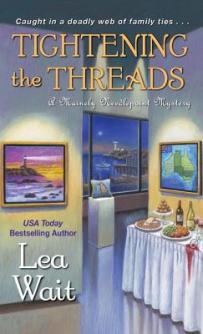 Tightening the Threads is a very good cozy mystery, set in Maine and focusing on family relationships Most of the characters in the story are the product of dysfunctional to nonexistent relationships with their parents. Some emerge from childhood with pain and an inability to have meaningful connections. Others find solace and stability with extended family or build strong bonds with friends.
There are mysteries to be solved that tie into the relationship issues; these crimes center around the patriarch Ted Lawrence, son of famous artist Robert Lawrence. The novel shows us once more that money and fame do not necessarily insure happiness or wisdom.
This author obviously has an interest in needlework in general and needlepoint in particular as evidenced by her main characters belonging to a group called the Mainely Needlepointers. She displays her historical interest by starting each chapter with a quote from a child’s sampler as well as a description of the sampler and information about the creator as available. I enjoyed this book and am definitely interested in reading more by author Lea Wait.
I would like to extend my thanks to netgalley.com and to Kensington Books for giving me the opportunity to read this book in exchange for an honest review.
Rating: 4/5
Category: Mystery
Notes: #5 in the Mainely Needlepoint Mystery Series, but works as a standalone.
Publication: March 28, 2017–Kensington Books
Memorable Lines:
During the ten years I’d lived in the almost perpetually neutral shades of Arizona, I’d missed seeing Maine hills glowing with gold and scarlet and orange in late September.
“Love you, too. As always, for always.”
“I think all families have mysteries, and secrets, and stories. I don’t think they’re all meant to be uncovered.”
Families weren’t simple. They weren’t like television show casts where everyone supported everyone else and laughed over dinner.

Of Hats, Pockets, Ears, and Hidden Messages
I read so many fascinating tales and review them in my blog, but probably none outshine the real story of Esther found in the Bible. Here my blogging friend Dolly (KOOLKOSHERKITCHEN) shares the original tale along with traditions that have developed and are part of the celebration of Purim. Don’t miss the funny video and delicious recipe she shares as well.

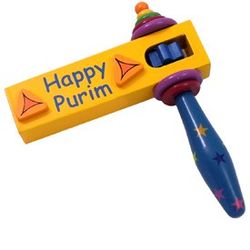
These pastries are called Hamantaschen. We can no more imagine the holiday of Purim without them than without the graggers – noisemakers gleefully shaken by children and adults alike to drown the name of the evil villain Haman.
That’s a story of Purim in a nutshell. Once again, the Jewish people, marked for wholesale slaughter, were saved through the good offices of the beautiful and pious Queen Esther and her uncle, the wise and righteous Mordechai. To commemorate this event, we read (or at least listen to) Megillas Esther (the Scroll of Esther) where the entire story is recorded in minute details. Every time when Haman (may his memory be erased forever) is mentioned, we make all kinds of noises, and not necessarily by using traditional graggers that look like this:
…but also anything that makes loud noises. I play castanets. A friend of mine, a very reserved lady…
View original post 1,545 more words
Malala: Activist for Girls’ Education
Malala: Activist for Girls’ Education
by Raphaële Frier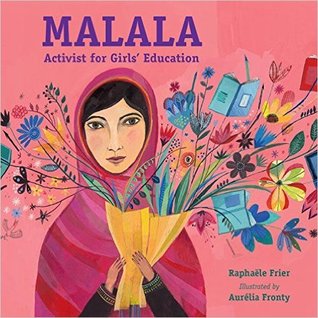
illustrated by Aurélia Fronty
The youngest recipient of the Nobel Peace Prize earned this award and world-wide acclaim through her activism in support of girls’ rights to education. Starting at age eleven, she began a courageous public battle against the Taliban and their destruction of girls’ schools in Pakistan. Malala: Activist for Girls’ Education, depicts Malala’s background and family support, her bravery in the face of Taliban violence, and her continuing efforts to bring light on rights’ issues for girls and women in particular, but including all downtrodden people.
The artwork is an essential part of this book, providing colorful symbolic images. At the end of the book there is a helpful timeline of events in Malala’s life as well as photographs of her. There is an added useful feature for parents and teachers who want to extend the study with information on Pakistan, education in Pakistan and the world, and Malala’s religion and inspiration. There are also brief discussions of other peacemakers: Gandhi, Mandela, and King. This section includes quotes from Malala as well as a listing of other sources of information about Malala including links to various important speeches she has made.
Teachers will find Malala: Activist for Girls’ Education a valuable teaching resource. It empowers both children and women to stand up for what is right and summarizes the religious and historical context in a way that is understandable and appropriate for children. This book could be used as an integral tool in many curricular units as well as to provoke thoughtful discussion by itself.
I would like to extend my thanks to netgalley.com and to Charlesbridge Publishing for giving me the opportunity to read this book in exchange for an honest review.
Rating: 5/5
Category: Younger Readers, Biography
Notes: recommended for ages 6-9
10 inches X 10 inches
48 pages
originally published in French
Publication: Charlesbridge Publishing–February 7, 2017
Memorable Lines:
One child, one teacher, one pen, and one book can change the world.
“Dear sisters and brothers, we realize the importance of light when we see darkness. We realize the importance of our voice when we are silenced. In the same way, when we were in Swat, the north of Pakistan, we realized the importance of pens and books when we saw the guns.”–Malala
“The extremists are afraid of books and pens. With guns you can kill terrorists; with education you can kill terrorism.”–Malala
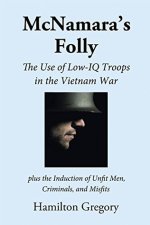
McNamara’s Folly: the Use of Low-IQ Troops in the Vietnam War
by Hamilton Gregory
This is a fascinating presentation by Hamilton Gregory (author, public speaker, educator, and journalist) at a college book signing for a book he wrote about using low-IQ soldiers in war. He draws on his own experiences in the Vietnam War as well as extensive research. His goal is to give a voice to those who were not able to speak up for themselves and to their families whose warnings were not heeded. In the prologue he says:
“While I was in the Army (1967-1970), I got to know some of McNamara’s substandard soldiers, and I vowed that someday I would tell their stories and give the historical background. This book is the fulfillment of that vow.”
Rating: 5/5
Category: Military History
Notes: Hamilton Gregory is my brother. I am aware that current protocol for reviewers is that they should not review the works of relatives. I, however, do no advertising and I make no money from this blog. I am retired, and this blog is my personal space for reflection on education and on books. I feel strongly that this is an excellent book and tells a tale that needs to be shared. I do highly recommend that you read it. You don’t have to be interested in military history; you just have to care about people. For official reviews and recommendations, I suggest you visit Amazon.com where people who are experienced experts in the field and are more qualified than I am have posted reviews. From my non-military viewpoint, I am amazed at the way the author intertwines data with the stories he gathered to make a compelling argument that our country should never let this happen again.
 Publication: Infinity Publishing–June 2015
Memorable Lines: “Freddie’s death hit me hard. I remembered how he was always sighing–an indication of the tremendous anxiety he experienced in Special Training. I remembered how he lacked the mental quickness to qualify with the M-14 rifle. I felt enormous anger, which I still feel decades later. He never should have been drafted. He never should have been ‘administratively passed’ at Special Training. He never should have been sent into combat.”
Escaping the Nazis on the Kindertransport–introduction to the Holocaust for younger students
Escaping the Nazis on the Kindertransport
by Emma Carlson Berne
 Many books have been written for middle school students about the Jews in Nazi Germany. In Escaping the Nazis on the Kindertransport, Emma Carlson Berne shares a piece of their story with children aged 8-12. As a teacher I could certainly see this book also being used as a resource for older students who are reading below grade level as it has an interest level appropriate to them as well.
The physical book is designed with the look and feel of an aging family picture album. There are seven chapters that focus on individual children who were part of the 10,000 children rescued from Nazi controlled areas and relocated to the United Kingdom prior to the beginning of World War II. Their story is told in the third person but from the child’s perspective.
The first chapter begins with a poem “The Leather Suitcase” written by Tom Berman who was saved as a 5 year old child by a Kindertransport. Some background is given as it describes what it must have been like for such a young boy to be separated from his parents for a long trip to an unfamiliar country with a different language, not knowing if he would ever see them again. This chapter captures the reader’s interest immediately.
The next chapter, “From Kristallnacht to Kindertransport,” gives more historical details about the increasing persecution of the Jews and their limited options for survival. Then the book returns to the stories of individual children, ending with a chapter that briefly recounts what happened to each child after the Kindertransport. It might be specifics of their time living with another family, further emigration, or an ultimate career, depending on their circumstances and the source documents available. There is also general statistical information about the 10,000 children of the Kindertransport.
There are study resources at the end of the book. The “Timeline” integrates important historical dates of the war with major events related to the Kindertransport and the seven children whose rescues are detailed in the book. The “Glossary,” of course, defines unfamiliar terms such as “haftarah” and “pogrom” which are used in the book. Next is a page which explains The Kindertransport Association (KTA), whose president was a consultant for the book. The KTA is comprised of the rescued Kinders, as they call themselves, and their descendants. “Read More” lists three more books on the topic for young readers. There is a page of discussion questions to evoke higher level thinking and several pages devoted to bibliography, source notes, and an index.
Escaping the Nazis on the Kindertransport is a valuable teaching resource, drawing from original sources. The length of the chapters is appropriate for this age level as well as for typical time periods in the school day. It could be used for independent reading or group study, but because of the difficult nature of the subject matter and the age of the intended reader, I definitely suggest adult support. The author handles the ugly reality of Nazi Germany with restraint without hiding the brutal truths of beatings, interments, and death. Being drawn into their stories will be troubling for some youngsters, especially those for whom this is their introduction to Holocaust studies.
I highly recommend Escaping the Nazis on the Kindertransport as an integrative teaching tool combining reading with social studies, especially history and geography. It abounds with possibilities for discussions to stretch young thinkers to make make new connections and offers opportunities for deep enrichment of vocabulary. Even as an adult, I found the book well written, interesting, and a source of new learning.
This book is scheduled for publication on February 1, 2017.
I would like to extend my thanks to netgalley.com and to Capstone Press for giving me the opportunity to read this book in exchange for an honest review.
Saving Graces–Review AND Reflections
Saving Graces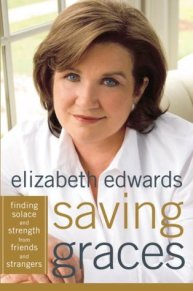
by Elizabeth Edwards
Elizabeth Edwards was the wife of John Edwards, a Democratic senator, an unsuccessful presidential primary candidate in 2004 and 2008, and running mate for John Kerry in the 2004 presidential election. Elizabeth was a popular and sympathetic public figure because of the death of her son at age sixteen in a car accident, her courageous battle with breast cancer, and revelations of her husband’s ongoing affair during her health struggles.
Elizabeth Edwards published the book Saving Graces in 2006, two years after she was diagnosed with cancer and the same year her husband began his infamous affair with Rielle Hunter, which he did not publicly admit to until August of 2008. I am laying out the dates carefully because I found it a bit confusing as Edwards begins telling her story at the same place in her life that she ends this book. Also, because she was such a family-oriented person, I had to wonder at what point in her painful saga was she unknowingly being betrayed by her husband. There is no foreshadowing of the affair.
No spoiler alert is needed on this review. Edwards in this memoir is sharing very personal insights into the events of her life up through the close of her treatment for the cancer that was discovered in November of 2004. The facts along with all the rumors of the time are readily available on the Internet.
I must warn potential readers that the first half of this book is a very difficult read. Most of it deals with the very raw grief which Edwards and her family experienced upon the sudden and unexpected death of her sixteen year old son Wade in a car accident. Although the distance of time helps, when she wrote the book she was still experiencing deep sorrow over his absence. Although Elizabeth Edwards worked as a lawyer, author and speaker, the job that was most important to her was that of mother. She loved the presence of her children and their friends filling her home. She loved interacting with them. When Wade died she seemed to lose a part of herself, of her reason for living. I hope the writing of this book proved cathartic for her. Her grief is so real and so painful that I had to put it aside for a few days.
Upon returning to Saving Graces I was relieved to find a turn of focus away from the pain of Wade’s death and toward the future as Elizabeth and John Edwards decide to extend their family and continue to be deeply involved in political races. Even reading about her first battle with cancer was not as painful as the discussion of the aftermath of her son’s death. Though fearful of losing to breast cancer, Edwards knew it was something she could fight. Speaking of the diagnosis she said “…it wasn’t, by a sad and huge distance, the worst news we had ever heard. Wade’s death had spared us that…”
As the United States is currently pushing toward presidential elections, I found glimpsing the campaigns from behind the scenes to be an interesting endeavor. It made me like Elizabeth Edwards better and most of the rest of the political players and the process even less. That outcome was certainly not Edwards’ intention or attitude in writing, but I am too jaded to view the political process through her rose-colored glasses of “John (Edwards) just wants to help people” (not a direct quote, but a phrase that certainly reflects her thoughts). In my opinion, based on later evidence available after this book was written, John Edwards had one goal–to enrich himself. His desires were for money, power, sex, and the flattery of younger women. During the last half of the book, I kept wanting to yell across the pages to Elizabeth that she was living in a house of cards about to collapse on her. I wanted to warn her that her wonderful family man was going to cheat on her, destroying the family she adored so much. I wanted to shout out a danger signal–this man you thought you could count on is going to pay you the ultimate disrespect while you are on the campaign trail telling others how wonderful he is.
Saving Graces has a very appropriate subtitle: Finding Solace and Strength from Friends and Strangers. In the first half of the book, the solace and strength come from others who have lost children. In the second part, she shares the outpouring of love and concern she received when she publicly announced her battle with cancer.
Elizabeth Edwards wrote another book, Resilience: Reflections on the Burdens and Gifts of Facing Life’s Adversities, which continues her story including the return of cancer and the Hunter affair. Although Edwards is a good writer and I sympathize with the tremendous pain she endured physically, mentally, and emotionally, I just don’t know if I will choose to read her detailing of it in Resilience. It seems bad enough that she had to live it.
Cliff Notes for American History???
 Everything You Need to Ace American History in One Big Fat Notebook is geared to Middle School Students, but makes an excellent reference for adults as well. The text is marked up with various colors of highlighter to emphasize the most important points. Periods are outlined so students can visualize a timeline of events, but are fleshed out enough that cause and effect are included making history more understandable and thus more memorable. Out of approximately 500 pages, I chose to read about the Civil War and Reconstruction periods because of a discussion with a colleague. I was not disappointed: I came away with answers to some questions and a better overall understanding of the events in a fairly brief amount of time. Obviously, since it was written for middle school students, it was not an exhaustive treatise on the Civil War, but it was a great summary and beginning place for more in-depth research. One of the difficulties of studying American History at any grade level is that is nearly impossible to cover the full history of America in one school year. With this supporting text, one could independently study periods that are not studied in class.
As an independent reviewer, I usually read a book one time and then move on to the next book. In this case I was looking forward to having Everything You Need to Ace American History in One Big Fat Notebook on my iPad as a reference and work through the various periods as a side hobby. As a tribute to the book’s usefulness, I must say I was disappointed to discover that this book has an expiration date and is no longer available to open. Who knew a book could be like a carton of milk? I guess I will purchase a copy!
Everything You Need to Ace American History in One Big Fat Notebook has a proposed publication date of August 9, 2016. I would like to extend my thanks to netgalley.com and to Workman Publishing for allowing me to read and review this book in exchange for an unbiased review.
 education pathways