
Home » Historical Fiction (Page 9)
Category Archives: Historical Fiction
Woman of Courage–a glimpse of Quakers in 1837
Woman of Courage
by Wanda E. Brunstetter
 Author Wanda E. Brunstetter is best known for her fiction books about the Amish. In Woman of Courage, she departs from that focus to write a work of historical fiction whose main character is a Quaker. Amanda Pearson, rejected by her fiancé in New York in 1837, decides to move across the continent to join a missionary couple ministering to the Nez Percé Indians in the Oregon Territory. The first part of her journey is by steamboats and then wagon. At Fort Laramie, she and her father meet up with the guide who is hired to take them the rest of the way by horseback.
Amanda is unprepared for the adventures to come, but she proves to be resilient, courageous, and of strong faith. On her journey she faces the deaths of those she depends on, wild animals, rough mountain men, and Indians from several tribes. Will she make it all the way to Oregon Territory? Can she be dissuaded from her faith in God by the devastations in her life? Will she ever be able to love again?
Brunstetter has researched the time period. She doesn’t fall back on stereotypes for the Quakers, mountain men, or Indians, but portrays them as individuals. This is a Christian book, but it doesn’t play out as a tale where everything works out with magical perfection for the characters who are Christians. They experience internal turmoil and external dangers like nonbelievers, but they have a strong God to rely on during the good times and the bad.
Several times I found myself reading on past my intended stopping place—always a good sign for a book. There are a number of occurrences that I just didn’t predict which keep the book moving at a brisk pace. The characters are well developed and interesting. The various settings are described in detail, appropriate to the action in the book and with language that lets the reader visualize the grandeur of nature. A novel with a Christian theme, it contains history, romance, and action along with thought-provoking concerns about evangelizing other cultures.
I would like to extend my thanks to netgalley.com and to Barbour Publishing (Shiloh Run Press) for giving me the opportunity to read this book in exchange for an honest review.
Rating: 4/5
Category: Christian, Historical Fiction
Notes: There are discussion questions at the end of the book. My version also contained a novella, Woman of Hope, based on a characters from Woman of Courage. It is a quick, interesting bonus read, and as expected, because of the brevity of the work, does not hold much character development.
Publication: December 1, 2018— Barbour Publishing (Shiloh Run Press)
Memorable Lines:
Gray Eagle didn’t mind them teaching his people from the Bible, but it wasn’t right that they expected the Nez Percé to give up many of their customs in favor of the white man’s way of doing things.
She remembered her father saying once that it was important to forgive someone who had wronged you, but that forgiving didn’t mean you had to be in a relationship with them. Sometimes it was best to keep a safe distance from the person who had done you wrong.
“…God, who I believe is the same as the Great Spirit we have worshiped for so many years. I believe it was God who kept me alive when I was taken from my people. He got me through times when I didn’t think I would survive, and it was Him who brought me home again.”
The Only Woman in the Room–beauty, talent, and brains
The Only Woman in the Room
by Marie Benedict
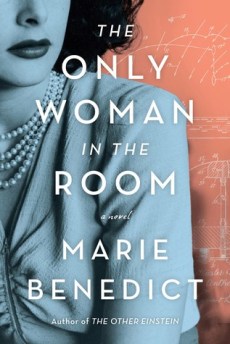 We meet Hedy Kiesler as a young actress in Vienna, Austria, in 1933 just as munitions manufacturer Friedrich (Fritz) Mandl begins courting her. Europe is on the cusp of war, and Hitler has started his attack on Jews. Under other circumstances, Hedy’s parents might have refused permission for the courtship, but they could see the benefit of a marriage to the rich, powerful, and well connected man.
Unfortunately, Mandl’s character changes after their marriage, and he becomes abusive and controlling. Hedy’s father had encouraged her as a child in studying many subjects, especially the sciences. Hedy teams her interest in science with her position as an ornament at dinner parties to listen in on the conversations of dangerous and powerful guests in the Mandl home. Later, after escaping from Fritz, she tries to use that knowledge to save lives as Hitler continues his military advances.
The book is divided into two parts. The first part deals with Hedy, her marriage, and the entrance of the United States into the war. The second focuses on her two careers after her escape from Fritz: one as the famous Hedy Lamarr (her new, non-German sounding, stage name) and the other as an inventor. Her talents as an actress and her incredible beauty outweigh her potential contributions to the war effort in the eyes of the men in power at that time.
In The Only Woman in the Room, Marie Benedict has created a historical novel about a very complex woman living in times that were difficult for everyone, but especially for women. It is important to remember that even though the book is well researched, Benedict is basically filling in the skeleton of a plot with details, some of which are true and others that only might have occurred. In this book Hedy is overcome with guilt over hearing Hitler’s plans but not doing anything about them. She doesn’t believe in God, but she is dogged by a fear that she has not done enough to make up for her silence and inaction. Of course, as she finds out later, as a woman there was little she could contribute that would be valued. During the last part of the book, I couldn’t help but wonder whose scales she was concerned about—her own sense of morality, public opinion, or judgement by a higher being. That was never clarified and yet it appeared to be a driving force for her.
I liked this book but not as much as Benedict’s two prior books, The Other Einstein and Carnegie’s Maid. All three novels address the hidden contributions of women. All three ladies are women of talent and intellect operating under difficult circumstances. All deserve respect, but I think I can empathize more with Mileva, Einstein’s first wife, and with Clara, a lady’s maid in Andrew Carnegie’s household. Hedy was born into privilege and by virtue of her beauty moved in important social circles. Although perhaps it shouldn’t, that background erects a barrier for me.
The Only Woman in the Room is a well-written and well-researched historical novel. Benedict specializes in drawing out the stories of women whose intellectual abilities have been overlooked. It will be interesting to see whose story she will discover and share in her next historical novel.
I would like to extend my thanks to netgalley.com and to Sourcebooks Landmark for giving me the opportunity to read this book in exchange for an honest review.
Rating: 4/5
Category: Historical Fiction
Publication: January 8, 2019—Sourcebooks Landmark
Memorable Lines:
I’d become like one of the Rembrandts on the wall or the antique Meissen porcelain on the sideboard. Simply another priceless, inanimate decoration for Fritz to display, a symbol of his wealth and prowess.
It seemed that my best chance of undermining the Third Reich—and ensuring that a German submarine or ship never again harmed a ship full of refugee children—might be to somehow use the knowledge I’d gathered to capitalize on the weakness in the German torpedo systems.
“I must admit it would be hard for us to sell our soldiers and sailors on a weapons system created by a woman. And we’re not going to try.”
The Christmas Prayer–Christmas surprises
The Christmas Prayer
by Wanda E. Brunstetter
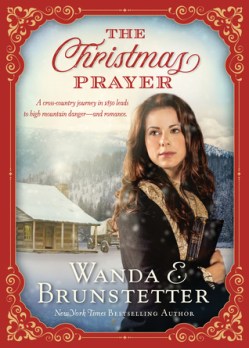 Wanda Brunstetter has a little gift for readers in her sweet novella The Christmas Prayer. Departing from her usual Amish fare, Brunstetter creates a tale of three families headed west in a tiny wagon train over the Sierra Nevada mountains with a goal of California: a businessman with his fiancé and her mother, a capable blacksmith in search of gold, and a widower traveling with two young children traumatized by the death of their mother.
Given the length of the book, there is not much opportunity for either plot or character development. The ending is predictable, but overall the novella is a nice addition to the genre of Christian historical fiction.
I would like to extend my thanks to netgalley.com and to Barbour Publishing (Shiloh Run Press) for giving me the opportunity to read this book in exchange for an honest review.
Rating: 4/5
Category: Christian, Historical Fiction
Notes: novella
Publication: September 1, 2018— Barbour Publishing (Shiloh Run Press)
Memorable Lines:
Is it always going to be this way—Walter treating me like a piece of property and acting like he owns me?
Despite their situation, it seemed that God was intervening, giving hope each time they felt defeated.
She didn’t want anything to spoil the day—something she knew Walter was capable of doing in just a matter of seconds.
Treacherous is the Night–once a spy, always a spy?
Treacherous is the Night
by Anna Lee Huber
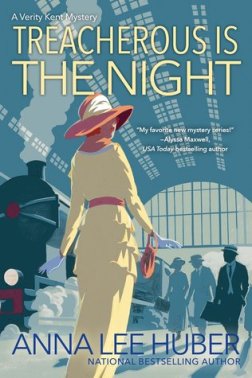 Although the Great War is over, no one is over the Great War in Anna Lee Huber’s Treacherous is the Night. Every family has been affected by the huge number of fatalities and the return of badly wounded soldiers. Civilians carry the memories of deprivation and on the continent all live daily in the midst of destruction and rebuilding. For Verity Kent, the end of the war means reunion with a husband long thought dead and the end of her dangerous stint as a spy. Verity is dragged back into the aftermath of the war when she is an unwilling participant in a séance that is an obvious hoax.
Verity and her husband are trying to sort out their difficult relationship, but manage to put their struggle aside to solve the mystery, decipher codes, and discover who is lying. Huber does an excellent job of putting the reader in the timeframe right after the end of the war, and she reveals the horrors of war without being graphic. She portrays Verity as a woman restricted by the times she lives in, but capable and competent to achieve so much more than is expected from a woman in that period.
I enjoyed Treacherous is the Night and would like to read the first book in the series for more background and to experience Verity’s previous adventures.
I would like to extend my thanks to netgalley.com and to Kensington Books for giving me the opportunity to read this book in exchange for an honest review.
Rating: 5/5
Category: Historical Fiction, Mystery
Notes: #2 in the Verity Kent Series, but acceptable as a standalone.
Publication: September 25, 2018—Kensington Books
Memorable Lines:
We might be incapable as of late at discussing anything of importance, but as well-educated upperclass Brits, we could always rely upon our proficiency at inane small talk. After all, we’d been drilled in it since the cradle.
But in my estimation, he was naught but an officious pig, no offense to the swine.
“…the truth is war is hell on everyone who falls near its angry maw. The actions you take thinking to spare the innocent or inexperienced can just as easily cause their destruction, simply because the world is turned so bloody upside down.”
My Real Name is Hanna–extremes of human behavior
My Real Name is Hanna
by Tara Lynn Masih
 My Real Name is Hanna is the story of a Jewish girl and her family who live under horrible circumstances in Ukraine to escape death at the hand of the Nazis and others. This book by Tara Lynn Masih has much potential. Many parts of the survival tale are drawn from the story of a real family that had to live underground. The first part of the book bounces around a little and then settles down into a sequential tale. Although it is a sad story, I didn’t really find myself emotionally involved with any of the characters. Parts of the narrative got my attention, such as when family members were in danger. I wanted to see them survive, but mainly I wanted the book to be over.
The author uses words from other languages freely. I like the authenticity of that but I would have appreciated a glossary, and I think young people would find that helpful as well. The area the family lives in has been occupied by many countries so there are competing cultures and languages—Jewish, Polish, Ukrainian, Russian, and German.
I actually found the “Historical Notes” at the end of the book more interesting than the book itself. Unfortunately, the author includes her own political stance on current events in these historical notes. If she wants to put forth these ideas in her book, I would suggest she do it in an editorial type section separate from a discussion of the historical basis of the book. Like the author, I hope the day will come when we don’t need reminders of the Holocaust as cautionary tales against cruelty. I don’t think, however, that it is appropriate to use her historical notes as a platform for indoctrinating young people into her political views. The story should stand on its own merits, and young people are capable of reading the book and making their own moral conclusions.
I would like to extend my thanks to netgalley.com and to Mandel Vilar Press for giving me the opportunity to read this book in exchange for an honest review.
Rating: 3/5
Category: Historical Fiction, Teens
Notes: Interest Level—Ages 12 and up
Grade Level 10-12
Publication: September 25, 2018—Mandel Vilar Press
Memorable Lines:
I see in my mind again those posters in the window, the big red letters, the lice, the blaming of Jews for the war. Someday, someone will betray us. For money, for food, for their own lives spared.
I can now hear what sounds like heavy boots approaching the house from down the lane, grinding the dirt and gravel with their murderous purpose.
When you’re hidden away, with no freedom, you crave news of the outside world as much as you crave food.
Dark Tide Rising–disappointing
Dark Tide Rising
by Anne Perry
 I know that Anne Perry is a celebrated author with two main series and many other books to her credit. Therefore, I was really looking forward to reading this work of historical fiction, a genre I have come to enjoy recently. Unfortunately, I was disappointed. A lot of Dark Tide Rising centers around a betrayal that is central to understanding the kidnapping and murder of Kate Exeter. When I say “a lot,” I mean Perry belabors the points to the extent of redundancy. Also, I figured out the identity and motive of the murderer early on in the book. The last courtroom scene of the book is interesting as it establishes proof of the murderer and motives for the actions of some of the minor characters. Another overly emphasized point is that Monk’s wife Hester served with Florence Nightingale in the Crimean War. Although Nightingale has long had my admiration, I do not think any and every association with her needs to be touted as proof of a woman’s fortitude. On a positive note, I did enjoy learning about the Thames River Police.
Although I was anxious to bring this book to a close, I am open to reading another by this author. I want to determine if the problem is this particular book or if Perry’s books are just not a good fit for me.
I would like to extend my thanks to netgalley.com and to Random House (Ballantine) for giving me the opportunity to read this book in exchange for an honest review.
Rating: 3/5
Category: Historical Fiction, Mystery
Notes: #24 in the Monk series, but works as a standalone
Publication: September 18, 2018—Random House (Ballantine)
Memorable Lines:
Monk himself ached in every bone, but how much was bruising and minor cuts, and how much the torture of utter failure, he did not yet know.
And what other secrets would the search lay bare? Perhaps it was selfish in the face of such grief to think of personal fears, not yet realized, but he could not discard them. When he lay alone and silent in the dark, there was nothing to hold them at bay.
Where the Fire Falls–Yosemite National Park
Where the Fire Falls
by Karen Barnett
 Themes abound in Karen Barnett’s work of historical fiction, set in Yosemite National Park, and they intertwine and work together well. In Where the Fire Falls, the Park itself almost seems like a character as it and its God-created beauty are central to the book. The novel has the Christian focus of man’s relationship with God through His grace. The two main characters have pasts they are struggling to both hide and overcome: Olivia, a rising watercolor artist, and Clark, a former pastor and currently a guide for tourists who want to mule pack into the wilderness.
The main characters are likable and the plot is surprisingly complex with some chaste romance throughout. Supporting characters include socialite patrons, an art agent, rangers at the park, other workers at Yosemite, a hermit, and Olivia’s two younger sisters and her Aunt Phyllis. Olivia has to overcome fears of the past, her inexperience with the outdoors, and her own naiveté. She has to peel off the mask she has created as a shield for herself and as a tool to promote herself in the art world. Clark seeks God’s guidance and direction but is unable to hear it because he feels unworthy.
The descriptions in this book are so well written that I can imagine standing at the various scenic spots as I am taken in by the beauty. Likewise, I can almost picture Olivia’s priceless watercolors that attempt to evoke an emotional response rather than provide a realistic depiction.
I enjoyed this book even more than the first in the series as the plot held more puzzles and surprises. The characters in the two books do not overlap so each actually is a standalone. It is my hope that the author will continue the Vintage National Park Series with new characters in a different national park.
I would like to extend my thanks to Edelweiss and to WaterBrook (Random House) for giving me the opportunity to read this book in exchange for an honest review.
Rating: 5/5
Category: Historical Fiction, Christian
Notes : A Vintage National Parks Novel
Publication: June 5, 2018—WaterBrook (Random House)
Memorable Lines:
The impulsive decision now hung on her like a dress two sizes too large.
“Scripture says faith can move mountains, but I’ve found time spent in the mountains sometimes moves us toward faith.”
“God saved up the best bits of creation and spent them here.” Viewing it from this angle, she could almost imagine a divine artist smiling as He carved the valley away from the giant monoliths.
“Dis-grace is a human term, Clark. God invented grace. No one can take it from you.”
Sold on a Monday–grab your heart
Sold on a Monday
by Kristina McMorris
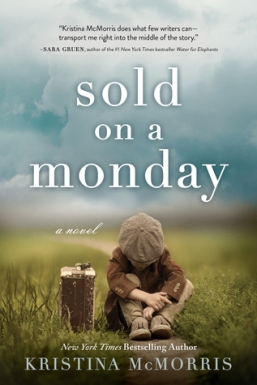 Sold on a Monday is one of those books that keeps returning to your thoughts—sad and soul crushing, but at the same time hopeful. Even the book’s title has a haunting echo: Sold on a Monday. What would it take for a mother to give up her children or further to sell them? Just how precious is a child to a mother and how can she survive when her child is gone? Sold on a Monday contains this theme within the story of a reporter’s drive for success, a secretary’s desire for secrecy, and families’ difficult relationships.
Sold on a Monday is set in the financial desolation of 1931 in Pennsylvania where Ellis, a reporter, snaps a photo of a sign “2 children for sale.” This one picture sets in motion the events contained in Kristina McMorris’ work of historical fiction that incorporates many elements of the Depression. It shows a poverty that brings out the best and the worst in people. Orphans are “adopted” to become forced workers. Mobs control cities, and Prohibition is for those without connections. Neighbors help neighbors, and shopkeepers set aside unsold goods for for the hungry, helpless, and homeless.
I was a little troubled by the romantic triangle in Sold on a Monday. At some points I felt the secretary with reporter aspirations, Lily, is being unfair to the two men interested in her. In fairness to her, however, although she has a four year old son, she is very young. At a time when being an unwed mother is a disgrace, she is attempting to make a living, take care of her child, and help her parents without whose support she would be in desperate straits. The author works out the triangle satisfactorily, if perhaps a bit too tidily, in the end.
I do recommend Sold on a Monday. It would be especially good for book clubs as it lends itself well to discussion. In fact, the author includes a section of questions for that purpose at the end of the book.
I would like to extend my thanks to netgalley.com and to Sourcebooks Landmark for giving me the opportunity to read this book in exchange for an honest review.
Rating: 5/5
Category: Historical Fiction, General Fiction (Adult)
Publication: August 28, 2018—Sourcebooks Landmark
Memorable Lines:
“Even when life’s downright lousy, most kids are still so resilient because…well, I guess ‘cause they don’t know any different. It’s like they only realize how unfair their lives are if you tell them. And even then, all they need is the smallest amount of hope and they could do just about anything they set their minds to…”
He dared to ask for a repeat of a point and instantly saw his mistake in the man’s hardened face. Everything about him—his eyes and nose, his build and demeanor resembled a watchful owl. Just biding his time until he swooped in for the kill.
Then she heard. “Can you tell me how it all started?” It was a standard question that blended the reporter in Lily’s head with the detective before her, and she wasn’t entirely certain which of them had asked.
The Road to Paradise–climbing new heights
The Road to Paradise

Karen Barnett’s The Road to Paradise is a delightful visit through time to Mount Rainier National Park in Washington. Set in 1927, the story tells of young Margie Lane, the socialite daughter of Senator Thomas Lane. A naturalist at heart, Margie is hired for the summer, as a political favor, into the male dominated environment with the expectation that she will only last a few days. Margie, lacking practical experience, brings with her determination, enthusiasm, a sense of wonder at God’s creation, and an academic background in botany and zoology.
This book has a villain, Phillip Carmichael, who has been manipulating Margie since childhood, and it has a hero, Chief Ranger Ford Brayden, Margie’s new boss. By the end of the story the reader has learned the motivations of each character and how their backgrounds and experiences set the stage for their actions.
Maggie is attracted to Ford, but realizes they have no future together because he does not share her faith in God. Calling God “the greatest Artist ever known,” Margie sees Him all around her in His amazing creation in Mount Rainier National Park and asks God to use her to share His love with others.
As Margie struggles in her new job and relationships with co-workers at the Park, Phillip is always a force as he tries to convert the Park from wilderness to super tourist entertainment center—by any means necessary. Margie’s parents also play a role with their expectations for their daughter’s social and media status.
I would like to extend my thanks to Edelweiss and to Waterbrook (Random House) for giving me the opportunity to read this book in exchange for an honest review.
Rating: 5/5
Category: Fiction, Christian, Historical Fiction
Notes: a Vintage National Parks novel
Publication: June 6, 2017—Waterbrook (Random House)
Memorable Lines:
Ridgeline after ridgeline of deep green rose to meet the jagged edges of the enormous peak, tucked into its rumpled blanket of white.
Her smile added to the graceful beauty of her face. “I love seeing God’s creation laid out in front of us. ‘The earth is full of thy riches.’ How anyone can look at this natural order and not see the Maker’s hand, I’ll never comprehend.”
“God wants me broken and miserable?” She shook her head. “I don’t think I’d go that far, Ford, but when we’re weak He is strong. It’s in His strength that we find victory.”
Auschwitz Lullaby–a mother’s amazing love
Auschwitz Lullaby
by Mario Escobar
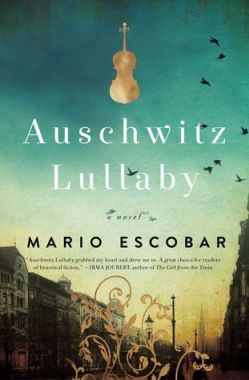 Auschwitz Lullaby is a sad book based on the life of Helene Hannemann, a German woman married to a talented Gypsy violinist. As an Aryan she could have saved her own life, but she chooses instead to accompany her five mixed-blood Gypsy children to Auschwitz. There she is chosen by the infamous Doctor Mengele to establish and run a nursery school at the concentration camp. Knowing that Mengele would only perform this “kindness” to the children for his own ends, she agrees anyway to provide the starving children with more nutritious food, several hours a day in a cleaner, healthier environment, and some mental respite from the stressful deprivations and horrors of the camp.
Without graphic descriptions, the author Mario Escobar uses a first person format, having Helene tell her own story through a journal which she supposedly left behind in the camp. Her writing is encased in a Prologue and Epilogue in Mengele’s voice. As I read this work of historical fiction, I wondered how much was true. I was gratified to discover a section called “Historical Clarifications” at the conclusion of the tale that explains clearly the aspects of the book that are nonfiction. The author is a historian so he also adds a “Chronology of the Gypsy Camp at Auschwitz” and acknowledgements of his sources of research.
Although the publisher categorizes the book as “historical fiction” and “Christian,” there are not a lot of overt references to Christianity, but there is an underlying thread of faith, hope,and love available through the power of God. The school holds a meager Christmas celebration which attempts to “give these children back a little bit of their faith.” Helene notes “that night we were celebrating life, the birth of the Christ child” and she ponders the message of the manger: “Glory to God in the highest, and on earth peace, goodwill towards men.” There are other Christian themes throughout of love, forgiving one’s enemies, God’s plan for Helene’s life, and the existence of evil.
I received a complimentary copy of this book from Thomas Nelson through NetGalley. Opinions expressed in this review are completely my own.
Rating: 5/5
Category: Historical Fiction, Christian
Publication: August 7, 2018 — Thomas Nelson
Memorable Lines:
“From the first time I saw you, I knew God had brought you here to ease our pain somehow. You were so lost, confused, and scared, but I could see a fierce determination in the back of your eyes.”
Death seemed like a gift from heaven, but I knew that it was not yet for me. I was an old ship in the middle of a storm, and my children anchored me to life. I had to keep fighting for them, trying to hold on to hope, looking each day in the face, praying for this nightmare to finally be over.
“God sent you here to guide us. We needed a breath of hope, and you showed up with your beautiful family. I’ve never known anyone as brave and determined as you.”
I tried to fill my heart with love. I did not want hatred to eat away my insides. I had to love even my enemies. It was the only way to keep from becoming a monster myself.
 education pathways