
Home » Historical Fiction
Category Archives: Historical Fiction
Beneath a Turquoise Sky–educating the Navajos
Beneath a Turquoise Sky
By Kiersti Giron
As Beneath a Turquoise Sky begins, the author introduces Caroline Haynes, a young lady in 1910 in Pennsylvania. After five years of playing the role of mother to her two younger brothers, she feels replaced by her father’s new wife Lillian. Her best friend’s brother, whom she had long adored, moved to China to be a missionary, without Caroline, and later married. Recognizing that she really doesn’t have a home or is needed in Pennsylvania, Caroline follows up on an article in the Home Mission Monthly seeking a teacher for the younger students at the Hebron Navajo Mission. She was drawn to “children in need of schooling, of the light of Jesus.”
When she arrives at the Territory of New Mexico after a long, arduous journey, she is shown to her tiny room attached to the girls’ dormitory and meets the handsome, but rigid, Rev. Willis Abernathy and his aunt Miss Spencer. Both have their own strict ways of running a school which are typical of schools set up for Native Americans at that time. The goal is conversion, but not just spiritual conversion. The white men wanted to get rid of Navajo culture and replace it with European customs all while making it clear that the Navajos are second class people. The motto of some was: “Kill the Indian, save the man.” To this end, the Navajo students were often punished if they spoke their own language. Haircuts were forced on them. Their traditional clothes were taken away, and they were supplied with uniforms.They were assigned Anglo names and removed from their families. The parents were told this was “all for their own good.”
Caroline’s interactions with the students and the other staff is a major part of the story, but just as important is Willis’ relationship with Tse, a Navajo two years younger. They grew up together and were friends for many years, but that all changed and we see it play out as Tse needs a job to help support his parents. Willis gives it to him but treats him in a very condescending way. As was typical of that time period, he seems to have no concept of the value of cultural differences. Tse is a Christian, but because he has reverted to Navajo dress and culture, Willis feels that he has turned his back on God.
Caroline “disobeys” Willis in her efforts to teach the children and give them the emotional support they need. Tse is her “accomplice” and both of them are chastised by Willis.
There are a number of well-executed plot twists that culminate in decisions these characters have to make that will affect their future and the future of the mission. Although I had a hard time liking Willis, I could understand him as a product of his time. That does not excuse most of his behavior, however. The story concludes with many loose ends tied up, but there are still systemic problems that are not worked out regarding how the Navajos and the white men interact with each other. Caroline and Tse are both very likable characters portrayed with some depth. They live out the kindness of Jesus in their everyday lives. Willis thinks he is doing the right things, but is missing the mark in his goals and how he treats others. All of the characters experience growth and positive change, and Tse especially comes to understand how he can honor his Navajo heritage and also be a follower of Jesus.
Rating: 5/5
Category: Historical Fiction, Christian, Romance
Notes: 1. The book includes a Glossary of Navajo Words, Historical Notes, and Acknowledgements of people and organizations that have contributed to the author’s understanding of the complicated historical and cultural background of this story.
2. Giron states that she has “shown only the milder side” of the trauma children experienced under this “education” system, but it is certainly sufficient to expose the reader to the damage even well meaning individuals caused in imposing Euro-American culture and customs in the name of religion.
Publication: April 14, 2025—Story Architect
Memorable Lines:
Perhaps being set apart did mean rejecting all that was Navajo and taking on the white man’s ways. But where was that ordained in Scripture? Not like the people of ancient Israel were European, after all.
But no, the bilagáanas were always right—government officials, Indian agents, or missionaries. No matter how many broken treaties, broken promises, broken families. Broken children’s hearts.
He sang as he bridled his horse, praising Jesus in his language, letting the tune follow the natural pattern of the tones, as in the chants. It sounded genuinely Navajo, yet the truth of the words lent a wholeness to his tongue he’d never heard before.
A Moment’s Shadow–Danger in Ireland
A Moment’s Shadow
by Anna Lee Huber
Having finished The Cold Light of Day, I was delighted to find that although I had missed getting A Moment’s Shadow as an ARC, my library had copies of this book in various formats. I grabbed the ebook to dive right in. It is even more interesting than the previous book which set the stage for Verity and Sidney Kent’s informal assignments in Ireland. They have several goals. Verity wants to find Alec, her former colleague during the Great War, who seems to have disappeared in Ireland. The pair has also been asked to investigate some missing phosgene cylinders, and they have determined that Verity’s nemesis, Lord Ardmore, who is always two steps ahead of them, is responsible. While they are in Ireland, a jewel thief visits one posh house after another. How he can accomplish these daring heists is baffling, but as Verity and Sidney already move in the social circles of the victims and have a reputation for solving mysteries, they are pulled into the investigation.
As the story progresses, it is difficult to know which side characters are on, and by the end the Kents are not sure which group they identify with. Both sides are committing heinous acts of murder, destruction, and torture. Both sides use deeply embedded spies to accomplish their goals. Verity disguises herself to pass as an Irish worker when needed and then as the socialite she is when that is appropriate to her sleuthing. Other than the social events they attend, nothing is glamorous about their lives in Dublin. Many of the wealthier class have escaped the turmoil by fleeing to their country homes, to England, and even abroad. Verity is “recalled” as some powerful person is unhappy with her inquiries. Since she is not working as a spy anymore, the government doesn’t really have the power or authority to demand her return. The people in charge, however, make it plain that they have been providing her with a measure of safety and can withdraw that protection if she does not return. A Moment’s Shadow has plot action that crescendos at the book’s conclusion with a hook that leaves the reader hanging and ready to devour the next book in the series.
Rating: 5/5
Category: Historical Fiction, Mystery
Notes: 1.#8 in the Verity Kent Mystery Series. The author reintroduces characters from #7 and previous books in the series but I think it would be hard to jump in with #8. If you really want to read just the ones dealing with the Irish Revolution, then start with #7 and plan on reading at least two more—#8 and #9.
2. A good plan for reading books #7-9 would be to list the characters and acronyms along with a basic note about each. There are a lot of characters, and you might find it helpful to comment on where you think their alliances lie.
3. The book ends with a teaser chapter from the next book in the series, The Bravest Hour, with a projected publication date of August 25, 2026!
Publication: 2025—Kensington
Memorable Lines:
These sights were always discomforting to me, for instinctively I wanted to cheer on our Tommies, and yet the Crown Forces’ behavior reminded me painfully of the Germans lording over the Belgians when they’d occupied their country during the war.
Everyone was trying to avoid the notice of the Black and Tans, to survive in a place where affordable housing was scarce, sanitation was abominable, and a stray bullet could end your life at any moment.
With all the dry and sunny weather we’d enjoyed in September, it was easy to forget how damp Ireland could be. October elected to remind us of this with a vengeance. It lashed, it bucketed, it showered, it drizzled, it misted—but at all times some sort of precipitation was falling from the sky.
The Teacher of Nomad Land–a child’s survival
The Teacher of Nomad Land: A World War II Story
by Daniel Nayeri
This is the story of two Iranian siblings, thirteen year old Babak and eight year old Sana, orphaned and separated during a time when their neutral country is being invaded by forces competing for Iranian oil—British, Soviet, and German. Add to that mix the Poles, the Jews, and the native nomads who don’t recognize any country as delineated on a map. Their various languages play an important role in this story. Babak has two goals—to become a teacher like his father and to take care of and stay with his sister.
Written for children, this is a fast read for adults. Instead of the horrors of concentration camps, The Teacher of Nomad Land focuses on the lives of the children as they to try to find “family” and dig within themselves to find what it takes to survive. In the Traveler, a friend of their father, they discover a kind man who tries to help. There is also a British soldier they bond with. Their lives are complicated by a mysterious man who is seeking a Jewish boy. All three children are put in danger by this situation. Babak’s resourcefulness is successful in dealing with the Soviets who halt the progress of the nomads in transitioning their herds to their winter home thus demonstrating his value to the nomads.
This is an age appropriate book that does not go into detail about concentration camps and home invasions. On the other hand, it does not shy away from the hunger the children suffer and the danger they face from other people. It highlights the communication problems when there are so many languages; and it shows how, despite being part of an army, individual soldiers can be nice to the local population. While Babak, as the older child, has much of the spotlight in this book, Sana also shines in certain situations with her creativity and ability to step up when things go bad. I was impressed by both characters at their positive attitudes, not allowing themselves to be overpowered by a victim mentality even when cold, hungry, tired or aching from long walks or sleeping on the hard ground.
Rating: 4/5
Category: Historical Fiction, Middle Grades
Notes: 1. Written for children Ages 8-12. Even though the reading level is for that age group, it may be too advanced in terms of understanding the political, geographical, linguistic, and social backgrounds. Discussion with an adult would be helpful for some children.
2. Included some helpful additions: a map, author’s notes about the political setting and the language barrier, and information on the Persian alphabet.
3. The book ends with “Further Reading” which lists nonfiction books for various ages.
Publication: 2025—Levine Querido
Memorable Lines:
“It might have been fair, but it wasn’t right.”
Everything is all at once. Our lives, these moments that change our lives, they all happen so fast.
Teaching is like sitting with a young person and encouraging them to only listen to the good angels in their mind and not the evil ones. But you can’t force them.
The Cold Light of Day–the Irish Revolution
The Cold Light of Day
By Anna Lee Huber
Told in the first person by Verity Kent, the reader is quickly informed that Verity had served as a spy during The Great War with dangerous assignments in Europe. Her husband also did undercover work, but he emerged as a well recognized hero. Despite needing to recover from their war experiences, including Verity’s belief that her husband Sidney had died, they quickly became a power couple invited to the very best homes in Britain. Money never seems to be a limitation for them.
The plot of The Cold Light of Day is tortuously twisted. Neither Verity nor Sidney knows which characters can be trusted as they work through unofficial assignments in Ireland where the two main branches of Irish rebels (Irish Republican Army and Sinn Féin) are resisting British rule. In talking about Irish resentment, she says “The Irish might be considered British citizens, but always second or third class.” The author researched the conflict well and is able to give the reader both sides of the revolution with Britain promising certain rights and then never fulfilling them. Both sides resorted to violence during this period.
The Kents live a double life in Ireland. They assume their natural role as socialites with their peers. Verity is a talented linguist so she also poses as an Irish house cleaner to be able to go places she can not visit as a glamorous Brit. Meanwhile, Sidney mixes with the males, some of whom were undercover or military during the war. They discuss current and past events after a few pints, and Sidney follows up on some of the things they divulge. They also bond over horse racing and riding.
The couple’s focus is on locating some missing phosgene cylinders so that this poisonous gas can not be used against either population. Also missing is Alec who formerly worked with Verity during her undercover years. In the middle of these searches, while trying to not trigger an enemy from either side, Verity is asked to solve the mystery of a young woman who has committed suicide. Even that effort becomes very complicated. When Verity confronts the British officials, she finds them very condescending; but when Nimble, her husband’s “batman” during the war and now his trusted valet, is brutalized and arrested, she stands up to those powerful men and makes them release him. She occasionally falls back on feminine wiles to manipulate men, using tricks she had to employ during the war.
The Cold Light of Day showed me how little I know about Irish history—especially the more recent Irish Revolution. Huber brings to light what people at that time experienced and how and why their loyalties were sometimes influenced by their humanity and often by their upbringing. The British in charge politically and militarily in Ireland were often motivated by greed, power, and career potential. There were many on both sides of the conflict who were willing to give up their lives for what they saw as the right thing to do.
I have read a few books in this well-written series, and I think it has just gotten better as it progressed. The author is skilled at creating believable characters from all classes—villains, heroes, and everyday workers. A thread that runs through the series is the character, actions, and motivations of Lord Ardmore. Almost everything bad can be traced back to his manipulations behind the scenes. I am not a fashionista, but I do like Huber’s descriptions of Verity’s clothes from the disguises as a “care woman” to her exquisite designs that attract both male and female attentions.
I received a complimentary copy of this book in exchange for an honest review. Opinions expressed in this review are completely my own.
Rating: 5/5
Category: Mystery
Notes: #7 in the Verity Kent Mystery series. I would not recommend it as a stand alone as there is so much critical background about the protagonists in the previous books.
Publication: October 24, 2024—Kensington
Memorable Lines:
But for every upstanding soldier there seemed to be another who took pleasure in the task of bullying and belittling those they were supposed to be protecting, not just policing.
Curse these men who had decided cutting women’s hair was a justified action. And curse the society who colluded in the weaponizing of shearing women’s hair by dint of the fact that somehow its length was an indication of virtue.
But while I’d failed to give chase, I had noted one particular thing about Collins’s bicycle. Its chain rattled like old Marley’s shackles from Dickens’s A Christmas Carol. That was something I was certain I would recognize if I heard it again.
A Choice Considered–building a railroad
A Choice Considered
by Tracie Peterson
Narrated by Jeanine Bartel

This work of historical fiction, set in the Wyoming Territory in 1868, as the railroad prepares to move further west, has strong Christian themes. The main characters try to make their choices and actions according to Christian principles. The female protagonist is Melody Doyle, a very sweet young lady devoted to her “Da.” Sadly, her father has never been the same since a railroad accident, but he insists he will move on with the railroad when the time comes. Melody doesn’t want to be separated from her dad but is tired of living in a tent and moving constantly. If she stays in Cheyenne, she could get a job and still see her father frequently through short trips.
Charlie is from a banking family, and his father sends him to Cheyenne to supervise the bank that his brother Jacob opened there. Jacob returned east due to illness leaving the bank in the hands of Jefferson who seems to resent Charlie’s arrival, especially when Charlie begins to examine the bank’s books. Charlie has a heart for education and wants to start a school. However, he does not want to disappoint his very strict father who has high banking expectations for him.
Da agrees to Melody’s staying in Cheyenne if she gets married before he leaves. Known for his gift of discernment, her father will interview and let appropriate young men take Melody on a date.
Charlie doesn’t sign up for this process because he wants the woman he marries to be his friend first.
A Choice Considered follows Melody, Charlie, and Da through the decisions they have to make in their lives, from their spiritual growth through their relationships, and in their professional lives. They all have supportive friends who pray with and for them in their journeys. The interactions of the characters are the basis for the plot and there are good events that will make the reader smile, but there is also a backdrop of impending tragedy.
The narrator of this audiobook, Jeanine Bartel, does a good job with all the voices but especially with the men. During the first part of the book, I found her voice for Melody to be a little too saccharine sweet. I think she was trying to show what a sweet person Melody is. As we moved into the story, I got used to the voice and found it more suiting to the character than I had thought.
Rating: 4/5
Category: Historical Fiction, Christian
Notes: #2 in the Heart of Cheyenne series. I had read the first and third books in the series. While I enjoyed all three books, I would have been happier reading them in sequence. Out of order, I found myself a little confused; and the third book, of necessity, had some spoilers for the second book.
Publication: July 2, 2024—Bethany House
A Truth Revealed–ambition and revenge
A Truth Revealed
By Tracie Peterson

At age twelve, Laura Evans lost her mother to consumption in 1858. Her father, Granite Evans, who became her long distance hero, immediately sent her to boarding school. After ten years apart, she finally rejoins him in Cheyenne in the Wyoming territory which was a rough area at that time. Does Laura really know the man she has put on a pedestal for so many years? Is he the gracious, generous man the townspeople admire so much? He doesn’t hide his political ambitions, but is there a limit to what he will do to become governor of the territory or even president of the U.S.?
Wilson Porter is a young minister hoping for a government appointment to work with the Indians in the area. Until treaties can be sorted out, Wilson is employed in a local furniture shop using his woodworking skills to provide a living. When his father dies unexpectedly, Wilson encourages his mother and sister to travel to Cheyenne to be closer to him. Sadly, tragedy strikes the family again in several ways. When Wilson is injured, Laura takes him into her father’s home and nurses him back to health. They come to know each other better, but they also learn about an evil side of Cheyenne.
One of the main plot threads is faith in God. Both Laura and Wilson attend church, but Granite refuses. He blames God for his wife’s death. Wilson also has some questions of faith that he has to work through. Meanwhile, Laura finds support from a group of ladies at church who meet weekly to pray and work on handicrafts.
The characters have depth, and the setting seems true to the Cheyenne area during Wyoming’s territorial days. The Christian faith is consistently woven into the story as many of the characters look to God for strength and wisdom. Life is not a smooth path as the characters endure some very difficult challenges. The author has Laura attend a women’s college in Tennessee which actually existed and added realism to the skills and knowledge Laura had that would have been unusual for a woman during that time period. The theme of evil versus good permeates the novel. I enjoyed this book and am planning to return to the series to pick up the second book in the series which focuses on Laura’s friend Melody.
I received a complimentary copy of this book in exchange for an honest review. Opinions expressed in this review are completely my own.
Rating: 4/5
Category: Christian, Historical Fiction, Romance
Notes: #3 in The Heart of Cheyenne series. The background is fully explained and in good order; it can definitely be enjoyed as a standalone. There is an overlap of characters but there are central protagonists specific to each book.
Publication: November 5, 2024—Bethany House
Memorable Lines:
Rejections from the doctors, church, and family had left Granite hard and angry, and when his beloved wife died, he vowed to make a success of himself in such a way that he could get back at those who had denied her help.
“Evil men will always do evil things, and, yes, there will be times when we suffer the effects, even as God’s beloved children. However, I still believe in His love and goodness.”
“But you know, life is a risk. Every day presents new challenges and heartache. But it also allows for happiness and good gifts. And no matter which come our way, God is there to help us through.”
The Memory of Old Jack–evocative language
The Memory of Old Jack
by Wendell Berry

Author Wendell Berry is loved and even revered by many of his readers. This is the third book I have read by him with my book club. He has written a series of novels describing the land and the people of the fictional Port William community in rural Kentucky from shortly after the Civil War to 1952. As a part of this series, The Memory of Old Jack’s timeline is a little jarring as it jumps repeatedly between Jack on a special September day and the memories he dredges up from a lifetime of experiences. A hard working farmer, he soaked in wisdom about farming and about life from an older neighbor.
My opinion of the character Jack also bounced around as I read about the various events of his life; sometimes I found him admirable and at other times an enigma. He is a rough man, tied to the land he loves so much. He has some regrets about his choices in life, but doesn’t seem to be able to make different choices or fix past mistakes and still stay true to himself.
Perhaps it is because of my own creeping age or the recent deaths of many loved ones, but I found the book very sad. Another member of my book club called it “grim,” and I must agree. It is not sprinkled with uplifting light spots, nothing to raise the heavy veil. There are some supporting characters that I liked, but they did not make up for the melancholy of this tale. Wendell Berry is a good writer in the sense that he effectively writes what I will call poetic prose. A few chapters into The Memory of Old Jack, I was struggling to want to finish this book. I made an attitude changing decision to do a read/listen and that made all the difference. The written language took on a beauty when it became oral.
There is no plot per se; the book moves along from anecdote (in this case memories) to anecdote. Although Berry tells his tale through the main characters, I never found them likable. To like this book, the reader would need to find the characters engaging. For me, it was more a matter of waiting for the next shoe to drop as the story moves to its inevitable conclusion.
The Memory of Old Jack is a vehicle for Berry’s expression of his philosophies about preserving the land and the customs and knowledge necessary for self-sufficiency. Berry was a farmer for forty years in addition to expressing his ideas through environmental activism. A poet, novelist, and essayist, he also worked as a professor. His use of story to promote socio-political thought is reminiscent of the writings of Sinclair Lewis.
This dichotomy of beautiful language in a novel that plods along makes reviewing and ranking it difficult. It deserves five stars, top in my rating system, for eloquent, descriptive language. For elements such as plot and character, I can only award it three stars as a book that I would never read again and am unable to recommend.
Rating: 4/5
Category: Fiction, Historical Fiction, Literary Fiction
Notes: 1. #3 in the Port William Series but all can be read as standalones.
2. Some profanity
3. Narrator Paul Michael of the audio version produced by Christian Audio is good with women’s voices as well as men’s.
Publication: October 8, 1999—Counterpoint
Memorable Lines:
That is what Old Jack has always given him—not help that he did not need but always exactly the help he has needed.
His vision, with the the finality of some physical change, has turned inward. More and more now the world as it is seems to him an apparition or a cloud that drifts, opening and closing, upon the clear, remembered lights and colors of the world as it was. The world as it is serves mostly to remind him, to turn him back along passages sometimes too well known into that other dead, mourned, unchangeable world that still lives in his mind.
…it is hard to keep his mind, ranging around the way it does, from crossing the track of his hard times.Though he would a lot rather let them lie still and be gone, once his mind strikes into his old troubles there is no stopping it; he is in his story then, watching, as he has helplessly done many times before, to see how one spell of trouble and sorrow led to another.
The Bletchley Riddle–young code breakers
The Bletchley Riddle

By Ruta Sepetys and Steve Sheinkin
Written specifically for Middle Grade students, The Bletchley Riddle will appeal to those interested in World War II but not ready for the torturous aspects of the conflict. This book deals with code breaking efforts that were a critical support to the military in winning the war.
Jakob, with mathematical talents, has been recruited from Cambridge and becomes part of the secretive code breaking team at Bletchley Park. His much younger sister Lizzie, who prides herself in being straight forward, escapes from Fleetword, her chaperone who is supposed to escort her from England to live with her Gram in Cleveland, Ohio. Lizzie wants to stay in England to investigate the death of her mother Willa as she does not believe that she died in an explosion in Poland.
This novel becomes very involved as the two youths form relationships with a variety of other interesting characters who live in the area. It’s hard to determine who is a spy and who is not, but Jakob also needs to restore his relationship with Lizzie.
The Bletchley Riddle deals with official decoding using the Enigma machine and with personal riddle solving of secretive messages the pair receives. The book is well written and appropriate for middle grades; the authors knew their audience. While some books written for young people can be captivating for older readers as well, The Bletchley Riddle is not one of them. I have enjoyed other books about Bletchley Park that are more interesting and engaging for adults.
I received a complimentary copy of this book in exchange for an honest review. Opinions expressed in this review are completely my own.
Rating: 4/5
Category: Fiction, Middle Grades, Historical Fiction
Notes: Appropriate for Ages 10+ and Grades 5+
Publication: October 8,2024—Penguin Group (Viking Books)
Memorable Lines:
“Do you always speak your thoughts aloud?” “I do. I’m half American. I’m straightforward. Does that make you uncomfortable?”
She looks with disapproval toward the crumpled papers on the floor. And she’s right. It’s sloppy. I get up to gather the scraps. Even our rubbish is secret here. All of it must be burned.
But the past months have shown that circumstance can be the thief of choice.
The Secret Life of Sunflowers—bringing Vincent van Gogh to the world
The Secret Life of Sunflowers: a gripping, inspiring novel based on the true story of Johanna Bonger, Vincent van Gogh’s sister-in-law
By Marta Molnar

There are many, many works from various media that focus on the artist Vincent van Gogh—books, movies, poems, songs, and of course prints of Van Gogh’s own artwork. The irony is that Vincent Van Gogh was not appreciated as an artist during his own lifetime. His brother Theo was not an artist, but he worked as an art dealer and made enough money to support his own family and his brother so that Vincent could concentrate on his artwork.
The Secret Life of Sunflowers is not about Vincent van Gogh. It tells of the efforts of his sister-in-law, Johanna Bonger van Gogh, to promote Vincent’s art and legacy after the death of both Vincent and shortly thereafter Theo. As a young widow, Johanna had to fight to even get recognized as capable of marketing Vincent’s art. She did this while caring for her young son and earning a living running a boarding house.
This is a dual timeline book. Emsley in our current day is an art auctioneer who faces residual gender discrimination in the art world. Because of the legacy of her bold and controversial Aunt Violet, Emsley pursues her personal and professional goals even in the face of the betrayal of her business partners who were formerly her best friend and her longtime romantic partner. Among other things, Emsley’s aunt bequeaths a diary and some old papers in Dutch to Emsley. They seem to hold secrets about Vincent van Gogh. Emsley has to dive into the meaning of these papers and an ugly small painting her aunt had saved. She accomplished all this while figuring out how to rescue her own business and fulfill her aunt’s final intentions.
The author of this book was intrigued with the story of Johanna, but she had great difficulty in finding information about Johanna in her research. She fleshed out the facts she discovered by adding interesting characters. Both timelines contain supportive friends—for Emsley and her aunt and for Johanna. These three are strong women, but having others come alongside made such a difference in their journeys. Emsley and Johanna both had difficult lives and had to push to make their ways in the world. Alternating between the two timelines was an effective technique as it relieved the building tension surrounding each protagonist.
Rating: 4/5
Category: Historical Fiction, Biographical Fiction
Notes: 1. #1 in the Light and Life Series
2. Includes discussion questions
Publication: July 19, 2022
Memorable Lines:
“Vincent says, If you hear a voice within say you cannot do something, then by all means do that thing, and that voice will be silenced.”
“Sunflowers mean gratitude to Vincent. He never loses faith.” I leaned against my husband and imagined an entire vast field of vibrant golden petals. Thousands of these flowers, unworried about the world, unafraid of the storms, turned as one in gratitude toward the sun.
If life was a rolling river, friendship was the life raft.
The Forgotten Names—forever a timely reminder
The Forgotten Names
by Mario Escobar
translated by Gretchen Abernathy
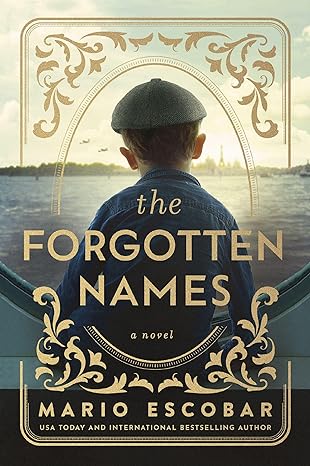
Many historical novels focus on one particular character and develop a story around that character. If it is a dual timeline, then the focus is on one character in each timeline. Escobar’s The Forgotten Names does, in the current timeline, focus on a nonfictional French historian and law student, Valérie Portheret. She spent 25 years identifying at least 90 of the 108 children whose identities were deliberately and necessarily abandoned in the rescue attempt from the Vénissieux internment camp near Lyon. Had their brave parents not signed release forms giving up their parental rights, the children would certainly have been killed by the Nazis who issued mandates for the number of Jews to be “processed.” The Vichy government was theoretically in control of France, but the reality was that they answered to the Nazis who disregarded both the legalities and moralities of the French.
A diverse coalition of Catholics, Protestants, and Jews, including social workers and Resistance organizations, found a loophole in the law. Orphaned minors could obtain an exemption from the roundup that sent the occupants of Vénissieux to their deaths. Escobar tells of the harrowing days and nights spent getting parents to agree, separating the children from their parents, arranging for new homes, transporting them to Lyon, and keeping them until the new parents arrived. All very secretive and all very dangerous for everyone involved in any way.
Escobar is a historian, but he also knows how to tell a story. The chapters are short, encouraging the reader to jump from the end of one into the beginning of the next chapter. The escape story of 1942 is framed by the research story which begins in 1992 when it was still difficult to find a sympathetic advisor. Sadly, the research was hampered by continuing anti-Semitism, rising fascism, and a reluctance to open up wounds of the past. Portheret persisted in locating the children for twenty-five years. The novel is personalized with the backgrounds and experiences of various children and families as imagined by Escobar. In this way, a sad part of history is brought to life with the goal of societies not repeating the horrific tragedies so many suffered through. Portheret originally planned her thesis to examine the life of the infamous Klaus Barbie, known as “the Butcher of Lyon.” As she began her work, however, she found herself drawn to the plan to “exterminate innocent children” and preferred to focus on the victims rather than the barbaric individuals who perpetrated the crimes.
There are so many books about World War II and the Nazis, but this is a new take on the crimes committed in that war. As hard as it is to read about the suffering of innocents whose only crime is to be Jewish, I am glad I read this book. Some of the Christian characters connect various events to Christian theology such as the birth of Jesus who was a Jew, God given Christian/human morality “which imposes duties and recognizes rights,” and the “demands of charity [love] made by Christ to be the distinctive mark of his disciples.” Above all is the emphasis that the human heart rebels against the cruel and painful measures enacted on Jews and certain groups of foreigners.
I received a complimentary copy of this book in exchange for an honest review. Opinions expressed in this review are completely my own.
Rating: 5/5
Category: Historical Fiction, Multicultural
Notes: The book contains references and something I always look for in historical fiction—a discussion of what is real and what is fictional. What follows is a World War II timeline beginning with the invasion of Poland by Germany in 1939 and continuing through the surrender of Nazi Germany to the Allies in 1945. The book concludes with Discussion Questions, information about the author who is Spanish and the translator.
Publication: June 11, 2024—Harper Muse
Memorable Lines:
“Have you noticed how the executioners often end up as celebrities? There are books and books about them. But so few write about their victims. The victims are mere numbers, faceless statistics, figures on the yellowed pages of history.”
The land of Mozart, Goethe, and Immanuel Kant had become a nation of barbarians, of heartless warriors whose driving desire was to control the human race and conquer the world.
“But now everybody—at least in the West—knows that it’s wrong to sacrifice humans. Maybe war will teach us a lesson we can’t learn any other way: the lesson that killing one another for our ideas, beliefs, or flags is absurd, because we all belong to the only human race there is, and we’re all brothers and sister of one another.”
 education pathways