Home » 2022 (Page 9)
Yearly Archives: 2022
Edgewater Road–second chance for ex-cons
Edgewater Road
by Shelley Shepard Gray

Jennifer inherits her grandmother Ginny’s old farmhouse with acreage in Ohio and soon discovers that her neighbor is John Lincoln Bennett, an ex-con who has a business managing properties. He also helps other ex-cons reintegrate into society when they are released. Jennifer works in her home as a medical transcriber but wants to reach outside the shield she has established to avoid trusting others. Lincoln is immediately drawn to her and feels very protective of her.
Edgewater Road contains romance, but the real focus is on the characters as their backgrounds are revealed and relationships are developed. There is also some gripping action and danger along with moments of humor as the characters interact in some awkward situations. Lincoln is a natural leader who instills respect, and Jennifer is almost too nice and trusting for her own good. Both are characters that you want to be successful individually and together. The ex-cons in general turn out to be helpful and respectful, especially Bo, Lincoln’s right hand man and Seth, formerly Amish and very polite and trustworthy. Wayne, a young Amish boy, needs to earn money, and his role in the story adds interest as does that of Chad, a semi-feral cat that Wayne finds in Jennifer’s barn.
Author Shelley Shepard Gray excels with plot action. The book is a page turner for me with Gray alternating telling the story from Jennifer’s perspective and from Lincoln’s. Without sugar coating a life of crime, Gray presents the difficulties that might lead one down a bad path, what prison is like, and the reactions of people to ex-cons. They are often viewed with suspicion and distrust and many end up back in prison for various reasons.
I highly recommend Edgewater Road and look forward to the next book in this series.
I would like to extend my thanks to NetGalley and to Blackstone Publishing for giving me the opportunity to read this book in exchange for an honest review.
Rating: 5/5
Category: General Fiction (Adult), Romance
Notes: 1. #1 in a new series, The Rumors in Ross County.
2. Although the books deals with some rough ex-cons, there is nothing graphic or offensive in the book, and it is clean in all aspects.
Publication: March 1, 2022—Blackstone Publishing
Memorable Lines:
There was a part of him that was drawn to her like a prisoner to a decent meal.
“That woman’s got more work that needs to be done than an old lady at the plastic surgeon.”
Back when he’d started this, his goals had been almost noble. He’d wanted to give men like him, men who’d made mistakes but were still decent, a second chance… Now, nearly eight years later, his aspirations weren’t quite so lofty. Oh, his heart still searched for the good in people, and he often shared some of the teachings he’d learned from the Bible. However, he’d also learned that not everyone could be rehabilitated.
The Bluebonnet Battle–feuding families
The Bluebonnet Battle
by Carolyn Brown
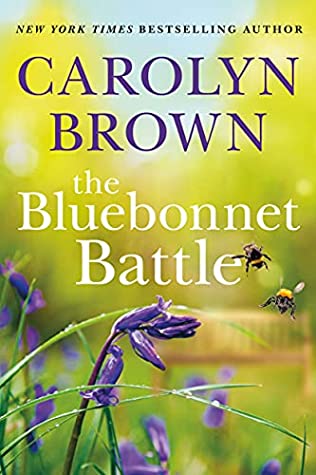
I expected a romance with conflict between two feuding families. What I got in The Bluebonnet Battle was a very mean-spirited tale. There were clearly two sides. Matilda is an angry woman who excels in manipulating others to get what she wants. The other side is headed up by Liddy who has certainly been wronged but is vindictive and unforgiving. In fact, one of her friends suggests to Liddy that she pray for Matilda explaining that it might not change Matilda but it might take the anger out of Liddy’s heart. Liddy responds with a venomous, disgusting, unkind prayer that causes her adult niece Ruth Ann who acts like a Greek chorus in this book to giggle. It is hard to like any of these characters.
Fortunately, Nick, Matilda’s son, and Amelia, Ruth Ann’s daughter, slowly overcome family hurdles to form a relationship. By the time you get to this point in the story, you will be so tired of how the feud plays out through vegan versus Southern cooking featuring lemon meringue and lemon chess pies, along with who controls the local funeral dinners, that you will be glad for romance in any form. There is actually some motivation revealed for why Matilda is the way she is, but the explanation is too little and too late. The townspeople are closed to outsiders and small-minded. Nick and Amelia develop into nice people, but my favorite of the bunch is Uncle Harry, Matilda’s much older brother; he is the only character I would like to know. If a romance’s plot is character driven, it shouldn’t be replete with bitter characters.
I would like to extend my thanks to NetGalley and to Montlake for giving me the opportunity to read this book in exchange for an honest review.
Rating: 3/5
Category: General Fiction (Adult), Romance
Notes: 1. Includes recipes.
2. Contains profanity, even in church where the characters immediately, but rather insincerely, ask God’s forgiveness.
3. Several older and presumably wiser characters suggest to Nick and Amelia that the only way to know a person (with the goal of having a good marriage) is to live together first. That is advice that may be popular in some circles, but is one with which I take issue.
4. Perhaps a minor detail to some, but the flowers on the cover are not bluebonnets.
Publication: March 8, 2022—Mountlake
Memorable Lines:
When I heard Matilda was coming back to town, I figured we’d have to weather some storms. I just didn’t think we would have a class-five tornado two days after she arrived.
Compared to this thing between her aunt and Nick’s mother, the Hatfield and McCoy feud looked like a kindergarten playground fight.
Matilda’s whisper went right along with the look in her eyes—so toxic that a hazmat team wouldn’t have come near her.
The Calm after the Storm
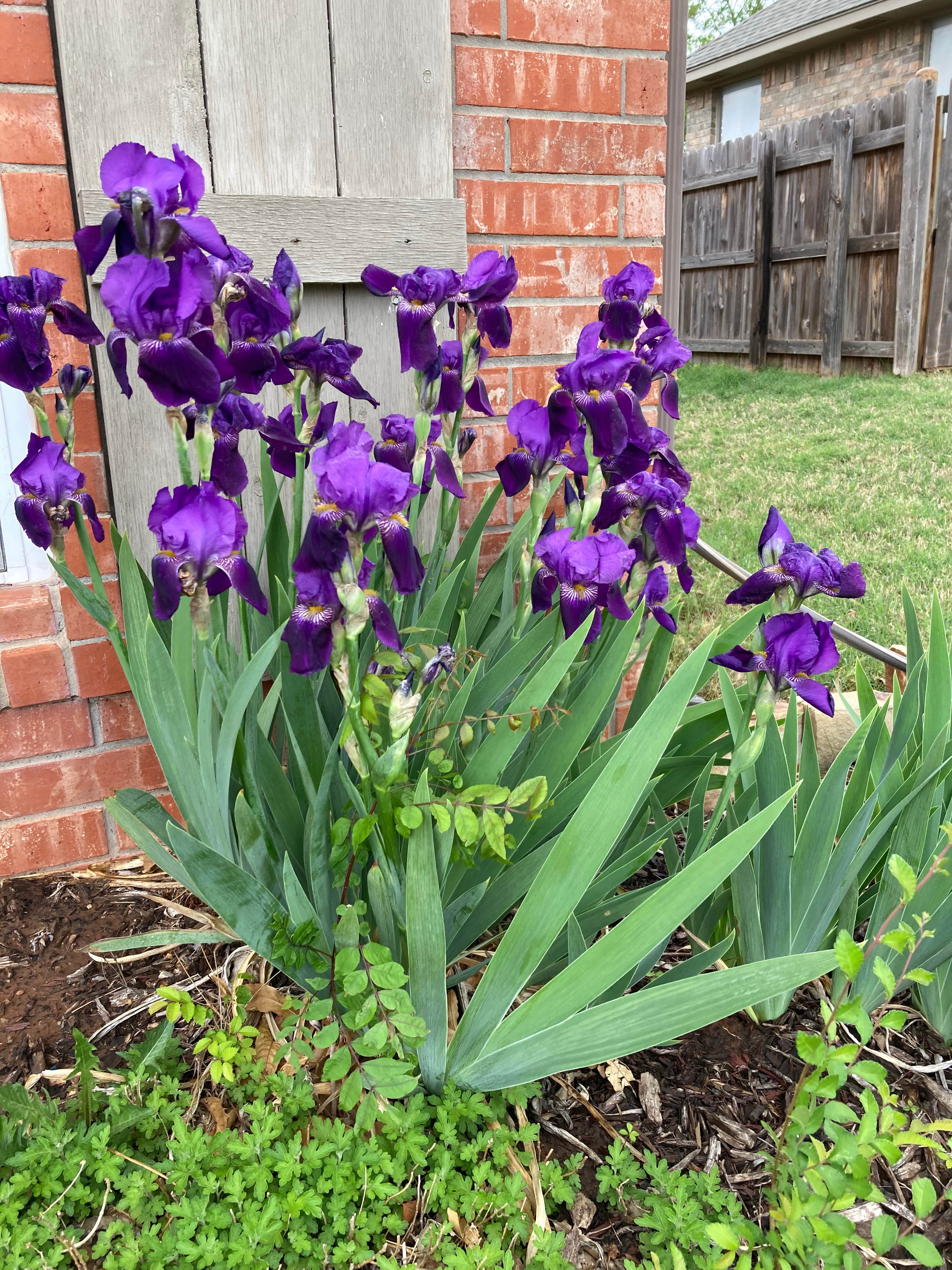
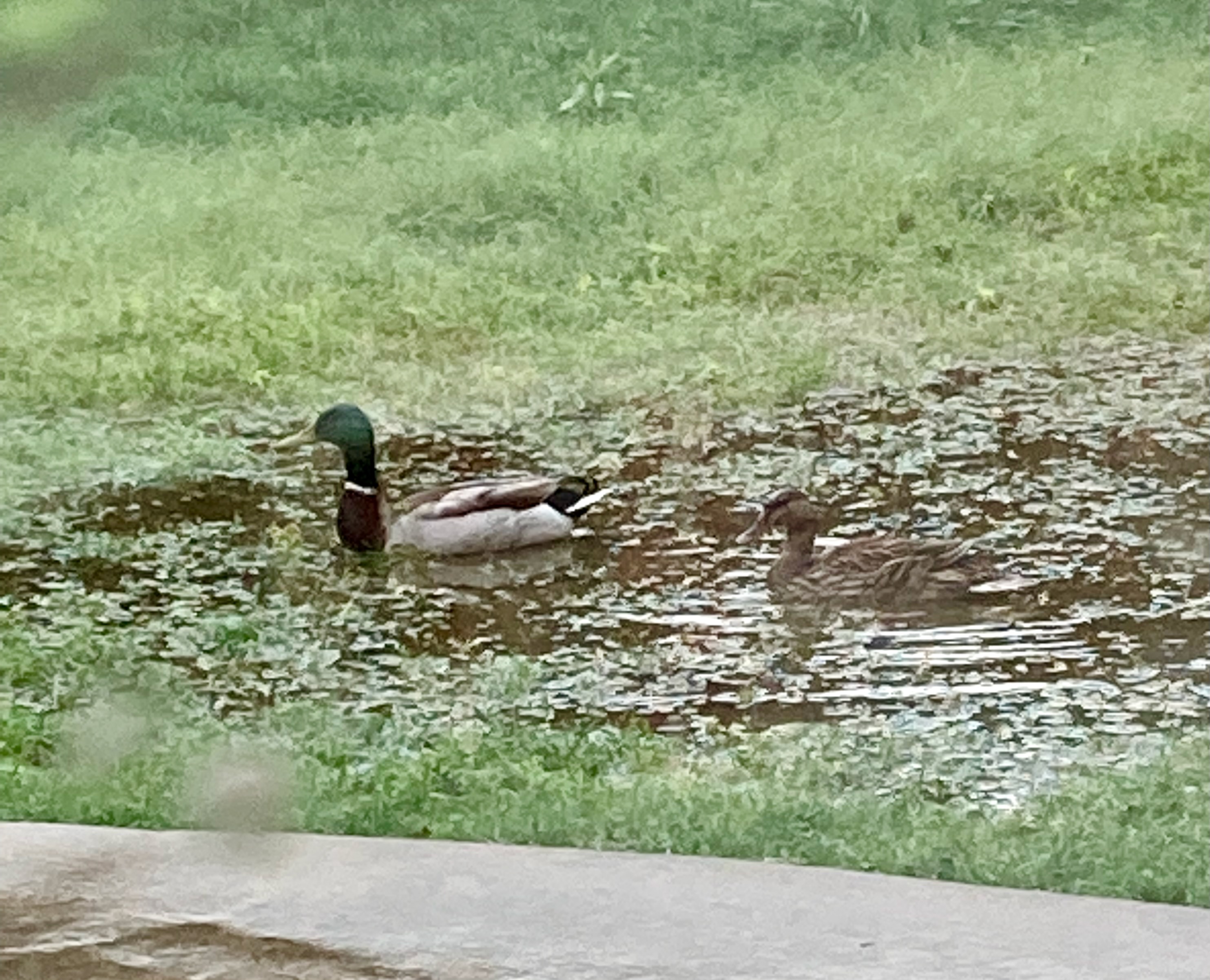
In Oklahoma this week we have been having crazy weather with extreme thunderstorms including hail and heavy winds along with hours and hours of tornado watches and warnings. Here are some “after” pictures as we head into some sunny days and unseasonably high temperatures
My favorite shades of my favorite color!
Rains made a pond in a low spot in our backyard bringing in the ducks from a bigger pond to search for earthworms.
Whooshing sounds brought us out into our backyard. Not uncommon in NM, but I hadn’t seen any in OK.

The Enchanted April–looking for happiness
The Enchanted April
by Elizabeth Von Arnim

In an exceptionally rainy and dreary March in England, four strangers decide to get away by sharing the rent on a medieval castle in sunny Italy for the month of April. Lotty Wilkins, who can “see” or visualize people at their best and happiest initiates the effort, recruiting Rose Arbuthnot. Both in their early thirties, they do not have happy marriages. Lady Caroline is a little younger and extremely attractive, but is tired of the superficial cloying of people bewitched by her good looks. The very authoritative Mrs. Fisher in her sixties is still wearing mourning blacks years after her husband’s death and focuses her thoughts and conversations on childhood memories of encounters with famous people, particularly authors. This fictional account relies strongly on character development as these ladies’ situations are examined and they react to each other and to their temporary environment for the month. As I reread the many lines I had highlighted, I found that the writing is indeed exquisite.
The Enchanted April is the kind of book that holds beauty and introspection and gently insists that readers immerse themselves in the deliciousness of a sunny month of flowering plants and enticing foods. There are humorous situations thrown in as Lotty and Rose speak no Italian and the other two ladies don’t want to undertake the bother of dealing with the servants or managing the finances. There are also some surprising plot twists at the end of the tale. If you join the ladies in their Italian castle, your only regret will be saying “Arrivederci” at the end of the stay.
Rating: 5/5
Category: Fiction
Notes: Originally published in 1922.
Publication: July 19, 2005—Project Gutenberg
Memorable Lines:
She wanted to be alone, but not lonely. That was very different; that was something that ached and hurt dreadfully right inside one. It was what one dreaded most…Was it possible that loneliness had nothing to do with circumstances, but only with the way one met them?
“Oh, but in a bitter wind to have nothing on and know there never will be anything on and you going to get colder and colder till at last you die of it—that’s what it was like, living with somebody who didn’t love one.”
In heaven nobody minded any of those done-with things, one didn’t even trouble to forgive and forget, one was much too happy.
Drop Acid–how to lower uric acid values
Drop Acid
by David Perlmutter
with Kristin Loberg

Be prepared when you read Drop Acid for a book that concentrates on a medical theory that attributes many of our medical woes including obesity, diabetes, nonalcoholic fatty liver disease, premature death, stroke, coronary artery disease, Alzheimer’s and hypertension to high levels of uric acid. In his efforts to convince the reader of his theory, Dr. Perlmutter, a neurologist, spends about half of his book expounding in detail the scientific basis of the principles of his LUV (Lower Uric Values) Diet, a trademarked designator. He spends a further 16% of the book at the end on notes for further reading.
The second part of Drop Acid lays out a plan of action for the reader to follow in lowering uric acid levels in three main areas: food; sleep, exercise, exposure to nature, and timing of meals; followed by fine tuning the process. He concludes with recipes that he developed with Tricia Williams, a food therapist.
I was really excited to read this potentially life-changing book. Unfortunately, my eyes glazed over during the details of the first half, and I failed to be convinced that this is a program I personally want to commit to. Even the recipes are challenging. Although Perlmutter claims substitutes can be made in ingredients, I have to ask why one would suggest recipes that specifically include Castelvetrano olives, za’atar seasoning, Tuscan kale, or dulse flakes.
I apply a healthy dose of skepticism when members of the medical community make a business out of healthcare. Perlmutter, in an effort at full disclosure, shares that he is on the board of directors of a company marketing a device, a continuous glucose monitor (CGM) to measure and monitor blood glucose, a device he maintains is not necessary for his program but would be very useful. He frequently in the text refers the reader both to that device and to his self-promoting website. He also introduces the website of Tricia Williams where his business is again promoted and ready-to-eat meals following this diet are available for purchase.
I am not a scientist or a medical professional, and I have not tried his program myself. I am reviewing the book for readability and appeal, not evaluating the efficacy of the LUV diet.
I would like to extend my thanks to NetGalley and to Little, Brown & Co. for giving me the opportunity to read this book in exchange for an honest review.
Rating: 2/5
Category: Health, Mind, and Body
Notes: 1. Perlmutter is the author of a family of five books focused on gluten-free diets. His flagship book for that effort is Grain Brain.
2. Perlmutter ties his Covid wagon to a uric acid star, seemingly willing to accept most of the pandemic deaths as the inevitable result of comorbidities associated with high uric acid rather than admit most could have been avoided with the right therapeutics.
Publication: February 15, 2022—Little, Brown, & Co.
Memorable Lines:
As you will soon learn, long before any symptoms develop, asymptomatic hyperuricemia may well be fomenting an unending, irreversible storm and subtly stoking biological processes that ultimately result in elevated blood sugar and blood pressure, bad cholesterol, excess body fat, and systemic inflammation, which opens the door for any number of chronic degenerative conditions.
Contrary to what Big Corn will tell you, fructose and glucose are not siblings with equal biological effects. Fructose is more like glucose’s evil twin: when you eat glucose, your body uses it to produce energy; but when you eat fructose, it triggers changes in the body that favor the storage of energy in the form of fat.
If elevated uric acid precedes and predicts biological mayhem and future risk for most chronic diseases, then we must start paying attention to this important metabolite.
The Sugarcreek Surprise–trusting again
The Sugarcreek Surprise
by Wanda E. Brunstetter

I was glad I returned to Wanda E. Brunstetter’s Creektown Discoveries series to read the second book, The Sugarcreek Surprise. Part way through the first book in the series, Brunstetter found her pace and upped her style. She maintained and even improved on it in this fictional tale of two young people who have been hurt by life and are afraid of renewed suffering if they give life a second chance—outside of the protective shell each one created.
Paul is betrayed by the woman he has been courting who drops him for his best friend. Lisa has survivor’s guilt when, as a child, her parents and grandparents are in a fatal car crash, but she alone survives. Fortunately, these two are mentored by loving relatives and friends. Life is not easy for either one of them and even more surprises are thrown their way as they cautiously try to open up to others.
I enjoyed this trip to Walnut Creek and Sugarcreek, Ohio. Lisa is a school teacher and I found the differences in her classroom
and the typical Englisch classroom fascinating. School extends only through eighth grade for the Amish. Although the children are typical for their ages in mischievousness and enthusiasm, they arrive with basic manners and parental expectations for good behavior. Paul has an excellent work ethic and is skilled in carpentry. Both are committed Christians and practice their faith through Amish customs. They learn to pray more and trust God more. Witnessing how Amish practices play out in our current world is interesting. This book makes it clear that there are benefits and hardships to contemplate about both Englisch and Amish lifestyles.
I would like to extend my thanks to NetGalley and to Barbour Publishing for giving me the opportunity to read this book in exchange for an honest review.
Rating: 4/5
Category: Christian, Romance, Women’s Fiction
Notes: 1. #2 in the Creektown Discoveries Series, but could be read as a standalone because the main characters first appear in this book.
2. The book ends with recipes and discussion questions
Publication: March 1, 2022—Barbour Publishing
Memorable Lines:
Even snippets from the past, which sometimes flitted through her mind, caused Lisa to feel fearful and despondent. She’d convinced herself that the only way she could be happy was to keep her focus on the present and refuse to give in to thoughts of the past.
The Lord knows each of us very well. He also knows what needs to happen for each of us at the proper time.
“Fear doesn’t stop death; it stops life. And worrying doesn’t take away tomorrow’s troubles; it takes away today’s peace.”
The Walnut Creek Wish–freedom through forgiveness
The Walnut Creek Wish
by Wanda E. Brunstetter

Rhonda and Jeff Davis are a financially successful couple living in a townhouse in Canton, Ohio, where she manages a hotel and he has his own restaurant. They love each other, but they have a fairly testy relationship often exchanging hurtful barbs. Neither wants anything to do with God because each had deep-felt prayers that had not been answered the way that they wanted them to be. Rhonda’s dad had affairs and eventually left his family behind. Jeff’s mom passed away when he was a teenager.
Rhonda and Jeff’s lives intersect with those of Orley and Lois who own an Amish antique store in rural Walnut Creek, Ohio, when the younger couple try to rejuvenate their marriage by purchasing a beautiful house and commuting to their jobs. Orley and Lois take every opportunity to encourage Rhonda and Jeff to develop a personal relationship with Jesus. A lot has to happen in the young couple’s lives before their hearts are opened to their need for God.
The Walnut Creek Wish is a quick and easy read, but it deals with some real issues—satisfaction, childlessness, abandonment, and forgiveness. The writing, especially the dialogue, in the first part of the book is somewhat stilted. Then the author breaks into a pace that is much more comfortable after the character backgrounds have been established and the action in the plot develops. It is a clean read with strong Christian themes involving both Amish and Englisch characters with interesting comparisons and contrasts of their lifestyles and their problems and how they react to them.
I would like to extend my thanks to netgalley.com and to Barbour Publishing for giving me the opportunity to read this book in exchange for an honest review.
Rating: 3/5
Category: Christian, Romance, Women’s Fiction
Notes: 1. #1 in the Creektown Discoveries series. I will be reading the next book in the series. I am interested to see if there is an overlap or continuation of characters and/or of setting and to see if the sudden improvement in style and pace in this book holds up in the next book.
2. Recipes for a cucumber dip and bacon cheese muffins are included.
3. There are questions for individual thought or book club discussions.
Publication: August 1, 2021—Barbour Publishing
Memorable Lines:
She and Jeff had been married twelve years, and all they had to show for it was a modern townhouse, an expensive sports car, a luxury SUV, and a chasm of disinterest between them.
“I don’t know all the reasons, but I’m sure the Lord directed that young man to our store for a purpose beyond looking at antiques.”
“Any time’s the right time to share God’s love and the redemption He offers because of His Son. Pray for the right words to say, and speak them from the heart with love.”
Seeing Beautiful Again–encouragement
Seeing Beautiful Again
by Lysa TerKeurst

Are you going through a hard time, something that is devastating and you have no control over? Do you wonder if you’ll ever “see beautiful” again? Lysa TerKeurst experienced three of those, two physical and one relational, in a short period of time. She has written several books that describe her journey. In Seeing Beautiful Again, she has drawn from her experiences and writings to compose a devotional book to guide readers through fifty days of their struggle. The goal is to give hope and demonstrate that by clinging to God’s promises, readers can stay the course and trust God.
Seeing Beautiful Again is divided into sections and each section begins with a letter to the reader from author Lysa TerKeurst. Each devotional begins with Scripture and ends with a prayer. In between Lysa shares her thoughts on the topic. These passages sometimes include parts of her personal story and always draw the reader to God’s truth which can be applied to a personal situation.
TerKeurst’s other books like Forgiving What You Can’t Forget examine in depth our response to hurts. This devotional is a daily dose of encouragement to fight the good fight and to remember God’s love and His promises in the middle of the trauma.
I would like to extend my thanks to Edelweiss and to HarperCollins Christian Publishers for giving me the opportunity to read this book in exchange for an honest review.
Rating: 4/5
Category: Religion, Christian Life, Women’s Issues
Notes: Devotional
Publication: March 30, 2021—Harper Collins Christian Publishers
Memorable Lines:
Their victory never hinged on their ability or any of their well-thought-out plans. It was solely dependent on their unwavering obedience offered to a loving and mighty God.
My job is to be obedient to God. God’s job is everything else.
Father God, thank You for reminding me I can trust You in the waiting. I know I can entrust every season of my life into Your hands. Thank You for being present in every moment, strengthening me in the places that I feel inadequate to keep going. When I feel uncertain about what’s ahead, remind me of who You are. I know it will get me through. In Jesus’ name, amen.
Bookshop by the Sea–second chance romance
Bookshop by the Sea
by Denise Hunter
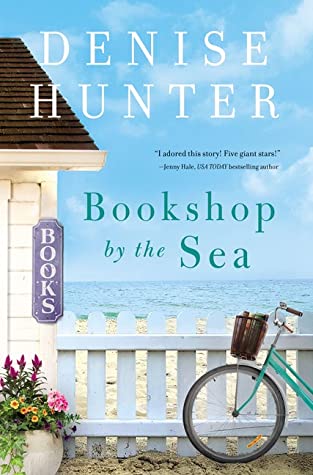
Sophie Lawson knows about abandonment and the pain it leaves in its trail. Her father left her family to fend for itself in the midst of her mother’s fatal illness on the very same day her boyfriend Aiden Maddox pulled up stakes and moved five hours away to start a new life. Aiden knows abandonment too. His mother left him sitting on the porch steps as a little boy and never looked back.
Sophie and Aiden loved each other or thought they did. Seven years later, just as Sophie’s dream to open her own bookshop is about to come true, Sophie and Aiden are thrown together once more—by a wedding and a hurricane. Can love revitalize and conquer bitterness, hurt, confusion, family obligations, and distance?
In Bookshop by the Sea, Denise Hunter paints an emotional in-depth picture of Sophie and Aiden, their pasts and the possibilities for their futures. Disaster keeps striking for Sophie who really deserves a break, but it’s hard to see how she’ll get one in time for her grand opening and book signing event. Those stressors are the backdrop for their relationship drama as the threads weave together, breaking in places only to be retied to push the characters towards growth and healing.
Bookshop by the Sea is a clean book with Christian undertones as the characters mention praying over situations. I enjoyed reading it, not really knowing if it would have a happily ever after ending, but hoping so. The characters definitely have baggage to work through—even the more minor characters as found in Sophie’s family. There is a lot of realism as no one’s life is presented as a fairy tale. There is also a lot of hope, kindness, and community spirit.
I received a complimentary copy of this book. Opinions expressed in this review are completely my own.
Rating: 4/5
Category: Romance
Publication: April 13, 2021—Thomas Nelson
Memorable Lines:
He’d forgotten how easily words of affirmation rolled off her tongue. She’d always made him feel like he could do anything. Be anything. He let the admiration in her eyes wash over him like a cool wave on a hot summer day.
“Don’t borrow trouble. ‘Who of you by worrying can add a single hour to your life?’ ’’ She gave him a wry look. “Did you just quote Scripture at me?” “Hey, there’s a reason I have it memorized. If I’ve learned anything it’s that worrying does nothing but stress you out.”
I guess somewhere along the line I started believing that when the going gets tough…people leave.” Sophie’s heart went soft and squishy at his words, his vulnerability. At the little boy who watched his mother drive away from him and never return.
Code Girls–The Untold Story of the American Women Code Breakers Who Helped Win World War II
Code Girls
by Liza Mundy

Nonfiction has the potential to be deadly boring or magnificently interesting. Liza Mundy’s Code Girls without a doubt falls into the latter category. It is not an easy read, but it is fascinating. Code Girls tells the tale of the essential role the code breakers, who were mostly women, played in the eventual Allied defeat of the Axis nations in World War II. If you are envisaging a handful of young women holed up in a room in D.C., think again. The Army’s code breakers numbered 10,500 with 70% of them women and most working out of the Arlington Hall campus in Virginia. The Navy’s group numbered 10,000 with half of those stationed in D.C. of which 80% were female. Both groups rose to those numbers from a mere 200 code breakers each in a short amount of time. These women came from all walks of life and backgrounds. Among the first recruited were college educated, low paid, school teachers at a time when a low priority was placed on education for women. Many of these women had a background in math and science, and all had a good memory. They were analytical and could approach problems in novel ways.
The code breakers’ stories went untold for most, if not all, of their lives because they were sworn to secrecy. They considered the work they did a duty of honor to their country and to the men in their lives. They understood that their work could literally save lives, perhaps even of their own loved ones, by intercepting and decoding enemy messages. It is a testament to their trustworthiness that Germany and Japan never knew that their transmissions had been intercepted. Even roommates and spouses could not speak of their work outside of their assigned workplace.
The author, Liza Mundy, had two hurdles to jump, both of which she accomplished with finesse. The first was her thorough research which is documented through 39 pages of notes and bibliography. Then she wove the hard facts into a narrative with a very personal touch derived from many interviews. She doesn’t just write that Washington, D.C. was inundated with uninitiated girls pouring in from all over the country needing housing, food, transportation, and training. She presents the scenario through the eyes and voices of the “girls” who lived it. Not everyone, of course, had the same experiences, and those experiences varied according to many factors including whether they were working for the Army or the Navy. They arrived with no assignments, just the promise that they would be helping their country.
The war period (1939-1945) was a time of great social upheaval. For most people, a woman’s place was in the home. Suddenly men were going overseas and their jobs needed to be filled along with positions created by the manufacturing needs of the war machine. There were many stereotypes that were broken down, and others that were not put to rest so willingly or easily.
Code Girls is masterfully written and a wonderful tribute to those women whose secrets can now be told. It should be “required reading” for all Americans who don’t want history to repeat itself, for readers who want to understand what previous generations endured to stand against tyranny, and for men and women interested in the societal changes that occurred as a result of World War II.
Rating: 5/5
Category: History, Nonfiction
Notes: The author sets the stage for the reader through her own notes as to how the book was written, information on the initial recruitment of women, and an introduction that discusses society in the U.S. at that tine and the military’s “bold” decision to recruit women. My copy of the book has an “Afterword for the Paperback Edition” in which the author shares the overwhelming response her book received from the code breakers and their families. The book also includes photographs of some of the women interviewed and more generic photographs of the code breakers at work. There is also a “Glossary of Code-Breaking Terms,” a very valuable “World War II Timeline,” and a “Reading Group Guide” of discussion questions.
Publication: October 20, 2017—Hachette Books
Memorable Lines:
Successful code breaking often comes down to diagnostics—the ability to see the whole rather than just the parts, to discern the underlying system the enemy has devised to disguise its communications. The Japanese, Agnes diagnosed, were encoding their messages and then using something called columnar transposition, which involves writing the code groups out horizontally but transmitting them vertically, aided by a grid with certain spaces blacked out, whose design changed often.
It was the first time many of the women had spent time in a bona fide workplace—apart from a classroom—and they discovered what workplaces are and have been since the dawn of time: places where one is annoyed and thwarted and underpaid and interrupted and underappreciated.
She and the other women knew that ship sinkings were the logical and desired consequence of their concerted efforts. They did not feel remorse. America was at war with Japan; Japan had started the war; the lives of American men were at stake, not to mention America itself. It really was that simple.
 education pathways