Home » Posts tagged 'WWII'
Tag Archives: WWII
The Bletchley Riddle–young code breakers
The Bletchley Riddle

By Ruta Sepetys and Steve Sheinkin
Written specifically for Middle Grade students, The Bletchley Riddle will appeal to those interested in World War II but not ready for the torturous aspects of the conflict. This book deals with code breaking efforts that were a critical support to the military in winning the war.
Jakob, with mathematical talents, has been recruited from Cambridge and becomes part of the secretive code breaking team at Bletchley Park. His much younger sister Lizzie, who prides herself in being straight forward, escapes from Fleetword, her chaperone who is supposed to escort her from England to live with her Gram in Cleveland, Ohio. Lizzie wants to stay in England to investigate the death of her mother Willa as she does not believe that she died in an explosion in Poland.
This novel becomes very involved as the two youths form relationships with a variety of other interesting characters who live in the area. It’s hard to determine who is a spy and who is not, but Jakob also needs to restore his relationship with Lizzie.
The Bletchley Riddle deals with official decoding using the Enigma machine and with personal riddle solving of secretive messages the pair receives. The book is well written and appropriate for middle grades; the authors knew their audience. While some books written for young people can be captivating for older readers as well, The Bletchley Riddle is not one of them. I have enjoyed other books about Bletchley Park that are more interesting and engaging for adults.
I received a complimentary copy of this book in exchange for an honest review. Opinions expressed in this review are completely my own.
Rating: 4/5
Category: Fiction, Middle Grades, Historical Fiction
Notes: Appropriate for Ages 10+ and Grades 5+
Publication: October 8,2024—Penguin Group (Viking Books)
Memorable Lines:
“Do you always speak your thoughts aloud?” “I do. I’m half American. I’m straightforward. Does that make you uncomfortable?”
She looks with disapproval toward the crumpled papers on the floor. And she’s right. It’s sloppy. I get up to gather the scraps. Even our rubbish is secret here. All of it must be burned.
But the past months have shown that circumstance can be the thief of choice.
Sisters Under the Rising Sun–cruelty and bravery
Sisters Under the Rising Sun
by Heather Morris
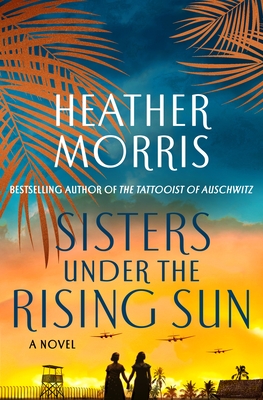
There are so many books that vividly describe the horrors of concentration camps in Europe during World War II, and Heather Morris has written several of these. In Sisters Under the Rising Sun, a work of historical fiction, Morris takes readers to the other side of the world to examine the equally dreadful treatment of civilians and Australian Army nurses in Japanese prisoner of war camps in World War II. Any sense of humanity went out the door on the part of the Japanese captors as their captives struggled to stay alive for almost 4 years with very little food, no medical supplies, unsanitary living conditions, and brutal treatment. There were many deaths, but also many examples of prisoners who survived by faith, loving and supporting each other with survival and hoping for a reunion with loved ones.
One prisoner has an extensive musical background and a lot of talent. She organizes a “voice orchestra” with women’s voices taking the parts of various musical instruments producing classical pieces to the amazement of all and with enthusiastic members. She refuses, however, the request of the camp captain to play a Japanese song, and she is harshly punished.
The groups are moved from camp to camp, each time having to restore the camp into a semi-livable place. They are given only a few inadequate tools for their work (e.g. two machetes to dig graves). Depending on the circumstances, they have to carry water quite a distance or dig wells with coconut shells or their hands. With very little to eat, they have very little energy for the work and weak immune systems. Vermin and rodents are a problem all the time. When the monsoons arrive, they have to repair their roofs with leaves. The heat is unbearable, and thirst is a common companion.
The book begins with a focus on two different groups. One is the brave and dedicated nurses who are addressed as “sisters.” The other is a family group consisting of two biological sisters and their husbands. It took me a little while to get into the story because initially the plot did not have a strong focus and kept going back and forth. Then the characters were united in one storyline which helped a lot. By the end of the story, I was smiling and crying at the resolutions for the various characters. They had become real to me.
I received a complimentary copy of this book in exchange for an honest review. Opinions expressed in this review are completely my own.
Rating: 5/5
Category: Historical Fiction
Notes: 1. As I began Sisters Under the Rising Sun, I pegged this book as worthy of 4/5 stars. By the end, my heart had gone out to the characters. Any book that can do that to me is worthy of 5/5 stars.
2. There is an epilogue that ties up what happened to the major characters when families are reunited. Ena and her sister Norah were prisoners together throughout the whole imprisonment period of almost 4 years but they had no idea what had happened to their loved ones. Especially important are June, a child who got separated from her parents and swept up in the arrests. She was cared for by Ena. Norah’s daughter Sally left Singapore under precarious conditions before everything fell apart.
3. The book ends with notes about what happened to the historical characters that the fictional ones are based on.
Publication: October 24, 2023—St. Martin’s Press
Memorable Lines:
“Be my life short or long, I’ll remember this moment forever. How in the worst possible circumstances two women, who I love more than life itself, found a way to laugh and make me laugh. Thank you, my darlings.’
“No, Sister, we’re not going anywhere. Can’t you see there are people here who need us? Yes, they have probably killed the men, but all our training and everything we stand for means we do not abandon those who need our help. I want you all to remember that where there is life there is hope.”
“I served in the Great War and I’ve been fighting in this one for two years. I thought I had seen and heard the worst of humanity. But today, just now, you have shown me that human brutality knows no bounds. What happened on that beach will not be forgotten. I’ll find a way to make it known and all I ask of you is that you say nothing to another living soul until you are safely back at home.”
The Boys in the Boat: Nine Americans and Their Epic Quest for Gold at the 1936 Berlin Olympics
The Boys in the Boat
by Daniel James Brown
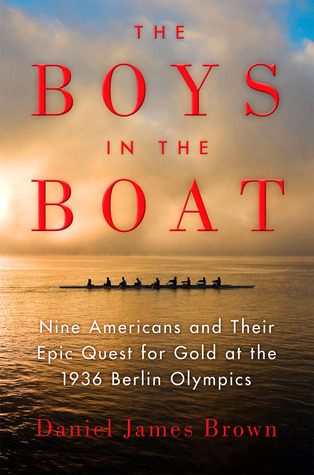
Are you a big sports fan? Do you love rowing competitions? Do you know what makes a good coxswain? If your answers, like mine, are “no,” I guarantee that you will love The Boys in the Boat anyway!
Daniel James Brown is a masterful writer. His research is the backbone of the story, but that is just the beginning. He focuses his story of nine young Americans and their coaches on one amazing young man, Joe Rantz. In the process of rolling out this tale, Brown gives the reader a deep look at Joe, who despite terrible odds survived desperate times and the abandonment of his family. With sacrifices and persistence, he struggled through the Depression to earn his way through college and a place on the University of Washington eight-oar crew.
Holding down several jobs and living in tiny, dank quarters, Joe was bullied by his teammates for always wearing the one ragged sweater he owned and for being perpetually hungry. Despite World Wars, the collapse of Wall Street, the Great Depression, flooding, the Dust Bowl, and record unemployment, there were still students who were of a “privileged” class. Many students in the West were from tougher, more humble circumstances, but few of Joe’s teammates had backgrounds comparable to Joe’s. The rowers in the East generally went to elite schools and reflected British roots in their rowing.
Although the book focuses on Joe, partly because of Joe’s unique story and partly because the author was able to interview Joe himself and Joe’s daughter, Brown also includes the backgrounds and activities of each of the other boys in the boat.
The descriptions of the qualifying race in Poughkeepsie and the Olympic competition in Berlin will immerse you in the races to the point of feeling like you are there. There are so many factors that play important roles in rowing. The coaches are key in bringing the boys along, eliminating those who do not have extreme desire and persistence. They have to motivate them to work as a team, teach them how to row, and strategize which students will work best in each position on the boat.
Each chapter starts with a philosophical rowing quote by boat builder George Yeoman Pocock. He hailed from a line of boat builders and prided himself on the quality of his boats. He also had a talent for both seeing how a rower could improve and effectively sharing that with the young man.
Leading into the Olympic competition is fascinating information about Hitler’s motivations with the Olympics and what he did to achieve world-wide acclaim. His public relations efforts portraying Nazis as accepting and culturally sensitive were quite successful internationally.
The Boys in the Boat is one of those books that will stay with me for a long time. Joe’s strength of character and physical endurance are inspirational. I am thankful that the author included an epilogue that shares what happened to each of the rowers in their adult lives. There are also a few pages that give insight into how Brown learned so much about this “epic quest.” The crew endured practices in cold and rain, in heat and rough waves. The success of the nine was well-deserved and merited recording in this outstanding book.
Rating: 5/5
Category: Nonfiction, History, Sports
Publication: 2013—Penguin
Memorable Lines:
To defeat an adversary who was your equal, maybe even your superior, it wasn’t necessarily enough just to give your all from start to finish. You had to master your opponent mentally. when the critical moment in a close race was upon you, you had to know something he did not—that down in your core you still had something in reserve, something you had not yet shown something that once revealed would make him doubt himself, make him falter just when it counted the most. Like so much in life, crew was partly about confidence, partly about knowing your own heart.
“It takes energy to get angry. It eats you up inside. I can’t waste my energy like that and expect to get ahead. When they left, it took everything I had in me just to survive. Now I have to stay focused. I’ve just gotta take care of it myself.”
The wood, Pocock murmured, taught us about survival, about overcoming difficulty, about prevailing over adversity, but it also taught us something about the underlying reason for surviving in the first place. Something about infinite beauty, about undying grace, about things larger and greater than ourselves, About the reasons we were all here. “Sure, I can make a boat,” he said, and then added quoting poet Joyce Kilmer, “ ‘But only God can make a tree.’ “
As the observation train drew back upriver again for the start of the varsity race, the atmosphere grew electric, the dusky sky crackling with static. The crowd began to buzz. Boat whistles shrilled. Alumni draped arms over one another’s shoulders and sang fight songs. Somebody was about to win big; somebody was about to lose big.
Madame Fourcade’s Secret War: The Daring Young Woman Who Led France’s Largest Spy Network against Hitler
Madame Fourcade’s Secret War
by Lynne Olson

Until I read Madame Fourcade’s Secret War, my idea of the French resistance in WWII was that it was composed of small, scattered groups of French who wanted no part of the German Nazis and fled to the forests to live in secrecy and give the Germans grief. This biography of Madame Fourcade is about her life, but also relates the amazing story of Alliance, an intricate spy network that collaborated with the British in obtaining information about German troop and ship movements that was critical to the eventual success of the Allies.
The work the resistance did was extremely dangerous from the undercover agents and their support crews to couriers and radio operators. Everyone was constantly under threat and generally on the move to avoid capture, imprisonment, torture, and execution. Yet these many brave individuals and the people who helped transport and conceal them performed their tasks voluntarily and with courage. They came from all walks of life knowing they were committing to the ultimate sacrifice in many cases.
It was amazing to read of the various situations they were involved in and the escape attempts. Fourcade, as the leader of this network, changed her identity and transferred her headquarters frequently, leaving her children in the care of others. The book makes clear how unusual and difficult it was in that time period for a woman to have a role of authority over men. She was a natural leader, however, and that quality was soon recognized by those who reported to her.
This work of nonfiction displays author Lynne Olson’s extensive research, but it reads like a novel. The reader wants to keep going to subsequent chapters to discover what happens next to the members of Alliance. There are many surprises, both good and bad.
The roles of the various countries and their agreements were at times quite infuriating. France was divided up into a northern part taken over by Germany and a southern part which became a puppet regime for Germany with their operatives everywhere. Even in exile in Britain there were two competing sides with French leaders—de Gaulle and the Free French vs. Giraud, a general the British were using to win over French forces in North Africa. There were even political pushes for dominance by the various resistance networks. Fourcade did her best to keep Alliance out of all the different political drives.
In each of the many historical fiction books popular right now, readers can learn something interesting and new about various groups in WWII. I recommend reading Madame Fourcade’s Secret War. As nonfiction, it is a slower and more difficult read, but it is well worth the effort to understand the French resistance movement and so much more about the events and major figures of WWII.
Rating: 5/5
Category: Nonfiction, Biography
Notes: 1. This would make a good selection for book clubs who want to read a work of nonfiction.
2. There are pictures of many of the agents.
3. Helpful sections of the book include Selected Cast of Characters, Author’s Note (about Fourcade’s name), Notes, Bibliography, and Index.
Publication: 2019—Random House
Memorable Lines:
Lynen, who had recently agreed to take part in a theatrical tour across France, said he would transport the transmitters and secret documents from one city to another in his costume trunk. He told Fourcade that his celebrity would be an advantage rather than a negative: No one would ever believe that the famous “Carrot Top” was a spy. It would be, he said with a grin, his finest role.
A few days before, she had gone to confession and told the priest about the poison she was taking with her and her concerns about being damned in the eyes of the church if she used it to kill herself. She hoped she would have the courage to resist torture, but she worried that she might not be able to do so and might, in the end, inform on her colleagues. The priest allayed her fears, saying her death would not be a suicide but rather a necessary means of resisting the enemy. He gave her absolution in advance.
Although they were from varied walks of life and political backgrounds, a moral common denominator overrode all their differences; a refusal to be silenced and an iron determination to fight against the destruction of freedom and human dignity. In doing so, they, along with other members of the resistance, saved the soul and honor of France.
The Ways We Hide–“escapologist extraordinaire”
The Ways We Hide
by Kristina McMorris

Admittedly it is hard to write a “happy” book about World War II. The Ways We Hide is definitely not a cheerful book. While she avoids graphic descriptions of the violence of the war, author Kristina McMorris excels at conveying the overwhelming sadness of the personal tragedies, even those that occurred pre-war, early in the orphaned protagonist Fenna’s life. When she escapes from an orphanage in the U.S., she is taken in by her best friend Arie’s family despite their religious differences. The parents in both families are Dutch immigrants. As young adults they discover their romantic love for each other, but Fenna suddenly leaves her adoptive family without explanation.
Taking her love of magic to the stage, Fenna becomes a self-made illusionist in the style of Houdini. She is recruited by the British in World War II to devise gadgets and conceal them in support of Allied troops in Europe. The British ask her to go to Holland on a dangerous rescue mission to find Arie, but more more is involved than her handlers are telling her.
The story is well played out with unexpected twists around every corner. This work of historical fiction is well written and extremely well researched. I can’t say that it is a page turner for me because it is so sad. The characters have little hope for positive outcomes, but pursue their noble goals against all odds. The work is undercover, classified, and occurs in Nazi controlled areas. Therefore, it is hard to know who can be trusted.
The author explains at the end of the book her framework for inserting the fictional Fenna into the mostly historically accurate backdrop with some slippage of time. She has researched her subjects well which include not only the war efforts but also an anti-labor strike event that changed Fenna’s life forever.
The ending is not a happily ever after with the protagonists riding off into the sunset, but how could it be when so many people have died? Despite the reality of the situation, the author does manage to conjure up a “lemons into lemonade” scenario for Fenna that is satisfying and actually sweet. I am glad I read this book which reveals a lot about undercover work, dangers, and relationships in World War II.
I received a complimentary copy of this book in exchange for an honest review. Opinions expressed in this review are completely my own.
Rating: 4/5
Category: Historical Fiction, Women’s Fiction
Notes: 1. There are author notes at the end which explain in detail how McMorris got her inspiration for the various parts of the book. It is followed by suggestions for further reading for those who would like to learn more about the topics in the book.
2. Online there is posted a Book Club Guide on the author’s website (kristinamcmorris.com). While I do recommend this book for book clubs, individual readers will also find this guide helpful in visualizing the setting and the culture. It includes Dutch inspired recipes plus a recipe for invisible ink (not the lemon juice type). There are questions designated as a Reading Group Guide. Perhaps most importantly to me, there are fifteen photographs that will transport the reader back in time. There are also QR codes for videos and other additional resources online. In addition, there are suggestions for group activities to enhance book club meetings.
Publication: September 6, 2022—Sourcebooks Landmark
Memorable Lines:
Traveling in clusters pallbearers carried pure-white caskets low at their sides. The dimensions of each befitted a child, the weight minuscule compared to the burden.
In this instant I consider a potential reason my life has been repeatedly spared. Could it be to attain justice for the victims of a cruel and callous enemy?
He offers his hand with a caring look. “May our paths cross again,” he says, “in a better world.” It’s impossible to envision any future beyond the immediate challenges ahead. Still, I accept his handshake, grateful for the notion.
The Guernsey Literary and Potato Peel Pie Society–comeback from World War II
The Guernsey Literary and Potato Peel Pie Society
by Mary Ann Shaffer and Annie Barrows
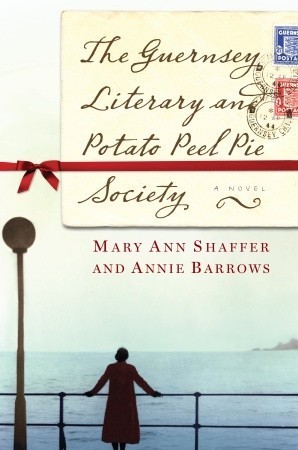
I approach epistolary fiction with a bit of trepidation. Can a story really be told effectively through a series of letters? In the case of the unusually named The Guernsey Literary and Potato Peel Pie Society, that is probably the best way to relate the events of the Nazi occupation of Guernsey and to present the characters and how the war affected them.
Juliet Ashton is a budding author with one successful book based on a column she wrote. Her publisher, Sidney, and his younger sister, Sophie, are friends of Juliet; their letters are part of the correspondence that moves the story along. The heart of this tale begins when a letter finds its way to Juliet in London from Guernsey where Dawsey Adams has bought a book by Charles Lamb with her name and address. Dawsey seeks more books by Lamb as well as information about him. Their correspondence leads to a discussion of the local book club which began during the Nazi Occupation.
Most of the book club characters are quite likable and work together because of, or in spite of, their idiosyncrasies and the hardships they have endured. They welcome the opportunity to share their stories with Juliet for potential publication. They are quite open to her personally as well. Juliet grows as a writer, her maternal instincts emerge, and she shows strength of character as she discovers what is important to her.
The Guernsey Literary and Potato Peel Pie Society is well-written with detailed settings and empathy for the characters. It is both a gentle and a strong book and gives a fair depiction of Nazi soldiers, most of whom suffer deprivation in Guernsey along with the locals. Some Nazis are depicted as brutal and a few as humane. Some citizens are supportive of each other and a few are treacherous. The accounts also included Todt slaves, brought in by the Germans. They suffer the most in this book. The Guernsey Literary and Potato Peel Pie Society has deservedly caused a lot of buzz among readers and has been made into a movie.
Rating: 5/5
Category: Historical Fiction
Publication: July 29, 2008—Dial Press
Memorable Lines:
I turned to a man sitting against a fence nearby and called out “We’re saved! It’s the British!” Then I saw he was dead. He had only missed it by minutes. I sat down in the mud and sobbed as though he’d been my best friend.
All those people I’ve come to know and even love a little, waiting to see—me. And I, without any paper to hide behind….I have become better at writing than living…On the page, I’m perfectly charming, but that’s just a trick I learned. It has nothing to do with me.
Dawsey was seeing to my bags and making sure that Kit didn’t fall off the pier and generally making himself useful. I began to see that this is what he does—and that everyone depends upon him to do it.
The Warsaw Orphan–survival in the Ghetto
The Warsaw Orphan
by Kelly Rimmer
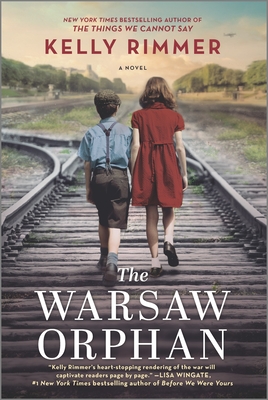
World War II is a popular subject for historical fiction. There are so many countries involved along with a variety of religions and philosophies. Lots of major political figures vie for power. Lives are turned upside down, families destroyed, and cultural icons demolished. In the midst of this upheaval, the citizens of Poland find themselves in a tug of war between Nazi Germany and the Red Army of the Soviet Union.
Roman, raised Catholic, is part Jewish. As a teenager he feels compelled to keep his Jewish family safe and later to fight from the Warsaw Ghetto with the Resistance for Poland’s freedom. Emilia (known as Elzbieta on her false identity papers) finds a way to work daily in the Ghetto under horrible conditions to help the people there who are overcrowded and sick from diseases and malnutrition. Their paths cross, and Roman and Emilia begin a friendship that lasts across the years.
In The Warsaw Orphan, Kelly Rimmer creates three dimensional characters who change and mature as a result of both growing up and experiencing the dramatic events that the war brings into their lives. They both see and endure things no one should have to—especially not teenagers. There are many characters of note and none of them see life as black and white. Many events take place in the grey area of life where one’s values and necessities do not line up perfectly. Some of the characters are Christian, some are Jewish, and others are atheists. Some are moral, decent people while others are torturing murderers.
The plot is told alternately from Roman’s and Emilia’s points of view. This is an effective way of narrating this story as it takes us on the personal journey each has to endure. There are decisions the characters have to make that affect others, not just themselves. The plot leads the reader through the many emotions that engulf the characters: grief, fear, shame, guilt, revenge. There are also moments of kindness, love, protectiveness, and generosity.
I thought The Warsaw Orphan was good, but the final fourth of the book was both surprising and riveting. You can’t expect a book about WWII to be filled with happiness and light, but I was amazed at Rimmer’s creative abilities to put her characters in desperate situations and then resolve them in a hopeful and rational way.
I received a complimentary copy of this book in exchange for an honest review. Opinions expressed in this review are completely my own.
Rating: 5/5
Category: Historical Fiction, General Fiction
Publication: June 1, 2021—Harlequin (Graydon House)
Memorable Lines:
Bystanders have allowed themselves to be convinced that the Jews are not like us, and as soon as you convince someone that a group of people is not human, they will allow you to treat them as badly as you wish.
Those agonizing weeks during the Uprising confirmed that art is not always for the viewer. Sometimes the very act of creating can mean salvation for the artist.
As punishment for our decision to rebel, our homes, our libraries, our monuments and our infrastructure would be reduced to dust. It wasn’t enough that they had taken our people and our homes—they were going to take what was left of our culture.
A Letter to the Last House Before the Sea–reinventing yourself
A Letter to the Last House Before the Sea
by Liz Eeles
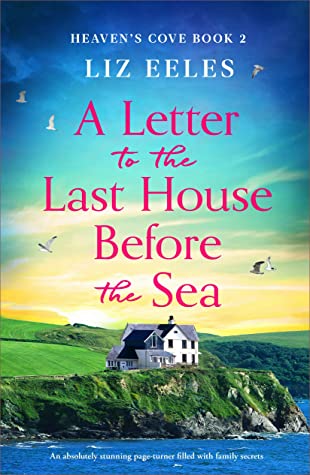
Many series depend on the continuation of a character or a set of characters. The Heaven’s Cove Series does not. The continuity is found in the setting—the little village of Heaven’s Cove and Driftwood House perched on a cliff high above the ocean. Therefore, with only a few characters from the first book showing up in the second, anyone can easily jump into the series with this second book, A Letter to the Last House Before the Sea. I should add, however, that I loved the first book and immediately after reading it purchased the second book so I would be ready to jump into the third which was recently published.
Lettie has had a hard time finding her way in life. Her family tries to manage her personal life while depending on her to be on call for their needs—be they babysitting, shopping, or sorting repairs. When she is sacked from a customer service job five weeks after the death of her beloved great-aunt Iris, she does a runner to Heaven’s Cove where she hopes to fulfill the bedside wish of her aunt to “find out for me, darling girl.” Aunt Iris had secrets about her past. She left Heaven’s Cove as a teenager with her whole family, never to return. She bequeathed a delicate gold key to Lettie that was connected to her secret. Lettie is committed to discovering what the secrets are that make up Iris’ past.
Locals are suspicious and disdainful of outsiders so Lettie has trouble researching the history, but in the process realizes that maybe she is ready to rediscover her former passion for history and reinvent herself. Along the way she meets several handsome young men and some cranky old timers. She finds Heaven’s Cove calling to her. As she follows leads on Iris’ story, she discovers someone else in need of her skills to track down a long lost love, adding another emotional dimension to the plot.
Lettie is a very likable main character. You will want the best for her and feel her frustrations as your own. My second visit to Heaven’s Cove kept me turning pages and ended with me smiling in satisfaction.
Rating: 5/5
Category: Women’s Fiction
Notes: 1. # 2 in the Heaven’s Cove Series, but would be good as a standalone.
2. Clean fiction—no sex or violence and very little swearing.
Publication: May 19, 2021—Bookouture
Memorable Lines:
Truth be told, Claude had saved Buster that night, as the rain lashed down and the shivering stray risked being swept away by the waves breaking over the quay wall. But then Buster had saved Claude, in return, from the loneliness that often threatened to overwhelm him.
“People disappear from your life, but they always leave an echo,” said Claude quickly.
Much as she’d grown to love Heaven’s Cove, she would never get used to the village grapevine. In London you could drop dead and no one would notice.
The Screwtape Letters–twisting good into evil
The Screwtape Letters
by C.S. Lewis
Welcome to the inside-out, topsy turvy world of The Screwtape Letters, correspondence supposedly written by Screwtape, an experienced devil who is mentoring his nephew Wormwood, a junior tempter, in the process of keeping the human assigned to him from becoming a Christian and making good choices. The human is considered a “patient.” God is called “the Enemy,” and Satan is referred to as “Our Father Below.” As you can imagine, this short book is not a quick read as you have to turn familiar designations of God and Satan, as well as your whole thought process, around so that the book will make sense.
First published in serial form in a newspaper, it is divided into chapters which are letters generally focused around one topic such as gluttony or humility and gives advice on how to twist things that God has created in beauty and purity into something that will draw the patient away from God and onto sinful paths.
I am glad I read this book, but I didn’t enjoy it in the same way I would an entertaining mystery or a gentle romance. It is quite witty with tongue-in-cheek humor throughout. It challenged my mind and spirit as I tried to decipher C.S. Lewis’ message. Reading The Screwtape Letters is rather like looking into a mirror. Beware! As you see a reflection of yourself in some of the passages, you may be inspired to make changes in your own life that will result in your reflecting God’s image rather than the one Satan would appreciate. With much food for thought, The Screwtape Letters could be read and studied many times, especially over the course of a lifetime, deriving a new depth of meaning applicable to you personally with each reading.
Rating: 5/5
Category: Christian, Fiction
Notes: C.S. Lewis was one of the intellectual giants of the 20th century. He is the noted author of many works of fiction and nonfiction including The Chronicles of Narnia and Mere Christianity. The Screwtape Letters was originally published in 1942.
Publication: 1959—Macmillan Publishing Co.
Memorable Lines:
All virtues are less formidable to us once the man is aware that he has them, but this is specially true of humility. Catch him at the moment when he is really poor in spirit and smuggle into his mind the gratifying reflection, “By jove! I’m being humble,” and almost immediately pride—pride at his own humility—will appear.
Music and silence…how I detest them both!…Noise, the grand dynamism, the audible expression of all that is exultant, ruthless, and virile—Noise which alone defends us from silly qualms, despairing scruples, and impossible desires.
And since we cannot deceive the whole human race all the time, it is most important thus to cut every generation off from all others; for where learning makes a free commerce between the ages there is always the danger that the characteristic errors of one may be corrected by the characteristic truths of another.
The Medallion–for the love of a child
The Medallion
by Cathy Gohlke
 What is worse than being a Pole during World War II? Being a Jew.
And what is worse than either? Being a Polish Jew, a target for abuse, humiliation, torture and destruction.
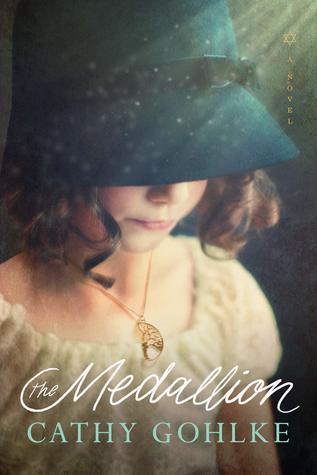
The Medallion by Cathy Gohlke tells the story of two families whose lives and deaths become joined through the horrors and hardships of life in Poland in World War II. Janet is a Polish fighter pilot married to Sophia, an English citizen, alone in Poland, but with a heart for Jewish children. Rosa has to make the most difficult decision possible to save her beloved daughter’s life. Her husband Itzhak, an electrician, endures the most horrific task assigned to any person by the Nazis, digging up mass graves with his bare hands. Can anything good possibly emerge from the desperation of this story?
Many of the characters in The Medallion are fictional, but are inspired by interviews and textual research. Some are found in history, including Irena Sandler who rescued 2,500 children and Dr. Janusz Korczak who ran an orphanage.
The tales of these two families are difficult to read but also inspiring. Towards the end of the book, when the war is over and all should be well, it isn’t. Sophia finds herself in a moral and personal crisis of faith that intimately affects the lives and futures of herself and those she loves most.
I would like to extend my thanks to netgalley.com and to Tyndale House Publishers for giving me the opportunity to read this book in exchange for an honest review.
Rating: 5/5
Category: Christian, Historical Fiction
Notes: The end of this book also includes discussion questions, notes to the reader about the writing of this book, and historical notes.
Publication: June 4, 2019—Tyndale House Publishers
Memorable Lines:
“Adonai makes a way when there appears no way. It is His specialty. Remember the Red Sea.” The words of her old friend came back to her, just as they did so often when Sophie felt at her wits’ end.
The Germans wanted to make certain that Poles were equipped only to follow orders, mostly for menial labor. They espoused the belief that a thinking Pole was a dangerous Pole. Hence, Polish schools were closed and thousands upon thousands of children did not learn to read or write—unless they were taught in secret.
“We’re not meant to handle life alone, Sophie. It’s too hard, too unpredictable, too messy and big. There is One who is willing and ready to help, to travel with us, if we let Him.”
 education pathways