
Home » Posts tagged 'WWI'
Tag Archives: WWI
Ladies of the Lake–bonds of friendship
Ladies of the Lake
by Cathy Gohlke

Viewing the same characters in a split timeline is a good way to tell the story of four girls who formed life long friendships at Lakeside Ladies Academy in Connecticut. They dubbed themselves “Ladies of the Lake.” They were not similar in background, but over their years at the school, they developed a close bond which they sealed with blood signatures at a gazebo on the school grounds, promising to keep in touch and support each other. The split timeline varies between showing the ladies as young people and as adults with a mystery gradually unraveling as the backgrounds and events that shaped them as adults are revealed.
Unfortunately, mistakes were made and things were said that broke some of the bonds. Dot and Addie are the most prominent characters, but they harbor secrets that keep them apart. Loving the same man, the Great War, and the Halifax Explosion all play a tumultuous role in their futures. Can a teenager bring them together?
Ladies of the Lake has a strong Christian theme as the women struggle through seemingly impossible situations. Portia, Addie’s housekeeper, is a woman of faith who gently guides Addie through some difficulties. The author holds up for examination the perspectives of the times on German Americans and Blacks. She invites the reader to see more than one side of an issue For example, people of German descent, former friends and neighbors, might be viewed as the enemy. Blacks were often held in contempt by some as “less than” even though they were put in a position of nurturing white children.
Forgiveness is a strong theme in this book as there are several characters who need to ask and receive forgiveness. Family is another important theme as the girls form a family for each other regardless of their home situations.
Reading this book is an escape into another world, but not one without pain. The characters are described well, and readers can immerse themselves in their lives as the story is full of twists and turns. The author cleverly hides the identity of Dorothy’s husband, but as the book progresses the reader will take pleasure in deciphering who he probably is.
I received a complimentary copy of this book in exchange for an honest review. Opinions expressed in this review are completely my own.
Rating: 5/5
Category: Historical Fiction, Christian, Women’s Fiction
Notes: There are lots of Scripture references and some particularly lovely and meaningful prayers at appropriate places in the story.
Publication: July 11, 2023—Tyndale House Publishers
Memorable Lines:
If I’d had a grandmother or a guardian angel, I would’ve wanted her to be just like Mrs. Simmons…I would have wanted her to be Mrs. Simmons.
She watched as he rejoined his brother, two halves of a whole, one with a slight limp and the other with a sleeve empty since the Great War, neither of which stole appeal from either man. That war had stolen much from the Meyer family, far more than the damage or loss of limbs.
Tears know no quota; mine couldn’t seem to stop.
The Boys in the Boat: Nine Americans and Their Epic Quest for Gold at the 1936 Berlin Olympics
The Boys in the Boat
by Daniel James Brown
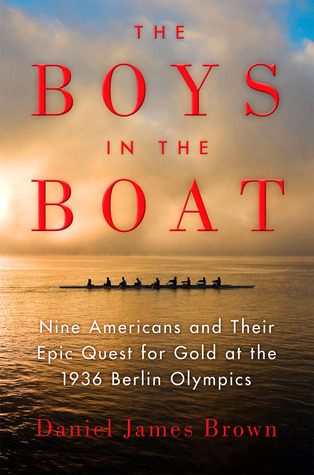
Are you a big sports fan? Do you love rowing competitions? Do you know what makes a good coxswain? If your answers, like mine, are “no,” I guarantee that you will love The Boys in the Boat anyway!
Daniel James Brown is a masterful writer. His research is the backbone of the story, but that is just the beginning. He focuses his story of nine young Americans and their coaches on one amazing young man, Joe Rantz. In the process of rolling out this tale, Brown gives the reader a deep look at Joe, who despite terrible odds survived desperate times and the abandonment of his family. With sacrifices and persistence, he struggled through the Depression to earn his way through college and a place on the University of Washington eight-oar crew.
Holding down several jobs and living in tiny, dank quarters, Joe was bullied by his teammates for always wearing the one ragged sweater he owned and for being perpetually hungry. Despite World Wars, the collapse of Wall Street, the Great Depression, flooding, the Dust Bowl, and record unemployment, there were still students who were of a “privileged” class. Many students in the West were from tougher, more humble circumstances, but few of Joe’s teammates had backgrounds comparable to Joe’s. The rowers in the East generally went to elite schools and reflected British roots in their rowing.
Although the book focuses on Joe, partly because of Joe’s unique story and partly because the author was able to interview Joe himself and Joe’s daughter, Brown also includes the backgrounds and activities of each of the other boys in the boat.
The descriptions of the qualifying race in Poughkeepsie and the Olympic competition in Berlin will immerse you in the races to the point of feeling like you are there. There are so many factors that play important roles in rowing. The coaches are key in bringing the boys along, eliminating those who do not have extreme desire and persistence. They have to motivate them to work as a team, teach them how to row, and strategize which students will work best in each position on the boat.
Each chapter starts with a philosophical rowing quote by boat builder George Yeoman Pocock. He hailed from a line of boat builders and prided himself on the quality of his boats. He also had a talent for both seeing how a rower could improve and effectively sharing that with the young man.
Leading into the Olympic competition is fascinating information about Hitler’s motivations with the Olympics and what he did to achieve world-wide acclaim. His public relations efforts portraying Nazis as accepting and culturally sensitive were quite successful internationally.
The Boys in the Boat is one of those books that will stay with me for a long time. Joe’s strength of character and physical endurance are inspirational. I am thankful that the author included an epilogue that shares what happened to each of the rowers in their adult lives. There are also a few pages that give insight into how Brown learned so much about this “epic quest.” The crew endured practices in cold and rain, in heat and rough waves. The success of the nine was well-deserved and merited recording in this outstanding book.
Rating: 5/5
Category: Nonfiction, History, Sports
Publication: 2013—Penguin
Memorable Lines:
To defeat an adversary who was your equal, maybe even your superior, it wasn’t necessarily enough just to give your all from start to finish. You had to master your opponent mentally. when the critical moment in a close race was upon you, you had to know something he did not—that down in your core you still had something in reserve, something you had not yet shown something that once revealed would make him doubt himself, make him falter just when it counted the most. Like so much in life, crew was partly about confidence, partly about knowing your own heart.
“It takes energy to get angry. It eats you up inside. I can’t waste my energy like that and expect to get ahead. When they left, it took everything I had in me just to survive. Now I have to stay focused. I’ve just gotta take care of it myself.”
The wood, Pocock murmured, taught us about survival, about overcoming difficulty, about prevailing over adversity, but it also taught us something about the underlying reason for surviving in the first place. Something about infinite beauty, about undying grace, about things larger and greater than ourselves, About the reasons we were all here. “Sure, I can make a boat,” he said, and then added quoting poet Joyce Kilmer, “ ‘But only God can make a tree.’ “
As the observation train drew back upriver again for the start of the varsity race, the atmosphere grew electric, the dusky sky crackling with static. The crowd began to buzz. Boat whistles shrilled. Alumni draped arms over one another’s shoulders and sang fight songs. Somebody was about to win big; somebody was about to lose big.
A Certain Darkness–could WWI have ended sooner?
A Certain Darkness
by Anna Lee Huber
Lord Ardmore—a good name for an evil person. Although he is not physically present in A Certain Darkness, his influence and machinations pervade the events of this spy novel. Verity Kent and her husband Sidney are a rich and glamorous couple who are both well known in the intelligence circle for undercover work for the British during WWI. Sidney is also a war hero. In this book, they are once more called into service by their country to discover potentially damaging evidence.
In this action packed drama, Verity and Sidney don’t know whom to trust as they try to uncover how a murder occurred on a train and in a jail cell without anyone seeing either crime. Verity is a polyglot, a helpful skill as the couple interacts with French, German, Dutch, and Flemish speakers. One of my favorite scenes involves Verity speaking in their language to someone who is previously unaware that she can understand their conversations with others—rather embarrassing for the speaker.
The plot is complicated because the events that occurred during and after the war are quite complex. Just when I thought I wasn’t enjoying the book because of the intricate historical references, the action and intrigue picked up and I couldn’t wait to read what would happen next.
Both characters suffer from the horrors and stresses of the war, but there are some mental and emotional breakthroughs for both of them in this book. Whereas in the first book I read in the series (#2) I found the couple rather frivolous, I have come to like and respect both of them as I have gotten to know them better. There has also been more character development with each book. If you are interested in history or like spy mysteries, you will enjoy this series including A Certain Darkness. It closes out with a very important hook that will keep me and other readers anxious to read the next book in the series.
I received a complimentary copy of this book in exchange for an honest review. Opinions expressed in this review are completely my own.
Rating: 4/5
Category: Mystery, Historical Fiction
Notes: 1. #6 in the Verity Kent Mystery Series. I do not recommend this book as a standalone. There is just too much necessary background provided in the previous books.
2. Clean.
3. One of the themes of this book concerns the ending of WWI. I did an Internet search on this topic and found this is a concern for some historians. In her introduction, Huber lists a recently published nonfiction book on this subject that she used as a resource for her fiction book.
Publication: August 30, 2022—Kensington
Memorable Lines:
Much of intelligence gathering in general was accepting that there were few total victories, few clear choices of right and wrong. Everything was shaded in gray. One had to make judgment calls, constantly wagering possible sacrifices versus gains. Sometimes you got it right and sometimes you got it wrong. But whatever the outcome, you had to swallow the guilt and disgust such decisions and compromises at times wrought.
I recognized what game he was playing, for he’d learned it from the best. After all, Lord Ardmore didn’t simply aim to outwit his opponents, but to corrupt and demoralize them. To turn them against themselves, against their very morals.
“I’d accepted long ago that the war was utterly senseless.” His voice rasped as if being dragged from the depths of his lungs. “That I was simply stuck. Just a little cog in a great monstrous machine that couldn’t be stopped and would one day consume me as well.”
Penny for Your Secrets–post World War I England
Penny for Your Secrets
by Anna Lee Huber
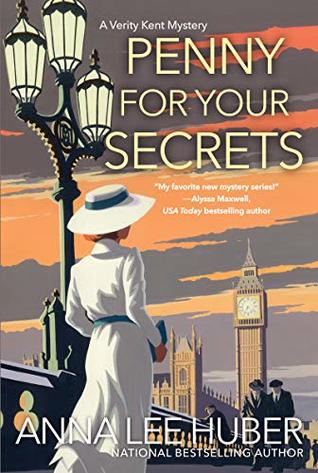 I do so enjoy historical fiction with more than a touch of mystery. Penny for Your Secrets by Anna Lee Huber is that kind of book. Unfortunately, and perhaps it was just me, but this novel seemed to drag a bit. The premise is interesting and becomes increasingly complicated as more murders occur. The Kents, Verity and Sidney, can’t get away from their heroic pasts. Each played a critical undercover role in World War I, and their friends, the media, and their own souls will not let them forget it. In this book, issues from World War I resurface in various ways and involve current MI5 operatives as well.
Although I like the Kents, their relationship issues play a role that is too prominent at the expense of the plot. I understand their angst over past decisions, but sometimes I just wanted to tell them how lucky they are: they emerged from a horrific war with no major physical injuries, considerable financial wealth, and a marriage intact. So many could not claim any of those benefits after World War I.
Kudos to the author for an intricate plot, an appealing setting, and historical accuracy. It will be interesting to see what adventures await the fashionable Kents next.
I would like to extend my thanks to netgalley.com and to Kensington Books for giving me the opportunity to read this book in exchange for an honest review.
Rating: 4/5
Category: Historical Fiction, Mystery
Notes: #3 in the Verity Kent Mystery Series, but works as a standalone
Publication: October 29, 2019—Kensington Books
Memorable Lines:
My skin prickled at being in such close proximity to so much anger, as if the daggers aimed at others had been deflected on to me.
“…my father always did have a different standard when it came to what he and his peers were allowed to do as opposed to the rest of the world.”
“In some situations, there is no winning. No right way. You can only make the best choices you can, and hope the people your decision might have harmed will forgive you in the end.”
The Escape Artists: A Band of Daredevil Pilots and the Greatest Prison Break of the Great War
The Escape Artists
by Neal Bascomb
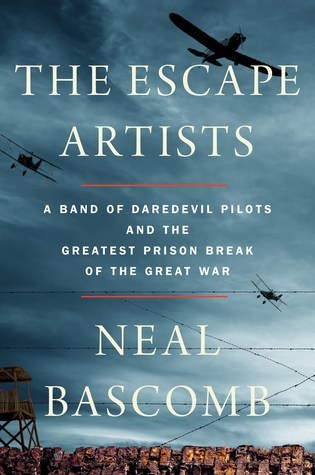 War is such a horrible thing—vicious, destructive, and despicable. It brings out the worst and the best in man. We see both in Neal Bascomb’s true recounting of the largest escape of WWI by the British at one time—twenty-nine officers of whom ten actually made it out of Germany to Holland without being recaptured.
Bascomb’s well-researched tale The Escape Artists is divided into four major sections. In the first, “Capture,” he provides a glimpse into the personalities and lives of some of the major players in the escape, their role in the military, and the circumstances of their capture.
The second section, “All Roads Lead to Hellminden,” describes a number of interment camps but focuses especially on notorious twin commandants, Karl and Heinrich Niemeyer. Both prisoners and commandants could be transferred at whim in Germany and being transferred could be positive or negative for a prisoner. This section details life in the camp and shows a better situation for officers than that experienced by enlisted soldiers who were put in labor camps. Officers, instilled with the patriotic drive to do whatever they could to hinder the enemy and return home to fight again, spent a lot of their energy devising and executing escape plans. If their attempts were unsuccessful or they were recaptured, the punishment was generally a long and uncomfortable time in a small isolation cell—dark, very hot or very cold, dirty, overrun with vermin, and little food. This trial on the body, mind, and spirit might last several days, weeks or months. Nevertheless, instead of deterring escape attempts, it prodded the officers into yet more clever tries.
“The Tunnel” describes the huge group effort spearheaded by an officer named Gray to construct a very long tunnel and plan how to proceed once outside the walls of Holzminden. All of the background material in the first two sections was essential, but at this point the story really takes off and you will want to keep reading until finished. The last section. “Breakout,” shares the actual escape attempt.
To write this book, Bascomb read a lot of books on the escape and the interment camps, interviewed descendants of the officers, and relied greatly on primary documents including memoirs and letters from the time. His narrative style is effective and the subject matter is interesting. Having read several books on labor and death camps, it was interesting to read about the British officers, drawn from all over the globe. Many of them were young pilots from exclusive schools and families. They had little training, but were very patriotic and had a honed sense of duty and honor. One surprising detail for me was that the imprisoned officers were able to write to their families and receive packages and money from them. Not everything went smoothly in that process, but they were better off than those in labor camps. They even had orderlies from the enlisted ranks of prisoners to make their beds, etc. This was not a luxury situation by any means, and the men were quite bored and frustrated whiling away time when they felt they should be fighting.
Neal Bascomb is a former journalist who turned to writing nonfiction books full-time in 2000. He is the award winning author of nine books for adults and three for young adults.
I would like to extend my thanks to netgalley.com and to Houghton Mifflin Harcourt for giving me the opportunity to read this book in exchange for an honest review.
Rating: 5/5
Category: History
Publication: September 18, 2018—Houghton Mifflin Harcourt
Memorable Lines:
The greatest resistance of all would be to escape.
None of the diplomats gathered in The Hague in 1899 or 1907 could have anticipated the vast populations of prisoners that would come out of industrialized total war—nor the challenges this would involve. In the first six months of World War I, 1.3 million soldiers became POWs across Europe.
The arrival in December of Harold Medlicott had bolstered the mood throughout the camp. The officers believed that if anybody could escape Holzminden and humiliate Karl Niemeyer, it was Medlicott. A legend even to the German guards, he had broken out of nine camps already, never using the same method twice.
Harvey might not get another chance to escape, but in aiding Cartwright, as in countless other efforts to help his fellow prisoners, he found freedom within. In his own way, he was a breakout artist.
 education pathways