
Home » Posts tagged 'World War II'
Tag Archives: World War II
The Incredible Winston Browne–“the baseball-loving sheriff”
The Incredible Winston Browne
by Sean Dietrich

I am not a very emotional reader, but that was certainly my response to The Incredible Winston Browne. This fictional work is populated by people in the small town of Moab, Florida, in the 1950’s who will fill your mind and heart as they go about their lives reacting to their circumstances the best way they know how. Sheriff Winston Browne went off to war, came back to his home town, had his heart broken, and became a quiet leader in a place where there was little crime but a lot of needs. Winston becomes the father to the town and the coach of its popular Little League baseball team, the Dodgers, named after the professional team adored by the town.
While dealing with his own failing health, he steps in to encourage Eleanor, a strong woman who, though active in the community, has remained firmly rooted in the past like most of Moab. She is frustrated by the lack of a relationship commitment by Jimmy, Winston’s best friend. Winston also is instrumental in the future of Jessie, a ten year old girl who escapes from a religious cult. He stands by Buz, a teenage boy with a single, polio-afflicted mom and an alcoholic grandfather. Buz and his mom lack the financial basics even though both of them work, and Buz needs guidance to become the man Winston knows he can be.
Broken into fairly short chapters, the book initially takes the reader back and forth between the Moab setting and Jessie’s trip to freedom while pursued by members of the Temple Community of Sanctified Brethren who consider her an abomination. Each part is well written and engaging. Readers will want good things for the main characters whose personalities are gradually revealed by their actions as the tale is told. Jessie, in particular, is fascinating as she experiences the wonders of life outside the cult. Winston is a true hero as he quietly helps others.
The is the first book I have read by Sean Dietrich, who writes about life in the American South both in novels and in periodical columns. In this book he adds a homey touch by occasionally including a column from the local paper that is a rundown on the local gossip including who escorted whom to the movies or dinner in Pensacola and where the newlyweds went on their honeymoon. The columnist is careful to include several times that this is the second marriage for the groom. Tidbits like this one give the reader a feel for Moab and provide a little relief from the tension in the main threads. Dietrich regularly describes settings in such a way that they become real: “The county roads couldn’t have been any bumpier if they’d been manufactured by the National Washboard Company.” I will be looking for more of Dietrich’s works as he is an author with literary skills that encompass technical excellence and the passion of a storyteller.
Rating: 5/5
Category: Fiction
Notes: 1. Clean
2. Great set of questions at the end of the book that our book club found very helpful in stimulating our discussions about symbolism and themes.
Publication: March 2, 2021—Thomas Nelson
Memorable Lines:
Doctor’s offices were their own kind of purgatory. He’d endured gunfire in muddy European trenches, and he’d captained teenagers across acres of farmland littered with antipersonnel mines. But he was frightened by a little old man in a white frock coat.
It was only a practice, but people in Moab came out to see the boys play three times a week because they were bored small-town people and they would have come out to watch paint dry if there had been nothing good on the radio.
There wasn’t a boy in Moab who didn’t respect Sheriff Browne. Even the hoodlums. Everyone like the baseball-loving sheriff. Some boys even worshipped him. To disappoint this man was like disappointing Abraham Lincoln and Gene Autry at once.
The Swiss Nurse–refugees from war
The Swiss Nurse
by Mario Escobar

I am so glad that I had read other books by Mario Escobar, because this work of historical fiction started off roughly for me. I feel sure the fault was my own. I am shamefully unfamiliar with the Spanish Civil War, and I started the book too late in the evening. I persevered the next day, however, and was quickly immersed in a tale of evil hearts and the strength of some good people who worked to help others in dire circumstances.
When Franco and his troops were successful in this war, they were determined to obliterate the Republicans fighting for their freedom and anyone associated with them. The result was a massive exodus of refugees into southern France which was not prepared for the influx and did not welcome them with open arms. The “camps” they provided were sandy beaches with no structures. There was little food and no potable water; the refugees were not allowed outside the camp.
This book is about the refugees in that war which was followed up by the events of World War II and the further torment of innocents by the French Vichy government which was a puppet government of the Nazis, and then by the Nazis themselves. Much of the story describes the horrible conditions of the refugee camps and the strength and boldness of Elisabeth Eidenbenz, a Swiss woman whose focus was orphans in Spain until she was forced relocate to southern France where she opened a hospital taking in pregnant women and giving them a safe place to deliver their babies. The other main character is Isabel, a Spanish lady who married Peter, an American who fought with the Spanish for their liberation. Their lives intersect when Isabel gives birth to her precious daughter Lisa at the Elne Maternity Hospital. With Peter held in various prisons and concentration camps and conscripted into the army for manual labor, Isabel stays to help in the maternity hospital.
The author pulls the reader into the horrible conditions and the faith and courage of characters who stand up for what is right. As a reader, you want everything to turn out great for the sympathetic characters. This is, however, a work of historical fiction, so not everyone has a happy ending. It is important to read works like this so that we are not duped yet again by politicians who promise good things and deliver nothing, creating untenable situations. History like this must not be allowed to repeat itself.
I received a complimentary copy of this book in exchange for an honest review. Opinions expressed in this review are completely my own.
Rating: 5/5
Category: Historical Fiction, Multicultural, Fiction
Notes: Additional material includes: References, Clarifications from History, Timeline, Discussion Questions, and Information about the Author and the Translator
Publication: April 14, 2023—Harper Muse
Memorable Lines:
Gazing off into the distance, their gaunt faces reflected the weary sadness of their souls. Their cheeks were sunken with hunger, and their skin was pallid from exhaustion and malnourishment.
An entire generation had been killed for naught: anonymous heroes on both sides, idealists attracted by the siren songs of their leaders who stayed safe in the rear guard. The only hope was to erase those painful years from their lives and try to start over from scratch.
Argelès-sur-Mer had been both refuge and jail. It had stamped out of us the hope of recovering our lives one day. We were now flea-infested riffraff with bones aching from damp nights spent on hard sand with thin blankets. The starry sky had been our prison roof.
“Sometimes we have to feel our way in the dark in order to find the path, but beyond the fog the sky is still blue, and the sun is still shining.”
Maiden Voyages–Women and ocean liners
Maiden Voyages
by Siân Evans
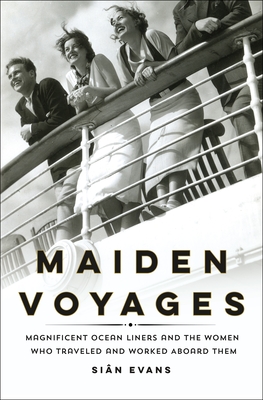
Under the overarching umbrella of History, the nonfiction book Maiden Voyages has two basic spokes—Women’s History and Nautical History. Author Siân Evans goes back to the beginnings of women’s affiliation with sea transportation which was mainly being the daughter or wife of a seaman. With a lot of research, she drives down to the first instances of women serving on ships and shows the progression of their work and social status as ships take on passengers in addition to cargo. Women book spaces to transport themselves across the ocean in uncomfortable circumstances. Gradually the concept of comfort on an ocean liner takes root and grows. More women begin to travel, and more women are hired to take care of their needs.
Most of this book focuses on the glory days of ocean liners between the two World Wars through the transition from transportation to holiday destination. Incorporated into the telling are stories about the lowliest women workers through the glamour stars who not only enjoy the trips, but use them as opportunities to see and be seen. The ship becomes a backdrop for those who have achieved or want to achieve fame and fortune.
The two World Wars affected all women in taking on jobs formerly held by men as the West saw a change in cultural expectations and increased rights for women. From a hazardous work environment for less pay than men received to breaking barriers and excelling in their chosen fields, women are the heroes of this book.
I liked Maiden Voyages, but I did not find it to be a page turner. Although it was told linearly as history progressed, there was some repetition as the author reminds the reader of facts as many of the personages’ roles continued through various eras of nautical travel. I learned a lot about the Golden Era of passenger ships, and I especially appreciated the many quotes from those actually involved. Primary sources authenticate Evans’ descriptions and conclusions. As the author researched the story of her great-great uncle, Cunard Chief Officer Stephen Grow of the Aquitania, this book emerged. It is told from a British perspective. History buffs, particularly those interested in Women’s Studies and Nautical History, will find Maiden Voyages very informative.
I received a complimentary copy of this book in exchange for an honest review. Opinions expressed in this review are completely my own.
Rating: 4/5
Category: History, Nonfiction
Publication: August 10, 2021—St. Martin’s Press
Memorable Lines:
The transatlantic ship not only provided a form of transport across the globe, it was also both the practical means and the symbol of opportunity, of new beginnings and fresh starts. From “third class” to “top deck,” from desperate women escaping financial hardship to wealthy international sophisticates hoping for romance and adventure, every transatlantic liner of this post-war era was freighted with hope.
There was a real symbiosis between Hollywood, the heart of the movie industry, which acted as a “dream factory” in the inter-war years, and the ocean liner, which on every voyage carried people full of hope and aspirations.
…working on the big ships became even more attractive as a career option for young men and women. The opportunity to leave behind the bomb sites and rubble, the poorly stocked shops, the dull and restricted food and the dismal British weather for the neon-lit, brilliantly colored, smartly dressed and culturally vibrant cities of the USA and Canada had never seemed so appealing to the restless young.
Lady Clementine–frustrated power
Lady Clementine
by Marie Benedict
 I had to work hard as I read Lady Clementine by Marie Benedict to differentiate my feelings about Clementine Churchill as the wife of a historical figure, Winston Churchill, Prime Minister of England during World War II, and Clementine, a character of historical fiction fleshed out by the author based on background information. In this book, which was both interesting and informative, I struggled because I just didn’t like Clementine. The story of her fight to be a changing force in a time when women had no power seems genuine, but I just could not identify with her inner turmoils. Part of her stress is a result of the “poor little rich girl” syndrome. For example, she complains multiple times of the difficulties of trying to live the rich life style her husband’s rank and tastes demand while on a limited budget and with an inadequate number of domestic servants. My biggest moment of disgust was when, for her nerves, she has to get away from it all for an extended retreat by herself at a facility in France and bemoans the fact that she can only afford to take her personal maid with her to care for her needs. She has to leave the rest of the domestics at home to care for the house, Winston, and the children. I realize that as I am not part of the aristocracy, understanding her dilemma is a reach for me, but I find it ironic that Clementine focuses much of her time and energy on helping women who can’t take fifteen minutes to themselves much less several months. The part I can empathize with is her struggle to balance efforts to promote and aid her husband with her own self-efficacy and the responsibilities of her family. Her family, except for her youngest daughter Mary, turn out to be the losers in this battle.
Although not a page turner, Lady Clementine is well written and prompts me to want to read some nonfiction about the Churchills. There is no doubt that they played a pivotal role in the defeat of the Nazis in World War II. If I don’t find them very likable, despite the more intimate conversations between them as “Pug” and “Cat,” the fault may be that they are both politicians, but in different ways. Politicians, in general, are self-concerned, and Winston and Clementine live that out in the pages of this book. They do good works but are always concerned about how those works reflect back on them.
I would like to extend my thanks to Netgalley and to Sourcebooks Landmark for giving me the opportunity to read this book in exchange for an honest review.
Rating: 4/5
Category: Historical Fiction
Publication: January 7, 2020—Sourcebooks Landmark
Memorable Lines:
“Since I was a young boy, I’ve had the unerring sense that my future and that of Great Britain were inextricably intertwined. That I would be called upon to rescue our nation in a time of tremendous turmoil.”
My husband’s discerning eye perceives all but the threats standing right in front of him, and it seems that I may have to serve as the sentinel of his personal landscape and the gatekeeper of our shared ideals and our marriage.
If he had slapped me, I could not have been more wounded. He only thinks about my identity and my worth in terms of the possessive, in terms of what I mean and what I do for him. I realize for the first time how dependent I’ve been on Winston for his admiration and how reliant I am for his permission to assume my own power, even if it is power derived from his own. No longer.
The Orphan Sisters–bonded forever
The Orphan Sisters
by Shirley Dickson
 In between the Great War and World War II, two sisters are dropped off by their widowed mother at the austere orphanage Blakely. Etty, the younger girl, has no warning or understanding of what had started out to be a fun family adventure on the train. Dorothy, the older of the two, is able to deal with the circumstances somewhat better. The girls remain there until they reach their fifteenth year. At that time each undergoes an adjustment to a world so different from the institution that had become an uncomfortable and regimented “home.”
In The Orphan Sisters, we trace the girls’ lives as they become adults, never willing to be far apart from each other. They have hopes and dreams and make choices that are life altering. As they move towards maturity, Great Britain is thrust into the war which affects every area of their lives with rationing, young men being called up for duty, relationships with the awareness that each day may be their last, and women being encouraged to support the war effort by taking on jobs.
The most dramatic parts of the book depict the physical and emotional effects of the bombings. There was great fear as people huddled in shelters and bombs exploded around them.
Shirley Dickson is a great storyteller. She weaves a tale that grips your heart and puts you in Geordie land with the accent and dialect particular to Tyneside. You will want everything to go well for Etty and Dorothy in the midst of the pain and chaos that surrounds them and invades their lives. You will hope for them to finally find peace in their search for their mother’s love.
I would like to extend my thanks to netgalley.com and to Bookouture for giving me the opportunity to read this book in exchange for an honest review.
Rating: 5/5
Category: Women’s Fiction, Historical Fiction
Publication: January 22, 2019—Bookouture
Memorable Lines:
The Mistress’s smile was more of a grimace—it didn’t look at all welcoming. Her eyes held no warmth in them, and dull and glazed, they reminded Esther of dead fish eyes.
Thankful for being saved, she breathed in the acrid air. But the world now seemed a more frightening place, and even the moon, soaring high in a clear sky, appeared to have a malevolent face.
The nation was at war; an aerial attack might happen any minute, but if your nappies weren’t blindingly white as they flapped on the line—then, according to the housewife law, you’d failed as a mother.
Hedy, What a woman
Blogger friend Wendy has long been an admirer of Hedy Lamarr. When she read my review of The Only Woman in the Room, she took the information and ran with it. Thank you, Wendy, for adding to my appreciation of the remarkable Hedy Lamarr!
The Only Woman in the Room–beauty, talent, and brains
The Only Woman in the Room
by Marie Benedict
 We meet Hedy Kiesler as a young actress in Vienna, Austria, in 1933 just as munitions manufacturer Friedrich (Fritz) Mandl begins courting her. Europe is on the cusp of war, and Hitler has started his attack on Jews. Under other circumstances, Hedy’s parents might have refused permission for the courtship, but they could see the benefit of a marriage to the rich, powerful, and well connected man.
Unfortunately, Mandl’s character changes after their marriage, and he becomes abusive and controlling. Hedy’s father had encouraged her as a child in studying many subjects, especially the sciences. Hedy teams her interest in science with her position as an ornament at dinner parties to listen in on the conversations of dangerous and powerful guests in the Mandl home. Later, after escaping from Fritz, she tries to use that knowledge to save lives as Hitler continues his military advances.
The book is divided into two parts. The first part deals with Hedy, her marriage, and the entrance of the United States into the war. The second focuses on her two careers after her escape from Fritz: one as the famous Hedy Lamarr (her new, non-German sounding, stage name) and the other as an inventor. Her talents as an actress and her incredible beauty outweigh her potential contributions to the war effort in the eyes of the men in power at that time.
In The Only Woman in the Room, Marie Benedict has created a historical novel about a very complex woman living in times that were difficult for everyone, but especially for women. It is important to remember that even though the book is well researched, Benedict is basically filling in the skeleton of a plot with details, some of which are true and others that only might have occurred. In this book Hedy is overcome with guilt over hearing Hitler’s plans but not doing anything about them. She doesn’t believe in God, but she is dogged by a fear that she has not done enough to make up for her silence and inaction. Of course, as she finds out later, as a woman there was little she could contribute that would be valued. During the last part of the book, I couldn’t help but wonder whose scales she was concerned about—her own sense of morality, public opinion, or judgement by a higher being. That was never clarified and yet it appeared to be a driving force for her.
I liked this book but not as much as Benedict’s two prior books, The Other Einstein and Carnegie’s Maid. All three novels address the hidden contributions of women. All three ladies are women of talent and intellect operating under difficult circumstances. All deserve respect, but I think I can empathize more with Mileva, Einstein’s first wife, and with Clara, a lady’s maid in Andrew Carnegie’s household. Hedy was born into privilege and by virtue of her beauty moved in important social circles. Although perhaps it shouldn’t, that background erects a barrier for me.
The Only Woman in the Room is a well-written and well-researched historical novel. Benedict specializes in drawing out the stories of women whose intellectual abilities have been overlooked. It will be interesting to see whose story she will discover and share in her next historical novel.
I would like to extend my thanks to netgalley.com and to Sourcebooks Landmark for giving me the opportunity to read this book in exchange for an honest review.
Rating: 4/5
Category: Historical Fiction
Publication: January 8, 2019—Sourcebooks Landmark
Memorable Lines:
I’d become like one of the Rembrandts on the wall or the antique Meissen porcelain on the sideboard. Simply another priceless, inanimate decoration for Fritz to display, a symbol of his wealth and prowess.
It seemed that my best chance of undermining the Third Reich—and ensuring that a German submarine or ship never again harmed a ship full of refugee children—might be to somehow use the knowledge I’d gathered to capitalize on the weakness in the German torpedo systems.
“I must admit it would be hard for us to sell our soldiers and sailors on a weapons system created by a woman. And we’re not going to try.”
Unbroken: A World War II Story of Survival, Resilience, and Redemption
Unbroken: A World War II Story of Survival, Resilience, and Redemption
by Laura Hillenbrand
 How much can the human body, the human spirit, endure? Unbroken is the story of Olympic track contender Louie Zamperini as he is tested past the limits of endurance during World War II. His running career is cut short as he becomes a bombardier. The characteristics that made him a difficult child, always testing the limits, become the foundation of an unrelenting resilience in the face of life challenging circumstances. He endured horrors, but he was miraculously saved from death several times. Did God have a plan for Louie’s life? Could he be saved from his own destructive behaviors and the hatred dwelling in his heart?
Unbroken is a biography and so much more. It reads like a fascinating work of fiction. In fact, if more nonfiction maintained the interest level of Unbroken, there would be a lot more readers of nonfiction. This book is engaging and fast paced. Unbroken was thoroughly researched over seven years using archives and many interviews including seventy-five interviews with Louie himself. Very importantly, author Laura Hillenbrand found few discrepancies among the various reports.
I read and review a lot of books. I mentally gauge my review comparing each book within its genre. A five star cozy mystery is not compared to a five star book of poetry, for example. I must state, however, that Unbroken rises above a star rating system. Although emotionally difficult in places, it is a book that everyone should read.
Rating: 5/5
Category: History, Biography
Notes: Thanks to my brother Don Lyons who insisted I borrow his copy of Unbroken. It was every bit as powerful as you said it would be!
Publication: November 16, 2010—Random House
Memorable Lines:
In a childhood of artful dodging, Louie made more than just mischief. He shaped who he would be in manhood. Confident that he was clever, resourceful, and bold enough to escape any predicament, he was almost incapable of discouragement. When history carried him into war, this resilient optimism would define him.
“The other pilots act as though nothing has happened and speak of sending the other fellow’s clothes home as though it were an everyday occurrence. That’s the way it has to be played because that’s the way it is—it’s an everyday occurrence!”
This self-respect and sense of self-worth, the innermost armament of the soul, lies at the heart of humanness; to be deprived of it is to be dehumanized, to be cleaved from, and cast below, mankind…Without dignity, identity is erased. In its absence, men are defined not by themselves, but by their captors and the circumstances in which they are forced to live.
In Farleigh Field–World War II spy novel
In Farleigh Field
by Rhys Bowen
 I was late coming to the TV series Downton Abbey, but it is now a fait accompli, and I enjoyed it very much. I found In Farleigh Field by Rhys Bowen to be reminiscent of Downton Abbey in its focus on the titled upper class during the hardships and upheavals of World War II. The plot is not highly complex, but it is interesting as characters of various social ranks use their skills to help England survive the Nazi onslaught.
I have two criticisms of the book. The character of Lady Diana (Dido) repeatedly whines about the war’s hampering her coming of age social season. I suppose a young woman could be that self-centered, but I kept wanting to tell her to grow up and look at the devastation surrounding her. Even her younger sister, Lady Phoebe (Feebs), seems mature, especially in times of crisis, at age twelve compared to her eighteen year old sibling. My other issue with In Farleigh Field is the ambivalence over secrets that are crucial to national security. The rules were emphasized over and over again and then broken on several occasions. At the same time, it seemed that more would be accomplished if branches of government cooperated.
The book does give insight into what it must have been like during World War II in England to work as a civilian for the government. Women were assumed to have secretarial jobs and men were thought to have bravery issues because they were not in the military.
I enjoyed the book, including the spy intrigue. There were surprises that kept the reader engaged, the setting was interesting, and the characters were appropriately either agreeable or unlikable.
I would like to extend my thanks to netgalley.com and to Lake Union Publishing for giving me the opportunity to read this book in exchange for an honest review.
Rating: 4/5
Category: General Fiction (Adult), Women’s Fiction
Notes: World War II era
Publication: March 1. 2017–Lake Union Publishing
Memorable Lines:
“Nasty Americanism, the word ‘weekend,’ ” Lord Westerham remarked. Although he had known Clementine Churchill for many years, he still hadn’t quite forgiven her for being American.
“I said she should have Margot’s bedroom, since she’s not likely to need it, but Pah said that standards had to be kept up, and it was not right for the staff to sleep on the same floor as the family, even if there was a war on.”
It was such a typical thing for someone like Lord Westerham to say. Not admitting that anything was allowed to change, even when the whole world was disintegrating around him.
Interested in World War II ? Dobryd is a good read!
 The period known as the Holocaust is a frequent topic of books for both adults and young adults. The book Dobryd is different in that it does not focus on characters who are arrested or imprisoned. In fact most of the story occurs in the years following the war. Told in the first person, this story details the struggles of a five year old girl as she emerges from over two years of hiding in a space too small for a standing adult. Most of her family is dead, but she still has her mother and an aunt. The reader is soon absorbed by their relationships as they begin to integrate into a Poland that is very different from the one they hid from. Their rescuer is Yuri, a Russian soldier who plays a pivotal role in helping young Ann relate to her new world and provides stability for her. Dobryd shows us the best and the worst of people and how they have a long lasting impact on Ann and her family.
Dobryd is classified as an autobiographical novel as the author was very young when the story begins and much is retold from the memories of others. It reads like fiction, but has the authenticity of history. Dobryd would be an excellent addition to a unit on the Holocaust or World War II. It invites comparisons to books such as The Diary of a Young Girl by Anne Frank that are typically enjoyed by students in learning about this period. Dobryd offers opportunities to feel with Ann the discrimination she experienced based on religion and her family’s former social standing. We get to learn of her rapidly disappearing Polish heritage and of the geographical struggles Poland underwent as a nation being divided by its neighbors as one of the spoils of war.
 education pathways