
Home » Posts tagged 'work'
Tag Archives: work
The Peacemaker–Amish mystery
The Peacemaker
by Wanda E. Brunstetter

Many of the books I read are either cozy mysteries or Amish romances. The Peacemaker is a well-conceived mix of the two.
Ada is a young Amish woman who works in a greenhouse in Belleville, Pennsylvania, but has hopes to one day get married and have a family. Ephraim, originally from the same area, lives in Bird-in-Hand in Lancaster County, where he takes care of his grandmother. Ada and Ephraim grew up together, connected by Ada’s best friend Rosa who has disappeared. Rosa was Ephraim’s “aldi” or girlfriend. When she disappears after they had an argument, Ephraim is briefly accused of murdering her. Even after the charges are dismissed, those in the local community still look on him with suspicion. Ada had always been attracted to Ephraim, but did not express that to anyone because of loyalty to her friend Rosa.
The reader watches the emergence of the gradual attraction between Ephraim and Ada along with family upheavals including other romances, childbirth, and a heart attack. Always in the background is concern for Rosa. Is she dead? Did she run off so she wouldn’t be pressured to join the Amish church? The answers to those questions are not found in The Peacemaker, but perhaps will be in the followup novel, The Pretender, which is set to be published on August 1, 2025.
I received a complimentary copy of this book in exchange for an honest review. Opinions expressed in this review are completely my own.
Rating: 4/5
Category: Christian, Religion, Romance, Mystery
Notes: Because of a mislabeling in my notes, I read this book in the Mifflin County Mystery series first. As #2, it was adequate as a standalone, but I plan to go back to the first one because I enjoyed this one and want to fill in some blanks. I want to know more about the characters I met in this book.
Publication: March 1, 2025—Barbour Publishing
Memorable Lines:
A sense of dread had soured his stomach like spoiled milk.
Although she did not receive the miracle that she had hoped for, Elsie returned to the house thankful that she’d been able to bless a stranger in need on this freezing-cold Christmas evening.
Susan knew he was a bad influence and being in his company inclined her to do things she wouldn’t normally do. She couldn’t get enough of him, though.
Liturgy of the Ordinary: sacred practices in everyday life
Liturgy of the Ordinary
by Tish Harrison Warren

Liturgy is the form or pattern that a church service follows. It may be a general and loose sequence or it may be highly structured as followed by Anglicans and other denominations that use The Book of Common Prayer. In Liturgy of the Ordinary, Tish Harrison Warren connects our daily routines to the rituals and patterns of the Christian life from our waking in the morning to our rest at the end of the day. Along the way she examines our search for lost objects and ties it into confession and repentance. She discusses quarrels within the family and how as Christians we are called to extend peace or shalom. Warren dissects how we look at time and at community. She suggests savoring the good gifts of God in our everyday life, but discourages overindulgence in pleasure lest it become an addiction, trapping us in the cycle of wanting more.
Liturgy of the Ordinary is a wonderful book for individual enjoyment and study or for sharing with a group. It is a book that takes simple concepts and invites a deeper dive. Warren is an excellent writer. The book is full of wisdom from both Warren and those she has studied. She invites the reader to look at everyday routines in a new way. The book is replete with anecdotes and quotes. Above all, Warren is open and honest; readers will see themselves in her struggles and her revelations. She makes the mystery of living out the Christian life in this broken world both real and accessible.
Rating: 5/5
Category: Christian, Nonfiction
Notes: Includes Discussion Questions, Practices, and a Bibliography
Publication: 2016—InterVarsity Press
Memorable Lines:
Waiting, therefore, is an act of faith in that it is oriented toward the future. Yet our assurance of hope is rooted in the past, in the person of Jesus of Nazareth and in his promises and resurrection. In this way, waiting, like time itself, centers on Christ—the fulcrum of time.
Christian friendships are call-and-response friendships. We tell each other over and over, back and forth, the truth of who we are and who God is…My best friendships are with people who are willing to get in the muck with me, who see me as I am, and who speak to me of our hope in Christ in the midst of it. These friends’ lives become a sermon to me.
The words of the liturgy felt like a mother rocking me, singing over me, speaking words of blessing again and again. I was relaxing into the church like an overtired child collapsing on her mom. When my husband and I would get into the car after church each week and talk about the service, I would say to him, “It feels like chamomile tea.”
Little Heathens–Hard Times and High Spirits on an Iowa Farm During the Great Depression
Little Heathens
by Mildred Armstrong Kalish
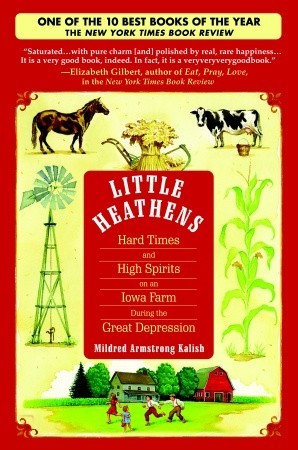
There are a variety of tales and anecdotes about life during the Great Depression, yet many who survived don’t want to talk about it. The experiences of those in the cities were quite different from those living in the country. Regardless of location, however, all but the very wealthy suffered and their lives and perspectives were formed or altered by their experiences.
In Little Heathens, Mildred Armstrong Kalish shares what life was like for herself and her extended family. It is somewhat difficult to distinguish between the normal trials of endless farm work and the efforts needed to reuse and repurpose items because of deprivation of money and resources. “Thrown away” was a foreign concept during this time and thrift was the champion of the day. Kalish shares the many saving and “make-do” tricks that were common during the Depression and some that were uncommon. Many of those have fallen out of use, but are still handy to know and good examples of the resourcefulness of our predecessors.
Kalish lays her memories out forthrightly, not concealing or varnishing the stories. Many are humorous and several are gasp-worth. Children worked alongside adults learning by example and experience. Farm life required the whole family to pitch in. Chores were divided by age and gender, but not strictly. For example, Monday Wash Day was a very physical, all-day task for which preparations began on Sunday night. Children and adults wore the same set of clothes all week, and everyone participated in wash day. The need for everyone to work together is apparent in the book over and over again.
Kalish addresses the many aspects of life at that time as seen through the eyes of a child who was an active participant. She has an incredible memory for detail right down to how to catch, kill, and prepare a snapping turtle for consumption. She also discusses the social aspects of community inside and outside the family unit. Her life was unique in that she lived in town during the winter and on a farm during the growing season because of her family situation. Her life was very different in each place, but the expectations of a good work ethic and attitude never changed.
The author viewed the hardships of her childhood as instrumental in her many achievements later in life. From success as a “hired girl” to working her way through college to her happy marriage and career as a professor, Kalish gives credit to her family, especially her mother: “Mama’s ability to meet challenges head-on and with a positive attitude created in us kids a sense of confidence that there was a way to solve every problem—just find it.” Although her life was hard, it was not unhappy and she prizes the memories of her past. I enjoyed her writing style, learned from the information she shared, and relived some of my past as I have memories of my Depression-era parents handing down wise sayings and thrifty values. Well done, Mildred Armstrong Kalish!
Rating: 5/5
Category: Memoir
Publication: May 29, 2007—Random House (Bantam)
Memorable Lines:
Mama, Aunt Hazel, Uncle Ernest, Grandma, and Grandpa had a real gift for integrating us children into farm life. Working alongside us, they taught us how to perform the chores and execute the obligations that make a family and a farm work.
An Old Maid (that’s what we called unmarried women in those days) was asked why she didn’t try to find a husband. Her reply was, “I have a dog that growls, a chimney that smokes, a parrot that swears, and a cat that stays out all night. Why do I need a husband?”
After our chores and household duties were done we were given “permission” to read. In other words, our elders positioned reading as a privilege—a much sought-after prize, granted only to those goodhardworkers who earned it. How clever of them.
She kept all of her needles stuck into a red felt pincushion which she had owned since just before God.
No Vacancy–struggle with religious identity
No Vacancy
by Tziporah Cohen

Life is not always easy as Miriam, an eleven year old, discovers. As her family faces financial distress, she is uprooted and transplanted to a motel in upstate New York. She leaves behind her close friends and spends her summer days helping her family revive the failing motel. Success for the motel would also mean better times for the Whitleys, a generous and kindly couple next door whose granddaughter Kate becomes Miriam’s best friend. When Miriam’s Uncle Mordy suggests it might take a miracle to keep the businesses afloat, Kate and Miriam decide to provide one!
As she is dealing with challenges at the motel, Miriam is trying to understand what it means to be Jewish and why she is different from others in her new community. She also wrestles with a fear of swimming.
Tziporah Cohen’s No Vacancy is a gentle, but thoughtful look at religion, ethics, and community. This work of fiction is aimed at middle schoolers, but I enjoyed reading it. I like Miriam and find that her interactions with other characters as she struggles with being open about being a Jew and about her aquaphobia gives the book more depth. Uncle Mordy shares differences that exist among Jews in practicing their faith. The Catholic priest acts as a counselor without being intrusive or preachy. The interactions between Miriam and Kate demonstrate that differences in faith don’t preclude a happy and healthy friendship.
I would like to extend my thanks to NetGalley and to Groundwood Books for giving me the opportunity to read this book in exchange for an honest review.
Rating: 4/5
Category: Children’s Fiction, Middle Grades
Notes: As an adult, I enjoyed this book, so just use this information as the publisher’s intended audience:
Grades: 4-7
Ages: 9-12
Publication: August 4, 2020—Groundwood Books
Memorable Lines:
Miriam starts to ask herself some prickly questions. Is a lie always a bad thing, even if what comes out of it is good? Does our faith make us so different from one another? And when bad things happen, do we really all have a shared responsibility for the hate in the world?
“It’s not that we can’t get along. We just believe in different things. And while I can be friends with someone who believes in different things than I do, it’s a lot harder to be married to, and raise a family with, someone who is different in these big ways. Not everyone feels that way, and that’s okay. but I do.”
“When someone is different from us,” he says, “sometimes we jump to conclusions instead of taking the time to understand.”
Empty Nest, Full Life: Discovering God’s Best for Your Nest
Empty Nest, Full Life: Discovering God’s Best for Your Nest
by Jill Savage
 Parents, but mothers in particular, spend almost twenty years preparing their children to fly out of the nest and into the world of adulthood. It turns out that the releasing can be as hard as the preparation. There are issues of control, especially if you have boomerang kids. Mothers are good at piling guilt on themselves when things don’t work out perfectly or as expected for their kids. Grandkids are a blessing, but they come with their own set of issues. The list goes on and on.
Jill Savage, a speaker and teacher of the Bible, who has endured her own personal trials, shares Biblical wisdom and personal anecdotes to illustrate her viewpoints on various subjects related to the “empty nest” in Empty Nest, Full Life. The first half of the book is entitled “Let Go!” and discusses the problems encountered during the empty nest season. It speaks of letting go of expectations, guilt, opinions, traditions, your child’s problems, and your own idols (the things that steal your attention away from God, the things you use to identify yourself). Part Two is called “Hold On!” and within that section lie ideas for what to actually do during that season of the empty nest. Savage encourages you to grab hold of a new mission field, passions, and friendships. She encourages you to revitalize your marriage and your relationship with God.
Each chapter closes with a truth from the Bible, an action step, and a prayer. The book itself ends with encouragement for the next season, a list of questions to help you identify current or past baggage that has affected your marriage, reference notes, and a discussion guide for a leader to use in a small group setting.
My personal nest has been empty for a number of years so I am not approaching or in the middle of an empty nest crisis. I would imagine, however, that this book would be helpful for those wondering how to deal with their new found “freedom.”
I would like to extend my thanks to netgalley.com and to Moody Publishing for giving me the opportunity to read this book in exchange for an honest review.
Rating: 4/5
Category: Christian, Parenting and Family
Publication: August 6, 2019—Moody Publishers
Memorable Lines:
Expectations will get us in trouble every time. They set us up for disappointment and leave us feeling disconnected.
Studies indicate the brain isn’t fully developed until the age of twenty-five. Yes, that means that our kids are now setting their own priorities when they’re not actually fully equipped to do so.
My friend Becky says that when she’s tempted to address something with her adult son, she tries to think of how she would address it with a friend. Most of the time she realizes she wouldn’t address it with a friend at all! This helps her find self-control and pray instead.
 education pathways