
Home » Posts tagged 'words'
Tag Archives: words
The Storyteller’s Tale–making words come to life
The Storyteller’s Tale
by Judith Bouilloc
translated from French by Madeline S. White
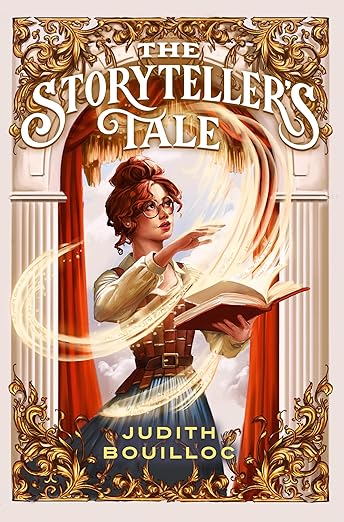
You’ve heard the expression “make words come to life”? In The Storyteller’s Tale, the librarian Iliad Livrani can do that. She is so talented that the queen invites her to come to the palace to perform. During this same period, a messenger arrives from the palace with an offer of marriage from Lord Tarlyn. The immediate complication to this generous offer is that there are several gentlemen at court with that name. Which one might he be? Iliad is chaperoned by her fire-breathing Granny Cassandra as they travel to the castle and have many adventures.
Iliad can create visible words that become images and this talent is useful to the king as he tries to transform his kingdom into a parliamentary monarchy. There is the usual infighting in the court and within the royal family. Magical creatures like a flying bird-deer populate this story. Lovers of literature will find pleasure in the various classical choices Iliad makes for her readings. Lord Tarlyn is a mystery man, and there are difficulties because of his character, abilities, and goals. There are reasons for his secrecy, but they are only gradually revealed.
I enjoyed the fantasy world the author created, especially the magic with words. The various creatures and plants were also interesting. There is a romantic hero and a villain, a mystery and a challenge. Iliad and her sisters are strong women with an equally strong sense of right and wrong. Democratic principles are important to them as are reconciliation and feelings. One of the themes is that character is more important than outward appearance.
I received a complimentary copy of this book in exchange for an honest review. Opinions expressed in this review are completely my own.
Rating: 4/5
Category: Middle Grades, Fantasy, Teens and Young Adult
Notes: All of Iliad’s book choices have footnotes to note the author and explain briefly what the work is about.
Publication: August 21, 2024—Rivka Publishing
Memorable Lines:
“The term snatchwords refers to a person who can make sentences detach themselves from paper by reading them aloud. They internalize each word turning them into moving figures and setting by sheer force of imagination.”
The Livrani women were known to express their feelings with great exuberance. Some might say it was their greatest weapon against ill-fortune.
“What I think is that Balthasar is an aristocrat by birth but a democrat by opinion, and as such, he is likely to change things.”
Reading for the Love of God–erudite and spiritual
Reading for the Love of God
by Jessica Hooten Wilson

I thought Reading for the Love of God would be the perfect book for me, channeling my reading choices in a way that points to God and shining a light on the spiritual connection of God and a reader. It did both of those things, but I have to admit that, as a whole, it was not the right book for me. Some of this well organized book was appropriate for the average reader, but much of it was clearly written by a professor with a strong background in both literature and theology. Perhaps it would be more appropriate for study in a college level course. Here is an example from the text that demonstrates the background knowledge needed to fully benefit from this book: “In Christian tradition, the anagogic sense refers to a text’s echo or reflection of the divine. Where do we see God here? Or we might equate the anagogical with the eschatological: Knowing that all will end in our death and Christ’s second coming, what matters in what we have read? It’s the cultivation of a sight that points our eyes ever upward toward heaven.”
On the other hand, Hooten presents a lot of interesting ideas about reading. She is quite knowledgeable and gathers information from and about many authors. The footnotes cover about twenty percent of the book. She extols the virtues of reading and rereading the classics, and she asserts that learning how to read various genres helps us learn to read Scripture. If we read other books than the Bible, even secular books, through the lens of Scripture, God can teach us. Even books that some Christians avoid reading (e.g. Harry Potter) can lead to examination and discussions of evil versus good, etc. We should both enjoy and use literature, but should not put the message above the story itself. She points out that there are many current and historical opinions about how to best read the Bible addressing issues such as meditation, interpretation, the role of allegory, the depths of word meanings, and symbolism.
The author carefully places essays in the book expounding on what we can learn from examining the writing and reading of St. Augustine, Julian of Norwich, Frederick Douglass, and Dorothy L. Sayers. After her Conclusion and Acknowledgments, she guides the reader through a practice session of analysis of Flannery O’Connor’s short story “The River.” O’Connor is a much referenced author in this book so this discussion seems quite appropriate. A section of Frequently Asked Questions is very practical and useful. It is followed by “Reading Lists of Great Books” which is grouped by ages. The next list is “Great Books: The Living Tradition” which contains classics sorted by time periods and followed by a list entitled “Writers Whose Works Touch the Sacred and the Profane.” I’m not sure what her criteria are for this list, but it includes authors such as Wendell Berry, Frederick Buechner, Willa Cather, G. K. Chesterton, and Dorothy Sayers.
I received a complimentary copy of this book in exchange for an honest review. Opinions expressed in this review are completely my own.
Rating: 4/5
Category: Christian, Religion & Spirituality
Notes: As I think back over Reading for the Love of God, I find I am viewing it in a more positive light than when I was working my way through it. I am not recommending it to my book club as I initially thought I would do. I will be mulling her theses over and referring to her suggestions for reading selections as I expand my personal reading choices.
Publication: March 28,2023—Brazos Press (Baker Publishing Group)
Memorable Lines:
If we are going to read—the Bible included—we should learn how to read well. We should become readers who do not read for our own gain but who read as a spiritual practice, always open to how the Lord is planting seeds in our heart, teaching us more about him, and showing us ways of living more like Christ in the world.
But we should not read Virgil’s Aeneid in order that we may check a box on a great books list. Rather, a book such as the Aeneid is to be used—for pleasure and edification temporarily—and ultimately enjoyed in how it points us to God.
We read because without books our world shrinks, our empathy thins, and our liberty wanes. We read for the same reason that people have read—and shared poems or stories—for thousands of years because our eyes are not enough by which to see. The time and place in which we live blinds us to other perspectives and ways of being that are not of our own experience. We read because we have been given the gift of imagination and intellect, and we exhibit our gratitude by using it.
 education pathways