Home » Posts tagged 'witch'
Tag Archives: witch
The Magician’s Nephew–another C.S. Lewis masterpiece
The Magician’s Nephew
by C.S. Lewis
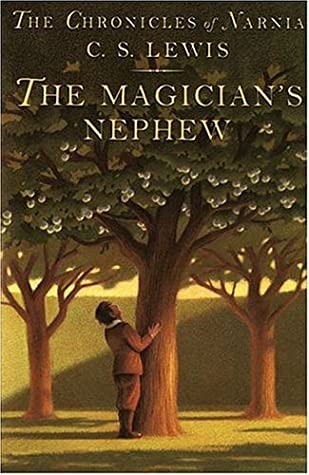
I entered The Magician’s Nephew not really knowing what to expect. It was written by C.S. Lewis the year prior to the publication of the last book in the series, The Last Battle, which I have not read yet. At the suggestion of a member of our book club who was actually rereading the series, we inserted The Magician’s Nephew immediately before The Last Battle—not because it belongs there chronologically, but because it could perhaps be appreciated better at that point in our reading. I don’t think you could go wrong with any sequence of these books! C.S. Lewis intended it to be read first in his Chronicles of Narnia, but by the time it was first published, many of his readers would have already greedily devoured the first five books. It is indeed a prequel to the delightful The Lion, Witch, and the Wardrobe, but for those who have already read that first classic tale, you will enjoy the “ah ha” moments that arise as Lewis gives you a backstory that renders both subtle and obvious connections. It never has the feel of a book written at the instigation of a publisher who just wants to squeeze more out of a popular series. It seems that it is Lewis’ desire to bring the pictures he has painted in his novels together with cohesion and forward looking vision.
In The Magician’s Nephew, a story which begins in London, you will learn of the creation of the world Narnia, meet Aslan the Lion, and witness the awakening of the Witch. There are many connections to the creation of Earth and its population as found in the Bible; but of course it is Narnia and in this fictional realm we learn how the animals came to talk and see the never changing character of Aslan who reigns with power and love, who grieves for the things that grieve us, and gives us hope during times of devastation.
This book has sad and fearful moments as well as happy and triumphant ones. The humor as the animals plant and water Uncle Andrew in hopes that the poor “plant” will revive is more refreshing to the reader than to Uncle Andrew! The pure evil of Jadis the Witch is the stuff of ancient fairy tales as is the conflict of good and evil. The characters are ones you can feel strongly about. The setting, as always with C.S. Lewis, is so vividly and well described that you can visualize both the “real” world of London and fictional worlds to which the children (main characters Digory and Polly) can transport themselves. As to plot, it constantly throws in surprises, but events are always connected. It becomes a quick read, not because it is short or light reading, but because it is so much fun to read. As with all the books in the series, it can be read as a child enjoys fiction or as an adult looking for deeper meaning. I suggest you read it both ways at once. Come to the story for entertainment and leave with the enrichment of a well-told tale imbued with rich symbolism.
Rating: 5/5
Category: Fiction, Christian
Notes: #1 in The Chronicles of Narnia series, but can be read at any time in the reading of the series. Warning: If this book is your first experience with this series, you will probably want to read more!
This series is often listed as Children’s Fiction, but is really appropriate for all ages with adults reading it on a different level from children. It is perfect for a read-aloud.
Publication: 1955—Harper Collins
Memorable Lines:
For what you see and hear depends a good deal on where you are standing; it also depends on what sort of person you are.
She has won her heart’s desire; she has unwearying strength and endless days like a goddess. But length of days with an evil heart is only length of misery and already she begins to know it. All get what they want; they do not always like it.
For the rest of that day, whenever he looked at the things about him, and saw how ordinary and unmagical they were, he hardly dared to hope; but when he remembered the face of Aslan he did hope.
The Silver Chair–the rescue of a prince
The Silver Chair
by C. S. Lewis

Eustace, who became a changed person for the better in C. S. Lewis’ The Voyage of the Dawn Treader, is given another opportunity to visit Narnia. He and Jill, a school friend, escape bullies by slipping through an unlocked gate at the school. Aslan, the Lion, has orchestrated the adventure to send them on a mission to locate the missing Prince Rilian who has been under the spell of a witch for ten years.
They are accompanied by Puddleglum, a Marsh-Wiggle, a delightfully morose character who can always find the potential bad in any situation. Despite his melancholy disposition, he proves to be a loyal, trustworthy, and brave companion. He also provides some levity for the reader during the perilous adventures.
Aslan gives the children four signs to follow. Their intentions are good, but they are not entirely successful. They escape from deceptive, hungry giants and are captured by Earthmen who take them to the Deep Realm in the Underland. When they find Prince Rilian, they have to decide on following his instructions or relying on the signs Aslan has given them.
As in all of The Chronicles of Narnia, The Silver Chair can be enjoyed as a fantasy or with little effort as a tome replete with symbolism. In this allegory, Aslan represents Jesus who is both the Lion and the sacrificial Lamb in the Bible, and the children are his followers. He provides direction and guidance, but his followers still have choices. One outstanding example of the Biblical parallel is when Prince Rilian declare to the children that “Aslan will be our good lord, whether he means us to live or die.” This same sentiment is uttered by Shadrach, Meshach, and Abednego in the Old Testament when they are threatened by King Nebuchadnezzar with being thrown into a furnace. They respond “our God whom we serve is able to deliver us from the burning fiery furnace, and he will deliver us out of your hand, O king. But if not, be it known to you, O king, that we will not serve your gods or worship the golden image that you have set up.” (Daniel 3: 17 & 18 ESV).
The Silver Chair is the fourth book in The Chronicles of Narnia for me. I expected that I would not like any as much as the first, The Lion, the Witch, and the Wardrobe. To my surprise, I have enjoyed all of them almost equally. Each one is fresh and engaging. The setting and characters overlap, but each adventure has the addition of new characters and stands on its own merits.
Rating: 5/5
Category: Children’s Fiction, Christian
Publication: 1953—Harper Collins
Memorable Lines:
“The bright side of it is,” said Puddleglum, “that if we break our necks getting down the cliff, then we’re safe from being drowned in the river.”
And though you might have expected that the idea of having a good time at Harfang would have made them more cheerful, it really made them more sorry for themselves and more grumpy and snappy with each other and with Puddleglum.
“And the lesson of it all is, your Highness,” said the oldest Dwarf, “that those Northern Witches always mean the same thing, but in every age they have a different plan for getting it.”
 education pathways