Home » Posts tagged 'water'
Tag Archives: water
The Covenant of Water–Indian multigenerational saga
The Covenant of Water
By Abraham Verghese
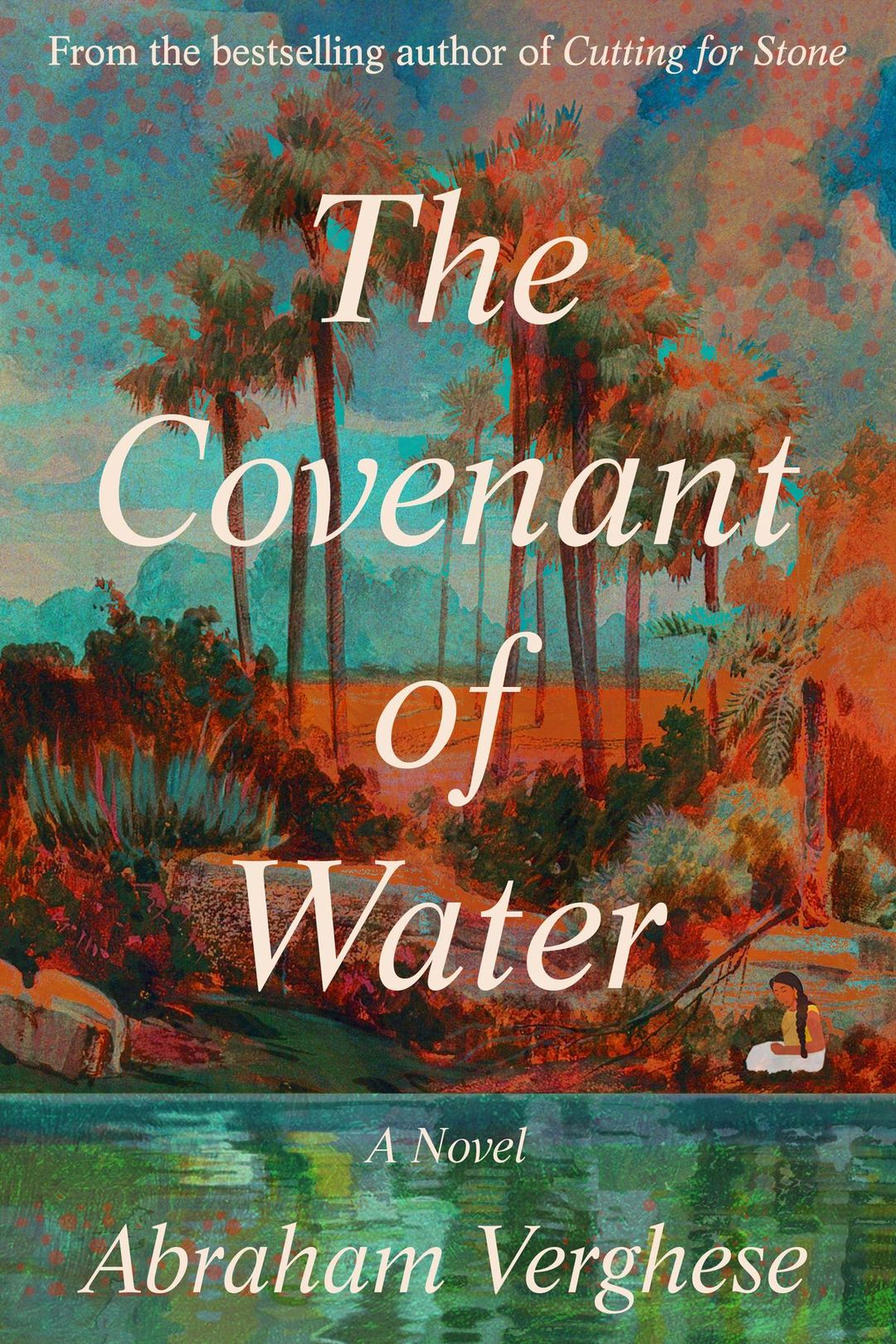
Fourteen years in the making, 724 pages long, this saga that mainly takes place in India will stay with readers long after they have finished reading it. This story spans the years 1900 to 1977 and begins with the arranged marriage of a twelve year old girl who is given years to mature and grow into her role before the marriage is consummated. She becomes the matriarch of the family and is known as Big Ammachi. The family has a secret, a curse they refer to as The Condition. At least one person, usually male, in each generation has died of drowning in a country where water is everywhere.
The reader takes a deep dive into the relationships that occur over the years in this area inhabited by St. Thomas Christians. The people in the community have a Christian faith, but it is interwoven with other cultural traditions. Big Ammachi’s husband Thamb’ran has the condition and was not allowed to travel by water to school. Therefore, he is an intelligent man, but has never learned to read. He also has a hearing loss.
Just when the reader has a grasp on these characters and the plot, the story jarringly transitions to Glasgow, Scotland, in 1919, where we meet Digby Kilgour, a surgeon, and become acquainted with the caste system. Although the transfer seems sudden, the plot soon moves back to Parambil in India where it is discovered that beloved Baby Mol suffers from a medical situation that will leave her childlike all of her life.
The Covenant of Water is too long for a reviewer to detail all of the events concerning the many characters. The plot is intricate and seemingly unconnected threads are eventually woven into other threads to create beautiful scenes full of emotion and love which cross many generations. There are tragedies and victories, happiness and great sadness. Heroic actions save lives and cause personal suffering. Writing and art are tools for healing. The World War brings death to many as Japan bombs Madras in India, but also inspires Indians to seek their freedom from Great Britain. There are births under primitive conditions, the arrival of electricity, and the release of Nehru after three years of imprisonment. Fire causes permanent damage as does leprosy, but with an undercurrent of faith, there is also healing and joy. Water is a powerful theme as the water flows through the land uniting all the characters with none of them having to stand alone because they are connected by the water—physically and emotionally. Story is important to this author and more important than themes and messages. As the story unfolds, however, Verghese reveals deep meanings and understandings of human nature in his beautiful writing. Although he labored over this saga for years, the telling seems to be effortless and replete with memorable lines and phrases. It is a masterpiece of fiction that readers will want to discuss and revisit for years to come.
Rating: 5/5
Category: Fiction
Notes: I am not normally a fan of celebrity book clubs, but I listened to Oprah Winfrey’s six part discussion (available on YouTube) of The Covenant of Water with author Abraham Verghese. It is a great interview and includes Verghese reading some passages from the book. It offers interesting insights into the writing process. I don’t usually listen to audio books because of hearing issues, but I could tell that Verghese’s reading of his book would be a positive addition to the enjoyment of The Covenant of Water.
It is a long book, but I think most people in my book club enjoyed it. One member shared a 5 page list of characters she found online. Because the book is so long, I would suggest readers explore that possibility or create their own list as they read.
Publication: May 2023—Grove Press
Memorable Lines:
The grandmother is certain of a few things: A tale that leaves its imprint on a listener tells the truth about how the world lives, and so, unavoidably, it is about families, their victories and wounds, and their departed, including the ghosts who linger; it must offer instructions for living in God’s realm, where joy never spares one from sorrow. A good story goes beyond what a forgiving God cares to do: it reconciles families and unburdens them of secrets whose bond is stronger than blood. But in their revealing, as in their keeping, secrets can tear a family apart.
“Are we not doing some good here, Honorine?” he asks gently. She looks at him kindly. “Aye, bonny lad, you are! Us all are! Our hospital, the railways and telegraphs. Plenty good things. But it’s their land, Digby, and we take and take us. We take tea, rubber, take their looms so they must buy our cotton at ten times the cost…”
“Half my life is spent on trains. Strangers of all religions, all castes getting on so well in a compartment. Why not same outside train? Why not simply all getting along?” Arjun looks out of the window and swallows hard.
Consider This, Señora–newcomers in a Mexican village
Consider This, Señora
by Harriet Doerr

If asked what a particular country is like, the wise respondent does not declare that the whole country is mono-anything. Cities are different from villages, mountains from deserts, and north from south. At the same time, there are cultural aspects that transcend regional differences. This is certainly true of Mexico as I can attest to after being privileged to live in that country for seven years. In Harriet Doerr’s Consider This, Señora, she captures the essence of rural Mexico, the things that make me nod and smile as I remember the way it is.
Here are things from the book that are, for the most part, neither bad nor good, just typically Mexican. I list them out, but in the book, they are integrated into the story:
- Workmen that don’t finish jobs.
- Problems solved by greasing the wheels with a little cash.
- Extended family relationships determining work placements.
- Government promises for utilities only partially or never fulfilled.
- Accidents caused by disregard for traffic “suggestion” signs.
- Brilliantly colored fiestas.
- Beautiful vistas.
- No understanding of queues, but extreme politeness one on one.
- Animals roaming free.
- Very young mothers.
- Children working from a young age.
- Beautiful babies with wide brown eyes and shy smiles.
- The staple food—taco.
- Popsicles sold from street carts.
The story is the tale of Sue Ames and Bud Loomis, strangers trying to escape their pasts who meet by chance in a property agent’s office in Mexico and buy a large plot of land to both live on and subdivide. Other people join them. Fran is a travel author. Fran’s mother, Ursula, is widowed and in her late 70’s. Don Enrique, the original owner of the land by ancestry finds a home there. Later the mysterious musician Herr Otto is added to the community. There are locals that make an essential supporting cast including Patricio, gardener and so much more for the Norte Americanos and Father Miguel who is a friend to all.
Consider This, Señora is a gem, a tale of travelers to another culture and how their lives intersect with the land and the lives of the locals. Although not a romance, love is a major theme in the book. Even though she is divorced, Sue has never fallen out of love with her husband. Fran, divorced twice, continues to search for an exciting but long-lasting love with men she meets in her travels. Ursula, widowed, is still in love with the husband she spent her life with. She, especially, contemplates what it means to love.
Sue is altruistic and generous, helping those in need. She takes on Altagracia, her part time maid from a young age, providing needed dental work and opportunities to bathe. As the girl emerges from her cocoon at age sixteen, Altagracia is described as one who “merely by her passage, turned the heads of men.” When Altagracia takes on a different domestic position, she supplies Sue with three of her little cousins who are starving. Sue opens her heart to them and provides help to the family.
Harriet Doerr’s descriptions are so well-written that the background comes to life enhancing the story without belaboring the details. She also includes a sprinkling of Spanish words adding to the authentic flavor, but most can be understood from context. The book flows, and I read it in one day wanting to know more and more about the characters and the little village of Lomas de Amapolas.
Rating: 5/5
Category: Fiction
Publication: August 15, 1994—Harcourt (A Harvest Book)
Memorable Lines:
Today had stopped happening. Already it had consigned its events to memory. Touched by the evening chill, she sat outside until dark, wrapped in the mists of her brief, uncertain future and the brilliant patchwork of her never-ending past.
The Mexican sky was excessive too, she believed. Wider than others, it stretched over people who appeared no fonder of life than death, as they darted on bicycles between trailer trucks and buses and hurried hand in hand, whole families strong, across divided freeways.
On all sides of the dead man and the mourners, headstones tilted into weeds. Two cypress trees shaded the crisscrossing tracks of animals, both tame and wild. A crumbling adobe wall bounded the pantéon and protected the dead.
A Long Walk to Water–impactful
A Long Walk to Water
by Linda Sue Park
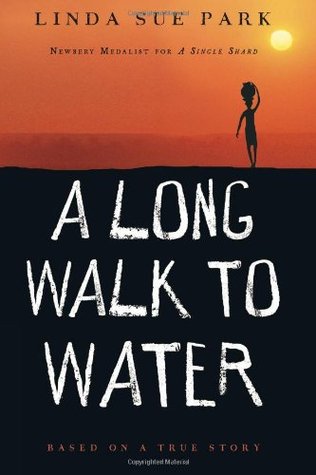
You have probably heard of the Lost Boys of Sudan. In A Long Walk to Water, Linda Sue Park tells the story of one of those lost boys, Salva Dut, who even as a refugee himself, took on a leadership role for 1500 boys in their very long, dangerous, and seemingly hopeless journey for survival. Salva, as a young adult, was chosen out of a refugee camp to emigrate to the United States. This book tells how he transformed his desperate situation into a life giving project for the people of Sudan based on hope, faith, and most especially perseverance.
Told in two timelines with apparently disparate plots, this book moves back and forth with both stories progressing forward in each chapter. It begins slowly, but soon picks up the pace and the reader’s interest. The book starts with the tale of Nya, an eleven year old girl in southern Sudan in 2008 who spends her day traveling from her village to a pond to collect dirty water in a jug which she then carries home on her head. She does this twice a day in extreme heat, traversing with bare feet a thorny path to bring home enough water for her family to survive.
Salva’s story also begins in southern Sudan, but much earlier, in 1985, when his village and school are attacked by armed men during an ongoing confrontation between the Muslim government in the north and the rebels of the south. Thus begins Salva’s separation from his family and his struggle for survival.
Although this book is aimed at a younger audience, as an adult I am so glad I read this story which is based on the lives of real people, Salva and Nya and their families. It reads quickly and lays out the need for clean, accessible water for South Sudan, pointing out the many rippling effects of pure water on a community. It also shows how diverse tribes can work together for a common good. The website noted at the end of the book provides more information and gives a practical way for those of us blessed with plenty to help those without the basic necessities.
Rating: 5/5
Category: Children’s Historical Fiction
Notes: 1. The suggested ages and grade levels vary according to printed reports, but in general: Grades 5-9 and Ages 10-14. The book does a good job of recording hardships and violence without graphic details. Because of the subject matter, I would not recommend it for younger children.
2. The reader will find links to lots of videos about Salva and his project at www.waterforsouthsudan.org.
Publication: October 4, 2011—HMH Books for Young Readers
Memorable Lines:
No one in the group had eaten anything for two days. Their water was nearly gone. Only the vision of leaving the desert kept them moving through the heat and the dust.
It did not seem as if the camp could possibly hold any more, but still they kept coming: long lines of people, some emaciated, some hurt or sick, all exhausted.
He felt as though he were standing on the edge of a giant hole—a hole filled with the black despair of nothingness. I am alone now.
It was hard to keep hope alive when there was so little to feed it.
 education pathways