Home » Posts tagged 'wagon'
Tag Archives: wagon
Caroline: Little House, Revisited
Caroline: Little House, Revisited
by Sarah Miller

The book Little House on the Prairie is part of a series of historical fiction books about the Ingalls family. Treasured by several generations of readers, it was written for children, but has also been enjoyed by adults and made into a television series. Caroline: Little House, Revisited tells the same story but from the perspective of the mother, Caroline. The original Little House on the Prairie book is written by one of the children in the story, Laura Ingalls Wilder. Both books are historical fiction with Little House on the Prairie based on Laura’s memory while Caroline is a combination of Wilder’s reminiscences, historical research, and Miller’s creativity.
Because of the source material and the intended audiences, the books are similar in most of the basic events, but quite different in a few aspects. Intending to read the two books side by side, I soon found Caroline deviating. In the book for adults, Caroline makes the long journey in a covered wagon from Wisconsin to Kansas pregnant with her third child. In Little House on the Prairie, Baby Carrie is already a part of the family and makes the trip with Pa, Ma, Mary, and Laura. Miller attributes this difference, which readers may find rather jarring at first, to Wilder’s condensing events because she had not planned on writing a series. She later continued writing about the Ingalls family because of her fans’ requests. As you might imagine, Caroline has a lot of focus on what it would be like to travel pregnant and give birth in very humble circumstances far from family support. Miller is a good writer who leads the reader to empathize with the protagonist even though her circumstances are outside the cultural norms of the twenty-first century.
Some of the disparities occur because Laura Ingalls Wilder was three years old when the family began their journeys. What impacts a child and stays with them can be quite different than what is important to an adult. Things that happen to the animals in the story are important to Laura. For example, in Wilder’s book, when they are trying to negotiate crossing a rushing creek with the wagon and ponies, their dog Jack disappears. This loss is traumatic for Laura. She recounts frequently how she tries to be as good as her older sister Mary and that sitting still is hard for her.
On several occasions, Indians came uninvited into their home and took things. This tale was a part of both books but only in Little House on the Prairie was there a description of the horrible odor in the house. It seems that the Indians were wearing skunk pelts! That would definitely make an impression on a young child.
Caroline is historical fiction that can make you feel like you are there—experiencing the jolting wagon, the terror of being a woman alone for days at a time in Indian Territory, the pain of childbirth, and the agony of malaria. The story is not all disheartening, however. Christmas is memorable, and the girls’ happiness over what we would consider a meager celebration will pull at heartstrings. The main characters are all likable. Pa is hardworking and kind. With his fiddle and the twinkle in his eye, he manages to make light of hardships. Ma (Caroline) is a strong woman who loves her husband and ever tries to smooth things over. She attempts to absorb the bad times and disappointments to protect her husband’s feelings and model strength for her daughters.
Caroline: Little House Revisited is a good work of historical fiction whether the reader is familiar with Little House on the Prairie or not. I also recommend Laura Ingalls Wilder’s original book for children. I enjoyed a reread as an adult, especially the version I chose with illustrations by Garth Williams.
Rating: 5/5
Category: Historical Fiction
Notes: The story of Little House on the Prairie told from the mother’s perspective.
Publication: 2017—Harper Collins
Memorable Lines:
“You’ll need two hands to fire it—hold your arms out straight ahead and lace your fingers around the stock, the way you do to pray.” Caroline’s tongue rose to object to the juxtaposition, then halted. If ever she had cause to fire this gun, there would indeed be a prayer behind it.
She sat down close beside Charles, too full for words, and looked out into the wide open night. It was to hard to imagine that darkness stretching all the way back across the long way they had come. And the fiddle sang, low and rich now, its melodies swaying in an easy back-and-forth rhythm until the home they had left and the home they would make seemed within reach of each other.
They would never, never forget this Christmas. None of them. Already Caroline could feel the morning embedding itself in her own memory. Her mind was a bottling it whole, so that it would remain fresh and glistening as a jar of preserves.
This Road We Traveled–“Mother of Oregon”
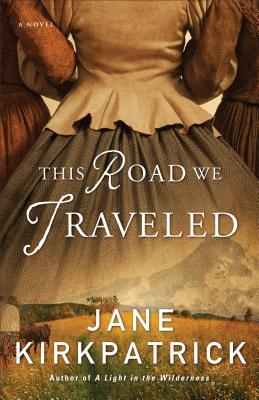
This Road We Traveled
by Jane Kirkpatrick
 The wilds of the western United States were conquered by the strengths, sacrifices, and sometimes deaths of women as well as men who left the security of their homes for adventure and, for some, a better life. Women often made the dangerous journey solely because their husbands made that decision for them. Women of that day had no vote and no right to apply for the free land being apportioned in Oregon. Oftentimes heart wrenching decisions were made for them, leaving them to trust in God for the consequences.
Jane Kirkpatrick researched the history of Tabitha Brown carefully and then brought her story to life in a fictional account of her actual travels from Missouri to Oregon in 1846. Never wanting to be dependent on her grown children, or perhaps because her independent nature carved from early widowhood drew wedges between her and her sons, Tabitha (Tabby) took responsibility for her decision to accompany part of her family on a harrowing journey and also care for her elderly brother-in-law on this long and dangerous trip.
This Road We Traveled gives insight into the physical, emotional, and spiritual struggles the various characters endure as seen through the eyes of Tabby, her daughter Pherne, and Pherne’s daughter Virgilia. These three generations of women are united in their love for God, family, and each other. Each struggles with different challenges and their characters are formed in the forge of the many tests they endure.
Kirkpatrick is a skilled storyteller cycling through the main characters’ points of view revealing the events occurring in each life without getting bogged down in any one character’s difficulties. None of the issues are simple, varying from choosing the correct fork in the road to discovering God’s will for the future. One woman dealt with reining in her tongue so that her words matched the kindness in her heart. Another struggled with the importance of possessions, and the third had difficulties with friendships.
The pacing of the plot is good and the characters are well developed. Although there are many Christian themes emphasizing moral choices, the book is not about a cookie cutter religion; the characters have various attitudes about their relationship with God and how they should live out their faith. The author describes the desert landscape, the treacherous mountain passes, and the homes, both humble and more luxurious with equal skill. Slavery, an issue that is being stiltedly worked out during that time period, crops up several times. The various Indian tribes are not stereotyped. Some are quite generous to the travelers who are in the throes of desperation and others are violent and aggressive. Politics also play a role as the U.S. is afraid the British will cut off routes in the west.
This Road We Traveled brings to life an important part of history. Tabitha was a real person who actually made this journey at the age of 66. She had hardships on the journey and went on to help many in the state of Oregon which publicly acknowledges her contributions with the title “Mother of Oregon.” I learned a lot about her life, travels in the 1840’s to the west, and the difficulties of settling into a new community. Tabby’s story is an inspiration, and I am grateful to Kirkpatrick for sharing it.
Rating: 5/5
Category: Christian, Historical Fiction
Notes: 1.Questions for discussion are included.
2. I read this book as the first book chosen for a book club newly formed by friends at church and held via Zoom meetings. I think the consensus was that we all enjoyed the book. There was plenty of depth for discussion on a variety of topics.
Publication: September 6, 2016—Revell
Memorable Lines:
“Your sadness, your anger at Orus, at me, those are losses reaching out like the gnarled hands of Shakespeare’s witches. They seek something to hold on to, but there is only air.”
Oh, she’d prayed and asked for guidance but didn’t see the clarity she would have liked. Some choices were like that. God left her to step into uncertainty. She guessed that’s where faith grew strongest.
“In the end, things don’t really matter. We think they do, but they don’t. What matters is keeping those we love alive.”
 education pathways