Home » Posts tagged 'village'
Tag Archives: village
Miss Plum and Miss Penny–love in a small village
Miss Plum and Miss Penny
By Dorothy Evelyn Smith
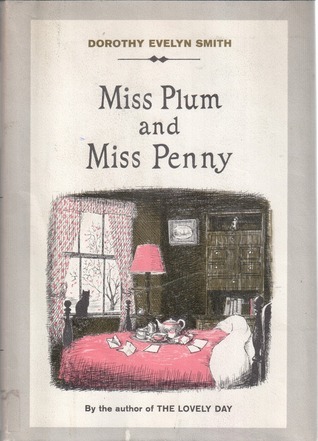
Miss Plum arrives in the little Yorkshire village of Greeth in a state of despair. When the main character of the story, Miss Penny, an unmarried woman, takes compassion on her, rescuing her from suicide by duck pond, she finds herself responsible for a woman who seems unable to accomplish anything and typically reacts to challenges, major or minor, by breaking down into tears. Somehow outside the government social system, Miss Plum has no one and nothing to her name. As Christmas approaches, Miss Penny and her friends find themselves unable to charitably rid themselves of the problems that daily accompany Miss Plum.
Miss Penny celebrates her fortieth birthday as the story opens. She is active in the village and content with her life. Romance for her is limited to a yearly birthday card from George, a commonplace beau she was forbidden by her parents to marry as a young lady. Her stalwart housekeeper and cook Ada is also her confidant and friend hailing back to her childhood. Miss Penny has two friends, a retired banker, and a vicar. Thoughts of a romantic relationship float about, but none of them take it seriously.
As Miss Plum, somehow attractive to men, stumbles from one disaster to another, the village moves on with skating on the frozen Tarn and engaging in Christmas caroling. Although a romance, Miss Plum and Miss Penny is very different from a modern love story. Character driven, this novel brings you into Alison Penny’s cozy home “The Laurels” and out into the wet and cold with galoshes, cardigans, and overcoats. The characters include a live-in housekeeper with various skill levels for Miss Penny and each of the two men. Clearly a marriage would disrupt the delicate balance of two households; good housekeepers are not easy to find!
There is a lot of humor in this charming novel. Not the “laugh out loud” kind, but the “smile and turn the page to see what the characters will do next” type. Imagine yourself curled up by the fire enjoying each page; that is the kind of book Miss Plum and Miss Penny is. The descriptions and writing style are enchanting. I liked the resolution as the book concluded, but was sorry to say goodbye to these delightful characters.
Rating: 5/5
Category: Fiction, Romance
Notes: This was a book club selection this fall, and not everyone in the book club enjoyed it as much as I did. Several members did not think there was enough character development or growth. Others pointed out that the characters did not change but did find contentment in their circumstances. These reactions are a prime example of not every book being the “right book” for every reader.
Publication: 1959—Robert Hale
August 3, 2020—Dean Street Press
Memorable Lines:
“Love isn’t safe,” he said heavily. “Love is a blinding flash in the dark. It is a leap over a cliff. It is a breathless dive to the bottom of the ocean…”
Love should be gentleness and tolerance and a sweet cherishing. That was the only kind of love she could ever have given—or accepted.
Women accepted sorrow and defeat. The cruel wind battered at them and they bowed to the wind; and when calmness came again they lifted their heads, bruised but unbroken. Not so men, who stormed and argued and kicked against the pricks, and often went to pieces altogether.
The Diary at the Last House Before the Sea–disappearance in the cove
The Diary at the Last House Before the Sea
By Liz Eeles

The chapters in this book alternate narrators from Clara who returned to Heaven’s Cove to help her mother when her father became sick; to Geoffrey, the Lord of the Manor; to River, Geoffrey’s estranged son. Clara’s mother, Julie Netherway, housekeeper and cook for the manor, still lives in the little house on the manor property where Clara was raised. She is dedicated to caring for Geoffrey and the manor as were all Netherway women who came before her.
Geoffrey was a gruff father, but actually loves his son. His wife left her husband with River when he was a teenager to live in a commune in Australia. It was hard to have a relationship with his father, and he cut ties completely with Clara who had been his friend from childhood.
River is called back to Heaven’s Cove as an adult because his father is in financial straits and Cousin Bartie is convincing him that he needs to sell the manor, the only home Geoffrey has ever known and his family heritage.
This novel has gentle romantic tones, but dives deeply into the characters and their motivations. Most interesting to me is the mystery of why Geoffrey’s beautiful and adored stepmother Audrey had committed suicide when he was just a child. Sadly, he actually saw her walk into the ocean to her death. He has always wondered why he was not good enough.
Clara discovers Audrey’s diary which seems to have coded messages in it. She is fascinated by this woman and the sad tale of her death which so many years later has affected Geoffrey and River in turn.
I highly recommend The Diary at the Last House Before the Sea for its intricate plot and interesting characters. I have read several books in this series and have enjoyed all of them. The author is a very good storyteller.
I received a complimentary copy of this book in exchange for an honest review. Opinions expressed in this review are completely my own.
Rating: 5/5
Category: Fiction, Women’s Fiction
Notes: #7 in the Heavens Cove series, but should be considered a standalone as the setting is the main element that connects these novels.
Publication: July 8, 2024—Bookouture
Memorable Lines:
Sunbeams were dappling through the trees at the cove’s edge and River realised that he was literally walking in his cousin’s shadow, just as he always had metaphorically.
…she nodded anyway, glowing at being called a swan. Though that did imply she’d once been an ugly duckling.
He’d long prided himself on being an unsentimental man, yet all kinds of emotions were now bubbling to the surface of his mind, like bleached bones rising from the depths of the ocean.
Consider This, Señora–newcomers in a Mexican village
Consider This, Señora
by Harriet Doerr

If asked what a particular country is like, the wise respondent does not declare that the whole country is mono-anything. Cities are different from villages, mountains from deserts, and north from south. At the same time, there are cultural aspects that transcend regional differences. This is certainly true of Mexico as I can attest to after being privileged to live in that country for seven years. In Harriet Doerr’s Consider This, Señora, she captures the essence of rural Mexico, the things that make me nod and smile as I remember the way it is.
Here are things from the book that are, for the most part, neither bad nor good, just typically Mexican. I list them out, but in the book, they are integrated into the story:
- Workmen that don’t finish jobs.
- Problems solved by greasing the wheels with a little cash.
- Extended family relationships determining work placements.
- Government promises for utilities only partially or never fulfilled.
- Accidents caused by disregard for traffic “suggestion” signs.
- Brilliantly colored fiestas.
- Beautiful vistas.
- No understanding of queues, but extreme politeness one on one.
- Animals roaming free.
- Very young mothers.
- Children working from a young age.
- Beautiful babies with wide brown eyes and shy smiles.
- The staple food—taco.
- Popsicles sold from street carts.
The story is the tale of Sue Ames and Bud Loomis, strangers trying to escape their pasts who meet by chance in a property agent’s office in Mexico and buy a large plot of land to both live on and subdivide. Other people join them. Fran is a travel author. Fran’s mother, Ursula, is widowed and in her late 70’s. Don Enrique, the original owner of the land by ancestry finds a home there. Later the mysterious musician Herr Otto is added to the community. There are locals that make an essential supporting cast including Patricio, gardener and so much more for the Norte Americanos and Father Miguel who is a friend to all.
Consider This, Señora is a gem, a tale of travelers to another culture and how their lives intersect with the land and the lives of the locals. Although not a romance, love is a major theme in the book. Even though she is divorced, Sue has never fallen out of love with her husband. Fran, divorced twice, continues to search for an exciting but long-lasting love with men she meets in her travels. Ursula, widowed, is still in love with the husband she spent her life with. She, especially, contemplates what it means to love.
Sue is altruistic and generous, helping those in need. She takes on Altagracia, her part time maid from a young age, providing needed dental work and opportunities to bathe. As the girl emerges from her cocoon at age sixteen, Altagracia is described as one who “merely by her passage, turned the heads of men.” When Altagracia takes on a different domestic position, she supplies Sue with three of her little cousins who are starving. Sue opens her heart to them and provides help to the family.
Harriet Doerr’s descriptions are so well-written that the background comes to life enhancing the story without belaboring the details. She also includes a sprinkling of Spanish words adding to the authentic flavor, but most can be understood from context. The book flows, and I read it in one day wanting to know more and more about the characters and the little village of Lomas de Amapolas.
Rating: 5/5
Category: Fiction
Publication: August 15, 1994—Harcourt (A Harvest Book)
Memorable Lines:
Today had stopped happening. Already it had consigned its events to memory. Touched by the evening chill, she sat outside until dark, wrapped in the mists of her brief, uncertain future and the brilliant patchwork of her never-ending past.
The Mexican sky was excessive too, she believed. Wider than others, it stretched over people who appeared no fonder of life than death, as they darted on bicycles between trailer trucks and buses and hurried hand in hand, whole families strong, across divided freeways.
On all sides of the dead man and the mourners, headstones tilted into weeds. Two cypress trees shaded the crisscrossing tracks of animals, both tame and wild. A crumbling adobe wall bounded the pantéon and protected the dead.
Flowers and Foul Play–a magical read!
Flowers and Foul Play
by Amanda Flower
 Flowers and Foul Play is an appropriately magical read. Fiona Knox receives a surprise inheritance when her Scottish godfather dies in the war in Afghanistan and wills everything to her including his land, cottage, and a walled garden with a reputation for being magical. It seems Fiona, a florist by trade, is somehow connected to the garden. Unfortunately, after her long flight from Tennessee to Scotland, she tours her garden and discovers a dead body.
Everything about the story is enjoyable. The plot has a lot of twists and turns. The characters are interesting, including the welcoming Lee who owns the Bellewick pub, Hamish, the elderly garden caretaker, and Chief Inspector Neil Craig who is not only very competent, but also very handsome. Of course, everything is very Scottish and the setting makes this cozy mystery even more interesting. Author Amanda Flower throws in a huge mehir in the garden, tales of an ancestor’s shipwreck, and a local controversy over a real estate deal with environmental implications. The result is a book I didn’t want to put down until the mystery was solved.
I would like to extend my thanks to netgalley.com and to Crooked Lane Books for giving me the opportunity to read this book in exchange for an honest review.
Rating: 5/5
Category: Mystery
Notes: #1 in the Magic Garden Mystery Series
Publication: May 8, 2018—Crooked Lane Books
Memorable Lines:
“If you think this is a rough night in Scotland, you are in for a rude awakening my lass, a very rude awakening indeed. We have storms that come off the sea that will curl your toes and make seasoned Highlanders hide under their beds.”
It reminded me again how old everything in Scotland was. In Nashville, the city practically builds a force field around a house that was built in the 1800s, to protect it from wear and tear. But the 1800s weren’t even a blip on the timeline in a place like Bellewick, where most of the buildings dated back to the thirteenth and fourteenth centuries.
“I think that is what his death has taught me the most: don’t count on someday because someday will never come. Too many people put off fighting for what they want until what they think will be a better time—after they’re married, after the kids are grown, after retirement—but the truth is, there is never a better time for anything.”
 education pathways