Home » Posts tagged 'United States'
Tag Archives: United States
Maiden Voyages–Women and ocean liners
Maiden Voyages
by Siân Evans
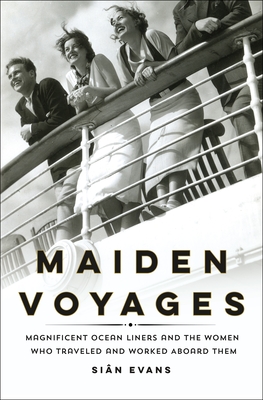
Under the overarching umbrella of History, the nonfiction book Maiden Voyages has two basic spokes—Women’s History and Nautical History. Author Siân Evans goes back to the beginnings of women’s affiliation with sea transportation which was mainly being the daughter or wife of a seaman. With a lot of research, she drives down to the first instances of women serving on ships and shows the progression of their work and social status as ships take on passengers in addition to cargo. Women book spaces to transport themselves across the ocean in uncomfortable circumstances. Gradually the concept of comfort on an ocean liner takes root and grows. More women begin to travel, and more women are hired to take care of their needs.
Most of this book focuses on the glory days of ocean liners between the two World Wars through the transition from transportation to holiday destination. Incorporated into the telling are stories about the lowliest women workers through the glamour stars who not only enjoy the trips, but use them as opportunities to see and be seen. The ship becomes a backdrop for those who have achieved or want to achieve fame and fortune.
The two World Wars affected all women in taking on jobs formerly held by men as the West saw a change in cultural expectations and increased rights for women. From a hazardous work environment for less pay than men received to breaking barriers and excelling in their chosen fields, women are the heroes of this book.
I liked Maiden Voyages, but I did not find it to be a page turner. Although it was told linearly as history progressed, there was some repetition as the author reminds the reader of facts as many of the personages’ roles continued through various eras of nautical travel. I learned a lot about the Golden Era of passenger ships, and I especially appreciated the many quotes from those actually involved. Primary sources authenticate Evans’ descriptions and conclusions. As the author researched the story of her great-great uncle, Cunard Chief Officer Stephen Grow of the Aquitania, this book emerged. It is told from a British perspective. History buffs, particularly those interested in Women’s Studies and Nautical History, will find Maiden Voyages very informative.
I received a complimentary copy of this book in exchange for an honest review. Opinions expressed in this review are completely my own.
Rating: 4/5
Category: History, Nonfiction
Publication: August 10, 2021—St. Martin’s Press
Memorable Lines:
The transatlantic ship not only provided a form of transport across the globe, it was also both the practical means and the symbol of opportunity, of new beginnings and fresh starts. From “third class” to “top deck,” from desperate women escaping financial hardship to wealthy international sophisticates hoping for romance and adventure, every transatlantic liner of this post-war era was freighted with hope.
There was a real symbiosis between Hollywood, the heart of the movie industry, which acted as a “dream factory” in the inter-war years, and the ocean liner, which on every voyage carried people full of hope and aspirations.
…working on the big ships became even more attractive as a career option for young men and women. The opportunity to leave behind the bomb sites and rubble, the poorly stocked shops, the dull and restricted food and the dismal British weather for the neon-lit, brilliantly colored, smartly dressed and culturally vibrant cities of the USA and Canada had never seemed so appealing to the restless young.
Everything Sad is Untrue–memories are culture carriers
Everything Sad is Untrue
by Daniel Nayeri
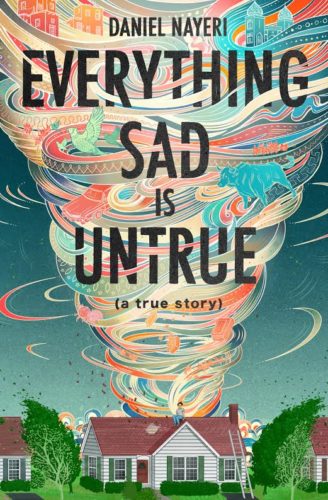
Daniel Nayeri’s Everything Sad is Untrue is part memoir and part storytelling where he fills in the things he doesn’t remember exactly from his childhood. The first part of the book is a mixture of three kinds of stories—myth, legend, and history—that attempt to place the reader in Daniel’s past and his ancestry as it happened and as he imagined it might have happened. He relates “story” in this way to help the reader understand the very different Persian culture he started his life in and which formed his beliefs and attitudes.
Although there are no chapters in this book, the reader can clearly tell when the story pivots from providing background to relating the events from the time his mother became a Christian on a visit to the West. She embraced Jesus and her faith in Him wholeheartedly. Christianity in Iran is a capital offense, so she had to take her children and flee. She traded a comfortable life as a respected physician married to a successful dentist for the life of an impoverished refugee, looked down on because of her language, menial job, and poverty. But she had Jesus, and no one could take that away from her.
Some of the book tells about the year they spent in a refugee camp in Italy. It was not actually a camp with tents, but a concrete building with small rooms and a bathroom. The residents were refugees from many countries, all waiting for the U.N. to find a place that would accept them. They had nothing and there was no access to books, media or recreation. It was made even harder by the refugees’ inability to converse with each other and by impatient workers who processed each refugee’s mound of paperwork.
A lot of Daniel’s story tells what life was like for him as a child in Edmond, Oklahoma, where they eventually settled. He experienced bullying, but came up with tricks for avoiding the worst of it. There was culture shock around every corner as he tried to fit into a very different mindset. Fortunately, he had an outstanding teacher in Mrs. Miller who encouraged him without babying him. The librarian in Edmond was kind too, and so Daniel spent many Saturdays there devouring books. His mom ended up in the emergency room several times thanks to his stepfather Ray, a black belt. Despite lots of difficult times, Daniel never seems to plead for sympathy from the reader and always points to his mother as the strongest person he knows.
Everything Sad is Untrue is a book I recommend. It is a challenging read as the author’s life is presented through the eyes of a child, but with some of the understanding of an adult. Memories are an important theme of this book as Daniel says, “Memories are always partly untrue.” and “A patchwork story is the shame of a refugee.” This is a book ripe with principles and beliefs worth pondering and a story and characters who will remain in the reader’s thoughts long after the last page is turned.
Rating: 5/5
Category: Autobiographical novel/fictionalized memoir
Notes: 1. This is a hard book to categorize which may, in part, be a critical factor in making it a very good book.
2. It has been rated for children 12+ on Amazon. Some readers refer to it as a Young Adult book. To me, it is probably more appropriate for adults. Some of the fascination with “poop,” however, in Daniel’s childhood classroom would attract the attention of middle school boys.
3. This book has won many awards.
4. I thought not having chapters would be a negative for me, but it does fit the style of Everything Sad is Untrue.
Publication: 2020—Levine Querido
Memorable Lines:
Memories are tricky things. They can fade or fester. You have to seal them up tight like pickles and keep out impurities like how hurt you feel when you open them. Or they’ll ferment and poison your brain.
And here is the part that gets hard to believe: Sima, my mom, read about him and became a Christian too. Not just a regular one, who keeps it in their pocket. She fell in love. She wanted everybody to have what she had, to be free, to realize that in other religions you have rules and codes and obligations to follow to earn good things, but all you had to do with Jesus was believe he was the one who died for you. And she believed.
Imagine you’re in a refugee camp and you know it’ll be a tough year. But for the person who thinks, “At the end of this year, I’m going somewhere to be free, a place without secret police, free to believe whatever I want and teach my children.” And you believe it’ll be hard, but eventually, you’ll build a whole new life….But if you’re thinking every place is the same, and there will always be people who abuse you, and about how poor you’ll be at first, the sadness overtakes you….But what you believe about the future will change how you live in the present.
My Several Worlds: A Personal Record
My Several Worlds: A Personal Record
by Pearl S. Buck
WHAT IS MY SEVERAL WORLDS?
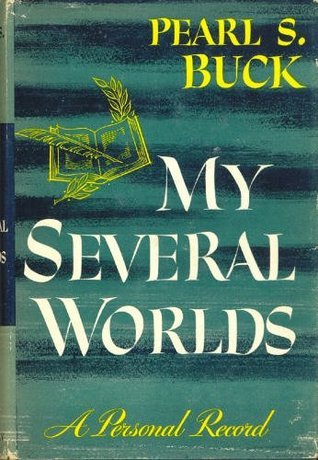
It is a collection of essays integrated into a memoir. Author Pearl S. Buck, as she writes this tome, considers herself midway in her writing career. She presents it as a “record of the age in which I lived” and “as nearly an autobiography as I shall ever write.” It is not a linear book. The place she is located when she writes each section is noted, but not the date because it is such a combination of times. Although a confusing style at first, it makes sense because as she is writing about her current life in the United States, she will suddenly revert to recounting her younger years in China and historical world events or advance her opinions on a variety of subjects from practical to esoteric.
WHO WAS PEARL S. BUCK (1892-1973)?
She was a prolific author, primarily a novelist, and the winner of both the Pulitzer Prize in 1932 and the Nobel Prize in Literature in 1938. The child of Christian missionaries, she spent much of her life in China until politics forced Americans to leave. Completely bilingual, Pearl was an astute translator of Chinese and had great admiration for Chinese social structure and love for the Chinese people. When she returned to the United States, she found that she lived in two separate worlds and never felt quite at home in either. She was well-traveled and had friends from all over the world.
WHERE DID BUCK GET HER INSPIRATION?
Buck’s source material was mainly her observations of people. In her travels, she paid attention to people, listening more than talking. Her focus was more on the common man and woman than the famous people who wanted to entertain her as a celebrity.
WHAT ARE SOME OF BUCK’S “SEVERAL WORLDS”?
Buck watched various political groups attempt takeovers in China. This land she loved and which helped shape her was subject to political strife from inside the country and by forces from the outside. She was witness to Western influences on young Chinese who studied in the United States and tried to bring change to ancient Chinese customs. These endeavors were not always positives for the Chinese people.
As an American adult with Chinese training, Buck experienced disparate worlds in the United States. Looking past geopolitical issues, Buck also had several worlds on a personal level. Although equipped to mingle in high society circles, she preferred a rural lifestyle with a large household of adopted children who learned life and family skills on their farm. She had a long, unhappy marriage to an agricultural missionary in China followed by a long, happy marriage to her publisher in the U.S. Although a teacher and primarily a writer, Buck devoted her talents to social enterprises as well. She opened The Welcome Home for U.S.-born children of Asian descent whose mixed-race status made them “unadoptable” according to adoption agencies. She also advocated for appropriate care for the disabled, a cause close to her heart as her first child was unable to live independently.
WHAT IS YOUR OPINION OF MY SEVERAL WORLDS?
This is not an easy read; there is no fluff to it. In My Several Worlds you will discover a lot of Chinese history since, as Buck points out, the Chinese civilization is very old. She refers to many events in China’s past without details as she feels they have already been discussed thoroughly in books she and others have written. Her thoughts on the various subjects she examines are interesting although I do not always agree with all of them. They are informed by her unique background of living a cosmopolitan life. She was homeschooled by Christians but tutored by a Confucian. She went to college in the United States, but despite altering her clothing never felt like she fit in.
Buck is an excellent writer, but the reader needs to approach this non-fiction work with a desire to learn—to learn more about China, about adults who have grown up in more than one culture, and about the fascinating Pearl S. Buck. Having read this memoir, I think a good follow up would be to read one of her many novels.
Rating: 5/5
Category: Memoir, Nonfiction
Publication: 1954—John Day Co.
Memorable Lines:
But I had never known what hatred was. I had neither been hated nor had I ever hated anyone. I could not understand why we, who were still ourselves and unchanged, should be lumped with unknown white men from unknown countries who had been what we were not, robbers and plunderers. It was now that I felt the first and primary injustice of life. I was innocent but because I had the fair skin, the blue eyes, the blond hair of my race I was hated, and because of fear of me and my kind I walked in danger.
No people can be educated or even cultivated until books are cheap enough for everybody to buy.
I went back to my own resurrected home with a heavy heart indeed, for I knew that from that day on the new government was doomed in the end to fail. Why? Because it had failed already in understanding the people whom it purposed to govern and when a government does not rule for the benefit of those ruled, sooner or later it always fails, and history teaches that lesson to every generation whether or not its rulers can or will understand.
 education pathways