Home » Posts tagged 'Ukraine'
Tag Archives: Ukraine
How the West Brought War to Ukraine–understanding how U.S. and NATO policies led to crisis, war, and the risk of nuclear catastrophe
How the West Brought War to Ukraine
by Benjamin Abelow

A short book, How the West Brought War to Ukraine, presents an important but controversial view of which countries are behind the current conflict between Russia and Ukraine. To understand Benjamin Abelow’s thesis, you have to revisit history going back almost 200 years to the Monroe Doctrine. In 1823, the United States made it clear that foreign forces placed near U.S. territory are in violation of that policy and provide a reason for war. If you follow that to its logical conclusion, countries massing troops on Russia’s border, especially with weapons whose capability allows reaching within Russia’s borders, is clearly an offensive act.
For years, the U.S. and NATO have been setting up countries that border Russia with military aid to be able to fight a proxy war. Abelow explains “How the Narrative Drives the War” in his introduction in which he lists the Western provocations. The rest of the book is an amplification and explanation of each one of these. One of his most compelling arguments is asking his reader to put the U.S. in Russia’s position. What would the U.S. do? How would it react if foreign forces massed on the Mexican or Canadian border with the ability to send destructive weapon fire into the U.S.?
The author is not a Putin lover, but he does try to present the other side, the side the Western media is not showing. The author is sympathetic to both Russian and Ukrainian soldiers. Among the many leaders he quotes, he includes Chas Freeman, former Assistant Secretary of Defense for International Security Affairs. He speaks of the U.S.’s two contradictory aims which will result in many deaths. Dripping with irony, Freeman says “We will fight to the last Ukrainian for Ukrainian independence.” The author also spreads the blame around to many Western leaders (including George W. Bush, Trump, and Biden) who have reneged on promises to secure borders and have propped up regimes whose goals were to break down those borders. You may or may not agree with the author, but if you read the book, you will be able to have an informed opinion about this conflict which could potentially evolve into a nuclear war.
I received a complimentary copy of this book in exchange for an honest review. Opinions expressed in this review are completely my own.
Rating: 5/5
Category: History, Nonfiction, Politics
Notes: 1. I always try to learn from history, and there are very few politicians I trust. I have to ask why we are involved in this conflict. It is hard to convince me that it is out of concern for the common man and woman in Ukraine when there are conflicts and genocides all over the world that we ignore. It seems something more than altruism is at play.
2. I have bumped this review ahead in my queue because the book’s message is time sensitive. Recently, pipelines that are important to our world were blown up, and this morning I read that an important bridge suffered an explosion in the Crimea and apparently several people lost their lives. There has been war and conflict in that part of the world for centuries, but it seems there currently is evil afoot with a very destructive path.
3. For memorable lines for this complex topic, I am just noting one paragraph rather than 3 shorter passages. I think it presents the theme and the persuasive writing style of this book quite well.
Publication: August 31, 2022—Siland Press
Memorable Lines:
Had the United States not pushed NATO to the border of Russia; not deployed nuclear-capable missile launch systems in Romania and planned them for Poland and perhaps elsewhere as well; not contributed to the overthrow of the democratically elected Ukrainian government in 2014; not abrogated the ABM treaty and then the intermediate-range nuclear missile treaty, and then disregarded Russian attempts to negotiate a bilateral moratorium on deployments; not conducted live-fire exercises with rockets in Estonia to practice striking targets inside Russia; not coordinated a massive 32-nation military training exercise near Russian territory; not intertwined the U.S. military with that of Ukraine; etc. etc. etc.—had the United States and its NATO allies not done these things, the war in Ukraine probably would not have taken place. I think that is a reasonable assertion.
Souvenirs from Kyiv–devastation of war
Souvenirs from Kyiv
by Chrystyna Lucyk-Berger
I want to believe Chrystyna Lucyk-Berger’s stories in Souvenirs from Kyiv are more fiction than history, but I know that is not true. She has researched and conducted interviews with survivors of World War II and its aftermath. She has compiled their memories into composite stories that share brutal truths about war. Her goal Is to “make it clear that conflict is not about two teams meeting on the battlefield—one called ‘good’ and one called ‘bad.’ There are no winners in this story.”
These tales are emotionally hard to read; I put aside the book several times to regroup. Because the author is Ukrainian-American, I expected the book would be slanted towards the Ukrainians. While they are certainly the focus, they are not depicted as guiltless. The barbarism of war is demonstrated in acts performed by Germany, Poland, the USSR, Ukraine, and the United Nations. “Sides” were not clear cut and people had to quickly change their nationalism based on necessity for survival.
In Ukraine’s War of Independence (1917-1921), a chant was popular:
Glory to Ukraine.
Glory to the heroes!
Death to the enemies.
It was revived in the 1940’s as a partisan group struggled to “ ‘purify’ Ukraine of Jews, of Poles, of Nazis, of Soviets.” The Organization of Ukrainian Nationalists (OUN) was founded after WW I. It fractured into two groups, each fiercely loyal to its leader. They expended energy which would have been better used in fighting their common enemy. That is an easy position to take from my safe twenty-first century armchair.
The author creates believable, fictional characters. Through them she makes real:
–the desperation of those in labor camps
–the hard work required just to survive each day
–the quick adjusting of priorities for those fleeing
–the raw, animalistic violence that emerged during the fight for survival—whether to get a place in a bomb shelter or to grasp a stale piece of bread.
There are also shining lights:
–parents sacrificing for children
–the kindness of a German officer leading a refuge family to safety during a bombing
–everyday citizens risking their lives by sharing their homes and what little food had been left for them by ravaging soldiers.
These are all stories that need to be told, but the tale goes further. When the dust of battle settles, what happens to the survivors? To what country will they claim allegiance? Even those captured by an army and put in uniform or forced into slave labor, can be blacklisted as traitors in their home country. There is the unimaginable prospect of labor camps once more. If these threats are not realized, the survivors still have to overcome physical and mental hurdles of reintegrating into a society, perhaps not the one of their birth. During and after the war, Ukraine Diaspora occurred in the U.S. and in Europe.
Although this book is historical fiction, I learned a lot about the strife between Ukraine and its neighbors. Conflict is not new in that area. The author made history come alive with characters caught up in a war not of their making. It is important to read the forward. The first story slowly immersed me into the time period. Then the rest of the book sped by quickly. This author has written other books, and I am interested in reading them as well. Although Souvenirs from Kyiv is about Ukraine, its theme, the devastation of war, has worldwide applications.
I would like to extend my thanks to NetGalley and to Bookouture for giving me the opportunity to read this book in exchange for an honest review.
Rating: 5/5
Category: Historical Fiction, General Fiction (Adult)
Notes: 1. A map of Ukraine is included.
2. The book ends with a letter from the author and also a valuable glossary. Some foreign language words are defined within the story, but the glossary is helpful for the other terms.
Publication: April 22, 2022—Bookouture
Memorable Lines:
I think of the Germans picking up and fleeing, the Red Army laying claim to the scorched land, and I know that one oppressor is no better than the next.
[Pretend death notification letter composed by an enlisted Ukrainian forced into the German army.] As we waited for our weapons to thaw, your son took a bullet. He did not die a hero. He did not kill many Red Army troops. He was shot, and others have died of TB, frozen to death, or have simply lost hope. You may stop sending blankets. They go to the officers, anyway. You could send clubs and knives, for we have been forced to turn into primitive cavemen. Our weapons are useless in this frozen land.
…if he has learned anything on this journey, it is this: he will give up everything—including his principles, including his painting, his life—to keep his family alive.
My Real Name is Hanna–extremes of human behavior
My Real Name is Hanna
by Tara Lynn Masih
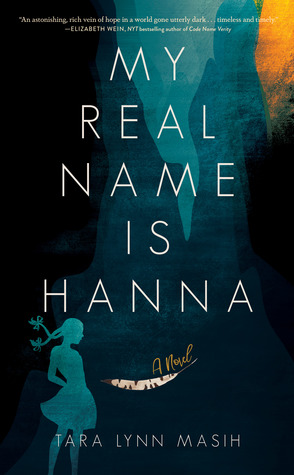 My Real Name is Hanna is the story of a Jewish girl and her family who live under horrible circumstances in Ukraine to escape death at the hand of the Nazis and others. This book by Tara Lynn Masih has much potential. Many parts of the survival tale are drawn from the story of a real family that had to live underground. The first part of the book bounces around a little and then settles down into a sequential tale. Although it is a sad story, I didn’t really find myself emotionally involved with any of the characters. Parts of the narrative got my attention, such as when family members were in danger. I wanted to see them survive, but mainly I wanted the book to be over.
The author uses words from other languages freely. I like the authenticity of that but I would have appreciated a glossary, and I think young people would find that helpful as well. The area the family lives in has been occupied by many countries so there are competing cultures and languages—Jewish, Polish, Ukrainian, Russian, and German.
I actually found the “Historical Notes” at the end of the book more interesting than the book itself. Unfortunately, the author includes her own political stance on current events in these historical notes. If she wants to put forth these ideas in her book, I would suggest she do it in an editorial type section separate from a discussion of the historical basis of the book. Like the author, I hope the day will come when we don’t need reminders of the Holocaust as cautionary tales against cruelty. I don’t think, however, that it is appropriate to use her historical notes as a platform for indoctrinating young people into her political views. The story should stand on its own merits, and young people are capable of reading the book and making their own moral conclusions.
I would like to extend my thanks to netgalley.com and to Mandel Vilar Press for giving me the opportunity to read this book in exchange for an honest review.
Rating: 3/5
Category: Historical Fiction, Teens
Notes: Interest Level—Ages 12 and up
Grade Level 10-12
Publication: September 25, 2018—Mandel Vilar Press
Memorable Lines:
I see in my mind again those posters in the window, the big red letters, the lice, the blaming of Jews for the war. Someday, someone will betray us. For money, for food, for their own lives spared.
I can now hear what sounds like heavy boots approaching the house from down the lane, grinding the dirt and gravel with their murderous purpose.
When you’re hidden away, with no freedom, you crave news of the outside world as much as you crave food.
 education pathways