
Home » Posts tagged 'Trinity'
Tag Archives: Trinity
Ordinary Time: The Season of Growth
Ordinary Time: The Season of Growth
By Amy Peeler
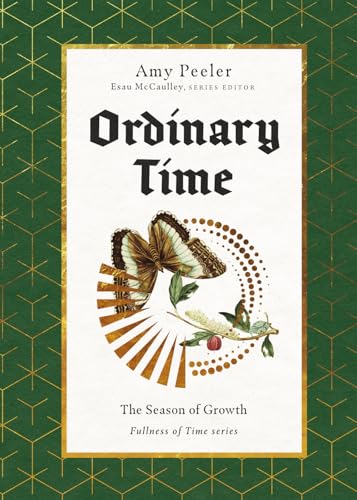
The Fullness of Time series discusses the “riches of the church year, exploring the traditions, prayers, Scriptures, and rituals of the seasons of the church calendar”: Advent, Christmas, Epiphany, Lent, Easter, and Pentecost. Outside of these specials seasons are more days—a period between Epiphany and Ash Wednesday and another between Pentecost and Advent. This season is called Ordinary Time and is a season of growth. How do these days fit into the life of a Christian? According to Amy Peeler, an Episcopal priest and professor at Wheaton College, “Being grateful for what God has done—previewed in Genesis and accomplished in Christ—is a necessary step toward daily faithfulness. That daily faithfulness is when trust, even in the face of death, becomes our new ordinary.”
The first half of the book deals with many of the common practices of worship in traditional liturgical churches. Especially meaningful is her in-depth discussion of the Lord’s Supper. The Book of Common Prayer holds many declarations and prayers used to proclaim God’s grace and our unworthiness as we join together as children of God to remember his sacrifice with the bread (His body) and the wine (His blood) as he instructed his followers to do when they gathered.
The second half of the book starts at the beginning of Genesis with the story of Abraham and Sarah and how they grow in faith by seeing God and acknowledging that God sees them, which leads them to trust God. Next is the story of Hagar, a slave, and her son by Abraham who was named Ishmael. There are many lessons about trust, which leads to gratitude, in their story. During Ordinary Time, as in the other seasons, the Scripture readings, prayers, and hymns are all chosen to reflect the theme and, of course, to point to the Trinity: God, the Father; Jesus, the Son; and the Holy Spirit.
Although short, Ordinary Time is not a book you will want to rush through. Its topics are practical, but the discussion reaches deeply into areas that could become perfunctory, but shouldn’t. I appreciated its accessibility while, at the same time, it went deeper, theologically speaking, than is normally expected from a brief book.
Rating: 5/5
Category: Christian, Religion, Spirituality, Theology
Notes: The Fullness of Time series is edited by Esau McCaulley. It is composed of seven stand alone books that can be read in any order: “Each volume in the Fullness of Time series invites readers to engage with the riches of the church year, exploring the traditions, prayers, Scriptures, and rituals of the seasons of the church calendar.” Ordinary Time completes the series.
Publication: 2026—InterVarsity Press
Memorable Lines:
The Holy Spirit does not choose the worthy but the willing.
The shattering of the wafer recalls this defeat of death through death.
We might, as Hebrews instructs, meet a stranger who is actually an angel (Hebrews 13:2), but even if that surprising event does not occur, we can rest assured that every person we meet bears the image of God and should be treated as such. Jesus too instructs his followers to treat others as we would treat him (Matthew 25:34-46).
Seeking Allah, Finding Jesus: A Devout Muslim Encounters Christianity
Seeking Allah, Finding Jesus
by Nabeel Qureshi
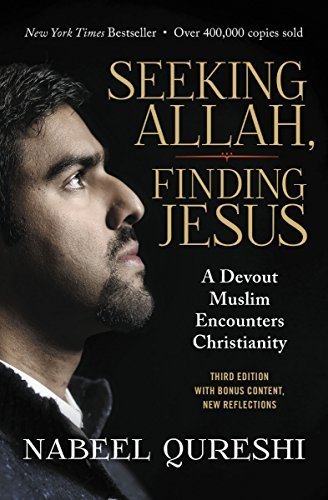
Nabeel Qureshi was an intellectual raised in a Muslim home who devoted years of study and fellowship with his best friend David, a Christian intellectual. They argued, researched, prayed, and maintained their friendship as Nabeel sought the Truth. Was he to find it in Jesus or in the teachings of Islam? This book is perfect for anyone who wants to:
—approach the Bible analytically
—prove or disprove the claims about Jesus Christ
—learn more about the beliefs of Muslims, their culture and how the two are related
—learn about the history of Islam
—understand the difference in approaches to Islam in the East and in the West
—learn some basic Islamic terminology
—witness a true Christian/Muslim friendship
—see how a Christian can share Jesus with others by example as he lives out his beliefs in Jesus through his actions
—learn how to disagree respectfully
—understand the Trinity
—gain an understanding of what a Muslim gives up when he converts to Christianity and the consequences of a conversion
—comprehend the claims and arguments against and for the crucifixion and resurrection of Jesus
—read truths about Muhammad and the Quran that imams don’t share with their followers.
The Foreword of Seeking Allah, Finding Jesus summarizes the book quite well: “This is the riveting story of one man’s quest to set aside his preconceptions and pursue answers to the most pressing issues of life and faith, despite enormous pressure to maintain the status quo.”
Rating: 5/5
Category: Memoir, Christian, Religion and Spiritual
Notes: The author describes the book as a “narrative biography,” and one of the contributors to the lengthy appendix which expands on the topics in the book calls it Qureshi’s “spiritual autobiography.”
Publication: August 21, 2018—Zondervan
Memorable Lines:
The culture clash of immigrant parents with their Western-born children is especially common during the emotionally stormy teenage years, and it serves to illustrate a vital fact: Muslim immigrants from the East are starkly different from their Muslim children born in the West.
Effective evangelism requires relationships. There are very few exceptions.
Because of hadith and tradition, Muslim religion, culture, heritage, and identity all find their core in the person of Muhammad. This is why Muslims see an attack on his character as equivalent to a personal attack on them and everything they stand for.
These are the costs Muslims must calculate when considering the gospel: losing the relationships they have built in this life, potentially losing this life itself, and if they are wrong, losing their afterlife in paradise. It is no understatement to say that Muslims often risk everything to embrace the cross.

