Home » Posts tagged 'travel writer'
Tag Archives: travel writer
Consider This, Señora–newcomers in a Mexican village
Consider This, Señora
by Harriet Doerr
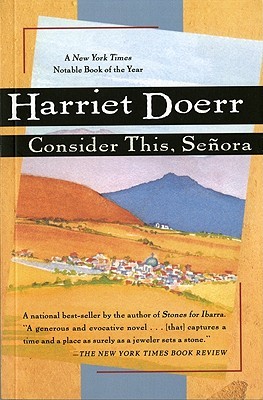
If asked what a particular country is like, the wise respondent does not declare that the whole country is mono-anything. Cities are different from villages, mountains from deserts, and north from south. At the same time, there are cultural aspects that transcend regional differences. This is certainly true of Mexico as I can attest to after being privileged to live in that country for seven years. In Harriet Doerr’s Consider This, Señora, she captures the essence of rural Mexico, the things that make me nod and smile as I remember the way it is.
Here are things from the book that are, for the most part, neither bad nor good, just typically Mexican. I list them out, but in the book, they are integrated into the story:
- Workmen that don’t finish jobs.
- Problems solved by greasing the wheels with a little cash.
- Extended family relationships determining work placements.
- Government promises for utilities only partially or never fulfilled.
- Accidents caused by disregard for traffic “suggestion” signs.
- Brilliantly colored fiestas.
- Beautiful vistas.
- No understanding of queues, but extreme politeness one on one.
- Animals roaming free.
- Very young mothers.
- Children working from a young age.
- Beautiful babies with wide brown eyes and shy smiles.
- The staple food—taco.
- Popsicles sold from street carts.
The story is the tale of Sue Ames and Bud Loomis, strangers trying to escape their pasts who meet by chance in a property agent’s office in Mexico and buy a large plot of land to both live on and subdivide. Other people join them. Fran is a travel author. Fran’s mother, Ursula, is widowed and in her late 70’s. Don Enrique, the original owner of the land by ancestry finds a home there. Later the mysterious musician Herr Otto is added to the community. There are locals that make an essential supporting cast including Patricio, gardener and so much more for the Norte Americanos and Father Miguel who is a friend to all.
Consider This, Señora is a gem, a tale of travelers to another culture and how their lives intersect with the land and the lives of the locals. Although not a romance, love is a major theme in the book. Even though she is divorced, Sue has never fallen out of love with her husband. Fran, divorced twice, continues to search for an exciting but long-lasting love with men she meets in her travels. Ursula, widowed, is still in love with the husband she spent her life with. She, especially, contemplates what it means to love.
Sue is altruistic and generous, helping those in need. She takes on Altagracia, her part time maid from a young age, providing needed dental work and opportunities to bathe. As the girl emerges from her cocoon at age sixteen, Altagracia is described as one who “merely by her passage, turned the heads of men.” When Altagracia takes on a different domestic position, she supplies Sue with three of her little cousins who are starving. Sue opens her heart to them and provides help to the family.
Harriet Doerr’s descriptions are so well-written that the background comes to life enhancing the story without belaboring the details. She also includes a sprinkling of Spanish words adding to the authentic flavor, but most can be understood from context. The book flows, and I read it in one day wanting to know more and more about the characters and the little village of Lomas de Amapolas.
Rating: 5/5
Category: Fiction
Publication: August 15, 1994—Harcourt (A Harvest Book)
Memorable Lines:
Today had stopped happening. Already it had consigned its events to memory. Touched by the evening chill, she sat outside until dark, wrapped in the mists of her brief, uncertain future and the brilliant patchwork of her never-ending past.
The Mexican sky was excessive too, she believed. Wider than others, it stretched over people who appeared no fonder of life than death, as they darted on bicycles between trailer trucks and buses and hurried hand in hand, whole families strong, across divided freeways.
On all sides of the dead man and the mourners, headstones tilted into weeds. Two cypress trees shaded the crisscrossing tracks of animals, both tame and wild. A crumbling adobe wall bounded the pantéon and protected the dead.
 education pathways