Home » Posts tagged 'therapy'
Tag Archives: therapy
Letters of Wisdom–forgiveness
Letters of Wisdom
By Wanda E. Brunstetter
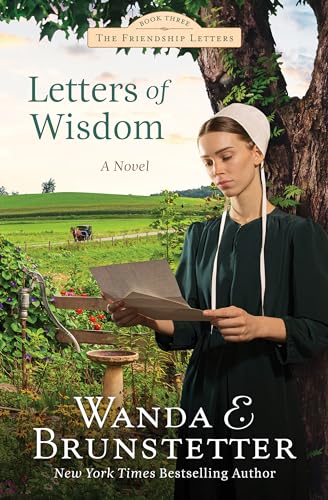
Long known as a writer of Amish themed novels, Wanda E. Brunstetter has recently turned her hand to writing some books with very serious themes. Although they still focus on the Amish and how characters face situations, the problems are consequential with multi-generational results. Sadly, the stories such as this one originate in Brunstetter’s personal experiences.
Irma Miller suffered traumatic physical and emotional abuse inflicted by her stepfather on her only, not on his biological children. She is reluctant to share these experiences until she sees herself morph into the monster her stepfather was. Her surprised husband insists she get help in the form of therapy with a Christian counselor. Her mother-in-law and the bishop’s wife also provide childcare for her children. Healing is not an instant process. Letters from her friends helped. She had not been able to deal with her three children rationally and a fourth is on the way. Irma finds she has to confront the trauma head-on, granting and accepting forgiveness. Her mother and step brothers and sisters needed to be a part of that process too.
The characters, other than the stepfather, are likable. They are all caught up in a web of pain. The extent of the abuse is not evident in the first part of Letters of Wisdom, but becomes apparent later. Prayer and forgiveness are essential parts of the healing process, but Irma’s path is a difficult one and hard to witness.
I received a complimentary copy of this book in exchange for an honest review. Opinions expressed in this review are completely my own.
Rating: 5/5
Category: Christian, Romance, Women’s Fiction
Notes: 1. #3 in the Friendship Letters Series, but can be read as a standalone.
2. This book has a frank and realistic view of abuse in the family. If that is a trigger for you, you might want to give it a pass.
Publication: March 1, 2024—Barbour
Memorable Lines:
She sensed the real emotions that remained in this house from Homer’s cruel treatment of Irma while she’d lived here, but none of the other children had ever talked about it.
She’d grown to hate him over the years. And even now, knowing he was dead, her soul filled with animosity thinking about all the terrible things he’d done to her.
“…it’s in the past and we must live in the now and do better in the future. We have all made mistakes that we can not erase. So, in order to live a happy, fulfilled life, we must confess our sins, turn our fears over to God, forgive our own shortcomings, and make every effort to behave in such a way that others will see Christ living in us. Only then will our hearts be filled with peace.”
Once Upon a Buggy–Amish Romeo and Juliet
Once Upon a Buggy
by Shelley Shepard Gray

May and Carl at ages 16 and 17 respectively sneak off to the feed barn for some innocent time away from the prying eyes and ears of siblings. When a lightening bolt strikes the wooden structure, their lives are changed forever, as are the lives of their families when a feud develops and the formerly close neighbors stop communicating altogether. As part of the Amish community in Apple Creek, Ohio, they should have been able to get past guilt and blame, but they haven’t, especially Carl’s family because he was injured so badly.
Six years later, Carl returns to Apple Creek for the first time to visit. Scarred mentally and physically, he has made a lonely life for himself as an Englischer. He is successful, however, as a project manager for a manufacturing company. Carl wants to leave the past behind and unite the two families. His sister and May’s brother find themselves in a Romeo and Juliet scenario as they are quite smitten with each other, but know neither family would approve. Carl finds that he still has feelings for May.
The author puts lots of obstacles in the way, and at times reconciliation for the two families seems impossible. The parents in this book are, of course, Amish, and the customs are for families to stay together with the father having ultimate authority. The adult children often have to walk a fine line between living out their lives and respecting their parents.
Once Upon a Buggy is well written with lots of character development. The conflicts are realistic. I am not Amish and am only aware of their societal structure through fiction, but I was surprised that their bishop in six years had not intervened in the feud. He was helpful, however, when called on by the younger members of the families who pushed a confrontation so they could move on with their lives.
There are two scenes that particularly caught my interest. A tornado moved through their county. Because Carl is Englisch, many people find out about the tornado watch and later the warning through Carl and his access to technology. That scenario made me wonder how the Amish normally find out about tornadoes moving through. In my county in Oklahoma, we have sirens as a warning system. The families’ preparations for the event, their time of sheltering, and the community’s working together in the aftermath particularly drew my attention.
May’s family owns alpacas, and the herd has an important role in the story. I enjoyed learning more about them.
I received a complimentary copy of this book in exchange for an honest review. Opinions expressed in this review are completely my own.
Rating: 5/5
Category: Christian, Romance
Notes: #2 in the Amish of Apple Creek Series, but works well as a standalone. I had not read #1 and didn’t feel like I had missed anything that would keep me from understanding or enjoying this book.
Publication: March 28, 2023—Kensington
Memorable Lines:
People started whispering. A low buzz surrounded her, sounding as if she was surrounded by a swarm of bees. Each one gossiping, talking, no doubt ready to sting her with an unkind comment.
It seemed that was how everyone handled his father now. They let Daed spout off rude things and didn’t correct him. Carl supposed that approach kept the peace, but he found it irritating.
“What I’m trying to say is that He did hear my prayers, but the solution wasn’t the one I thought I wanted. It was the one I needed. I didn’t need to have pain and sadness removed from my life…I just needed a way to manage them.”
The Remarkable Ordinary: How to Stop, Look, and Listen to Life
The Remarkable Ordinary
by Frederick Buechner

Art and music as gateways to God—an interesting thought Frederick Buechner uses as the basis of his first chapter in The Remarkable Ordinary. That beginning was a little slow to take hold on me, and it didn’t really continue on as a predominant theme in the book. In fact, the book continues forward in three parts with a total of eight chapters. As I read, I felt like I was examining Buechner’s mind, his thought processes, his memories, and most importantly his search for God in the ordinary things of life. When he began a relationship with Christ, he was “all in.” Not content to read the Bible through as a first step, he wanted to jump right into seminary. He eventually decided that his training in the ministry and his skills would be best used as a writer rather than as a pastor. He never used the term philosopher, but that is what I see him as. The Remarkable Ordinary is part philosophical treatise and part memoir. He delves into therapy sessions, dreams, and family history that helped form his character and beliefs.
Buechner is honest and introspective, and the book is a product of his soul searching. Each chapter is a collection of his thoughts on various themes. He reflects on holiness, our personal journeys, our efforts at controlling others, and the wars we wage with ourselves and those around us. He shows facets of God to us as he examines the arts, other people, the ordinary things around us, and our stories, dreams and memories. He ties all of these parts of the “remarkable ordinary” into our need to “stop, look, and listen to life.”
I actually read much of the book twice in an effort to understand Buechner’s views. It is different from other books I have read by religious leaders. Buechner is very open about his beliefs and his past and yet, probably rightly, he did not reveal all as he continued to clarify his thoughts. Some things are too personal to share with the world. Frederick Buechner passed away on August 15. 2022, leaving behind a legacy of 39 works of fiction and nonfiction in several genres written over a span of 60 years.
Rating: 4/5
Category: Nonfiction, Christian
Publication: October 3, 2017—Zondervan
Memorable Lines:
It seems to me almost before the Bible says anything else, it is saying that—how important it is to be alive and to pay attention to being alive, pay attention to each other, pay attention to God as he moves and as he speaks. Pay attention to where life or God has tried to take you.
We’ve all had saints in our lives, by which I mean not plaster saints, not moral exemplars, not people setting for us a sort of suffocating good example, but I mean saints in the sense of life-givers, people through knowing whom we become more alive.
I was so motivated because I was at that point so on fire with, I can only say, Christ. I was to the point where when I would see his name on a page, it was like seeing the face of somebody you loved, and my heart would beat faster. I had to find out more about him.
I certainly am always at war one way or another with myself, and some of them are wars I must fight to try to slay the demons, to kill the dragon, to lay the ghost to rest. But there are other wars you fight with yourself that are really not worth fighting at all. The war to make yourself be more, do more than you have it in you really to do or to be.
The Best is Yet to Come–hope for the hurting
The Best is Yet to Come
by Debbie Macomber

When a hurt is so deep, so intense, that it permeates your very soul; when it causes pain that is both physical and mental, is there any way out? Cade survived a firefight after watching his two best friends die. He has a leg injury, PTSD, and a lot of anger. He lost his parents’ support when he chose not to follow the family tradition of becoming a lawyer.
Shadow is a German Shepherd who was abused and neglected; but even in his malnourished state, he is aggressive toward all in the animal shelter until he meets Hope. Hope is a high school teacher and counselor who is determined to win Shadow over with patience and love. Can she do the same for Cade?
Hope has her own past to get over as her twin brother died in Afghanistan. He was her only remaining family member, and they were very close.
Along the journey Cade makes toward wellness, we meet Harry his VA counselor, the other members of his group counseling sessions, and a lot of supportive people.
The Best is Yet to Come is a book with relevant issues facing many who have served in the military and their loved ones. It is a clean romance with emotional impact. A quick read, it provides lots of opportunities to take breaks, but you won’t want to. The story line includes interactions with some of Hope’s students focusing on their struggles, and it climaxes with an action-packed scene.
The author provides satisfying resolution to all the plot threads, and the book leaves you wanting to read another Debbie Macomber novel. Fortunately, there are many you can choose from.
I received a complimentary copy of this book in exchange for an honest review. Opinions expressed in this review are completely my own.
Rating: 5/5
Category: Women’s Fiction, Romance
Notes: This is #3 in the series Oceanside, but it read like a standalone to me. I was not aware it was part of a series until I began to write the review.
Publication: July 12, 2022—Balantine (Random House)
Memorable Lines:
The memories of that last battle engagement clawed at him like an eagle’s talons, his sleep peppered with nightmares that his mind insisted on tossing at him like a hundred-mile-an-hour hardball pitch. He drank to forget. To sleep. To escape.
“By being loners, we feel like we’re handling life; we’ve built this fortress around ourselves. Involving others, inviting them into our pain, is hard. We resist. We don’t like it. We feel we can handle it on our own. We’re islands unto ourselves, not needing anyone.”
“An attitude of gratitude,” Harry said. “That, young man, will take you far.”
 education pathways