
Home » Posts tagged 'strength'
Tag Archives: strength
Joe Nuthin’s Guide to Life–not a mean bone in his body
Joe Nuthin’s Guide to Life
by Helen Fisher
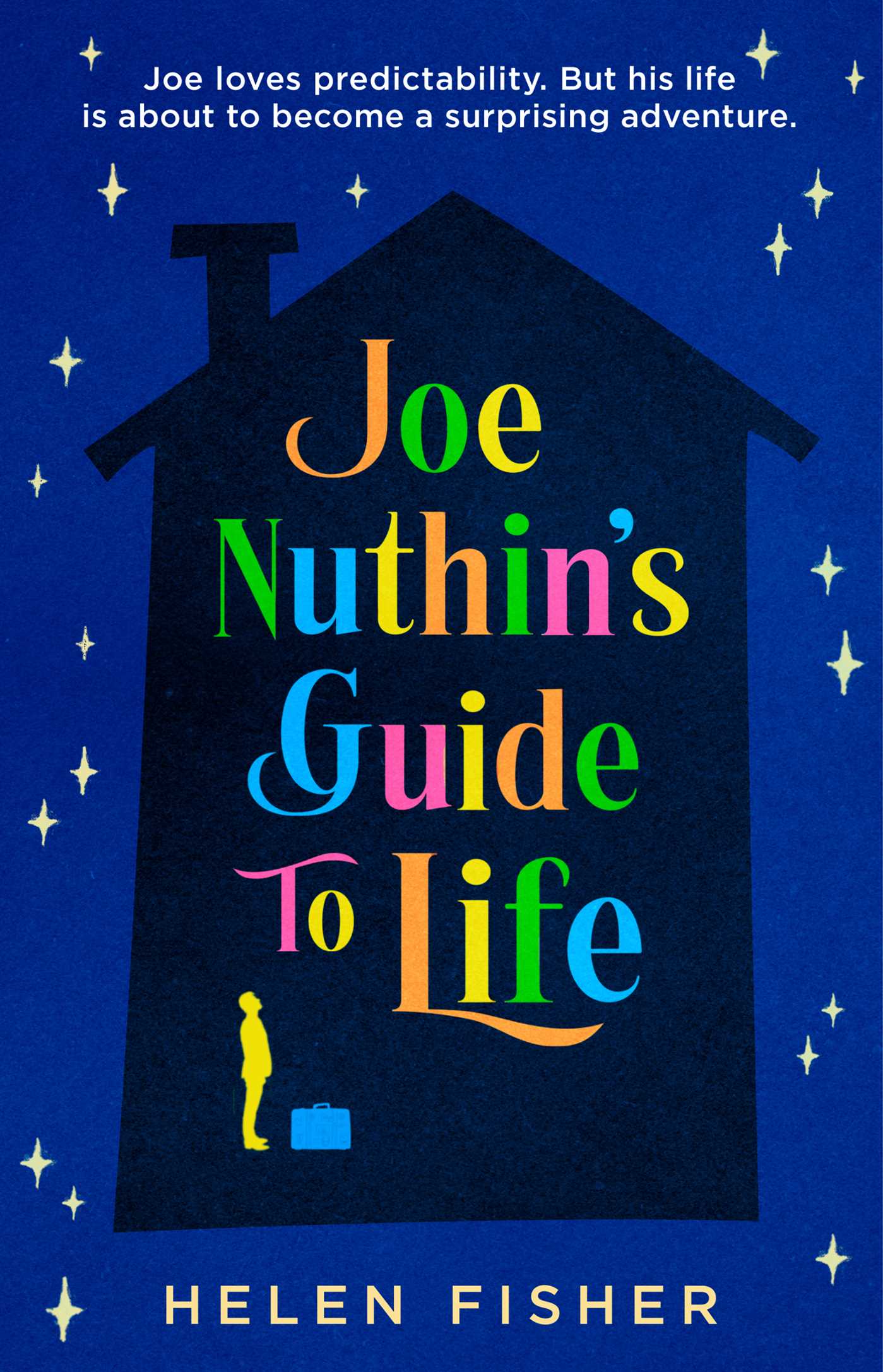
Joe Nuthin’s Guide to Life is the story of a neurodiverse young man whose mother’s goal is to support him into being a happy person able to live independently and hold down a job. He is a man of routines and anything that deviates from that routine or is out of place makes Joe very uncomfortable. Joe has a job at a grocery store called The Compass where his favorite activities are to stack items for display and to return mislaid items to where they belong. His mother is writing a book, a manual, for him in case he gets confused or forgets how to do something. He is quite literate, reading and retaining so many facts, but he can’t make the connections necessary for functioning easily in settings with other people. He has an understanding boss Hugo. Joe’s friend Chloe is a foul-mouthed co-worker who is not afraid to stand up to “Mean Charlie” who bullies Joe unmercifully.
The first part of Joe Nuthin’s Guide to Life is well-written, and I really cared about Joe and the other characters. There is a major event which happens in Joe’s life (spoiler if I included it) after which the book went downhill for me. The plot and the characters became more negative. Joe’s life goal is to prove his mom right that he “doesn’t have a mean bone in his body.” While that is a positive attribute, because Joe doesn’t understand anything that is not literal or is nuanced, he unintentionally causes a lot of physical pain in a relational situation. The reader has to cringe and inwardly say, “No, Joe! Stop!” several times.
Joe’s mother has beautiful handwriting. In this book the author quotes from the manual when Joe reads passages in it. This style and format (italics in place of cursive) are effective ways to demonstrate the difficulties faced by neurodivergent children and adults and how Joe’s mom clearly tries to address all of his present and future concerns. People who are neurodivergent are open to bullying, and their parents face huge challenges in preparing them for life as adults, especially after the parents have died.
Rating: 3/5
Category: Literary Fiction, Fiction, Women’s Fiction
Notes: 1. I am probably in the minority in not loving this book. I really liked the character of Joe, and I understood the author’s portrayal of him. I even both sympathized and empathized with Joe, but the negative events were too strong and outweighed the positives for me.
2. There was a lot of inappropriate language from Chloe who is actually one of my favorite characters because she is someone Joe can rely on and she has no agenda. Even Joe didn’t like her swearing; he made a box for her to put money in when she swore.
3. One of Joe’s favorite things to do with and without his mom was to watch episodes of the TV show “Friends.” It was part of his routine and relaxed him. I just don’t think that show has good role models and would have too many jokes and situations that Joe would not understand.
4. A minor detail: the author used a mask in a scene and the usage was OK in terms of the plot. Joe understandably doesn’t like masks because he can’t tell what expression the person has and match it up with the expressions he has learned from a chart. The mask in this case was worn by an insensitive bully and was the face of an American president. My problem with this scene is that the author slipped in a slur about the president. It was not funny and it did not further the plot in any way. It was clearly politically motivated and unnecessary, and I would not have appreciated it regardless of which president was depicted.
5. The book includes “Topics and Questions for Discussion” and a section of activities to “Enhance Your Book Club.” Both of these were well done.
Publication: May 28,2024—Gallery Books (Simon and Schuster)
Memorable Lines:
Making sure that her son had a secure job with a nice manager somewhere that was walking distance from home was one of the most important things on Janet’s list to help Joe-Nathan prepare for independent life.
Janet knew that assumptions were lazy; a simple way of filling in the blanks when there wasn’t enough information Assumptions were a way of connecting the dots to give you a picture that worked, but not necessarily the right picture. Not necessarily the truth.
He wished it was Monday morning so he could go to work and feel completely comfortable knowing how he fitted into the world.
The Swiss Nurse–refugees from war
The Swiss Nurse
by Mario Escobar

I am so glad that I had read other books by Mario Escobar, because this work of historical fiction started off roughly for me. I feel sure the fault was my own. I am shamefully unfamiliar with the Spanish Civil War, and I started the book too late in the evening. I persevered the next day, however, and was quickly immersed in a tale of evil hearts and the strength of some good people who worked to help others in dire circumstances.
When Franco and his troops were successful in this war, they were determined to obliterate the Republicans fighting for their freedom and anyone associated with them. The result was a massive exodus of refugees into southern France which was not prepared for the influx and did not welcome them with open arms. The “camps” they provided were sandy beaches with no structures. There was little food and no potable water; the refugees were not allowed outside the camp.
This book is about the refugees in that war which was followed up by the events of World War II and the further torment of innocents by the French Vichy government which was a puppet government of the Nazis, and then by the Nazis themselves. Much of the story describes the horrible conditions of the refugee camps and the strength and boldness of Elisabeth Eidenbenz, a Swiss woman whose focus was orphans in Spain until she was forced relocate to southern France where she opened a hospital taking in pregnant women and giving them a safe place to deliver their babies. The other main character is Isabel, a Spanish lady who married Peter, an American who fought with the Spanish for their liberation. Their lives intersect when Isabel gives birth to her precious daughter Lisa at the Elne Maternity Hospital. With Peter held in various prisons and concentration camps and conscripted into the army for manual labor, Isabel stays to help in the maternity hospital.
The author pulls the reader into the horrible conditions and the faith and courage of characters who stand up for what is right. As a reader, you want everything to turn out great for the sympathetic characters. This is, however, a work of historical fiction, so not everyone has a happy ending. It is important to read works like this so that we are not duped yet again by politicians who promise good things and deliver nothing, creating untenable situations. History like this must not be allowed to repeat itself.
I received a complimentary copy of this book in exchange for an honest review. Opinions expressed in this review are completely my own.
Rating: 5/5
Category: Historical Fiction, Multicultural, Fiction
Notes: Additional material includes: References, Clarifications from History, Timeline, Discussion Questions, and Information about the Author and the Translator
Publication: April 14, 2023—Harper Muse
Memorable Lines:
Gazing off into the distance, their gaunt faces reflected the weary sadness of their souls. Their cheeks were sunken with hunger, and their skin was pallid from exhaustion and malnourishment.
An entire generation had been killed for naught: anonymous heroes on both sides, idealists attracted by the siren songs of their leaders who stayed safe in the rear guard. The only hope was to erase those painful years from their lives and try to start over from scratch.
Argelès-sur-Mer had been both refuge and jail. It had stamped out of us the hope of recovering our lives one day. We were now flea-infested riffraff with bones aching from damp nights spent on hard sand with thin blankets. The starry sky had been our prison roof.
“Sometimes we have to feel our way in the dark in order to find the path, but beyond the fog the sky is still blue, and the sun is still shining.”
Everything Sad is Untrue–memories are culture carriers
Everything Sad is Untrue
by Daniel Nayeri

Daniel Nayeri’s Everything Sad is Untrue is part memoir and part storytelling where he fills in the things he doesn’t remember exactly from his childhood. The first part of the book is a mixture of three kinds of stories—myth, legend, and history—that attempt to place the reader in Daniel’s past and his ancestry as it happened and as he imagined it might have happened. He relates “story” in this way to help the reader understand the very different Persian culture he started his life in and which formed his beliefs and attitudes.
Although there are no chapters in this book, the reader can clearly tell when the story pivots from providing background to relating the events from the time his mother became a Christian on a visit to the West. She embraced Jesus and her faith in Him wholeheartedly. Christianity in Iran is a capital offense, so she had to take her children and flee. She traded a comfortable life as a respected physician married to a successful dentist for the life of an impoverished refugee, looked down on because of her language, menial job, and poverty. But she had Jesus, and no one could take that away from her.
Some of the book tells about the year they spent in a refugee camp in Italy. It was not actually a camp with tents, but a concrete building with small rooms and a bathroom. The residents were refugees from many countries, all waiting for the U.N. to find a place that would accept them. They had nothing and there was no access to books, media or recreation. It was made even harder by the refugees’ inability to converse with each other and by impatient workers who processed each refugee’s mound of paperwork.
A lot of Daniel’s story tells what life was like for him as a child in Edmond, Oklahoma, where they eventually settled. He experienced bullying, but came up with tricks for avoiding the worst of it. There was culture shock around every corner as he tried to fit into a very different mindset. Fortunately, he had an outstanding teacher in Mrs. Miller who encouraged him without babying him. The librarian in Edmond was kind too, and so Daniel spent many Saturdays there devouring books. His mom ended up in the emergency room several times thanks to his stepfather Ray, a black belt. Despite lots of difficult times, Daniel never seems to plead for sympathy from the reader and always points to his mother as the strongest person he knows.
Everything Sad is Untrue is a book I recommend. It is a challenging read as the author’s life is presented through the eyes of a child, but with some of the understanding of an adult. Memories are an important theme of this book as Daniel says, “Memories are always partly untrue.” and “A patchwork story is the shame of a refugee.” This is a book ripe with principles and beliefs worth pondering and a story and characters who will remain in the reader’s thoughts long after the last page is turned.
Rating: 5/5
Category: Autobiographical novel/fictionalized memoir
Notes: 1. This is a hard book to categorize which may, in part, be a critical factor in making it a very good book.
2. It has been rated for children 12+ on Amazon. Some readers refer to it as a Young Adult book. To me, it is probably more appropriate for adults. Some of the fascination with “poop,” however, in Daniel’s childhood classroom would attract the attention of middle school boys.
3. This book has won many awards.
4. I thought not having chapters would be a negative for me, but it does fit the style of Everything Sad is Untrue.
Publication: 2020—Levine Querido
Memorable Lines:
Memories are tricky things. They can fade or fester. You have to seal them up tight like pickles and keep out impurities like how hurt you feel when you open them. Or they’ll ferment and poison your brain.
And here is the part that gets hard to believe: Sima, my mom, read about him and became a Christian too. Not just a regular one, who keeps it in their pocket. She fell in love. She wanted everybody to have what she had, to be free, to realize that in other religions you have rules and codes and obligations to follow to earn good things, but all you had to do with Jesus was believe he was the one who died for you. And she believed.
Imagine you’re in a refugee camp and you know it’ll be a tough year. But for the person who thinks, “At the end of this year, I’m going somewhere to be free, a place without secret police, free to believe whatever I want and teach my children.” And you believe it’ll be hard, but eventually, you’ll build a whole new life….But if you’re thinking every place is the same, and there will always be people who abuse you, and about how poor you’ll be at first, the sadness overtakes you….But what you believe about the future will change how you live in the present.
Putting It Together Again When It’s All Fallen Apart–rebuilding
Putting It Together Again When It’s All Fallen Apart
by Tom Holladay
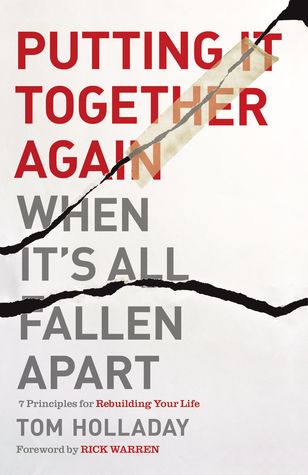 We all have times when we need to rebuild, whether it is a “church, a business, a relationship, or a purpose in your life” says Tom Holladay. He is the senior teaching pastor at Saddleback Church in Lake Forest, CA, and he uses the book of Nehemiah in the Bible as his foundation for teachings about “putting it together again when it’s all fallen apart.”
Do you, like me, need a reminder, a prod—who was Nehemiah anyway? Holladay says “Nehemiah was a government leader who rebuilt the wall of Jerusalem after it had fallen into ruin.” Actually, in the book I learned that Nehemiah also went on to reestablish the city, resettle its inhabitants, establish rules for commerce that aligned with God’s laws, and give thanks to God for completing the project which naysayers said couldn’t be done.
Holladay takes a book of the Old Testament that could be boring and makes it come alive. He analyzes the text well and applies it in a very practical way to a variety of situations from personal to business. He gives examples of how real people have used these principles successfully in their lives. I especially like that this is not a verse by verse study of Nehemiah; Holladay explains how Nehemiah worked through the problems of his building project and how we can apply the same Scriptures in our own lives.
I highly recommend this book for its interesting content and writing style and for its Scriptural insights and integrity. There are so many possible applications that I think every reader will come away enlightened and blessed in their daily walk with God.
I would like to extend my thanks to netgalley.com and to Zondervan for giving me the opportunity to read this book in exchange for an honest review.
Rating: 5/5
Category: Christian
Notes: This book ends with a Small Group Study Guide and references 10 minute videos available on YouTube to accompany each chapter.
Publication: February 6, 2018–Zondervan
Memorable Lines: (Just way too many—a sign of a book with a lot of wisdom—so I’ll just pull out a few of the first ones I highlighted.)
Gossipers love to destroy what others are building. It gives them a twisted sense of power.
Victory comes from your relationship with God. Nehemiah exemplifies dependence on God at every point in the battle: he talks to God in prayer, follows God in the changes, listens to God in his encouragement, and lives by means of God’s priorities through God’s Word.
Rebuilders must have thick skin because they’re going to face attack. That attack may come from an individual, but it can also come from within. One of the names for Satan in the Bible is “the accuser” (Revelation 12:10). He loves to ridicule your faith. So he’ll send a thought when you want to renew your faith, a relationship, a ministry, or a dream.
 education pathways