Home » Posts tagged 'socialism'
Tag Archives: socialism
The Last Battle–the end
The Last Battle
by C.S. Lewis
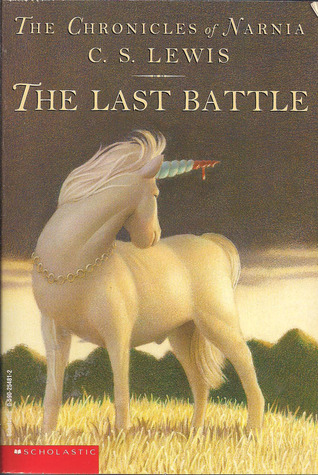
The final installment of The Chronicles of Narnia is as interesting, exciting, and thought provoking as the other six books. I read the last part slowly, eager to know what would happen next but not wanting to arrive at the end of the magnificent tale by C.S. Lewis, the consummate storyteller.
There are many important and timely themes including freedom vs. socialism, manipulation, deception, power and control, sacrifice, good vs. evil, and seeking God. Lewis brings together the characters and elements of all the books into a grand and surprising, but satisfying finale.
There are new characters added to the series. Shift is an ape who keeps Puzzle the donkey controlled by undermining his self-confidence. Old characters are present too as King Tirian calls out to Aslan the lion for help and “the seven friends of Narnia” from our world are whooshed into Narnia where they prepare to do battle against Shift, the Calormenes led by Rishda, and Tash the Calormene god. Shift devises elaborate schemes to deceive the Narnians and convince them that Puzzle, dressed in a lion’s skin and only appearing in the dark, is Aslan. This false Aslan through Shift’s directives is a cruel ruler, unlike the real Aslan. He enslaves the Dwarfs and Talking Horses making them work to accrue wealth for himself. Shift and Rishda convince the Narnian Talking Animals that Tash and Aslan are the same god and that they should now worship “Tashlan.”
Speaking further of the plot would disclose too many events that readers will surely want to discover on their own. The Last Battle is an adventure story replete with easy to understand symbolism and ageless themes. Quoting the last paragraph of the book would be the ultimate spoiler, but don’t fly to it first when you read the book. When you reach the ending, having experienced adventures alongside the characters and learned more of the attributes of the real Aslan, you will smile and savor the thoughts in that last beautifully composed paragraph.
Rating: 5/5
Category: Fiction, Christian
Notes: 1. #7 in The Chronicles of Narnia series. This is the final book in the series and should be read last.
2. This series is often listed as Children’s Fiction, but is really appropriate for all ages with adults reading it on a different level from children. It is perfect for a read-aloud.
3. I can’t believe I had never read the full series. If you are in a similar position, I urge you to delve into this treasure of a series. You will not regret it.
Publication: Original copyright is 1956. My copy was printed by Scholastic in 1995.
Memorable Lines:
“I was with him in his last hour and he gave me this message to your Majesty: to remember that all worlds draw to an end and that noble death is a treasure which no one is too poor to buy.” “So,” said the King, after a long silence “Narnia is no more.”
And then she understood the devilish cunning of the enemies’ plan. By mixing a little truth with it they had made their lie far stronger.
“They will not let us help them. They have chosen cunning instead of belief. Their prison is only in their own minds, yet they are in that prison; and so afraid of being taken in that they cannot be taken out.”
1984–is 2021 moving us into this future?
1984
by George Orwell
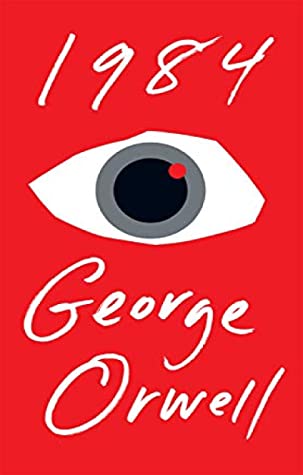
When I finished the first chapter of 1984, which introduces the very intrusive society of Oceania dominated by Big Brother and the Party, I was disquieted by what was happening in that society and the easy comparison to current events in the U.S. and around the world in 2020-2021. I knew I would return to the book, but immersed in the intensity of the total lack of personal freedom in this totalitarian regime, I allowed myself a few hours respite. I was only reading about it; what if I had to live it? George Orwell had my complete attention within the well-crafted words of the first few pages.
Winston Smith works in the Records Department at the Ministry of Truth where he rewrites the past to align it with current events. This process involves multiple revisions over time with all documentary evidence of a different previous reality immediately destroyed. He has a shabby existence—never enough food, a cold, dingy apartment, and most importantly the monitoring of every movement, facial expression, and utterance 24/7 by Big Brother through a telescreen. Even Big Brother’s eyes on giant posters seem to follow him. In this society, sex is allowed occasionally, but only for the sole purpose of procreation. Children belong to groups called “Spies;” and as they mature, they advance to the “Youth League.” Both organizations encourage their members to denounce their parents and other adults to the Thought Police for crimes of unorthodoxy. Party members engage in Two Minutes Hate daily to keep their loathing at a high level and focused on the internal threat, The Enemy of the People, and on the external threat, whatever group of countries is supposedly currently at war with Oceania.
Winston internally rebels, and 1984 charts the expression of his rebellion as well as the consequences. His parents were disappeared when he was ten or eleven. Using doublethink to convince the population that what is, isn’t and Newspeak to provide a minimal language in which it is impossible to express certain ideas, Big Brother (the Party) gains control of minds subtly, but effectively. We are, sadly, seeing a version of that today with censorship and mind control by main stream media as they tell us what to think and say and try to shame those who disagree. It is echoed in our educational system that stresses rote learning, eliminates creativity, and insists on social, political, and religious “correctness.” We are in a season that calls us to read or reread 1984 before this work of fiction becomes reality and is banned.
Rating: 5/5
Category: Fiction
Notes: 1. In the Signet Classic version, there is an afterword by Erich Fromm, a psychoanalyst who moved from Nazi Germany to the U.S. in 1934. This essay is about several books, including 1984 that warn us of the future unless we change our direction.
2. I strongly recommend reading Orwell’s Animal Farm first (and especially for younger readers) as an introduction to the ideas found in both books. As an allegory, Animal Farm is more gentle and less descriptive of the violence that is part of the control of the populace.
3. A reader’s guide is available at penguinrandomhouse.com
Publication: Originally it was published in 1949. I read one of the many reprints. My copy is a Signet Classic published January 1, 1961 by Penguin Random House.
Memorable Lines:
And if all others accepted the lie which the Party imposed—if all records told the same tale—then the lie passed into history and became truth. “Who controls the past,” ran the Party slogan, “controls the future: who controls the present controls the past.”
Doublethink means the power of holding two contradictory beliefs in one’s mind simultaneously, and accepting both of them…The process has to be conscious, or it would not be carried out with sufficient precision, but it also has to be unconscious or it would bring with it a feeling of falsity and hence of guilt…Even in using the word doublethink it is necessary to exercise doublethink.
…no change of doctrine or in political alignment can ever be admitted…And if the facts say otherwise, then the facts must be altered.
Animal Farm–still relevant
Animal Farm
by George Orwell

In reaction to Stalin’s efforts to gain control in the Spanish Civil War in 1937, George Orwell, a writer who fought in that war and witnessed the purges, created what he called “a fairy tale.” Russell Baker, author of the afterword in the Signet Classics edition of Animal Farm said that Orwell “thought too many decent people in the Western democracies had succumbed to a dangerously romantic view of the Russian revolution that blinded them to Soviet reality.” Clearly, Orwell, a self-proclaimed socialist, abhorred the totalitarian state which could emerge from socialism.
The allegory Animal Farm was first published in 1945 after pro-Soviet sentiment died down. It was immediately popular in England and America. It has a timeless theme which Téa Obreht, originally from Yugoslavia, shares in her introduction: “no society is inherently safe from these horrors.” Sometime in the new century, when engaging in retirement downsizing, I donated my copy of Animal Farm remembering it as an important work, but convinced that it is not relevant in our freedom loving United States of America. Recently, concerned about the direction toward total control being gradually imposed in my country, I bought a new copy of Animal Farm.
This short work of fiction tells the story of the animals on Mr. Jones’ farm. They don’t have it too bad. They have just enough to eat and a place to sleep, but they resent Mr. and Mrs. Jones and their farmhouse. The animals are convinced by Major, a prize boar, to fight for their freedom and transform their home into a socialistic farm where no one would be their master, they wouldn’t have to work as hard, and food would be in abundance. They are successful initially in working toward their dream, but things change very gradually as two competing pigs take over after the death of Major. Some of the problems at Animal Farm are born of natural disasters; others are the result of greedy and power-hungry pigs with their security guard dogs.
The animals continue to work hard and grumble little, but life gets worse for all but the pigs and dogs. Eventually the animals no longer remember what the seven commandments that structure their society are or recognize the changes that occur in them. Most can not read them anyway. They also don’t remember what things were really like in the past. They are easily convinced by the leader’s assistant, who with rapid-fire delivery spouts off “facts and figures,” thus proving that their lives are much better than they used to be.
Most of the characters are animals, of course. My favorite is the donkey, Benjamin, who has seen it all, but rarely talks. He just goes along knowing he will probably outlive whatever the latest notion is. Boxer is a very strong horse who has two personal mottos: “I will work harder.” and “Napoleon [the victorious pig leader] is always right.” The other animals find Boxer very inspiring. The animals are divided into committees. Interestingly, there is a Re-education Committee which the cat, who is rarely around at work time, joins. There is a large contingent of sheep who can be counted on to respond to everything with a loud chanting of “Four legs good, two legs bad.”
If you have not read Animal Farm, I encourage you to do so. It truly is reflective of what is occurring within the U.S. society including the political class and those who serve them. Although this was written with Stalin in mind, I was able to discern similarities to people, groups, and events in 2020-2021 and ponder the twenty or so build-up years leading to the changes we’re currently experiencing. Animal Farm is relevant today, and sadly will remain relevant as long as there is a greedy, power-hungry class and a populace that can be duped by false “facts,” persuasive rhetoric, and romantic notions of a utopian society.
Rating: 5/5
Category: Fiction
Notes: Political Allegory
Publication: Originally published in 1948. I read the Signet Classics edition published in June 2020 by Penguin Random House.
Memorable Lines:
He repeated a number of times, “Tactics, comrades, tactics!” skipping round and whisking his tail with a merry laugh. The animals were not certain what the word meant, but Squealer spoke so persuasively, and the three dogs who happened to be with him growled so threateningly, that they accepted his explanation without further questions.
Truth to tell, Jones and all he stood for had almost faded out of their memories. They knew that life nowadays was harsh and bare, that they were often hungry and often cold, and that they were usually working when they were not asleep. But doubtless it had been worse in the old days. They were glad to believe so.
But once Benjamin consented to break his rule, and he read out to her what was written on the wall. There was nothing there now except a single Commandment. It ran:
ALL ANIMALS ARE EQUAL
BUT SOME ANIMALS ARE MORE EQUAL THAN OTHERS
 education pathways