
Home » Posts tagged 'social workers'
Tag Archives: social workers
The Forgotten Names—forever a timely reminder
The Forgotten Names
by Mario Escobar
translated by Gretchen Abernathy
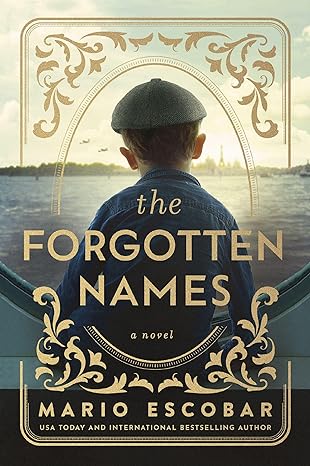
Many historical novels focus on one particular character and develop a story around that character. If it is a dual timeline, then the focus is on one character in each timeline. Escobar’s The Forgotten Names does, in the current timeline, focus on a nonfictional French historian and law student, Valérie Portheret. She spent 25 years identifying at least 90 of the 108 children whose identities were deliberately and necessarily abandoned in the rescue attempt from the Vénissieux internment camp near Lyon. Had their brave parents not signed release forms giving up their parental rights, the children would certainly have been killed by the Nazis who issued mandates for the number of Jews to be “processed.” The Vichy government was theoretically in control of France, but the reality was that they answered to the Nazis who disregarded both the legalities and moralities of the French.
A diverse coalition of Catholics, Protestants, and Jews, including social workers and Resistance organizations, found a loophole in the law. Orphaned minors could obtain an exemption from the roundup that sent the occupants of Vénissieux to their deaths. Escobar tells of the harrowing days and nights spent getting parents to agree, separating the children from their parents, arranging for new homes, transporting them to Lyon, and keeping them until the new parents arrived. All very secretive and all very dangerous for everyone involved in any way.
Escobar is a historian, but he also knows how to tell a story. The chapters are short, encouraging the reader to jump from the end of one into the beginning of the next chapter. The escape story of 1942 is framed by the research story which begins in 1992 when it was still difficult to find a sympathetic advisor. Sadly, the research was hampered by continuing anti-Semitism, rising fascism, and a reluctance to open up wounds of the past. Portheret persisted in locating the children for twenty-five years. The novel is personalized with the backgrounds and experiences of various children and families as imagined by Escobar. In this way, a sad part of history is brought to life with the goal of societies not repeating the horrific tragedies so many suffered through. Portheret originally planned her thesis to examine the life of the infamous Klaus Barbie, known as “the Butcher of Lyon.” As she began her work, however, she found herself drawn to the plan to “exterminate innocent children” and preferred to focus on the victims rather than the barbaric individuals who perpetrated the crimes.
There are so many books about World War II and the Nazis, but this is a new take on the crimes committed in that war. As hard as it is to read about the suffering of innocents whose only crime is to be Jewish, I am glad I read this book. Some of the Christian characters connect various events to Christian theology such as the birth of Jesus who was a Jew, God given Christian/human morality “which imposes duties and recognizes rights,” and the “demands of charity [love] made by Christ to be the distinctive mark of his disciples.” Above all is the emphasis that the human heart rebels against the cruel and painful measures enacted on Jews and certain groups of foreigners.
I received a complimentary copy of this book in exchange for an honest review. Opinions expressed in this review are completely my own.
Rating: 5/5
Category: Historical Fiction, Multicultural
Notes: The book contains references and something I always look for in historical fiction—a discussion of what is real and what is fictional. What follows is a World War II timeline beginning with the invasion of Poland by Germany in 1939 and continuing through the surrender of Nazi Germany to the Allies in 1945. The book concludes with Discussion Questions, information about the author who is Spanish and the translator.
Publication: June 11, 2024—Harper Muse
Memorable Lines:
“Have you noticed how the executioners often end up as celebrities? There are books and books about them. But so few write about their victims. The victims are mere numbers, faceless statistics, figures on the yellowed pages of history.”
The land of Mozart, Goethe, and Immanuel Kant had become a nation of barbarians, of heartless warriors whose driving desire was to control the human race and conquer the world.
“But now everybody—at least in the West—knows that it’s wrong to sacrifice humans. Maybe war will teach us a lesson we can’t learn any other way: the lesson that killing one another for our ideas, beliefs, or flags is absurd, because we all belong to the only human race there is, and we’re all brothers and sister of one another.”
 education pathways