Home » Posts tagged 'refugees'
Tag Archives: refugees
The Swiss Nurse–refugees from war
The Swiss Nurse
by Mario Escobar

I am so glad that I had read other books by Mario Escobar, because this work of historical fiction started off roughly for me. I feel sure the fault was my own. I am shamefully unfamiliar with the Spanish Civil War, and I started the book too late in the evening. I persevered the next day, however, and was quickly immersed in a tale of evil hearts and the strength of some good people who worked to help others in dire circumstances.
When Franco and his troops were successful in this war, they were determined to obliterate the Republicans fighting for their freedom and anyone associated with them. The result was a massive exodus of refugees into southern France which was not prepared for the influx and did not welcome them with open arms. The “camps” they provided were sandy beaches with no structures. There was little food and no potable water; the refugees were not allowed outside the camp.
This book is about the refugees in that war which was followed up by the events of World War II and the further torment of innocents by the French Vichy government which was a puppet government of the Nazis, and then by the Nazis themselves. Much of the story describes the horrible conditions of the refugee camps and the strength and boldness of Elisabeth Eidenbenz, a Swiss woman whose focus was orphans in Spain until she was forced relocate to southern France where she opened a hospital taking in pregnant women and giving them a safe place to deliver their babies. The other main character is Isabel, a Spanish lady who married Peter, an American who fought with the Spanish for their liberation. Their lives intersect when Isabel gives birth to her precious daughter Lisa at the Elne Maternity Hospital. With Peter held in various prisons and concentration camps and conscripted into the army for manual labor, Isabel stays to help in the maternity hospital.
The author pulls the reader into the horrible conditions and the faith and courage of characters who stand up for what is right. As a reader, you want everything to turn out great for the sympathetic characters. This is, however, a work of historical fiction, so not everyone has a happy ending. It is important to read works like this so that we are not duped yet again by politicians who promise good things and deliver nothing, creating untenable situations. History like this must not be allowed to repeat itself.
I received a complimentary copy of this book in exchange for an honest review. Opinions expressed in this review are completely my own.
Rating: 5/5
Category: Historical Fiction, Multicultural, Fiction
Notes: Additional material includes: References, Clarifications from History, Timeline, Discussion Questions, and Information about the Author and the Translator
Publication: April 14, 2023—Harper Muse
Memorable Lines:
Gazing off into the distance, their gaunt faces reflected the weary sadness of their souls. Their cheeks were sunken with hunger, and their skin was pallid from exhaustion and malnourishment.
An entire generation had been killed for naught: anonymous heroes on both sides, idealists attracted by the siren songs of their leaders who stayed safe in the rear guard. The only hope was to erase those painful years from their lives and try to start over from scratch.
Argelès-sur-Mer had been both refuge and jail. It had stamped out of us the hope of recovering our lives one day. We were now flea-infested riffraff with bones aching from damp nights spent on hard sand with thin blankets. The starry sky had been our prison roof.
“Sometimes we have to feel our way in the dark in order to find the path, but beyond the fog the sky is still blue, and the sun is still shining.”
Everything Sad is Untrue–memories are culture carriers
Everything Sad is Untrue
by Daniel Nayeri
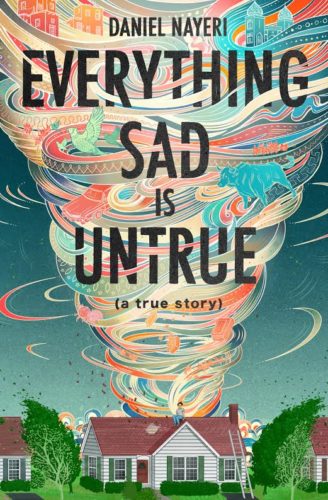
Daniel Nayeri’s Everything Sad is Untrue is part memoir and part storytelling where he fills in the things he doesn’t remember exactly from his childhood. The first part of the book is a mixture of three kinds of stories—myth, legend, and history—that attempt to place the reader in Daniel’s past and his ancestry as it happened and as he imagined it might have happened. He relates “story” in this way to help the reader understand the very different Persian culture he started his life in and which formed his beliefs and attitudes.
Although there are no chapters in this book, the reader can clearly tell when the story pivots from providing background to relating the events from the time his mother became a Christian on a visit to the West. She embraced Jesus and her faith in Him wholeheartedly. Christianity in Iran is a capital offense, so she had to take her children and flee. She traded a comfortable life as a respected physician married to a successful dentist for the life of an impoverished refugee, looked down on because of her language, menial job, and poverty. But she had Jesus, and no one could take that away from her.
Some of the book tells about the year they spent in a refugee camp in Italy. It was not actually a camp with tents, but a concrete building with small rooms and a bathroom. The residents were refugees from many countries, all waiting for the U.N. to find a place that would accept them. They had nothing and there was no access to books, media or recreation. It was made even harder by the refugees’ inability to converse with each other and by impatient workers who processed each refugee’s mound of paperwork.
A lot of Daniel’s story tells what life was like for him as a child in Edmond, Oklahoma, where they eventually settled. He experienced bullying, but came up with tricks for avoiding the worst of it. There was culture shock around every corner as he tried to fit into a very different mindset. Fortunately, he had an outstanding teacher in Mrs. Miller who encouraged him without babying him. The librarian in Edmond was kind too, and so Daniel spent many Saturdays there devouring books. His mom ended up in the emergency room several times thanks to his stepfather Ray, a black belt. Despite lots of difficult times, Daniel never seems to plead for sympathy from the reader and always points to his mother as the strongest person he knows.
Everything Sad is Untrue is a book I recommend. It is a challenging read as the author’s life is presented through the eyes of a child, but with some of the understanding of an adult. Memories are an important theme of this book as Daniel says, “Memories are always partly untrue.” and “A patchwork story is the shame of a refugee.” This is a book ripe with principles and beliefs worth pondering and a story and characters who will remain in the reader’s thoughts long after the last page is turned.
Rating: 5/5
Category: Autobiographical novel/fictionalized memoir
Notes: 1. This is a hard book to categorize which may, in part, be a critical factor in making it a very good book.
2. It has been rated for children 12+ on Amazon. Some readers refer to it as a Young Adult book. To me, it is probably more appropriate for adults. Some of the fascination with “poop,” however, in Daniel’s childhood classroom would attract the attention of middle school boys.
3. This book has won many awards.
4. I thought not having chapters would be a negative for me, but it does fit the style of Everything Sad is Untrue.
Publication: 2020—Levine Querido
Memorable Lines:
Memories are tricky things. They can fade or fester. You have to seal them up tight like pickles and keep out impurities like how hurt you feel when you open them. Or they’ll ferment and poison your brain.
And here is the part that gets hard to believe: Sima, my mom, read about him and became a Christian too. Not just a regular one, who keeps it in their pocket. She fell in love. She wanted everybody to have what she had, to be free, to realize that in other religions you have rules and codes and obligations to follow to earn good things, but all you had to do with Jesus was believe he was the one who died for you. And she believed.
Imagine you’re in a refugee camp and you know it’ll be a tough year. But for the person who thinks, “At the end of this year, I’m going somewhere to be free, a place without secret police, free to believe whatever I want and teach my children.” And you believe it’ll be hard, but eventually, you’ll build a whole new life….But if you’re thinking every place is the same, and there will always be people who abuse you, and about how poor you’ll be at first, the sadness overtakes you….But what you believe about the future will change how you live in the present.
What They Meant for Evil: How a Lost Girl of Sudan Found Healing, Peace, and Purpose in the Midst of Suffering
What They Meant for Evil: How a Lost Girl of Sudan Found Healing, Peace, and Purpose in the Midst of Suffering
by Rebecca Deng with Ginger Kolbaba
 We hear reports on the news of massacres of innocents in various countries around the globe and stories of displaced men, women, and children who become refugees and try to survive in crowded refugee camps. Those stories are usually sound bites, quickly discarded for the next big story. Rebecca Deng, a survivor of the horrific Bor Massacre of 1991 in Sudan, gives us the perspective of a six year old girl in What They Meant for Evil. We see her confusion as she flees with family walking through the wilds. She becomes an orphan as those she loves most are killed and grows up in a refugee camp. The UN provides a small amount of maize, without seasoning, to sustain the population. The bathroom is an open area on the other side of a dry riverbed with nothing to provide privacy. I had always imagined a refugee camp as a temporary facility, but Rebecca lived in Kakuma Refugee Camp in northern Kenya for eight years before she benefited from a special program that relocated her to the U.S. and placed her with an adoptive family. Many of her Sudanese relatives remained in the camp long after that.
In the latter part of the book, we learn of Rebecca’s life as an adult and her spiritual growth as she comes to terms with her identity and the trauma of her past. She uses her education, her experiences, and her faith in God to help other refugees recover as she sees God’s plan unfold to bring good out of what others intended for evil.
I would like to extend my thanks to netgalley.com and to Faith Words for giving me the opportunity to read this book in exchange for an honest review.
Rating: 4/5
Category: Christian, Memoir, Nonfiction
Publication: September 8, 2020—Faith Words
Memorable Lines:
That was what the war did to the tens of thousands of innocent children who lost everything—it took their childhood, their innocence, their families, their homes, even their lives.
More crowds meant less food for everybody. And less food meant more violence. Crime seemed to be everywhere. People began bullying other people, stealing their food, and beating and raping them. These things were unheard of for my people before coming here. My language doesn’t even have a word for rape.
…I had learned that God doesn’t always keep us from experiencing trauma, but his unseen presence is with us, strengthening us.
But there’s another aspect of forgiveness that we too often forget or neglect, and that is forgiving ourselves. If we want true forgiveness, we must forgive ourselves for the ways in which we have failed ourselves. We do more damage to ourselves when we believe the lies others have said about us and the lies the enemy whispers into our minds—the lies that tell us we are no good, we are worthless, we can never experience true freedom or true love.
Too Many Crooks Spoil the Plot–great plot and characters
Too Many Crooks Spoil the Plot
by Sarah Osborne
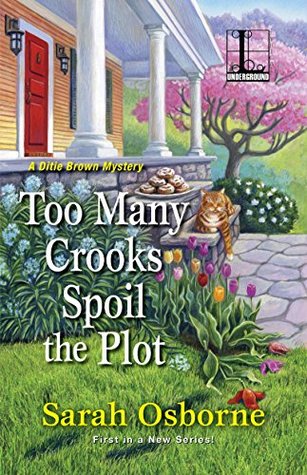 Too Many Crooks Spoil the Plot begins with “Nothing warned me that my world was about to tilt on its axis and never tilt back again,” a sentence full of promise for a good cozy mystery. Author Sarah Osborne manages to pack a lot of background into her opening chapter. We are introduced to the main character, Dr. Ditie Brown, a pediatrician who works in a refugee clinic, her two pets, and her brother Tommy. There are hints of family troubles. Ditie reunites with her old friend Ellie whose emotions bounce all over the place. She asks a huge favor: “Do you think the kids could stay with you for a few days?” Unfortunately someone was gunning for Ellie—literally.
The plot is quite complex with lots of threads that seemingly don’t connect…until they do. Meanwhile, who are the good guys and who are the bad guys? What do Ellie’s children have that is worth killing for? Through all of this we watch Ditie, her friend Lurleen (with an interesting faux French background and accent), Detective Garrett, P.I. Dan, and Garrett’s mother, a retired cop, work diligently to solve the mystery and keep the children, Lucie and Jason, safe.
I see in Lucie a level of responsibility that a former student of mine had. In my student’s case, the mother was an alcoholic and my first grader got herself and her kindergarten brother ready for school and on the bus each day. Therefore, I find realism in Lucie, a fictional child whose mother is erratic; Lucie has to step in and be the “adult” for her brother.
Initially I felt that the two romances in the books happen way too quickly. On the other hand, extreme circumstances can cause extreme emotional reactions. I quickly got over my hesitation with that aspect of the story and enjoyed watching the two couples grow in their relationships as the story progresses.
This book is a winner. I’m looking forward to the next cozy mystery in this series.
I would like to extend my thanks to netgalley.com and to Lyrical Underground (Kensington Press) for giving me the opportunity to read this book in exchange for an honest review.
Rating: 5/5
Category: Mystery
Notes: #1 in the Ditie Brown Mystery Series
Publication: May 29, 2018—Lyrical Underground (Kensington Press)
Memorable Lines:
It’s not every dog that can smile, but when you find one who does, you know you have a treasure.
He could hide behind the lights, the glitter, so that no one, least of all his sister, ever knew who he really was.
I felt uneasy. The murders felt so neatly solved. It was just the murderers that didn’t quite fit.
 education pathways