Home » Posts tagged 'Rangers'
Tag Archives: Rangers
Roberts Ridge: A Story of Courage and Sacrifice on Takur Ghar Mountain, Afghanistan
Roberts Ridge
by Malcolm MacPherson
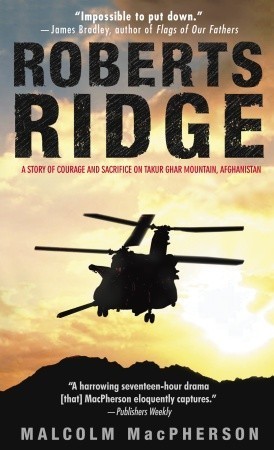
War stories are not part of my regular reading choices. In fact, this may be the first battle account I have ever read. Sure, I have read about various wars, but those narratives tend toward general descriptions and the impact of conflict on citizens. Roberts Ridge, however, describes in detail seventeen hours of hostilities involving multiple branches of the military, with SEALS, Rangers, and other special forces struggling at 10,240 feet to take a strategic position. Intel had not advised the warriors that Takur Ghar was already occupied by the enemy. Al-Qaeda had two established and camouflaged bunkers with equipment and food.
Communication problems and technology issues compounded the difficulties, highlighting in retrospect the need for backup skills and equipment like “map-reading,…, basic rifle marksmanship, and fire and maneuver.” Sometimes, orders were delayed or conflicting. Frustration occurred when the commanders did not seem to understand what the men on the ground were seeing and needed. The author gives his personal analysis in the Afterword: “The fog and friction of war will continue to be ubiquitous. One must understand that fog, friction, and chance dictate limitations. To survive on future battlefields, U.S. military commanders should understand war for what it is—a complex and unpredictable endeavor that requires warriors, educated and prepared to encounter uncertainty. Such warriors must understand not only the capabilities of the latest technologies, but also their limitations.”
Roberts Ridge did not set out to “bash” anyone. MacPherson, although not helped in his research by official military sources, persisted in telling a story he felt needed to be told. He made some contacts who connected him with others who could provide first-hand information. He conducted a lot of interviews and extended his research to books and articles. He follows his account of events with an Executive Summary, a ten page version of the events at Takur Ghar provided by the Department of Defense.
Roberts Ridge is a page turner, but between the tension the soldiers experienced and the emotional impact of soldiers dying, watching their friends die, and enduring pain for hours on end, I sometimes needed a break. I was frustrated along with the leaders on site when they were not given all the information they needed to make good decisions in what turned out to be a very complicated assault and rescue situation.
The inclusion of maps and photos was a great help, but even more photos would have been better. As a non-military reader, I did not know most of the military acronyms that were used frequently in the book. Some were explained; others were not. With the Internet’s help, I got most of them defined. A glossary of these terms would have been very helpful for quick reference. Similarly, there were a lot of people involved in this mission. Although they were generally well-introduced, a listing of these individuals with a brief descriptor and grouping by the part of the mission they participated in would be beneficial for the reader. There is a handy index.
Although outside my usual genre, Roberts Ridge is a book I am glad I read. It not only told about a battle and some heroes I needed to know about, but it broadened my understanding of the Afghan war.
Rating: 5/5
Category: Nonfiction, War
Notes: As this is a nonfiction account of tough, courageous men engaged in life-threatening conflict, expect swearing.
Publication: 2005—Dell
Memorable Lines:
The guy out in the snow could be anybody, Mack was thinking. Friendly Afghans roamed these mountains, some of them allies of the coalition forces. Christ, they lived here; this was their patch. Neither Mack nor anybody else knew at any given time exactly where to expect them to appear. And whether they were enemy or friendly, they all looked the same.
For special operators…leaving a teammate in the lurch and not returning was far more serious than breaking any social vow, in a fundamental, even atavistic way, because it entailed death, and the dead man easily could be you. Returning for a lost brother required no thought, no decision. It was an ingrained reaction, not an idea.
The Rangers’ movement up the hill was a physically demanding 2-hour effort under heavy mortar fire and in thin mountain air. They climbed the 45-70 degree slope, most of it covered in three feet of snow, weighted down by their weapons, body armor and equipment.

