
Home » Posts tagged 'railroad'
Tag Archives: railroad
Doc Susie: The True Story of a Country Physician in the Colorado Rockies
Doc Susie
By Virginia Cornell
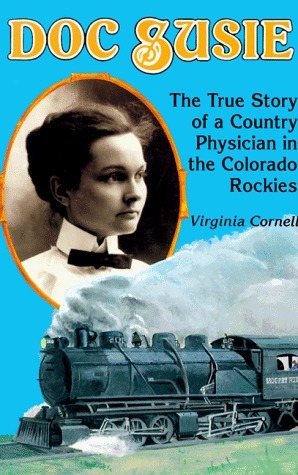
Life was hard, very hard, for the residents of Fraser, Colorado, according to Virginia Cornell’s biography of Doc Susie. Most of the year was extremely cold, and some peoples’ bodies never adjusted to the high altitude. Men were employed in low paying, dangerous lumber jobs or in higher paying, but even more dangerous work, digging out and constructing a tunnel to make faster passage west out of Denver on Moffat Road and across the Continental Divide. When finished, it replaced a treacherous railway route that connected Tolland to Fraser. Lives were lost through accidents and illnesses resulting from bad working conditions. The owners of the railroad and tunnel project were anxious to achieve success along with accompanying fame, prestige, and money, without regard for the people who did all the hard work and took the risks.
Doctors were needed in Fraser, but few wanted to stay long. Doc Susie moved there in 1907 as a cure for her own tuberculosis and to escape an unhappy home life. A petite lady, she had graduated from the University of Michigan. Despite being a woman doctor, she gradually earned the respect of the residents. She made a lot of “house calls,” often to the scene of an accident—deep woods or remote, snowy roads. Frequently, she answered pleas for help for sick patients in isolated areas of Grand County. When she arrived, she examined the patient and took charge, giving orders to the family members. She had a “no drug, no alcohol” policy which meant some painful treatments, but she did use ether for surgery. Going to the patient’s home gave Doc Susie the opportunity to teach the families, by word and by example, the importance of cleanliness so that a wound would not become infected or a disease spread. This spunky lady was not afraid to stand up to railroad bosses or any other man who challenged her personally or professionally.
Doc Susie would have enjoyed being a wife and mother, but those roles never worked out as possibilities for her. This book gives a good picture of what life was like in the Rockies during the first half of the 1900’s for both men and women. The information in the book is well-researched. The author brings Doc Susie’s tale to life in a well-written narrative style. She also includes reproductions of many period photos, including some of Doc Susie. The courageous Doc Susie and her friends are historical figures that I cared about as I envisioned their place in the development of Colorado and of the United States.
Rating: 5/5
Category: Biography, Nonfiction
Publication: 1991—Manifest Publications
Memorable Lines:
Doc Susie looked into a sea of sincere blue eyes. She knew these men, knew their word was as good as money in the First National Bank in Denver, knew that trying to change their minds—well, some said it would have been easier for the Captain to turn the Titanic around before it hit the iceberg than to change a Swede’s mind. If these men said they were going to move a building, you might as well stand back because you might get hurt if you stood in the way.
Mountain life was so harsh; a woman’s waking hours had to be spent keeping the family fed, warm and clean. The same drudgeries awaited them week after week: boil the clothes on Monday and hang them on the line to be showered by cinders raining from the sky each time a train passed, iron on Tuesday, bake on Wednesday, mend on Thursday, split kindling, split kindling, split kindling. The only recognitions these drudges got for their efforts was to be yelled at if things didn’t get done.
Sometimes it seemed there were handsome, strong, beautiful men behind every tree. Unfortunately, the pastoral illusion vanished the moment these he-mountains opened their mouths. After an evening of trying to make conversation with some muscle-brain she found herself yearning for the stimulation of a good book. Sometimes she found herself attracted to raw masculinity; usually the man in question vanished from the scene very quickly, intimidated by her authoritative ways and superior education.
A Choice Considered–building a railroad
A Choice Considered
by Tracie Peterson
Narrated by Jeanine Bartel

This work of historical fiction, set in the Wyoming Territory in 1868, as the railroad prepares to move further west, has strong Christian themes. The main characters try to make their choices and actions according to Christian principles. The female protagonist is Melody Doyle, a very sweet young lady devoted to her “Da.” Sadly, her father has never been the same since a railroad accident, but he insists he will move on with the railroad when the time comes. Melody doesn’t want to be separated from her dad but is tired of living in a tent and moving constantly. If she stays in Cheyenne, she could get a job and still see her father frequently through short trips.
Charlie is from a banking family, and his father sends him to Cheyenne to supervise the bank that his brother Jacob opened there. Jacob returned east due to illness leaving the bank in the hands of Jefferson who seems to resent Charlie’s arrival, especially when Charlie begins to examine the bank’s books. Charlie has a heart for education and wants to start a school. However, he does not want to disappoint his very strict father who has high banking expectations for him.
Da agrees to Melody’s staying in Cheyenne if she gets married before he leaves. Known for his gift of discernment, her father will interview and let appropriate young men take Melody on a date.
Charlie doesn’t sign up for this process because he wants the woman he marries to be his friend first.
A Choice Considered follows Melody, Charlie, and Da through the decisions they have to make in their lives, from their spiritual growth through their relationships, and in their professional lives. They all have supportive friends who pray with and for them in their journeys. The interactions of the characters are the basis for the plot and there are good events that will make the reader smile, but there is also a backdrop of impending tragedy.
The narrator of this audiobook, Jeanine Bartel, does a good job with all the voices but especially with the men. During the first part of the book, I found her voice for Melody to be a little too saccharine sweet. I think she was trying to show what a sweet person Melody is. As we moved into the story, I got used to the voice and found it more suiting to the character than I had thought.
Rating: 4/5
Category: Historical Fiction, Christian
Notes: #2 in the Heart of Cheyenne series. I had read the first and third books in the series. While I enjoyed all three books, I would have been happier reading them in sequence. Out of order, I found myself a little confused; and the third book, of necessity, had some spoilers for the second book.
Publication: July 2, 2024—Bethany House
A Love Discovered–Wild West
A Love Discovered
by Tracie Peterson

When Marybeth Kruger’s father dies in a wagon accident, he leaves Marybeth and her two year old stepsister without money. Marybeth is the only “mother” little Carrie has ever known and she refuses to part with her. She is offered a way out of her situation by Edward Vogel, her friend and the husband of her deceased friend Janey.
Cheyenne is a booming town in the Dakota Territory. Edward receives a job offer as a lawman there, but the preference is for a family man. Marybeth and Edward agree to a marriage of convenience. They will not be intimate as he feels responsible for the death of Janey during childbirth. Neither anticipates the feelings that blossom as they struggle together to adapt to life in Cheyenne.
Marybeth is a tough young lady, and if anyone can survive the cold and windy winters of Cheyenne in a tiny tent, she has the fortitude to do it. Any sacrifices are worth it to keep Carrie, a precious little girl who soon calls Edward “Papa.” He loves Carrie right back and is continually concerned about the dangers of the railroad town that is truly the wild west where murders are a frequent event and justice is meted out by vigilantes when it is clear that a hanging offense has occurred.
The historical aspects of life shortly after the Civil War as the country looks westward through railroad expansion are fascinating, but the real focus of the story is Marybeth and Edward’s relationship. Edward has to come to grips with his trust issues with God before he can move ahead with Marybeth. There were a few times that progress in the book seemed slow and the relationship issues repetitive, but I liked the characters especially little Carrie. Tracie Peterson is a prolific writer and was recommended to me by a friend as a good author of Christian historical fiction. I will return to read more of her books to evaluate her works more thoroughly.
I received a complimentary copy of this book in exchange for an honest review. Opinions expressed in this review are completely my own.
Rating: 4/5
Category: Historical Fiction, Christian, Romance
Notes: #1 in The Heart of Cheyenne series
Publication: March 5, 2024—Bethany House
Memorable Lines:
“Ah, ya’ve a wee daughter. A greater blessin’ can’t be had. Oh, a son is a fine thing, but a daughter is somethin’ special.” The man’s eyes seemed to twinkle in the the dim light.
I remember my parents sayin’ that folks need a Savior, but they also need a friend.” He smiled. “Pa also said we need to be careful and not try to be both.”
“Sometimes we do a thing out of obligation, and in time, we learn to take joy in it.”

