
Home » Posts tagged 'race'
Tag Archives: race
Hans Brinker, or The Silver Skates–historical look at Holland
Hans Brinker, or The Silver Skates
by Mary Mapes Dodge
illustrated by Edna Cooke
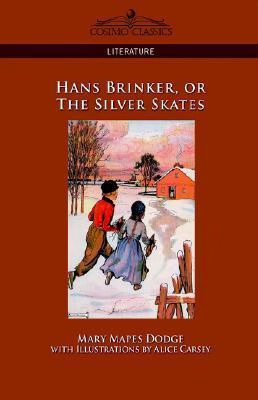
This children’s novel depicts life in Holland in the early 19th century and according to the author “aims to combine the instructive features of a book of travels with the interest of a domestic tale.” Dodge has done of lot of research so much of the book focuses on Dutch history and customs. Although Hans Brinker is the protagonist, he is not even a character in a large part of the book that describes a skating trip a small group of boys undertake traveling on frozen canals and rivers to various cities.
Hans and his family live in deep poverty because the father Raff had a work accident ten years prior that affected his brain. His wife also can not work because she has to stay home to look after her unpredictable husband. Hans and his sister Gretel are not always treated well because of their social standing. The author states that the circumstances of Raff’s situation were true.
Hans and Gretel have only inefficient wooden skates that Hans carved for them, but both are good skaters. Surprisingly, not much of the story deals with the race for silver skates. Hans is an honorable young man as is shown many times in the story.
The fictional part of Hans Brinker is interesting, even exciting, but the historical portions are less interesting. The boys visit museums on their trip and the history bounces from one item to another just as it would if you were visiting a museum. There are a lot of events referenced that students today do not have the historical background for (e.g. Prince William of Orange who freed Holland from Spain and became King of England). For further personal education on Dutch history or if working with homeschool students, Hans Brinker or the Silver Skates could be a valuable resource. Unless I were teaching a unit on Holland in a classroom, I doubt I would read this to or with Middle Grade students. I found the Preface to be a valuable introduction to what was to follow. I also liked the satisfying Conclusion which shared what happened to the characters as life moved on for them.
Rating: 4/5
Category: Children’s fiction, Historical fiction
Notes: 1. Intended for children 8-12 years old
2. I found this to be a slow read, but there were others in my book club who found the historical references very interesting.
Publication: 1865—George W. Jacobs & Co.
I obtained my copy from Gutenberg Press.
Memorable Lines:
“…the father and I saved and saved that we might have something laid by. ‘Little and often soon fills the pouch.’ ”
“We cannot say what we might have become under other circumstances. We have been bolstered up from evil, since the hour we were born. A happy home and good parents might have made that man a fine fellow instead of what he is. God grant that the law may cure and not crush him!”
Ten years dropped from a man’s life are no small loss; ten years of manhood, of household happiness and care; ten years of honest labor, of conscious enjoyment of sunshine and outdoor beauty, ten years of grateful life—One day looking forward to all this; the next, waking to find them passed, and a blank. What wonder the scalding tears dropped one by one upon your cheek!
Before We Were Yours–stealing and selling children
Before We Were Yours
by Lisa Wingate
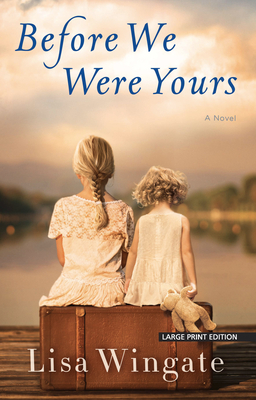
This tale is based on actual events at the Memphis Tennessee Children’s Home Society in 1939 where Georgia Tann collected babies and sold them to adoptive parents. Sometimes she had police round them up from the streets. Other times she scammed unsuspecting parents when the groggy mothers of newborns were asked to sign papers which in fact turned the babies over to the state.
In this story, Rill (later renamed May), is 12 years old and given responsibility for her siblings when her mother has to go to the hospital for a difficult delivery. Scary men show up to their shanty boat telling the children lies and forcing them to go to the children’s home where as “swamp rats” they were treated despicably.
This is a dual timeline book, and the protagonist in the present time is Avery, a lawyer from the prominent Stafford political family in South Carolina. She is being groomed to take over her father’s political office if he succumbs to cancer.
In a chance meeting, May takes Avery’s bracelet, a dragonfly bracelet that is a family heirloom given to Avery by her Grandma Judy. In recovering the jewelry, Avery discovers a mysterious connection. Despite Judy’s gradually succumbing to Alzheimer’s, Avery pursues the relationship between the two women.
Before We Were Yours reveals a very sad series of events in U.S. history. Georgia Tann was a ruthless woman who took advantage of poor families during the Depression as well as families hurting from childlessness. The book is complex but Lisa Wingate tells the story with compassion. She researched her topic well and created a fictional tale that is substantiated by reported events and melds the facts into a compelling story.
Rating: 5/5
Category: Historical Fiction
Notes: Random House has an online book club kit that has resources that any reader would find beneficial, whether reading the book individually or with a group.
Publication: 2017—Ballentine
Memorable Lines:
She stops short of repeating the woman’s naughty words. Camellia’s eaten enough soap to clean up the inside of a whale in her ten years. She’s practically been raised on it. It’s a wonder bubbles don’t pour out her ears.
There’s no denying that Magnolia Manor is more upscale than the nursing home May Crandall lives in, but both places face the same underlying challenge—how to provide dignity, care, and comfort as life turns difficult corners.
“A woman’s past need not predict her future. She can dance to new music if she chooses. Her own music. To hear the tune, she must only stop talking. To herself, I mean. We’re always trying to persuade ourselves of things.”
Pride–love in the ‘hood
Pride: A Pride and Prejudice Remix
by Ibi Zoboi

In a fun retelling of Jane Austen’s Pride and Prejudice, similar themes of class differences and the prejudices that accompany them are the focus of Ibi Zoboi’s Pride. The characters are of Haitian-Dominican background and the setting is the “hood” of Bushwick in Brooklyn.
Life changes dramatically for the Benitez sisters when the rundown property across the street is renovated by the upper class Darcy family. Ainsley Darcy, who attends Cornell, is attracted to Janae Benitez, a student at Syracuse. His younger brother Darius is treated harshly and with suspicion by our narrator who is also the protagonist, Zuri Benitez, age 17. The Darcy’s clearly don’t fit into the hood, but when Zuri goes out of Bushwick, she finds that she doesn’t fit in easily there.
This young adult novel explores the barriers put up intentionally and often unwittingly by the community and by individuals. It seems that Bushwick will be forced to change, but where does that leave its residents? If you are not from that community, dear reader, you will find yourself immersed in an unfamiliar culture with new words and customs. I found myself liking the characters and the warmness of their world although it is outwardly a much tougher one than the home community in which I was cocooned. This book exposes the assumptions it is all too easy to make when we are confronted with dissonance. Reading it will expand your horizons and make you dive deeply into your soul to consider how you view those whose life circumstances are different from your own.
Rating: 4/5
Category: Young Adult, Romance, Fiction
Notes: Contains a fair amount of cursing as appropriate to the street language of the community
Publication: 2018—Balzer and Bray (HarperCollins)
Memorable Lines:
Every book is a different hood, a different country, a different world. Reading is how I visit places and people and ideas. And when something rings true or if I still have a question, I outline it with a bright yellow highlighter so that it’s lit up in my mind, like a lightbulb or a torch leading the way to somewhere new.
If Janae is the sticky sweetness keeping us sisters together, then I’m the hard candy shell, the protector. If anyone wants to get to the Benitez sisters, they’ll have to crack open my heart first.
I’d look back at them with defiance and a little pride; a look that says that I love my family and we may be messy and loud, but we’re all together and we love each other.
Seabiscuit–racehorse with a heart
Seabiscuit: An American Legend
by Laura Hillenbrand
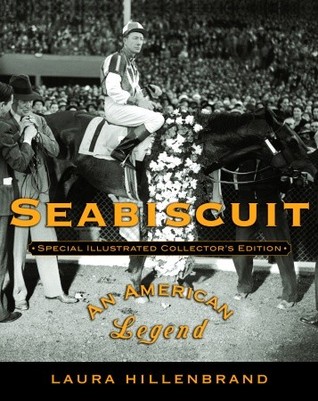
Seabiscuit is the story of an incredible racehorse who took the nation by storm at a time when people needed something positive. He lacked perfect conformation. It seemed like he never got a lucky break when it came to weather or rulings about the amount of extra weight added to his saddle for the races. What he had, however, was strength, speed, competitiveness, and the ability to give all that was asked of him. He also had a supportive team that never gave up on him.
Laura Hillenbrand had been writing about horses and racing in periodicals for years. In Seabiscuit she took that writing to a whole new level, researching, interviewing, delving into archives and corroborating the facts. Then she worked her magic as an outstanding writer to organize the information and make it come alive in word pictures that capture the reader’s heart and imagination.
Hillenbrand doesn’t just help the reader understand and come to love Seabiscuit as his fans did. She takes us into the life of Red Pollard, the jockey who knew Seabiscuit and his ways best. She introduces us to owner Charles Howard and trainer Tom Smith who were as unlikely to be part of his success story as Seabiscuit himself. We are treated to mini-biographies of those around Seabiscuit and the general nature of racing and betting in the 1930’s.
As a complete novice in the world of horse racing, I had to labor a little initially to follow the details, but I soon caught on and began chasing the powerful horse across the pages of this well written book. Hillenbrand’s words are chosen with care and create images in the mind and stir emotions in the heart making this a truly unforgettable piece of nonfiction.
Rating: 5/5
Category: Nonfiction, History
Notes: I purchased the Special Illustrated Collector’s Edition which contains more photographs than the original publication. I highly recommend this edition.
Publication: 2003—Random House
Memorable Lines:
Red Pollard and George Woolf had signed on to a life that used men up. But for all its miseries, there was an unmistakable allure to the jockey’s craft, one that both found irresistible….When a horse and a jockey flew over the track together, there were moments in which the man’s mind wedded itself to the animal’s body to form something greater than the sum of both parts….At the bottom of the Depression, when wrenching need narrowed the parameters of experience as never before, the liberation offered by the racehorse was, to young men like Pollard and Woolf, a siren song.
Seabiscuit seemed a cumbersome giant in comparison. At 1,040 pounds, he outweighed War Admiral by 80 pounds, with six feet of girth and a markedly wider chest. But the big body was perched on legs a full two inches shorter. His neck was thick, his head heavy, his tail stubby, his boxing-glove knees crouched….the mane plaits didn’t lie right and stuck out like quills. the horse stood straddle-legged, as if perpetually bracing himself against a strong wind.
A mournful hush fell over the barn, broken only by the long, low moans of a saddle pony who missed his absent stable companion. All evening long, the deep sad sound drifted out from the shed rows.
Gilead–coherent ramblings
Gilead
by Marilynne Robinson
 I do most of my reading and reviewing as a solitary occupation until I publish my thoughts on a book. I was glad to have read Gilead by Marilynne Robinson as a part of a book club where we could all bounce our reflections on the book off the mirrors of the impressions of others. The member of our group who suggested this book had read it several times. When I first began the book, I could not imagine enduring more than one reading. I have never liked stream-of-consciousness as a style of writing, and this book is a good example. John Ames, a Congregationalist minister, puts pen to paper to share his final thoughts with his young son, the things he would have told him as he grew, were their age difference not so pronounced. Having finished the book, I reread the first page to gather my thoughts and was amazed at what a perfect beginning it holds, carefully crafted and full of promise.
Although I still don’t favor the stream-of-consciousness style, I appreciate how appropriate it is to this epistolary novel with its many themes. The setting is the Midwestern town of Gilead that was once part of the underground railroad. Racial issues keep popping up at the most unexpected times in this book. Much of the story deals with relationships across generations. Without strict attention, it can be difficult to sort out which generation is being referenced. There are many ministers in the family line, but father and son bonds can be troublesome as the characters struggle to answer for themselves what is required to have a good life. Another level of complication is added in the thread of John’s namesake, Jack, the son of his best friend Robert who is also a pastor. There are undertones of the Biblical story of the “Prodigal Son” in some of those difficult associations. John, who never says anything bad about anyone, will leave behind a loving wife with a mysterious past, a much loved son, and boxes and boxes of sermons. How will he be remembered?
Gilead is not an easy or quick read. Be prepared to reread passages, especially those with theological depth. Some I just had to walk away from; others benefited from group discussion. I plodded through the first half of disparate pieces; I was fascinated with the second half as those pieces came together to form a beautiful design. At some point I probably will reread Gilead after I stand apart a bit and allow the characters of Gilead to become a comfortable part of my vision of “the good life.”
Rating: 4/5
Category: Historical Fiction, Christian
Notes: 1. 2005 Pulitzer Prize for Fiction
2. There are three other books that involve many of the same characters, but Gilead was written first.
Publication: November 15, 2004—Picador
Memorable Lines:
A little too much anger, too often or at the wrong time, can destroy more than you would ever image.
When you encounter another person, when you have dealings with anyone at all, it is as if a question is being put to you. So you must think, What is the Lord asking of me in this moment, in this situation?
I have decided the two choices open to me are (1) to torment myself or (2) to trust the Lord. There is no earthly solution to the problems that confront me. But I can add to my problems, as I believe I have done, by dwelling on them.
 education pathways