Home » Posts tagged 'prisoners'
Tag Archives: prisoners
When We Were Young and Brave–kindness in the midst of despair
When We Were Young and Brave
by Hazel Gaynor
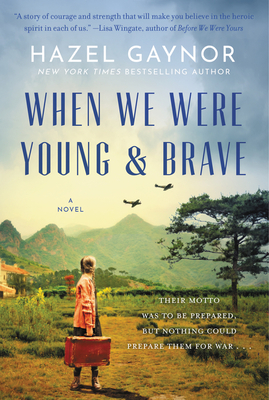
During our current tumultuous times, When We Were Young and Brave was somewhat of a difficult read for me, but I’m glad it is now a part of my personal reading journey. Hazel Gaynor’s latest book relates a fictional version of the events following Japan’s bombing of Pearl Harbor as they play out for the students and teachers at the China Inland Mission School in Chefoo, China. With Japan’s invasion of China, the Japanese seize and occupy the school, later interning the residents in the much larger prison camp known as the Weihsien Civilian Assembly Center where sanitation facilities are disgusting and meals are meager, nutritionally inadequate for growing children, and almost inedible. Despite the harsh conditions, the teachers protect the children as best they can while rallying them with insistence on routines, cleanliness, and a hearty “chin up” attitude. Of particular note is the role of their Girl Guide troop and standards that help the students in maintaining a positive outlook.
The last sections of the book, “Liberation” and “Remembrance,” are remarkable in the beauty of the skillful writing that describes the impact of the American liberation on the camp residents. They gain relief from the fears that haunted them daily, but endure the substitution of new anxieties and questions for the future. Where will they go and what will they do? Is anyone waiting for them at home?
The story is told by alternating narrators. Elspeth is a competent, well-organized, and kind teacher who has a special motherly feeling for Nancy, the daughter of missionaries in China. Their relationship is always teacher and student, but as months of internment become years, Elspeth takes on increasingly more of the commitment for safe care that she made to Nancy’s mother as they departed by boat to sail to the school, both as first-timers. We view their ordeals from both Elspeth’s and Nancy’s points of view.
There are a lot of themes in the book including resilience, relationships, releasing the past, and looking to the future. Symbolism is also important in the kingfisher that becomes the emblem of the new Girl Guide patrol and the sunflower which holds a special meaning for teacher and students.
The characters emerge as three dimensional figures as they are well developed. Realism comes into play with descriptions of the harsh conditions; no one’s story is fairytale like or even positive. The setting is well-executed with vivid word pictures. As the Chinese workers slosh through the camp, the odor of the filth of “honey-pot” buckets they pull from the latrines makes an unforgettable olfactory experience. There are also more pleasant descriptions of the beauty outside the camp, but glimpses are rare for those interned. The last two sections make the book a winner for me, but the first sections are also well written and essential to the success of this historical novel.
Rating: 5/5
Category: Historical Fiction
Notes: There is a very informative section at the end of the book that describes the author’s research and thought processes and some historical background. The author has also included a brief history of the Girl Guides as that organization plays an important role in the girls’ lives. Other additions are a list of books and websites for further reading, including original source documents found at weihsien-paintings.org, and some questions for discussion.
Publication: October 6, 2020—Harper Collins
Memorable Lines:
When she was cross, Miss Kent spoke in a way that reminded me of brittle twigs snapping underfoot on autumn walks. I felt my cheeks go red. Without giving me a ticking-off, she’d done exactly that.
I knew the smile she gave us that morning was the sort of “we must be brave” smile adults use when they’re trying to pretend something awful isn’t happening.
But, as I’d come to realize about life during a war, nothing stayed the same for long. Just when you thought you’d adjusted and adapted and found a way to cope, the situation changed.
The Escape Artists: A Band of Daredevil Pilots and the Greatest Prison Break of the Great War
The Escape Artists
by Neal Bascomb
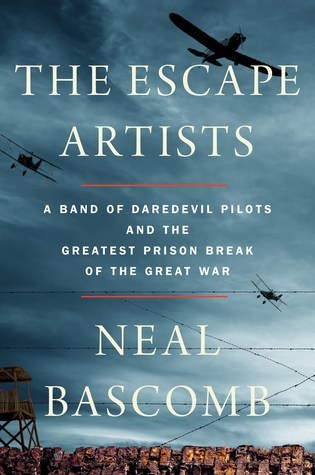 War is such a horrible thing—vicious, destructive, and despicable. It brings out the worst and the best in man. We see both in Neal Bascomb’s true recounting of the largest escape of WWI by the British at one time—twenty-nine officers of whom ten actually made it out of Germany to Holland without being recaptured.
Bascomb’s well-researched tale The Escape Artists is divided into four major sections. In the first, “Capture,” he provides a glimpse into the personalities and lives of some of the major players in the escape, their role in the military, and the circumstances of their capture.
The second section, “All Roads Lead to Hellminden,” describes a number of interment camps but focuses especially on notorious twin commandants, Karl and Heinrich Niemeyer. Both prisoners and commandants could be transferred at whim in Germany and being transferred could be positive or negative for a prisoner. This section details life in the camp and shows a better situation for officers than that experienced by enlisted soldiers who were put in labor camps. Officers, instilled with the patriotic drive to do whatever they could to hinder the enemy and return home to fight again, spent a lot of their energy devising and executing escape plans. If their attempts were unsuccessful or they were recaptured, the punishment was generally a long and uncomfortable time in a small isolation cell—dark, very hot or very cold, dirty, overrun with vermin, and little food. This trial on the body, mind, and spirit might last several days, weeks or months. Nevertheless, instead of deterring escape attempts, it prodded the officers into yet more clever tries.
“The Tunnel” describes the huge group effort spearheaded by an officer named Gray to construct a very long tunnel and plan how to proceed once outside the walls of Holzminden. All of the background material in the first two sections was essential, but at this point the story really takes off and you will want to keep reading until finished. The last section. “Breakout,” shares the actual escape attempt.
To write this book, Bascomb read a lot of books on the escape and the interment camps, interviewed descendants of the officers, and relied greatly on primary documents including memoirs and letters from the time. His narrative style is effective and the subject matter is interesting. Having read several books on labor and death camps, it was interesting to read about the British officers, drawn from all over the globe. Many of them were young pilots from exclusive schools and families. They had little training, but were very patriotic and had a honed sense of duty and honor. One surprising detail for me was that the imprisoned officers were able to write to their families and receive packages and money from them. Not everything went smoothly in that process, but they were better off than those in labor camps. They even had orderlies from the enlisted ranks of prisoners to make their beds, etc. This was not a luxury situation by any means, and the men were quite bored and frustrated whiling away time when they felt they should be fighting.
Neal Bascomb is a former journalist who turned to writing nonfiction books full-time in 2000. He is the award winning author of nine books for adults and three for young adults.
I would like to extend my thanks to netgalley.com and to Houghton Mifflin Harcourt for giving me the opportunity to read this book in exchange for an honest review.
Rating: 5/5
Category: History
Publication: September 18, 2018—Houghton Mifflin Harcourt
Memorable Lines:
The greatest resistance of all would be to escape.
None of the diplomats gathered in The Hague in 1899 or 1907 could have anticipated the vast populations of prisoners that would come out of industrialized total war—nor the challenges this would involve. In the first six months of World War I, 1.3 million soldiers became POWs across Europe.
The arrival in December of Harold Medlicott had bolstered the mood throughout the camp. The officers believed that if anybody could escape Holzminden and humiliate Karl Niemeyer, it was Medlicott. A legend even to the German guards, he had broken out of nine camps already, never using the same method twice.
Harvey might not get another chance to escape, but in aiding Cartwright, as in countless other efforts to help his fellow prisoners, he found freedom within. In his own way, he was a breakout artist.
Auschwitz Lullaby–a mother’s amazing love
Auschwitz Lullaby
by Mario Escobar
 Auschwitz Lullaby is a sad book based on the life of Helene Hannemann, a German woman married to a talented Gypsy violinist. As an Aryan she could have saved her own life, but she chooses instead to accompany her five mixed-blood Gypsy children to Auschwitz. There she is chosen by the infamous Doctor Mengele to establish and run a nursery school at the concentration camp. Knowing that Mengele would only perform this “kindness” to the children for his own ends, she agrees anyway to provide the starving children with more nutritious food, several hours a day in a cleaner, healthier environment, and some mental respite from the stressful deprivations and horrors of the camp.
Without graphic descriptions, the author Mario Escobar uses a first person format, having Helene tell her own story through a journal which she supposedly left behind in the camp. Her writing is encased in a Prologue and Epilogue in Mengele’s voice. As I read this work of historical fiction, I wondered how much was true. I was gratified to discover a section called “Historical Clarifications” at the conclusion of the tale that explains clearly the aspects of the book that are nonfiction. The author is a historian so he also adds a “Chronology of the Gypsy Camp at Auschwitz” and acknowledgements of his sources of research.
Although the publisher categorizes the book as “historical fiction” and “Christian,” there are not a lot of overt references to Christianity, but there is an underlying thread of faith, hope,and love available through the power of God. The school holds a meager Christmas celebration which attempts to “give these children back a little bit of their faith.” Helene notes “that night we were celebrating life, the birth of the Christ child” and she ponders the message of the manger: “Glory to God in the highest, and on earth peace, goodwill towards men.” There are other Christian themes throughout of love, forgiving one’s enemies, God’s plan for Helene’s life, and the existence of evil.
I received a complimentary copy of this book from Thomas Nelson through NetGalley. Opinions expressed in this review are completely my own.
Rating: 5/5
Category: Historical Fiction, Christian
Publication: August 7, 2018 — Thomas Nelson
Memorable Lines:
“From the first time I saw you, I knew God had brought you here to ease our pain somehow. You were so lost, confused, and scared, but I could see a fierce determination in the back of your eyes.”
Death seemed like a gift from heaven, but I knew that it was not yet for me. I was an old ship in the middle of a storm, and my children anchored me to life. I had to keep fighting for them, trying to hold on to hope, looking each day in the face, praying for this nightmare to finally be over.
“God sent you here to guide us. We needed a breath of hope, and you showed up with your beautiful family. I’ve never known anyone as brave and determined as you.”
I tried to fill my heart with love. I did not want hatred to eat away my insides. I had to love even my enemies. It was the only way to keep from becoming a monster myself.
 education pathways