
Home » Posts tagged 'poverty'
Tag Archives: poverty
The Four Winds–Historical Fiction about The Great Depression and the Dust Bowl
The Four Winds
By Kristin Hannah
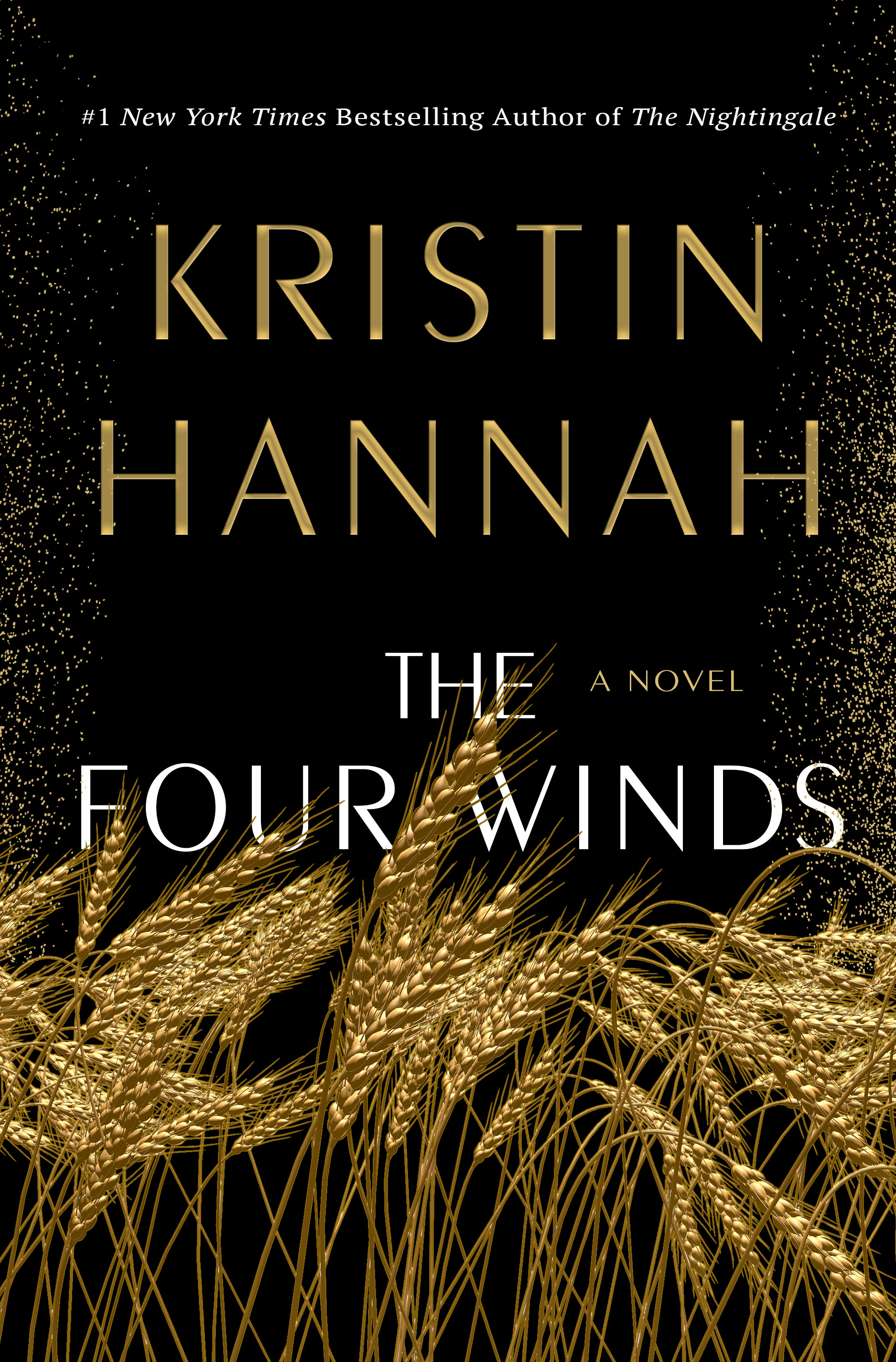
From prosperity to devastating poverty, The Four Winds takes the reader on a journey across time and across the United States. Since childhood, Elsa has been told she is unattractive, physically weakened by an illness, and ineligible for marriage. Her brief search for adventure and love in her small town leads her to Italian immigrants Tony and Rose and their son Rafe. The Martinellis take Elsa under their wing, connect her to the land, and love her as their own.
The Great Depression rips away the hopes and dreams of the generations who endured the struggle, but Tony and Rose are strong and refuse to give up their land. Then come years and years of drought and dust storms. The government says the farmers are to blame and provides minimal help. Millions of citizens leave Texas and surrounding states to find what is billed as a “land of milk and honey” where they will surely find work so they can support their families. Instead they find difficult work on large farms if they are lucky. They live in filthy conditions on subsistence wages or less. Each day they have to walk miles both ways from muddy tent cities to the fields where there is no guarantee of a job. Those seeking work are maligned by the residents who view them as dirty and lazy. If they manage to get on at a farm that supplies housing, a few toilets, and some running water and electricity, they soon discover that they are paid with credit at the expensive company store. There is a fee for everything, even obtaining pay in cash. When they dig deeper, the workers find that the whole setup, including where they live and when they work is completely set up to satisfy the greed of the owner. A worker is always indebted to the company.
Communists, at physical danger to themselves, work to organize the farm workers to strike for better working conditions. It is an uphill battle because the workers have safety concerns if they protest in addition to the possibility of losing their opportunity for work—such as it is. California is not the “Promised Land” after all.
Elsa is not just the main character of The Four Winds: she is the heroine. She is a strong, strong woman living out a difficult life with perseverance and determination. Come what may, she would do her best for her children whether eking out survival in a formerly rich land where cattle died with bellies full of sand or traveling across the desert in an unreliable vehicle praying that there was enough water and gas to get the family to their destination. She proves to be a good friend to others in need. She compromises when necessary for the sake of her children, but she reaches a limit where she stands up to greedy business people who deserve to be shamed.
The Four Winds exposes a sad part of our history showing a period in time that was devastating to people. Through no fault of their own they found themselves unable to care for their families. Many were proud and refused government aid. Some of that help from the government was commendable putting men to work in respectable jobs, but some was too little, too late and unreliable in execution. The people of California were depicted as mean-spirited and unwilling to help those who needed help. They looked down on the laborers with contempt. The one exception that stood out for me was an understanding librarian who checked out books to Elsa’s daughter and then gave Elsa a library card which Elsa presented to her daughter as her Christmas gift. It was treasured.
This work of historical fiction concludes nicely, but there is not a happy ending for everyone. The book is more realistic than that. Overall it is well written and kept me wanting to read more. It is a sad book, however. It has to be—it is about sad times.
Rating: 5/5
Category: Historical Fiction
Publication: March 14, 2023—St. Martin’s Griffin
Memorable Lines:
“Believe me, Elsa, this little girl will love you as no one ever has…and make you crazy and try your soul. Often all at the same time.” In Rose’s dark, tear-brightened eyes. Elsa saw a perfect reflection of her own emotions and a soul-deep understanding of this bond—motherhood—shared by women for millennia.
“Girls like that, unkind girls who think it’s funny to laugh at another’s misfortune, are nothing. Specks on fleas on a dog’s butt.”
Once, Elsa would have said, God will provide, and she would have believed it, but her faith had hit the same hard times that had struck the country. Now, the only help women had was each other. “I’ll be here for you,” Elsa said, then added, “Maybe that’s how God provides. He put me in your path and you in mine.”
Winter hit the San Joaquin Valley hard, a frightening combination of bad weather and no work. Day after day, rain fell from steel-wool-colored skies, fat drops clattering on the automobiles and tin-can shacks and tents clustered along the ditch bank. Puddles of mud formed and wandered, became trenches. Brown splatter marks discolored everything.
Poverty was a soul-crushing thing. A cave that tightened around you, its pinprick of light closing a little more at the end of each desperate, unchanged day.
The Boys in the Boat: Nine Americans and Their Epic Quest for Gold at the 1936 Berlin Olympics
The Boys in the Boat
by Daniel James Brown
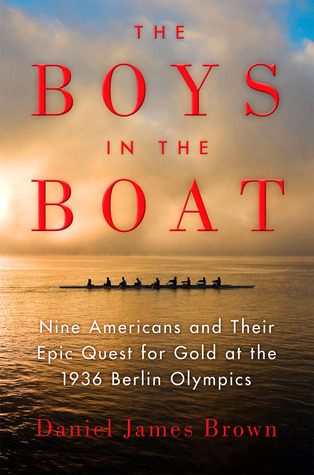
Are you a big sports fan? Do you love rowing competitions? Do you know what makes a good coxswain? If your answers, like mine, are “no,” I guarantee that you will love The Boys in the Boat anyway!
Daniel James Brown is a masterful writer. His research is the backbone of the story, but that is just the beginning. He focuses his story of nine young Americans and their coaches on one amazing young man, Joe Rantz. In the process of rolling out this tale, Brown gives the reader a deep look at Joe, who despite terrible odds survived desperate times and the abandonment of his family. With sacrifices and persistence, he struggled through the Depression to earn his way through college and a place on the University of Washington eight-oar crew.
Holding down several jobs and living in tiny, dank quarters, Joe was bullied by his teammates for always wearing the one ragged sweater he owned and for being perpetually hungry. Despite World Wars, the collapse of Wall Street, the Great Depression, flooding, the Dust Bowl, and record unemployment, there were still students who were of a “privileged” class. Many students in the West were from tougher, more humble circumstances, but few of Joe’s teammates had backgrounds comparable to Joe’s. The rowers in the East generally went to elite schools and reflected British roots in their rowing.
Although the book focuses on Joe, partly because of Joe’s unique story and partly because the author was able to interview Joe himself and Joe’s daughter, Brown also includes the backgrounds and activities of each of the other boys in the boat.
The descriptions of the qualifying race in Poughkeepsie and the Olympic competition in Berlin will immerse you in the races to the point of feeling like you are there. There are so many factors that play important roles in rowing. The coaches are key in bringing the boys along, eliminating those who do not have extreme desire and persistence. They have to motivate them to work as a team, teach them how to row, and strategize which students will work best in each position on the boat.
Each chapter starts with a philosophical rowing quote by boat builder George Yeoman Pocock. He hailed from a line of boat builders and prided himself on the quality of his boats. He also had a talent for both seeing how a rower could improve and effectively sharing that with the young man.
Leading into the Olympic competition is fascinating information about Hitler’s motivations with the Olympics and what he did to achieve world-wide acclaim. His public relations efforts portraying Nazis as accepting and culturally sensitive were quite successful internationally.
The Boys in the Boat is one of those books that will stay with me for a long time. Joe’s strength of character and physical endurance are inspirational. I am thankful that the author included an epilogue that shares what happened to each of the rowers in their adult lives. There are also a few pages that give insight into how Brown learned so much about this “epic quest.” The crew endured practices in cold and rain, in heat and rough waves. The success of the nine was well-deserved and merited recording in this outstanding book.
Rating: 5/5
Category: Nonfiction, History, Sports
Publication: 2013—Penguin
Memorable Lines:
To defeat an adversary who was your equal, maybe even your superior, it wasn’t necessarily enough just to give your all from start to finish. You had to master your opponent mentally. when the critical moment in a close race was upon you, you had to know something he did not—that down in your core you still had something in reserve, something you had not yet shown something that once revealed would make him doubt himself, make him falter just when it counted the most. Like so much in life, crew was partly about confidence, partly about knowing your own heart.
“It takes energy to get angry. It eats you up inside. I can’t waste my energy like that and expect to get ahead. When they left, it took everything I had in me just to survive. Now I have to stay focused. I’ve just gotta take care of it myself.”
The wood, Pocock murmured, taught us about survival, about overcoming difficulty, about prevailing over adversity, but it also taught us something about the underlying reason for surviving in the first place. Something about infinite beauty, about undying grace, about things larger and greater than ourselves, About the reasons we were all here. “Sure, I can make a boat,” he said, and then added quoting poet Joyce Kilmer, “ ‘But only God can make a tree.’ “
As the observation train drew back upriver again for the start of the varsity race, the atmosphere grew electric, the dusky sky crackling with static. The crowd began to buzz. Boat whistles shrilled. Alumni draped arms over one another’s shoulders and sang fight songs. Somebody was about to win big; somebody was about to lose big.
A Tree Grows in Brooklyn–a no-nonsense coming of age story
A Tree Grows in Brooklyn
by Betty Smith
Sometimes publishers and reviewers have the audacity to promote a newly published book as a “classic.” In my opinion a classic is a book of excellence that has stood the test of time and is judged to be worthy of reading and rereading by future generations. First published in 1943, A Tree Grows in Brooklyn is such a book. Written by Betty Smith, it is fiction but it has its basis in Betty Smith’s own coming of age in Brooklyn.
The protagonist is Francie, a girl who grows up in difficult circumstances of poverty with an alcoholic father who is nonetheless likable. Her mother favors her younger brother over Francie knowing she will be able to succeed in spite of her background. Francie, like Betty Smith herself, from a young age is a reader and a writer. Francie’s mother, Katie, works cleaning houses and believes with all of her being that education is the route to success for her children. She insists that her children read a page from Shakespeare and the Bible each night. She evens barters piano lessons for herself and Francie, with little brother Neeley, who inherited his father’s musical aptitude, watching. Their father Johnny worked as a singing waiter when he could get employment.
There is not a plot per se in A Tree Grows in Brooklyn; it is a recounting of a family’s struggle to survive. The reader is immersed in the setting, the culture, and the characters. Despite the lack of twists, cliff hangers, climax, and denouement, this novel is a page turner of a gentle sort. Ripe with symbolism, this book is perfect for discussion and introspection. It opens the door to an era gone by and good hearted, imperfect people who want to keep their dysfunctional families intact and give their children a better life than they had. It is the fight for the American Dream set down on paper.
Rating: 5/5
Category: Classic, Literary Fiction
Publication: 1943—Harper Collins
Memorable Lines:
Mama explained: “Francie is entitled to one cup each meal like the rest. If it makes her feel better to throw it away rather than to drink it, all right. I think it’s good that people like us can waste something once in a while and get the feeling of how it would be to have lots of money and not have to worry about scrounging.”
“Who wants to die? Everything struggles to live. Look at that tree growing up there out of that grating. It gets no sun, and water only when it rains. It’s growing out of sour earth. And it’s strong because its hard struggle to live is making it strong. My children will be strong that way.”
Oh, the last time how clearly you see everything; as though a magnifying light had been turned on it. And you grieve because you hadn’t held it tighter when you had it every day.
Run, Rose, Run–country western songwriter and singer
Run, Rose, Run
by Dolly Parton and James Patterson
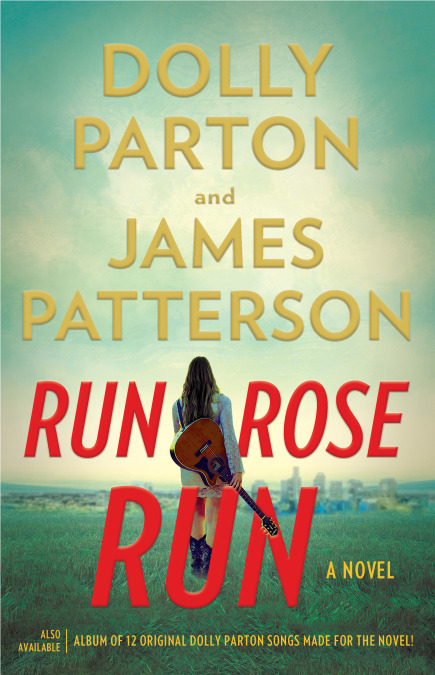
What do you get when a country music legend collaborates with the world’s best selling author? If the pair is comprised of Dolly Parton and James Patterson, then the creation is Run, Rose, Run. The two authors draw on each other’s strengths to write a fascinating thriller about a young singer-songwriter with the talent and drive to make it to the top. AnnieLee Keyes, unfortunately, has a past that haunts her present as she desperately tries to outrun some evil men. Her secrets are so painful that she can not bear to share them with anyone.
AnnieLee gradually goes from homeless to having a peek at what life could look like if she were successful in the tough music industry. She had the good fortune to meet Ethan who is also struggling financially and emotionally, but who is immediately attracted to this beautiful, talented “firecracker.” He introduces her to his famous boss Ruthanna Ryder who has retired from public singing and releasing new works, but continues to write songs and sing them in her private studio.
Run, Rose, Run moves from focusing on AnnieLee’s survival to her career development and back to survival again as she is physically attacked several times. She conceals on each occasion who is attacking her and why increasing the suspense for the reader.
Patterson brings storytelling skills and experience as an author to the book, and Parton contributes knowledge of how the music industry works. The reader gets glimpses of what success looks like, what is involved in attaining it, and how fame affects people. Quite unfamiliar with the music industry, I found myself looking up a few terms and was surprised by the difficult life endured by those at the bottom of the ladder. Without a doubt, parts of Ruthanna’s character are based on Dolly Parton’s life, especially her efforts to get books in the hands of children. Also Dolly Parton and the characters Ruthanna and AnnieLee have in common a love of song writing. I picture Ruthanna as a fictional Dolly Parton from her folksy, direct Southern expressions to her adherence to expensive clothes, full makeup, and glitzy stage costumes. Run, Rose, Run is a fun trip behind the scenes to learn how country music stars are made, told via a dramatic mystery that kept me turning pages and, at times, holding my breath.
I received a complimentary copy of this book in exchange for an honest review. Opinions expressed in this review are completely my own.
Rating: 5/5
Category: Mystery and Thriller
Notes: 1. Contains lots of swearing.
2. Dolly produced an accompanying album. You can listen to the music composed by the characters in the book if you seek it out on YouTube.
Publication: March 7, 2022—Little, Brown, & Co.
Memorable Lines:
“If time is money, my friends,” she said in conclusion, “just think of all I’ve saved you by not rambling on and on. So be generous tonight, please, and help us give books to kids who need them. Who crave them. And whose lives will be forever changed by them. Because books, my friends, are true magic bound between two covers. Thank you.”
Ethan was funny, though, and Ruthanna had quickly developed a soft spot for him, partly because he thought he was so tough. One of these days she was going to tell him that a bullet wound and a Purple Heart didn’t make him hard as nails. They made him just like everyone else. Sometimes you could see the scars and sometimes you couldn’t. But everybody had them.
But Ethan had seen AnnieLee in her kitchen, and as far as he could tell, she barely knew a colander from a cantaloupe, Left to her own devices, she’d probably survive on canned beans, Pringles, and the occasional multivitamin at best.
The Book of Lost Friends–unforgettable
The Book of Lost Friends
by Lisa Wingate
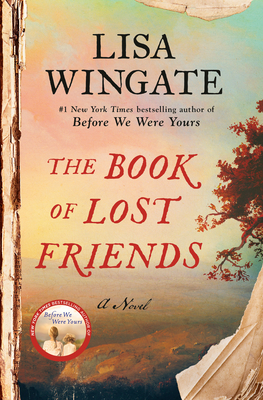
Slavery and the Civil War tore families apart—especially Black families. Some of their stories appeared in the newspaper Southwestern Christian Advocate as desperate appeals to locate or discover news of long lost family members. Pastors were encouraged to read them to their congregations, and optimism sprang up in the hearts of many former slaves as they hoped and prayed to be united many years later with family who in countless cases were only a name passed down from parent to child. I can’t imagine the pain parents suffered at having their children ripped away from them and sold often never to be heard from again. The Black slaves were people, but they were regarded as disposable property.
The Book of Lost Friends begins with the story of Hannie Gossett who misses her family desperately. Unable to read or write, she has all of their names recorded in her memory. In 1875, Hannie and Tati who raised her are close to completing a ten year period of working a piece of land that belongs to her former slave owners. Just as the contract’s transfer should be completed, the former master disappears and the contract is put in jeopardy. Hannie begins a journey with great risks to find him. A black woman traveling alone is a dangerous undertaking, and her departure could annul the very contract she is trying to locate.
This novel has a dual timeline. Every other chapter alternates to tell the story of Benny Silva, a young teacher who has a past with secrets but a heart to make a difference for her students growing up in poverty in Augustine, Louisiana, in 1987. Constantly bombarded with negative messages about their worth, these students go to a different school from those who have more prosperous parents. The school building is in bad shape, the students’ attendance and behavior are abysmal, and parent support is almost non-existent.
When Benny discovers and obtains access to a private library of books, she thinks she may have found a motivator for her students. She wins support from some local women the students respect, and the teens become excited about a school project.
As both timelines move forward, it is difficult for the reader to leave one timeline to see where the story is going in the other timeline. In a good dual timeline novel, the reader is equally interested in both timelines and in discovering where they cross or overlap. Lisa Wingate is an expert at storytelling and at weaving her tales together. There are many other fascinating characters, and The Book of Lost Friends quickly became a book I didn’t want to put down. It is so well told that I could put myself in the story imagining vividly the struggles of the former slaves and of the students captive to poverty and dysfunctional families.
Rating: 5/5
Category: Historical Fiction
Notes: 1. All of the Hannie chapters include a letter to the editor of the Lost Friends column so you can read for yourself this part of history.
2. At the author’s website, lisawingate.com there are valuable resources listed under the heading “for book clubs” that include discussion questions and pictures and information the author gathered by visiting plantations and national parks. There are also links to pertinent interviews and podcasts as well as a database that has been created based on the Lost Friends letters.
Publication: 2020—Ballantine Books (Random House)
Memorable Lines:
Few things are more life affirming than watching an idea that was fledgling and frail in its infancy, seemingly destined for birth and death in almost the same breath, stretch its lungs and curl its fingers around the threads of life, and hang on with a determination that can’t be understood, only felt.
The thing about so many of the kids here—country kids, town kids, a sad majority of these kids—is that their norm is constant drama, constant escalation. Conversations start, grow louder, get ugly, get personal. Insults fly and then lead to pushing, shoving, hair pulling, scratching, throwing punches, you name it…All too often children in Augustine grow up in a pressure cooker.
When you’re a kid in a tough family situation, you’re painfully vulnerable to trying to fill the void with peers. As much as I’m in favor of young love in theory, I’m also aware of the potential fallout. I can’t help feeling that Lil’ Ray and LaJuna need a teenage relationship about as much as I need five-inch stilettos.
I Capture the Castle–class structure in mid-20th century England
I Capture the Castle
by Dodie Smith
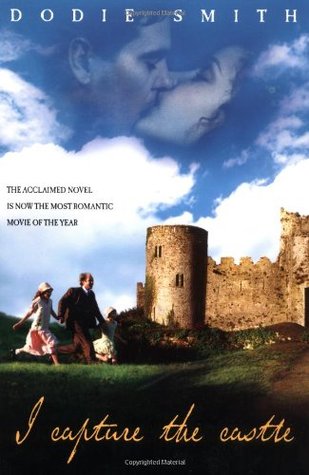
To label I Capture the Castle as a “coming of age” story is true, but the novel is so much more. It is related in her journal by Cassandra who lives in poverty under the leaky roof of a crumbling castle. Her father Mortmain is a writer with one successful book to his credit before he hit a writing desert. He secured a forty-year lease on the castle on a whim. The other residents are his son, another daughter, a boy taken in when his servant mother passed, and Topaz, the children’s stepmother. All in the family realize that the only way out of their financial straits is for at least one of the girls to marry into a rich family.
Author Dodie Smith has gifted us with a book full of nonconventional characters, a beautiful romantic background, and moral dilemmas. The plot begins with touches reminiscent of Pride and Prejudice but deviates fairly quickly. There is a similar theme of class differences, but without Austen’s use of satire. Two of the potential romantic interests grew up in America, one in the East and one in the West. Their backgrounds add another layer of social and cultural differences. Cassandra’s family is caught in the middle. They clearly had money in the past, but they have sold off most of their belongings and are reduced to very meager meals and one or two threadbare outfits per person. They have to be very creative to be acceptable in the social milieu to which they aspire.
I Capture the Castle has the depth necessary for a book to stand the test of time and appeal to a wide audience. It includes topics like women’s roles, art and sexuality, depression, literary criticism, and the laws of inheritance in Great Britain. While it addresses these issues, it remains an interesting and well-told tale with an ending that does not tie everything up neatly. Instead, it gives the reader the opportunity to speculate on the characters’ future decisions and actions which is a good way for this novel to conclude.
Rating: 5/5
Category: Romance, General Fiction
Notes: 1. There are discussion questions at the end.
2. The book has been made into a movie.
Publication: 1948—St. Martin’s Press
Memorable Lines:
I am writing this journal partly to practice my newly acquired speed-writing and partly to teach myself how to write a novel—I intend to capture all our characters and put in conversations. It ought to be good for my style to dash along without much thought, as up to now my stories have been very stiff and self-conscious.
The taxi drew up at a wonderful shop—the sort of shop I would never dare to walk through without a reason. We went in by way of the glove and stocking department, but there were things from other departments just dotted about; bottles of scent and a little glass tree with cherries on it and a piece of white branched coral on a sea-green chiffon scarf. Oh, it was an artful place—it must make people who have money want to spend it madly!
In the end, Topaz got Stephen to take the hen-house door off its hinges and make some rough trestles to put it on, and we pushed it close to the window-seat, which saved us three chairs. We used the grey brocade curtains from the hall as a table-cloth—they looked magnificent though the join showed a bit and they got in the way of our feet. All our silver and good china and glass went long ago, but the Vicar lent us his, including his silver candelabra.
Crazy Brave–memoir of the U.S. Poet Laureate
Crazy Brave
by Joy Harjo

When the Poet Laureate of the United States writes a memoir, you can expect it to deviate from the standard timeline format, and Joy Harjo’s Crazy Brave is anything but formulaic. She divides her book into four parts according to compass directions. As a Creek Indian, directions, nature, art, music, and family provide her orientation to life. Each section begins with poetic prose.
“East is the direction of beginnings.” She begins her tale this way and it is a little difficult to settle into the story as she shares her views from the eyes of a child filled with a mix of fear and adoration.
“North is the direction where the difficult teachers live.” In the second section, Harjo shares the realities of a brutal and abusive childhood in a time and culture that viewed spousal and child abuse and drunkenness as family problems to be either dealt with or endured within the family. After I read the book, I learned later through a webinar that this section was a very difficult one for Harjo to write. In fact, she got stuck for years on this part of her story with the book taking fourteen years to complete. There is redemption in her story, however, as education offers Harjo, as a teenager, a way out of her circumstances.
“West is the direction of endings.” In this section, Harjo describes her young adulthood as she becomes a teenage mother and finds herself trying to live in poverty, at odds with her mother-in-law, and responsible for a stepchild. What happened to her hopes and dreams for a creative life?
“South is the direction of release.” Probably the most poetic and visionary of the sections, “South” continues Harjo’s fight to survive but also interprets her dreams and visions as short stories and poems. She creates an interesting mix of fiction and nonfiction in her writing featuring monsters, eagles, demons, and ancestors.
Harjo describes her panic attacks as monsters. She labels the instincts that help guide her decision making as the “knowing.” She refers to her ancestors, those who have passed, as guardians in her life, and she speaks to them through her poetry. This memoir is a mix of what really occurred, her perceptions of those events, and flights of fantasy taken from her dream world; she melds poetry and prose in mind bending impressions.
Crazy Brave personalizes for me the individual and tribal struggles of Native Americans. Although the abuse tied to alcoholism is difficult to read about, it is an important part of Harjo’s experiences and of understanding the Native culture that helped shape her voice as an author and artist.
Rating: 4/5
Category: Memoir
Notes: Harjo is currently writing another memoir to continue her story where Crazy Brave left off.
Publication: July 9, 2012—W.W. Norton & Co.
Memorable Lines:
Because music is a language that lives in the spiritual realms, we can hear it, we can notate it and create it, but we cannot hold it in our hands. Music can help raise a people up or call them to gather for war.
Though I was blurred with fear, I could still hear and feel the knowing. The knowing was my rudder, a shimmer of intelligent light, unerring in the midst of this destructive, terrible, and beautiful life. It is a strand of the divine, a pathway for the ancestors and teachers who love us.
It was in the fires of creativity at the Institute of American Indian Arts that my spirit found a place to heal. I thrived with others who carried family and personal stories similar to my own. I belonged. Mine was no longer a solitary journey.
The Ministry of Ordinary Places: Waking Up to God’s Goodness Around You
The Ministry of Ordinary Places: Waking Up to God’s Goodness Around You
by Shannan Martin
 Where is a Christian’s mission field? You know, the ordinary person who has not been called to go to another country? Shannan Martin in The Ministry of Ordinary Places says it is wherever God has placed you. She doesn’t advocate passing out pamphlets, cornering people, or pushing invitations to come to church. Instead, we are to love people, listen to them, invite them into our homes, be available to them and to the opportunities to help them as God presents them to us.
As a rural introvert, Martin has had to change a lot in opening her heart, time, and home to her neighbors in a multicultural setting. She had to “choose the comfort of the past or the struggle of moving forward.” She learned that hospitality is not perfection in entertainment; it is extending invitations willy nilly, throwing together some tacos, and letting God take it from there. She has learned to receive kindness from others, understanding the cost of that kindness from someone who is down and out.
Martin’s story is engaging, and her writing style is excellent from the humorous “Go with God, good middle school bus driver. You are a rose among loud, hormonal, Hot-Cheetos-for-breakfast-eating, lanyard-flipping thorns” to sharp edged descriptions such as “She has known the desolate landscape of struggle. Hunger and wanting blow through her life like gale-force winds through a thin cotton jacket.” There is magic for the reader in words like these.
Martin does not believe in pushing Jesus down anyone’s throat; she makes her own heart accessible and invites others into her life where they not only see, but feel, the impact of Jesus on individual lives.
I would like to extend my thanks to netgalley.com and to Thomas Nelson for giving me the opportunity to read this book in exchange for an honest review.
Rating: 5/5
Category: Christian
Publication: October 9, 2018—Thomas Nelson
Memorable Lines:
Only as we engage in the hidden practice of listening do we learn about the struggles of others, gaining empathy where we one cast judgement.
It’s so easy to tip into judgment when we view the world through an us-them dichotomy. Sitting face-to-face, the problems loom larger and we have to contend with the sticky fact that there is simply always more to the story.
…we are all longing to be part of something bigger than ourselves. Sometimes we get so hung up on doing something great, we forget the best thing is often the smallest.
The Summer Nanny–relationships and their impact
The Summer Nanny
by Holly Chamberlin
 The term “women’s fiction” can connote quite a broad range of books. Thus I was unsure what to expect from The Summer Nanny by Holly Chamberlin. This story is actually two tales in one as best friends Amy and Hayley, from very different backgrounds and with very different prospects, decide to accept employment for the summer as nannies for wealthy vacationing families. Hayley is a product of a dysfunctional family with an alcoholic and abusive father. She loves academia, but rather than finish college has to work cleaning houses to support her family. Amy’s father passed away when she was a baby, but her mother, a gifted crafter of fiber arts, has raised her in a small but comfortable home in a loving atmosphere.
Amy and Hayley find personal challenges in their summer jobs. Naive Amy is hired by a narcissistic and controlling successful businesswoman who claims to want to mentor Amy. Hayley, on the other hand, finds relief from her home environment in her job as a nanny for two year old twins whose mother is teaching French at a community college as a favor to a friend. Both girls experience personal growth as a result of their jobs. Romance plays a role in this novel, but so do family connections.
The style of The Summer Nanny with its short chapters keeps the plot moving as the focus of the chapters alternates between the two main characters. The book is interesting, but some of the scenes could have been omitted without sacrificing the integrity of the plot or the points the author wants to make.
Although this book could be considered a “beach read,” it is not really fluff. The author encourages the reader to examine questions of the causes and results of two abusive situations and the responses of the characters involved in them. There are definite themes of right and wrong and the importance of choices.
I would like to extend my thanks to netgalley.com and to Kensington Books for giving me the opportunity to read this book in exchange for an honest review.
Rating: 4/5
Category: Women’s Fiction
Notes: One of the recurring characters in the book is a lesbian and a subplot concerns her relationship status, but there are no descriptions of a physical relationship.
Publication: June 26, 2018—Kensington Books
Memorable Lines:
Hayley was smart enough to know there was no possibility of completely throwing off one’s past, but there had to be ways to move into the future relatively unencumbered by traumas experienced when one was young.
Love and admiration transformed an average-looking human being into an angel of beauty. Contempt and dislike transformed an average-looking human being into a goblin.
“What with arts education funding being cut so drastically, I feel I have to do something. Kids need to learn visual thinking and creative problem solving.”
Your Dream. God’s Plan.–Are You Longing for Something More?
Your Dream. God’s Plan.
by Tiffany Smiling
with Margot Starbuck
 What were you like in fourth grade? How about when you were sixteen? Those are the ages at which Tiffany Smiling had major, life-changing medical events. She shares those stories in her book Your Dream. God’s Plan. Although these were pivotal points in Tiffany’s life, she was rescued by God to later do amazing things for His kingdom.
Your Dream. God’s Plan. is really focused on an audience of young women, but others can derive inspiration and guidance as well. She challenges young women to devote themselves to drawing close to God and then listening to the call He has for them. Her fascinating story relates miracles of how God used her and many amazing people she met to give out of their abundance and find that God always supplies enough.
Tiffany will draw you into worlds of poverty of body and spirit as she describes orphans, women rescued from sexual trafficking, extreme poverty, disease, and demons. But she also shares the many ways God answers prayers when the people of God make themselves available to be used by Him.
The book includes a section appropriate for study by groups or individuals for each chapter. There is a summarizing sentence followed by questions to help the reader personalize the content to her own life. The questions are followed by a “Dream Challenge” which focuses on how you can implement the concepts to find a closer relationship to God and thus discover His plan for your life. She finishes with a sentence or two “tip,” an additional quick take-away to help you make changes in your life to align your dream with God’s plan.
I would like to extend my thanks to netgalley.com and to Barbour Publishing for giving me the opportunity to read this book in exchange for an honest review.
Rating: 5/5
Category: Christian
Notes: I had so many “memorable lines” highlighted that I just pulled out the first 3/4 for use below. I am not a thirty-something or a new Christian, but there was still so much to ponder and so many possibilities for spiritual growth to attend to.
Publication: November 1, 2017 — Barbour Publishing
Memorable Lines:
At the moment the “good life” was just within reach, I discovered that lasting satisfaction wasn’t found where I thought it might be. In fact, as God revealed to me that scrambling after the dream I’d bought into would never satisfy, I tasted something even more fulfilling.
As you release the barren pursuit of earthly pleasures, exchanging it for the surprising way of Jesus, you will experience lasting satisfaction as you embrace what matters most.
You were made for so much more. If you are a student or a single working woman or a missionary or a full-time mommy, there is a calling over your life that involves bringing light to the dark places—in university hallways, in work cubicles, in overseas villages, and in the rooms of your home. If you are willing to release your grip on the plans you’ve been holding for your life, God is waiting to show you His plan that is even better for you and for the people He loves.
 education pathways