
Home » Posts tagged 'pain'
Tag Archives: pain
Fight Back with Joy–seeking “a life radiant with joy”
and Fight Back with Joy Bible Study
by Margaret Feinberg

Margaret Feinberg was already an author and speaker when she had the rug pulled out from under her with a cancer diagnosis. With painfully candid honesty, Feinberg shares her journey through the medical and emotional roller coaster that her life became. She and her husband Leif struggled together to find joy in a very difficult situation. They always found God to be faithful as they pursued good health for Margaret and a closer relationship to Him.
Fight Back with Joy chronicles their struggles and recounts how they found joy in the little things. At no point does she exaggerate or minimize her spiritual, physical, or emotional battles. She includes practical advice and examples of their pursuit of joy which was often difficult. Feinberg shows how the things she learned can be applied to the many struggles that her readers undergo, not just physical illness.
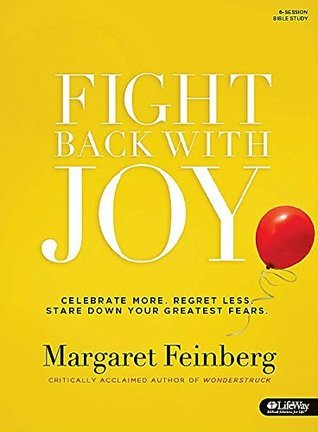
The workbook is intended to be used by groups or individuals in corporation with a video series of Margaret’s teachings on joy. I did not have the videos, but that did not hinder my use of either book. The study helps the reader to dive deeper into what the Bible has to say about the struggles of life and our response to them. The book would be valuable even without the workbook, but I certainly would not advise trying to use the workbook without the teachings in the book.
Rating: 5/5
Category: Religion, Christian Life, Personal Growth
Publication: 2015—Worthy Publishing
Memorable Lines:
When we fight back with joy, we no longer size the character of God according to our circumstances, but we size our circumstances according to the character of God and his great affection for us.
When everything goes awry, we are tempted to rush past, stuff, deny, or file the situation under “unmentionables.” We will do anything to make the chaos subside. Something inside us lunges to grieve, but we stiff-arm the impulse, forcing ourselves to keep it together.
…one of the fastest ways to receive joy is to give it away. One of the best ways to be lifted up is to lift up others.
No matter what adversity we face, we can turn our eyes from what’s before us and refocus on the God who fills us with joy. Instead of only seeing adversity, we become alert to Christ, who has overcome all things and for whom nothing is impossible.
Run, Rose, Run–country western songwriter and singer
Run, Rose, Run
by Dolly Parton and James Patterson
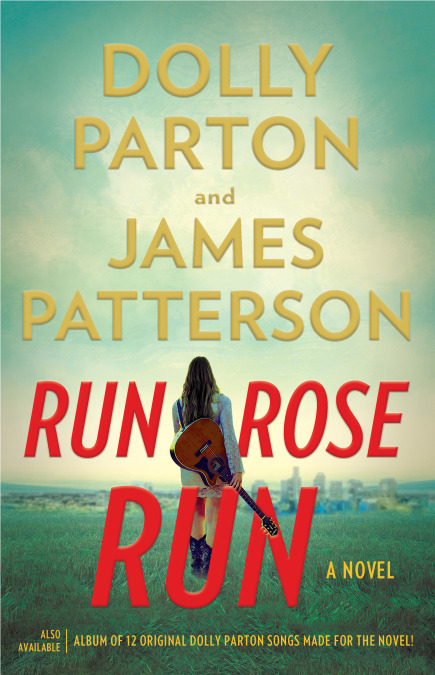
What do you get when a country music legend collaborates with the world’s best selling author? If the pair is comprised of Dolly Parton and James Patterson, then the creation is Run, Rose, Run. The two authors draw on each other’s strengths to write a fascinating thriller about a young singer-songwriter with the talent and drive to make it to the top. AnnieLee Keyes, unfortunately, has a past that haunts her present as she desperately tries to outrun some evil men. Her secrets are so painful that she can not bear to share them with anyone.
AnnieLee gradually goes from homeless to having a peek at what life could look like if she were successful in the tough music industry. She had the good fortune to meet Ethan who is also struggling financially and emotionally, but who is immediately attracted to this beautiful, talented “firecracker.” He introduces her to his famous boss Ruthanna Ryder who has retired from public singing and releasing new works, but continues to write songs and sing them in her private studio.
Run, Rose, Run moves from focusing on AnnieLee’s survival to her career development and back to survival again as she is physically attacked several times. She conceals on each occasion who is attacking her and why increasing the suspense for the reader.
Patterson brings storytelling skills and experience as an author to the book, and Parton contributes knowledge of how the music industry works. The reader gets glimpses of what success looks like, what is involved in attaining it, and how fame affects people. Quite unfamiliar with the music industry, I found myself looking up a few terms and was surprised by the difficult life endured by those at the bottom of the ladder. Without a doubt, parts of Ruthanna’s character are based on Dolly Parton’s life, especially her efforts to get books in the hands of children. Also Dolly Parton and the characters Ruthanna and AnnieLee have in common a love of song writing. I picture Ruthanna as a fictional Dolly Parton from her folksy, direct Southern expressions to her adherence to expensive clothes, full makeup, and glitzy stage costumes. Run, Rose, Run is a fun trip behind the scenes to learn how country music stars are made, told via a dramatic mystery that kept me turning pages and, at times, holding my breath.
I received a complimentary copy of this book in exchange for an honest review. Opinions expressed in this review are completely my own.
Rating: 5/5
Category: Mystery and Thriller
Notes: 1. Contains lots of swearing.
2. Dolly produced an accompanying album. You can listen to the music composed by the characters in the book if you seek it out on YouTube.
Publication: March 7, 2022—Little, Brown, & Co.
Memorable Lines:
“If time is money, my friends,” she said in conclusion, “just think of all I’ve saved you by not rambling on and on. So be generous tonight, please, and help us give books to kids who need them. Who crave them. And whose lives will be forever changed by them. Because books, my friends, are true magic bound between two covers. Thank you.”
Ethan was funny, though, and Ruthanna had quickly developed a soft spot for him, partly because he thought he was so tough. One of these days she was going to tell him that a bullet wound and a Purple Heart didn’t make him hard as nails. They made him just like everyone else. Sometimes you could see the scars and sometimes you couldn’t. But everybody had them.
But Ethan had seen AnnieLee in her kitchen, and as far as he could tell, she barely knew a colander from a cantaloupe, Left to her own devices, she’d probably survive on canned beans, Pringles, and the occasional multivitamin at best.
Prayer in the Night–for those who work or watch or weep
Prayer in the Night
by Tish Harrison Warren

“Compline” or “Night Prayer” dates back to the fourth century and is intended to be a simple, private service to end the day. It includes Psalms and other Scriptures. One of the prayers, the subject of Prayer in the Night, is:
Keep watch, dear Lord, with those who work, or watch or weep this night, and give your angels charge over those who sleep. Tend the sick, Lord Christ; give rest to the weary, bless the dying, soothe the suffering, pity the afflicted, shield the joyous; and all for your love’s sake. Amen.
Tish Harrison Warren, an Anglican priest, analyzes this prayer describing anecdotally and theologically how and why the prayer has come to mean so much to her.
Life has not been particularly easy for Warren or for many of the parishioners under her care. She is honest and real about her struggles. Most of the book is written in layman terms, but there are some theological concepts that she labels somewhat abstractly. For example, “theodicy” was not a part of my vocabulary although I am aware of the inner conflict many have wondering “why bad things happen to good people.” She used it enough times in context that I was able to adopt it.
Warren doesn’t shy away from pain, vulnerability, weariness, and grieving. She points out the differences between the suffering and the afflicted and how God brings comfort to both. While much of the book addresses the darker side of life, she also brings light on that darkness with the joy, love, and trustworthiness of God.
Rating: 5/5
Category: Christianity, Religion, Theology
Notes: Includes Discussion Questions and Suggested Practices for groups or individuals to encourage deep thinking and application.
Publication: January 26, 2021—IVP
Memorable Lines:
When we’re drowning we need a lifeline, and our lifeline in grief cannot be mere optimism that maybe our circumstances will improve because we know that may not be true. We need practices that don’t simply palliate our fears or pain, but that teach us to walk with God in the crucible of our own fragility.
The hope God offers us is this: he will keep close to us, even in darkness, in doubt, in fear and vulnerability. He does not promise to keep bad things from happening. He does not promise that night will not come, or that it will not be terrifying, or that we will immediately be tugged to shore. He promises that we will not be left alone. He will keep watch with us in the night.
In a culture that’s increasingly committed to nursing every grievance, there’s deep wisdom in being able to name what is right and whole about life, to keep moving forward despite obstacles, to have a wider perspective, to look hardship in the eye and laugh.
Where I End–A Story of Tragedy, Truth, and Rebellious Hope
Where I End
by Katherine Elizabeth Clark
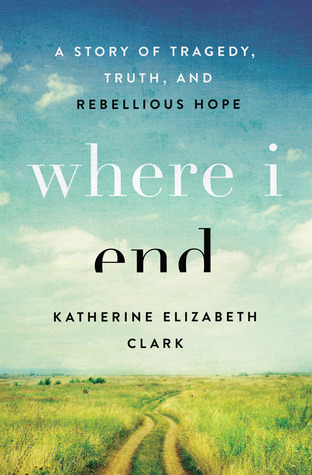 In Where I End, Katherine Elizabeth Clark shares a chance accident, a moment in time, that altered her life and the lives of her family members forever. She describes and analyzes the event and her journey to healing from the viewpoint of a Christian. Although she did not have a “leap to her feet dancing” experience, she did eventually regain the ability to walk, which her surgeon regarded as a miracle: “I can take no credit. God did this.”
Although Kate is left with residual, fairly dramatic difficulties and constant pain, her progress has been remarkable. As she shares her story, she relates how God worked in her life through family, friends and strangers who ministered to her. She tells of the humiliation and frustration of being unable to do even the simplest things for herself. Before the accident Kate was employed as a writer by a Christian organization so her prose is excellent and well thought out and her ideas are clearly expressed. She backs up her theological positions with Scripture references and quotes from Biblical scholars. She shares her story not to put a focus on herself, but on Jesus, who was and is with her through the trials and pain of the accident, surgery, rehabilitation and daily renewal of her hope and trust.
I would like to extend my thanks to netgalley.com and to Moody Publishing for giving me the opportunity to read this book in exchange for an honest review.
Rating: 5/5
Category: Memoir, Christian
Publication: January 2, 2018—Moody Publishing
Memorable Lines:
In that moment, my steady world, where bodies work in harmony with brains, was bartered for an unrecognizable universe, something resembling a Salvador Dalí painting; I felt as if I had slipped into a surreal, disorientated dream.
Yet though our Father promises to hear the cries of His children, He has not promised to exhaustively reveal His mind or plans. We must trust Him, and sometimes in the dark.
When Scripture speaks of not being afraid, it is always cloaked in the presence of the Lord. Be not afraid, not because the situation isn’t terrifying, but because you’re not alone. You have a Good Shepherd who hides you beneath His wing.
It is a great mercy of God that we cannot see the future.
Healing Back Pain: The Mind-Body Connection
Healing Back Pain: The Mind-Body Connection
by John E. Sarno, M.D.
 Dr. Sarno, through many years of treating patients with back pain, has discovered what he considers an epidemic of back pain in the U.S. and states that usually the cause is not an accident or a degenerative disease. He attributes it to repressed emotions, usually anger or anxiety, and says that the stressful situation that causes the Tension Myositis Syndrome (TMS) does not always have to be resolved for the pain to go away. The patient just needs to recognize the mind-body connection that he is experiencing.
I have not tried to apply Healing Back Pain: The Mind-Body Connection’s seemingly simple techniques; I have only read the book. Dr. Sarno’s detailed discussion of the failure of traditional medicine’s handling of back pain does make sense. He advises someone with back pain to consult with a doctor to get that perspective, but then evaluate their symptoms in the light of his thesis. He also says many other conditions such as eczema, headaches, and irritable bowl syndrome may be attributable to repressed emotions also.
Dr. Sarno cites a lot of anecdotal evidence as well as data gained from surveys of patients to support his theory. He does not claim to understand how the brain can exert such powerful control over the body, but reminds the reader that there are many things about the way the brain works that are not completely understood yet. Dr. Sarno is a medical doctor, not a salesman, not a slick businessman ready to perform on morning TV. His background is displayed in his writing style, and my 4 star rating reflects that. His bold stance against the traditional and unsuccessful medical view of back pain and his obvious enthusiasm for helping those with back pain rates 5 stars.
Rating: 4/5
Category: Health
Notes:
- Much of the book is technical. The chapter about his technique is vague, maybe because it is so simple and we expect more bells and whistles from modern medicine. Because of these factors, I found the Appendix particularly valuable. It is comprised of “Letters from Patients” and shows concretely how various patients have applied his theory and their results.
- Having finished this book on the mind/body connection, which deals primarily with the power of repressed emotions, I was amazed as I started a fictional book to discover at least four prominent references in the first chapter to how the characters realistically reacted viscerally in various ways to stress inducing moments. I reflected that if people instantaneously respond physically (tightening muscles, a sinking feeling in the gut) to anxiety, then Dr. Sarno’s connection of repressed emotions and body pain seems rational even if ignored by the medical community.
Publication: Original 1991, Kindle 2001—Hachette Book Group
Memorable Lines:
Though the low back is the most common location for an acute attack, it can occur anywhere in the neck, shoulders, or upper and lower back. Wherever it occurs, it is the most painful thing I know of in clinical medicine, which is ironic because it is completely harmless.
It is not the occasion itself but the degree of anxiety or anger that it generates that determines if there will be a physical reaction. The important thing is the emotion generated and repressed, for we have a built-in tendency to repress unpleasant, painful, or embarrassing emotions. These repressed feelings are the stimulus for TMS and other disorders like it. Anxiety and anger are two of those undesirable emotions that we would rather not be aware of, and so the mind keeps them in the subterranean precincts of the subconscious if it possibly can.
Traditional medical diagnoses focus on the machine, the body, while the real problem seems to relate to what makes the machine work—the mind. TMS is characterized by physical pain, but that acute discomfort is induced by the psychological phenomena rather than structural abnormalities or muscle deficiency.
 education pathways