Home » Posts tagged 'orphanage'
Tag Archives: orphanage
Jayber Crow–Life Story
Jayber Crow
by Wendell Berry
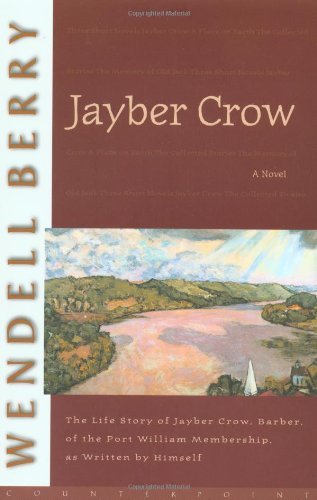
Some books are hard to encapsulate in a book review. Jayber Crow is one of those books. I am grateful to have book club members willing to share their insights and perspectives and give me opportunities to reflect on my own.
Author Wendell Berry is a Kentuckian through and through as is demonstrated in his Port Williams series of 11 novels and additional short story collections with a Kentucky setting. A novelist, poet, agrarian, activist, essayist, and farmer, Berry tells the story of Port William through the lives of his characters. Not a lot “happens” in Port William, but individuals like Jayber Crow are on display for the reader to understand how their experiences determine their strength of character. Jayber Crow has a series of rough circumstances as a child and as a young man; but never viewing himself as a victim, he develops the mental, emotional, and even physical fortitude to become a strong and introspective person. As is often the way in small towns, he is still considered an outsider even after many years of residing in Port William. With the goal of never being under the control of “the man across the desk,” Jayber, who considers himself the town’s most “ineligible bachelor,” has his own business as the town’s barber with side jobs as grave digger and church sexton.
Jayber was born in 1914, so he and all of Port William were affected by both World Wars and the Depression. He was witness to the technological changes that some called progress and others perceived as movements away from self-sufficiency and a difficult, but very satisfying way of life. In the process, they replaced a slower existence powered by manual labor with a more stressful one with a never-ending cycle of debt.
Jayber’s spiritual life is explored in the novel as he was placed in an unloving church orphanage where he thought he was called by God into the ministry. He was given a college scholarship to that end, but had a change of heart as he progressed through his studies. Jayber’s story shows the hand of God working behind the scenes as events from his early days help him as an adult. He is quiet, doing a lot of listening as a barber. As you read this book, you will watch Jayber navigate literal and metaphysical floods. There is a lot of symbolism in the book as related to water and course of direction. His relationships with women are interesting as he finally comes out of his shell by visiting a neighboring town where he will be subject to less town gossip. His marriage covenant is a most unusual one and may leave the reader with more questions than answers.
There is so much to think about in Jayber Crow that it is not a quick or easy to read book. I did enjoy it and recommend it. It takes the reader on a journey across Jayber’s lifetime, but never far from Port William.
Rating: 5/5
Category: Historical Fiction
Notes: 1. #6 in the Port William Series, but works well as a standalone
2. Contains a map and a genealogy of the families of Port William featured in the series.
Publication: 2000—Counterpoint (Berkeley)
Memorable Lines:
Back there at the beginning, as I see now, my life was all time and almost no memory. Though I knew early of death, it still seemed to be something that happened only to other people, and I stood in an unending river of time that would go on making the same changes and the same returns forever. And now, nearing the end, I see that my life is almost entirely memory and very little time.
The talk went the way I love it, so quiet and unhurried I could hear the dampened fire fluttering in the stove.
Her hearing was as sharp as Miss Sigurnia’s was dull. Aunt Beulah could hear the dust motes collide in a sunbeam; she could hear spiders chewing on flies.
The Branches seemed uninterested in getting somewhere and making something of themselves. What they liked was making something of nearly nothing.
Why is hate so easy and love so difficult?
Before We Were Yours–stealing and selling children
Before We Were Yours
by Lisa Wingate
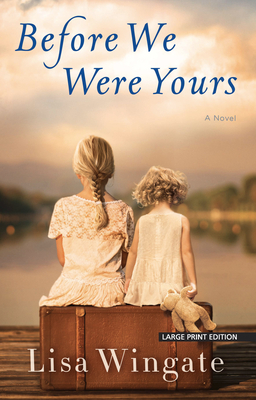
This tale is based on actual events at the Memphis Tennessee Children’s Home Society in 1939 where Georgia Tann collected babies and sold them to adoptive parents. Sometimes she had police round them up from the streets. Other times she scammed unsuspecting parents when the groggy mothers of newborns were asked to sign papers which in fact turned the babies over to the state.
In this story, Rill (later renamed May), is 12 years old and given responsibility for her siblings when her mother has to go to the hospital for a difficult delivery. Scary men show up to their shanty boat telling the children lies and forcing them to go to the children’s home where as “swamp rats” they were treated despicably.
This is a dual timeline book, and the protagonist in the present time is Avery, a lawyer from the prominent Stafford political family in South Carolina. She is being groomed to take over her father’s political office if he succumbs to cancer.
In a chance meeting, May takes Avery’s bracelet, a dragonfly bracelet that is a family heirloom given to Avery by her Grandma Judy. In recovering the jewelry, Avery discovers a mysterious connection. Despite Judy’s gradually succumbing to Alzheimer’s, Avery pursues the relationship between the two women.
Before We Were Yours reveals a very sad series of events in U.S. history. Georgia Tann was a ruthless woman who took advantage of poor families during the Depression as well as families hurting from childlessness. The book is complex but Lisa Wingate tells the story with compassion. She researched her topic well and created a fictional tale that is substantiated by reported events and melds the facts into a compelling story.
Rating: 5/5
Category: Historical Fiction
Notes: Random House has an online book club kit that has resources that any reader would find beneficial, whether reading the book individually or with a group.
Publication: 2017—Ballentine
Memorable Lines:
She stops short of repeating the woman’s naughty words. Camellia’s eaten enough soap to clean up the inside of a whale in her ten years. She’s practically been raised on it. It’s a wonder bubbles don’t pour out her ears.
There’s no denying that Magnolia Manor is more upscale than the nursing home May Crandall lives in, but both places face the same underlying challenge—how to provide dignity, care, and comfort as life turns difficult corners.
“A woman’s past need not predict her future. She can dance to new music if she chooses. Her own music. To hear the tune, she must only stop talking. To herself, I mean. We’re always trying to persuade ourselves of things.”
The Ways We Hide–“escapologist extraordinaire”
The Ways We Hide
by Kristina McMorris

Admittedly it is hard to write a “happy” book about World War II. The Ways We Hide is definitely not a cheerful book. While she avoids graphic descriptions of the violence of the war, author Kristina McMorris excels at conveying the overwhelming sadness of the personal tragedies, even those that occurred pre-war, early in the orphaned protagonist Fenna’s life. When she escapes from an orphanage in the U.S., she is taken in by her best friend Arie’s family despite their religious differences. The parents in both families are Dutch immigrants. As young adults they discover their romantic love for each other, but Fenna suddenly leaves her adoptive family without explanation.
Taking her love of magic to the stage, Fenna becomes a self-made illusionist in the style of Houdini. She is recruited by the British in World War II to devise gadgets and conceal them in support of Allied troops in Europe. The British ask her to go to Holland on a dangerous rescue mission to find Arie, but more more is involved than her handlers are telling her.
The story is well played out with unexpected twists around every corner. This work of historical fiction is well written and extremely well researched. I can’t say that it is a page turner for me because it is so sad. The characters have little hope for positive outcomes, but pursue their noble goals against all odds. The work is undercover, classified, and occurs in Nazi controlled areas. Therefore, it is hard to know who can be trusted.
The author explains at the end of the book her framework for inserting the fictional Fenna into the mostly historically accurate backdrop with some slippage of time. She has researched her subjects well which include not only the war efforts but also an anti-labor strike event that changed Fenna’s life forever.
The ending is not a happily ever after with the protagonists riding off into the sunset, but how could it be when so many people have died? Despite the reality of the situation, the author does manage to conjure up a “lemons into lemonade” scenario for Fenna that is satisfying and actually sweet. I am glad I read this book which reveals a lot about undercover work, dangers, and relationships in World War II.
I received a complimentary copy of this book in exchange for an honest review. Opinions expressed in this review are completely my own.
Rating: 4/5
Category: Historical Fiction, Women’s Fiction
Notes: 1. There are author notes at the end which explain in detail how McMorris got her inspiration for the various parts of the book. It is followed by suggestions for further reading for those who would like to learn more about the topics in the book.
2. Online there is posted a Book Club Guide on the author’s website (kristinamcmorris.com). While I do recommend this book for book clubs, individual readers will also find this guide helpful in visualizing the setting and the culture. It includes Dutch inspired recipes plus a recipe for invisible ink (not the lemon juice type). There are questions designated as a Reading Group Guide. Perhaps most importantly to me, there are fifteen photographs that will transport the reader back in time. There are also QR codes for videos and other additional resources online. In addition, there are suggestions for group activities to enhance book club meetings.
Publication: September 6, 2022—Sourcebooks Landmark
Memorable Lines:
Traveling in clusters pallbearers carried pure-white caskets low at their sides. The dimensions of each befitted a child, the weight minuscule compared to the burden.
In this instant I consider a potential reason my life has been repeatedly spared. Could it be to attain justice for the victims of a cruel and callous enemy?
He offers his hand with a caring look. “May our paths cross again,” he says, “in a better world.” It’s impossible to envision any future beyond the immediate challenges ahead. Still, I accept his handshake, grateful for the notion.
The Teacher of Warsaw–hope in the middle of despair
The Teacher of Warsaw
by Mario Escobar
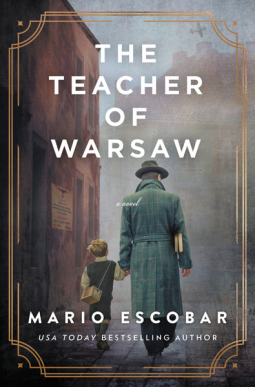
When a book leaves an impact on your soul after the covers are closed, you know you have read a treasure. I was a few chapters into The Teacher of Warsaw before I was captivated by Mario Escobar’s work of historical fiction. After I understood what this author with a master’s degree in Modern History had set out to share, I was repeatedly drawn back from my world into the sad and inspiring world of Janusz Korczak, a pediatrician and teacher with many talents who dedicated his life to the children in his orphanage. They suffered together as the Nazis made their lives and the lives of all Polish Jews a nightmare of starvation and deprivation. Thanks to Dr. Korczak and the dedicated group of tutors who worked alongside him, the children were given hope and taught to love even their enemies. Korczak was Jewish by heritage but had not been raised in a religious family. He admired and appreciated many things about the Jew Jesus and likened Him to the anticipated Messiah, but did not accept Him as the fulfillment of prophecies. Dr. Korczak described himself at various times as an atheist, an agnostic, and a seeker, but those around him would have been hard pressed to find a stronger, more sacrificial, more ethical, and more loving leader. In return the children loved him, and he was regarded with respect by all but the most evil of Nazis.
Dr. Korczak was encouraged by many, including Polish social worker Irena Sendler, to escape the Warsaw Ghetto and the extermination which was surely coming, but his answer was always the same: the children of the orphanage needed him and he would not abandon them. The Teacher of Warsaw is both horrifying and inspiring as it depicts the worst and the best of mankind and demonstrates the power of love.
I received a complimentary copy of this book in exchange for an honest review. Opinions expressed in this review are completely my own.
Rating: 5/5
Category: Historical Fiction
Notes: 1. Translated from Spanish by Gretchen Abernathy.
2. Includes two sections that discuss the historical basis of the story, a timeline of the Warsaw Ghetto, and discussion questions for the reader.
Publication: June 7, 2022—Harper Muse
Memorable Lines:
“Can you think what would’ve happened to the boy had we not been passing by? Everything happens for a reason. Even the greatest misfortunes can become the sweetest blessings.”
“We labor to give them back their hope: but we cannot give what we do not possess. Therefore, be full of hope this morning. May your joy overflow because you do what you do out of love and service for the weakest ones. And when negative thoughts come to steal your peace and joy, don’t let them make a nest in your minds. We can’t avoid those kinds of thoughts, but we can keep them from controlling us.”
I had two hundred children whom I loved and who loved me. I was undoubtedly the richest man in the Warsaw ghetto.
The Orphan Sisters–bonded forever
The Orphan Sisters
by Shirley Dickson
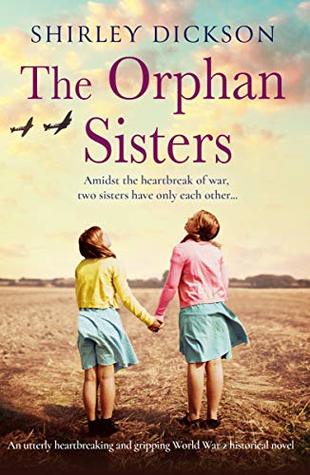 In between the Great War and World War II, two sisters are dropped off by their widowed mother at the austere orphanage Blakely. Etty, the younger girl, has no warning or understanding of what had started out to be a fun family adventure on the train. Dorothy, the older of the two, is able to deal with the circumstances somewhat better. The girls remain there until they reach their fifteenth year. At that time each undergoes an adjustment to a world so different from the institution that had become an uncomfortable and regimented “home.”
In The Orphan Sisters, we trace the girls’ lives as they become adults, never willing to be far apart from each other. They have hopes and dreams and make choices that are life altering. As they move towards maturity, Great Britain is thrust into the war which affects every area of their lives with rationing, young men being called up for duty, relationships with the awareness that each day may be their last, and women being encouraged to support the war effort by taking on jobs.
The most dramatic parts of the book depict the physical and emotional effects of the bombings. There was great fear as people huddled in shelters and bombs exploded around them.
Shirley Dickson is a great storyteller. She weaves a tale that grips your heart and puts you in Geordie land with the accent and dialect particular to Tyneside. You will want everything to go well for Etty and Dorothy in the midst of the pain and chaos that surrounds them and invades their lives. You will hope for them to finally find peace in their search for their mother’s love.
I would like to extend my thanks to netgalley.com and to Bookouture for giving me the opportunity to read this book in exchange for an honest review.
Rating: 5/5
Category: Women’s Fiction, Historical Fiction
Publication: January 22, 2019—Bookouture
Memorable Lines:
The Mistress’s smile was more of a grimace—it didn’t look at all welcoming. Her eyes held no warmth in them, and dull and glazed, they reminded Esther of dead fish eyes.
Thankful for being saved, she breathed in the acrid air. But the world now seemed a more frightening place, and even the moon, soaring high in a clear sky, appeared to have a malevolent face.
The nation was at war; an aerial attack might happen any minute, but if your nappies weren’t blindingly white as they flapped on the line—then, according to the housewife law, you’d failed as a mother.
 education pathways