
Home » Posts tagged 'manipulation'
Tag Archives: manipulation
The Fisherman’s Lady–Scottish classic
The Fisherman’s Lady
by George MacDonald
edited by Michael Phillips
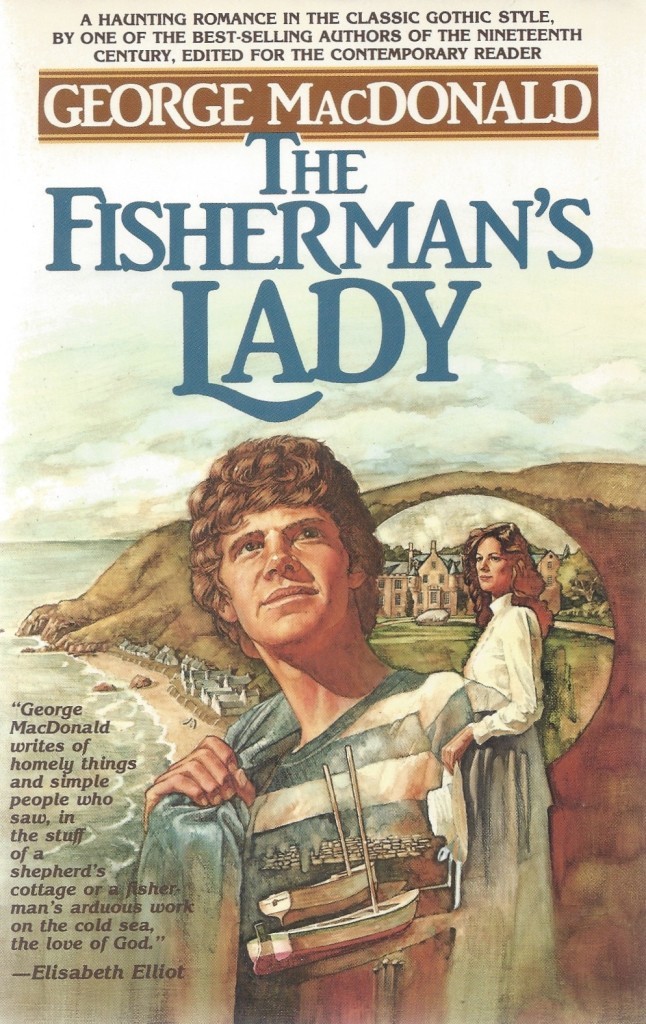
First published in 1875, entitled Malcolm, with a sequel arriving in 1877, The Fisherman’s Lady is a challenging read and a classical romance by a prolific writer of many genres. C.S. Lewis claimed MacDonald as his favorite writer saying, “I never wrote a book in which I did not quote George MacDonald.” The language is, of course, of an older age and reflects MacDonald’s background: Scottish minister, and author of fiction and nonfiction, including poetry. Contemporaries include Lewis Carroll, G.K. Chesterton, Charles Dickens, and Mark Twain.
Much of the dialogue in The Fisherman’s Lady is written with a Scottish brogue adding to the difficulty for the modern reader. Initially, I purchased a Kindle version that included both Malcolm and The Marquis of Lossie. Next, I located a printed version of The Fisherman’s Lady edited by Michael Phillips. He simplified the original by omitting some of the passages, but he also left some of the Scottish dialect for an authentic flavor.
Some readers categorize this novel as having a “gothic style.” It does contain some gothic elements from that Victorian period—a castle; dark, locked rooms; potential hauntings; crumbling stairways; the past affecting the present; twisted family ties; missing people; unusual sounds; and dreams.
The plot starts with sudden impact as it focuses on a corpse. Then, it proceeds slowly as characters are introduced. There are a lot of important figures in the book, and the editor lists them and a note about most of them, along with an area map. The story gains momentum and interest for the reader with lots of hooks leading into the following chapters. The protagonist is Malcolm, a fisherman who lives with his adopted father Duncan, an elderly, blind piper. Malcolm is a happy young man, honest, and a hard worker. He is devoted to the man who raised him whose only fault appears to be a quick temper over an old feud with another family. On the other side of the social strata is the Marquis of Lossie and his daughter, the beautiful Lady Florimel (Flory). Questions hang throughout the book concerning Malcolm’s parentage and that of the “Mad Lair,” a hunchbacked dwarf who has been badly mistreated by his mother.
Malcolm and Flory become friends, but they do not develop a romantic relationship because they both realize that social boundaries make any such bond between them unrealistic. Malcolm, however, would do anything for Flory, desiring to serve her long-term.
There are a few really evil women in this book. The way the upper class treats servants, laborers, the poor, and the disabled is upsetting, but a reflection of the times.
I enjoyed most of the book as far as it went, but I was disappointed in the sudden cut-off of the tale with no satisfactory conclusion for the characters. Most modern tales with sequels tie up the main threads in the first book but provide a motivation to encourage the reader to continue on to find out what happens to the characters in the next stage of their lives. This book contains a major event and then just ends with little attention to the aftershocks. The editor does include a brief paragraph to assure the reader on certain key points, but that statement was not part of the original text.
Rating: 4/5
Category: Historical Romance, Classic
Notes: 1. The first part of a two part set of books about Malcolm.
2. Includes Christian themes and shows characters trying to come to grips with their faith.
3. Clean
4. Includes preface by the editor and three appendices providing historical notes.
5. I have not yet decided if I will read the sequel, The Marquis of Lossie, or not.
Publication: Original in 1875—Henry S. King Publishers in Great Britain, and George Routledge & Sons in New York, and J.B. Lippincott in Philadelphia
This version edited by Michael Phillips in 1982—Bethany House Publishers
Memorable Lines:
Whatever may have been the projected attitude of the marquis, the moment he stood on the piper’s floor, the gentleman in him got the upper hand and his behavior to the old man was not only polite but respectful. At no period in the last twenty years had he been so nigh the kingdom of heaven as he was now when making his peace with the blind piper.
But Lady Florine had never studied anything yet, had never even perceived that anything wanted studying—that is, demanded to be understood. What appeared to her most odd, most inconsistent, was his delight in what she regarded only as the menial and dirty occupation of cleaning lamps and candlesticks; the poetic side of it, rendered tenfold poetic by his blindness, she never saw.
“No, no; never run from a lie. And never say, neither that you didn’t do the things except it be laid straight to your face. Let a lie lay in the dirt. If you pick it up, the dirt’ll stick to you, even if you fling the lie over the dike at the end of the world. No, no! Let a lie lay as you would the devil’s tail!”
Sandcastle Hurricane–joy from a hurricane
Sandcastle Hurricane
by Carolyn Brown
Two adult cousins, Tabby and Ellie Mae, with dysfunctional family backgrounds are reunited when their Aunt Charlotte decides to retire from the B&B she owns in the little beach town of Sandcastle, TX. Although she has moved away from hurricane country to snow country, she is a constant source of encouragement and advice to her nieces through phone calls and statements sprinkled throughout the book as the cousins can almost hear her talking.
Tabby and Ellie Mae have only been at the B&B for a few weeks when they find themselves boarding up windows in response to warnings of Hurricane Delilah. Aunt Charlotte arranges for her friend Alex to help them as he always helped her and for the trio to take in four residents from an assisted living center who have no family.
The story is very character driven as we learn the backgrounds of all of them and how life’s events have affected them. Tabby and Ellie Mae are both battling grief. Neither has a positive relationship with their families for good reason. The four elderly characters are a study in contrasts. The author shows how it is possible to change, grow, and stand up to overwhelming problems. Although humor is not a mainstay of this book, there are amusing situations and dialogue that lighten the tone of some serious issues and confrontations.
There are romantic scenarios for Tabby and Ellie Mae. The events at the end of the book lead to good things for the characters even though they would not have planned the turns that happen in their journey. Sandcastle Hurricane is about people struggling to do their best, misunderstandings, and family. It deals with the problems that can accompany mixed race marriages and their offspring as well as the joys of color-blind friendships.
I received a complimentary copy of this book in exchange for an honest review. Opinions expressed in this review are completely my own.
Rating: 4/5
Category: General Fiction, Romance
Notes: Contains about a dozen instances of mild swearing
Publication: November 8, 2022—Montlake
Memorable Lines:
Why can’t my dad and his brother get along like Homer and Frank? Ellie Mae bit back a sigh. Because they never had to go through tough times together. That builds character and teaches people to depend on each other, Aunt Charlotte whispered softly in her ear.
A woman who has lost her husband is called a widow. Children who lose their parents are orphans.. But there is no word for mothers who lose children, because the grief is too hard to put a name on it.
“We just have to believe what is happening now is for a good reason, and what brought us to this day has shaped us into the people we are.”
Pride and Prejudice–courtship in the early 1800’s
Pride and Prejudice
by Jane Austen
In preparation for reading Pride, a modern day version of Jane Austen’s Pride and Prejudice, with my book club, I decided to reread the original. I knew I could watch a video of the story, but I decided to aim for authenticity and read the actual book. I was glad I did as there is so much to be appreciated in Austen’s words, style, and depiction of characters. In retrospect, I believe my younger self had seen one of the several videos, but had never actually read the novel. I would still like to view one of the movies for an opportunity to better envision the costumes and settings of this period piece, but there is much value to be gained from the reading experience.
Pride and Prejudice is a romance particularly focusing on Jane and Elizabeth Bennet as they navigate the difficult waters of courtship in the early 1800’s in England. Their courses are made more murky by the family’s financial and social status. They are not part of the old monied class that is full of prejudice, but they have standards and they and their suitors are driven at least in part by pride. From a twenty-first century viewpoint, the courtship and rules of engagement seem stilted, but the reader can see in a younger sister’s impetuous disregard for the rules and assumptions of the time, that there are real societal and personal consequences for ignoring the standards of any time period.
I enjoyed the book which is as much about social issues as it is a romance. Pride and prejudice are, of course, themes throughout the book. Most of the characters of the novel grow and develop through the events of the story. Some remain stuck in their ways of thinking, and those continue to be persons the reader won’t like. You may find yourself rereading Pride and Prejudice for love of the characters, the joy of the language, or the journey towards a known ending—happy for some, less so for others.
Rating: 5/5
Notes: Edited by R. W. Chapman. Distributed by Gutenberg Press
Category: General Fiction, Romance
Publication: 1813—T. Egerton Military Library, Whitehall
Memorable Lines:
“Affectation of candor is common enough;—one meets it every where. But to be candid without ostentation or design—to take the good of every body’s character and make it still better, and say nothing of the bad—belongs to you alone.”
Without thinking highly either of men or of matrimony, marriage had always been her object; it was the only honorable provision for well-educated young women of small fortune, and however uncertain of giving happiness, must be their pleasantest preservative from want. This preservative she had now obtained; and at the age of twenty-seven, without having ever been handsome, she felt all the good luck of it.
“You mean to frighten me, Mr. Darcy, by coming in all this state to hear me? But I will not be alarmed though your sister does play so well. There is a stubbornness about me that never can bear to be frightened at the will of others. My courage always rises with every attempt to intimidate me.”
The Last Battle–the end
The Last Battle
by C.S. Lewis
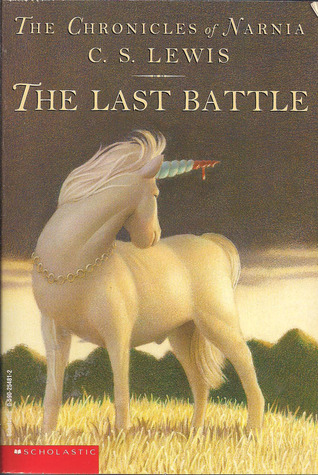
The final installment of The Chronicles of Narnia is as interesting, exciting, and thought provoking as the other six books. I read the last part slowly, eager to know what would happen next but not wanting to arrive at the end of the magnificent tale by C.S. Lewis, the consummate storyteller.
There are many important and timely themes including freedom vs. socialism, manipulation, deception, power and control, sacrifice, good vs. evil, and seeking God. Lewis brings together the characters and elements of all the books into a grand and surprising, but satisfying finale.
There are new characters added to the series. Shift is an ape who keeps Puzzle the donkey controlled by undermining his self-confidence. Old characters are present too as King Tirian calls out to Aslan the lion for help and “the seven friends of Narnia” from our world are whooshed into Narnia where they prepare to do battle against Shift, the Calormenes led by Rishda, and Tash the Calormene god. Shift devises elaborate schemes to deceive the Narnians and convince them that Puzzle, dressed in a lion’s skin and only appearing in the dark, is Aslan. This false Aslan through Shift’s directives is a cruel ruler, unlike the real Aslan. He enslaves the Dwarfs and Talking Horses making them work to accrue wealth for himself. Shift and Rishda convince the Narnian Talking Animals that Tash and Aslan are the same god and that they should now worship “Tashlan.”
Speaking further of the plot would disclose too many events that readers will surely want to discover on their own. The Last Battle is an adventure story replete with easy to understand symbolism and ageless themes. Quoting the last paragraph of the book would be the ultimate spoiler, but don’t fly to it first when you read the book. When you reach the ending, having experienced adventures alongside the characters and learned more of the attributes of the real Aslan, you will smile and savor the thoughts in that last beautifully composed paragraph.
Rating: 5/5
Category: Fiction, Christian
Notes: 1. #7 in The Chronicles of Narnia series. This is the final book in the series and should be read last.
2. This series is often listed as Children’s Fiction, but is really appropriate for all ages with adults reading it on a different level from children. It is perfect for a read-aloud.
3. I can’t believe I had never read the full series. If you are in a similar position, I urge you to delve into this treasure of a series. You will not regret it.
Publication: Original copyright is 1956. My copy was printed by Scholastic in 1995.
Memorable Lines:
“I was with him in his last hour and he gave me this message to your Majesty: to remember that all worlds draw to an end and that noble death is a treasure which no one is too poor to buy.” “So,” said the King, after a long silence “Narnia is no more.”
And then she understood the devilish cunning of the enemies’ plan. By mixing a little truth with it they had made their lie far stronger.
“They will not let us help them. They have chosen cunning instead of belief. Their prison is only in their own minds, yet they are in that prison; and so afraid of being taken in that they cannot be taken out.”
Trap Lane–confusion in Folly
Trap Lane
by Stella Cameron
 I’m disappointed. I was sure that Trap Lane by Stella Cameron would be another puzzling, exciting mystery in the Alex Duggins Series. It was indeed puzzling all the way through. I felt like I was missing the backstory, but that was not the case. In fact the characters, including the investigators and the reader are clueless all the way through. Even at the conclusion of the tale, not all of the ends are tied up; and the status of most of the characters (those who are not dead, of course) is unknown.
Setting, mood, and dialogue are all well executed, but the characters fumble around trying to protect each other from various unknown dangers. Secrets obviously abound, but they are vague enough to be uncompelling. The characters don’t seem to understand “obstruction of justice” to the point that they obfuscate the many murder investigations with the end result being more harm than good to those they are trying to protect.
The main characters, Alex and Tony, are likable, but I wished I could alternately shake them into reality or plop them in a new setting. The elderly sisters who run a tea shop have the potential to be interesting characters, but serve more as background. Annie, who is supposed to garner sympathy, is never fully explained and appears a wimp. I like her even less than the stereotyped villainess Neve. Even the thread of the forensic pathologist could have been developed to be interesting. Instead, her potential problems and relationships are mentioned and dropped.
Although disappointed, I will continue to read the Alex Duggins Series, hopeful that the next book will restore my confidence in this series.
I would like to extend my thanks to netgalley.com and to Severn House for giving me the opportunity to read this book in exchange for an honest review.
Rating: 3/5
Category: Mystery
Notes: #6 in the Alex Duggins Series
Publication: October 1, 2019—Severn House
Memorable Lines:
Accepting that there was nothing she could do to change whatever inner battles he was fighting did nothing to soothe her jumpiness.
So true that love and hate are close neighbors.
What Alex felt for him wasn’t pity, it was closer to grief for the loss of his youthful optimism.
How to Stop Time–historical fiction with a science fiction twist
How to Stop Time
by Matt Haig
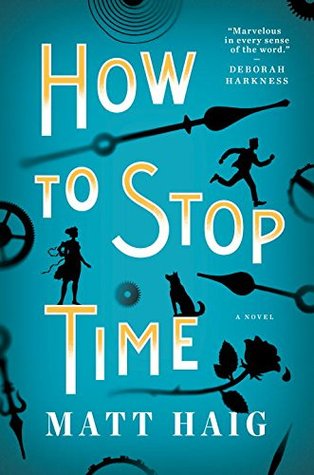 The typical work of historical fiction takes a character from a specific time and place and imagines, hopefully based on some research, what life would have been like for that person. How to Stop Time is not a “typical work of historical fiction.” Author Matt Haig dares to explore what would happen if certain people were naturally genetically designed to age slowly, to live hundreds of years. What would life be like for that person? What would the response of others be to them? How do you form a relationship with someone who will certainly age at a different rate? What if one of these “albatrosses” becomes powerful enough to use various means to control the others?
How to Stop Time follows Tom Hazard as he negotiates life in the twenty-first century and reflects on events in his past spanning multiple centuries, locations, careers and aliases. He is musically inclined and along the way discovers an aptitude for teaching history.
Tom is a likable character whose situation is in some ways different from the circumstances of “normal” human beings. In many aspects, however, his struggles are the same as he tries to fit in, decides how open to be with those he meets, and battles with opening his heart. We all on occasion want to stop time to savor the moment, to revisit past decisions, and to look ahead into the future.
How to Stop Time is an excellent work of fiction, well-written and interesting. It introduces historical characters such as Shakespeare and Captain Cook, but there are equally fascinating fictional characters who convincingly embody the everyday men and women of past generations. With its fast-moving storyline, this book is one I recommend you add to your To Be Read list.
I would like to extend my thanks to netgalley.com and to the Penguin Group (Viking) for giving me the opportunity to read this book in exchange for an honest review.
Rating: 5/5
Category: Historical Fiction
Publication: February 6, 2018—Penguin Group (Viking)
Memorable Lines:
I had no idea I had been looking for her, but now I had found her, I had no idea what would happen. I felt like I was spinning fast and out of control, like the seed of a sycamore, traveling on a changing wind.
I kept going cross the desert and over dry hills and mountains and past a large quarry that seemed to my delirious mind like the blackness of death itself calling me towards it like the River Styx.
I can’t right now think of a better purpose in life than to be a teacher. To teach feels like you are a guardian of time itself, protecting the future happiness of the world via the minds that are yet to shape it.

