
Home » Posts tagged 'maid'
Tag Archives: maid
The Valet’s Secret–class barriers to love
The Valet’s Secret
by Josi S. Kilpack
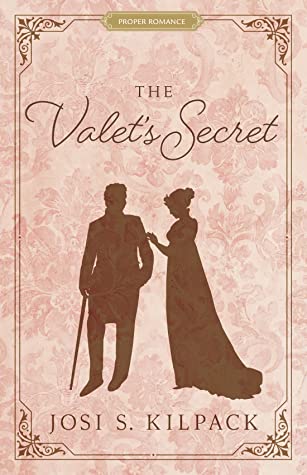
When I started reading The Valet’s Secret, I realized it is a historical romance, not of the Jane Austen satirical variety, but one of romantic attraction thwarted by class differences. This is not my typical reading genre, and so it took a few chapters for me to get involved with the characters and their dilemmas. At that point I began to really care about the main characters.
Kenneth Winterton, while raised as a gentleman, had no expectations or training to be the future Earl of Brenton. When his cousin Edward dies suddenly, Kenneth is expected to prepare himself for his new role, including marrying someone from the local gentry. Thus begins round after round of entertainments to introduce him to suitable ladies. His heart has already been stolen by a chance encounter with Rebecca Parker, a widow living with an abusive, alcoholic father, helping him with his craft of silhouettes. Prior to her marriage, she had been “in service” as a maid. Kenneth and Rebecca are by status incompatible.
As the story moves towards its conclusion, the reader must certainly wonder how the couple could possibly marry. There are several dramatic twists; the actions of a few characters reveal their true motivations and scheming, and some even have a change of heart. The cover reflects the importance of silhouettes in the story, and the title reflects an early, light-hearted deception in the tale with serious consequences. By the end of The Valet’s Secret, I was convinced by this quick read that this genre and author deserve some more attention from me as I make future selections.
I would like to extend my thanks to NetGalley and to Shadow Mountain Publishing for giving me the opportunity to read this book in exchange for an honest review.
Rating: 4/5
Category: Romance
Publication: March 8, 2022—Shadow Mountain Publishing
Memorable Lines:
“The title precedes you into every room, every relationship, every decision. You do not think what is best for any individual—not even yourself—but what is best for the community affected by your status. Nothing comes above that responsibility. Nothing at all.”
…the thought that he would remain here, learning to live a life that was uncomfortable with a woman whom he did not know while waiting for an old man he loved to die, made him extremely sad.
How he hated this marriage mart he was hung within. So very much. The only viable solution to get out of it was, in fact, to marry.
Conan Doyle for the Defence–real life detection
Conan Doyle for the Defence
by Margalit Fox
 As a lover of mysteries, I enjoyed reading Conan Doyle for the Defense. Be forewarned, however, that this book is not light reading. It is the recounting of Arthur Conan Doyle’s application of Holmesian deductive skills to the real case of Oscar Slater, wrongfully found guilty of the murder of an elderly lady.
In the process of relating the details of the case, the author Margalit Fox puts the events in context. She discusses the Victorian era and the development of crime fiction, including, of course, the Sherlock Holmes mystery series. She also addresses the life and character of Arthur Conan Doyle as well as Scottish politics, police, and the penal system. Fox presents an in-depth discussion of the different types of reasoning that might be used in trying to solve crimes.
If you are looking for a beach read, Conan Doyle for the Defence is not it. If you are interested in learning more about true crime detection, and how its principles apply to fiction, then this is the right book for you.
I would like to extend my thanks to netgalley.com and to Profile Books/Serpent’s Tail for giving me the opportunity to read this book in exchange for an honest review.
Rating: 5/5
Category: History, True Crime
Notes: Includes a complete list of references, footnotes, and bibliography to support the information contained in the book.
Publication: June 28, 2018—Profile Books/Serpent’s Tail
Memorable Lines:
First joining the case in 1912, he turned his formidable powers to the effort to free him, dissecting the conduct of police and prosecution with Holmesian acumen. But despite his influence and energy, Conan Doyle discovered, he wrote, that “I was up against a ring of political lawyers who could not give away the police without also giving away themselves.”
Holmes quickly became a global sensation, not only for his investigative prowess, unimpeachable morals and ultrarational cast of mind, but also for his exquisite embodiment of an age of Victorian gentility, and Victorian certainties, that was already imperiled.
Detection, at bottom, is a diagnostic enterprise, and the late 19th century was where the shared diagnostic concerns of medicine, criminalistics and literary detection first truly converged in public life.
 education pathways