
Home » Posts tagged 'love' (Page 2)
Tag Archives: love
The Path to the Last House Before the Sea–sad secrets
The Path to the Last House Before the Sea
by Liz Eeles
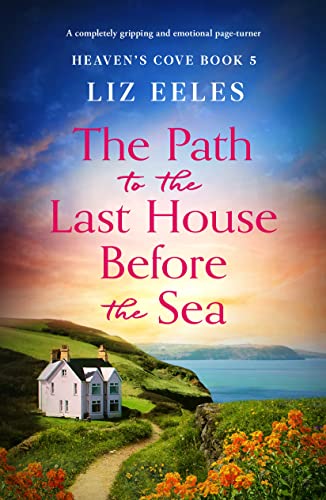
Alyssa has come to Heaven’s Cove to start life over, changing her name and her profession while harboring a big secret. She lives in a small wooden caravan on Magda’s property. Magda owns an ice cream parlor and returned a number of years ago to be close to her best friend Penny and husband Stan. Magda has her own secret that is eating away at her despite the happy face she presents to the world. Jack is taking a hiatus from his work to help out his dad Stan in the town’s only grocery store, a tiny place that the community depends upon. Their lives become intertwined as an unlikely romance develops between visionary Alyssa and nerdy Jack.
A major thread is Alyssa’s search for clues and information about a 300 year old tale of a missing couple and a smuggling ring. Her search for the truth puts Alyssa and Jack’s lives in danger. Meanwhile Jack is dealing with his soon-to-be ex-wife, her boyfriend, and his beloved adopted son.
Author Liz Eeles weaves all of these threads into a background of a wedding in Heaven’s Cove that the whole community is involved in. The setting is beautiful and the town’s residents are both kind and gossipy at the same time. If you like an interesting plot and characters in a clean novel, The Path to the Last House Before the Sea would be a great choice.
I received a complimentary copy of this book in exchange for an honest review. Opinions expressed in this review are completely my own.
Rating: 5/5
Category: Fiction, Women’s Fiction
Notes: #5 in the Heaven’s Cove Series, but can be read as a standalone. There are characters from previous books who make cameo appearances, but each book in the series has new characters who are the focus of the current book.
Publication: May 18, 2023—Bookouture
Memorable Lines:
A hot wash of shame flooded through him. When had he become so…? He turned into the lane that led past the village green, unable to settle on the right word for his behaviour. Arrogant, maybe? Ignorant? Boorish?
“Three point one four one five nine…” he began to mutter under his breath. Reciting the mathematical constant pi from memory, as far as he could go, always calmed him down. The number was beautiful. It was fixed and unchanging—unlike his life right now.
Alyssa crossed her fingers, just in case, and watched seagulls—tiny white dots—swooping over cottage roofs, and a child’s lost red balloon floating into the sky. The village looked like a spider’s web from up here, with paths going in all directions and the church in the centre.
The Prodigal God: Recovering the Heart of the Christian Faith
The Prodigal God
by Timothy Keller
You may feel the urge to read that title twice. Wait, you say, the parable in the Bible is commonly referred to as “The Prodigal Son”! One of the meanings of prodigal, however, is “recklessly extravagant,” and that is the kind of love God has for us.
The Prodigal God is a fairly short book that uses Jesus’ parable about a spendthrift son who wastes his inheritance on immoral living to explain the good news of God’s love and salvation. If you are not familiar with the tale, it’s okay because Keller shares the story as told by Luke at the first of his book. As you read it you will be reminded that there are two brothers who both have bad attitudes. The younger brother engages in wild living, but the older brother who exemplifies the religious leaders listening to the parable has an attitude problem as well. These self-righteous scribes and Pharisees try to follow the letter of the law but not the spirit of the law. One of the chapter titles is “The Two Lost Sons.” Neither son shows the respect for the father that would be expected according to the customs of their culture.
This is a great book to read if you are seeking a personal relationship with God. It is also good for those who are already followers of Jesus. I particularly appreciated the examination of the characters’ actions in the light of the time and place where they lived. It made a story I have long been familiar with come alive. Keller compares the feast at the end of the parable with “the great festival of God at the end of history” and explains four ways in which salvation is like a feast. This book will challenge your mind and heart.
Rating: 5/5
Category: Christian, Nonfiction, Religion, Theology
Publication: 2008—Penguin Group
Memorable Lines:
…sin is not just breaking the rules, it is putting yourself in the place of God as Savior, Lord, and Judge just as each son sought to displace the authority of the father in his own life.
…the prerequisite for receiving the grace of God is to know you need it.
We must learn how to repent of the sin under all our other sins and under all our righteousness—the sin of seeking to be our own Savior and Lord. We must admit that we’ve put our ultimate hope and trust in things other than God, and that in both our wrongdoing and right doing we have been seeking to get around God or get control of God in order to get control of those things.
Reading for the Love of God–erudite and spiritual
Reading for the Love of God
by Jessica Hooten Wilson

I thought Reading for the Love of God would be the perfect book for me, channeling my reading choices in a way that points to God and shining a light on the spiritual connection of God and a reader. It did both of those things, but I have to admit that, as a whole, it was not the right book for me. Some of this well organized book was appropriate for the average reader, but much of it was clearly written by a professor with a strong background in both literature and theology. Perhaps it would be more appropriate for study in a college level course. Here is an example from the text that demonstrates the background knowledge needed to fully benefit from this book: “In Christian tradition, the anagogic sense refers to a text’s echo or reflection of the divine. Where do we see God here? Or we might equate the anagogical with the eschatological: Knowing that all will end in our death and Christ’s second coming, what matters in what we have read? It’s the cultivation of a sight that points our eyes ever upward toward heaven.”
On the other hand, Hooten presents a lot of interesting ideas about reading. She is quite knowledgeable and gathers information from and about many authors. The footnotes cover about twenty percent of the book. She extols the virtues of reading and rereading the classics, and she asserts that learning how to read various genres helps us learn to read Scripture. If we read other books than the Bible, even secular books, through the lens of Scripture, God can teach us. Even books that some Christians avoid reading (e.g. Harry Potter) can lead to examination and discussions of evil versus good, etc. We should both enjoy and use literature, but should not put the message above the story itself. She points out that there are many current and historical opinions about how to best read the Bible addressing issues such as meditation, interpretation, the role of allegory, the depths of word meanings, and symbolism.
The author carefully places essays in the book expounding on what we can learn from examining the writing and reading of St. Augustine, Julian of Norwich, Frederick Douglass, and Dorothy L. Sayers. After her Conclusion and Acknowledgments, she guides the reader through a practice session of analysis of Flannery O’Connor’s short story “The River.” O’Connor is a much referenced author in this book so this discussion seems quite appropriate. A section of Frequently Asked Questions is very practical and useful. It is followed by “Reading Lists of Great Books” which is grouped by ages. The next list is “Great Books: The Living Tradition” which contains classics sorted by time periods and followed by a list entitled “Writers Whose Works Touch the Sacred and the Profane.” I’m not sure what her criteria are for this list, but it includes authors such as Wendell Berry, Frederick Buechner, Willa Cather, G. K. Chesterton, and Dorothy Sayers.
I received a complimentary copy of this book in exchange for an honest review. Opinions expressed in this review are completely my own.
Rating: 4/5
Category: Christian, Religion & Spirituality
Notes: As I think back over Reading for the Love of God, I find I am viewing it in a more positive light than when I was working my way through it. I am not recommending it to my book club as I initially thought I would do. I will be mulling her theses over and referring to her suggestions for reading selections as I expand my personal reading choices.
Publication: March 28,2023—Brazos Press (Baker Publishing Group)
Memorable Lines:
If we are going to read—the Bible included—we should learn how to read well. We should become readers who do not read for our own gain but who read as a spiritual practice, always open to how the Lord is planting seeds in our heart, teaching us more about him, and showing us ways of living more like Christ in the world.
But we should not read Virgil’s Aeneid in order that we may check a box on a great books list. Rather, a book such as the Aeneid is to be used—for pleasure and edification temporarily—and ultimately enjoyed in how it points us to God.
We read because without books our world shrinks, our empathy thins, and our liberty wanes. We read for the same reason that people have read—and shared poems or stories—for thousands of years because our eyes are not enough by which to see. The time and place in which we live blinds us to other perspectives and ways of being that are not of our own experience. We read because we have been given the gift of imagination and intellect, and we exhibit our gratitude by using it.
Hopefully Ever After–struggling against a past
Hopefully Ever After
by Beth Wiseman

This novel has a lot going for it:
- So many important themes including: forgiveness, faith, love, security, family, abuse, goals, healing, independence, maturity, drugs, love of books, respect.
- Interplay of Amish and Englisch characters with several experiencing one culture and considering or actually changing to the other.
- Temptations for both Amish and Englisch characters.
- Contrast of Amish lifestyles with Englisch lifestyles.
- View of how technology, especially cell phones, has affected the Amish.
- A great plot centered around a 16 year old girl, Eden, with a difficult upbringing who stays for a month with her Amish cousin and her husband. She discovers what a real family could be like.
- Lots of characters with their own difficulties—Samuel, a 17 year old with overly strict parents; Yvonne and Abraham who take in Eden for a month; Emma, a much older cousin who is Eden’s guardian; and Eden’s mom, a currently imprisoned drug addict.
- Emotional tale as Eden and Samuel struggle with their attraction to each other. Eden, who is determined to not be like her mother, has a past to overcome. Samuel is unsure of God’s will and is anxious to see the world outside his home community as it must be so exciting.
- The setting is described so well. Without air conditioning, beautiful Indiana farmland can be very hot in July. It was easy to imagine the characters with sweat pouring off them, trying to rehydrate and get a little cooling from battery operated fans.
- There are lots of twists along the way, and as the book moves toward its conclusion, a happily ever after seems out of reach. Thanks to some surprises, although problems are not magically solved, the ending is quite satisfying.
I received a complimentary copy of this book in exchange for an honest review. Opinions expressed in this review are completely my own.
Rating: 5/5
Category: Christian, Romance, Religion, Fiction
Notes: #3 in the Amish Bookstore Novels, but the author fills in background quite well so it could be read as a standalone.
Publication: April 18, 2023—Zondervan
Memorable Lines:
Eden didn’t even try to make friends at school these days. What was the point? They’d eventually find out her mother was in prison—a fact that seemed to define Eden, whether it was fair or not.
She could either choose to be a victim—life surely hadn’t treated her fairly—or let go of the past and commit to being the best person she could be. Eden chose the latter, but it wasn’t without a struggle.
“I know that everything changed for me once I found a relationship with God. At first it was like having a new friend, someone I could talk to about anything. And the more I talked, the more I knew God was listening.” She didn’t verbalize the last thought in her mind, probably the biggest change in her life since she had found God: she was no longer alone.
Earth’s the Right Place for Love–young love and friendship
Earth’s the Right Place for Love
by Elizabeth Berg

I have read several novels by Elizabeth Berg. She excels at writing character driven novels. The first book I read by her was The Story of Arthur Truluv. I was enchanted by the character of Arthur, a kind, nonjudgemental, gentle, elderly man. In Earth’s the Right Place for Love, Berg returns to the character of Arthur as a sixteen year old. We learn that Arthur was the kind of person you could trust even as a teenager. He was always different from his peers. Never interested in sports, Arthur loved nature, especially plants. Most of the book follows his love for Nola who was cute, popular, and enjoyed Arthur’s friendship. Arthur wanted more, but never pushed for more from Nola who was very interested in Arthur’s older brother Frank.
I almost stopped reading the book during the first part because of physical abuse that happened when Arthur’s father was drunk. Those passages are not graphic but recognizing the occurrences is unavoidable. They ended about one-third of the way into the book. I was glad I just pushed on through as the rest of the book was so good. There is sadness to the book, but is is also a hopeful book with the main character mostly optimistic and patient.
Besides Arthur and Nola, Frank is another likable main character. He is bold, good at sports, and appeals to women. A sounding board and mentor for Arthur, Frank’s goal is to become a writer. The brothers’ relationship and Frank’s story are important parts of this novel. Their mother models love based on commitment. At times her actions make her seem weak, but actually she is strong and determined to keep her family together.
I received a complimentary copy of this book in exchange for an honest review. Opinions expressed in this review are completely my own.
Rating: 4/5
Category: General Fiction, Literary Fiction, Women’s Fiction
Notes: 1. Although the protagonist, Arthur Moses, is the same Arthur as found in The Story of Arthur Truluv, this novel is about Arthur as a boy and young man. The stories are not dependent on each other.
2. The setting of the story is the small town of Mason where Berg has set three other novels.
3. Warning of potential trigger for some readers: references to physical abuse.
Publication: March 21, 2023—Random House
Memorable Lines:
If nothing else, Arthur had learned this: love came in without knocking and stayed without your permission. And when hard times came between you and the one you loved, you didn’t run away. You stayed. His mother had told him that. His mother had demonstrated that.
“Remember, Pop was an orphan. And he didn’t get adopted until he was ten.” “Yeah, so?” “So it makes a difference, Arthur. Pop’s got a hole we won’t ever fill.”
The natural world was better than anything. He couldn’t say in words what it gave him, but he could feel it the minute he stepped outside: a kind of expansiveness and peace.
The Courtship Plan–first love
The Courtship Plan
by Kathleen Fuller
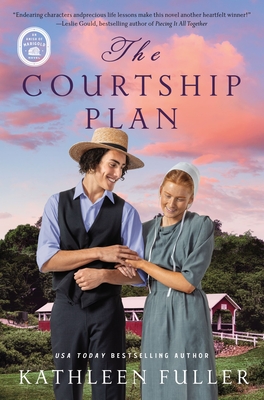
Things aren’t going well for Charity Raber as she looks for a job and a husband in Birch Creek. She was one of many young ladies responding to an ad that said there were a lot of young Amish men in Birch Creek looking for wives. Charity is thin with bright red hair and more freckles than can be counted. Because of a difficult family background, she comes across as…odd. She is too eager, her speech is unfiltered, and she just doesn’t know how to act around her peers. She was even set up with a date as a prank by one brother fooling another. She escapes more embarrassment by moving to Marigold where she is hired as a caregiver to Shirley, a kind English woman. To her dismay, just as she is adjusting well, one of the brothers moves in next door.
Charity wants love and sets out to get a husband with the aid of library books that hold some pretty bad advice and lead Charity into some situations that are very funny. The interactions between Shirley and Charity with their neighbor Jesse are the basis of a good story that is mostly not a fairy tale romance. A fun addition is Shirley’s escape artist dog Monroe. A serious complication is Charity’s relationship with her father and stepmother.
Love and forgiveness are strong themes that move forward an interesting story. Charity is a complicated character with a complicated background. She is the underdog protagonist that you will root for, but a happy ending seems difficult to achieve.
I received a complimentary copy of this book in exchange for an honest review. Opinions expressed in this review are completely my own.
Rating: 5/5
Category: Christian, Romance
Notes: #1 in the Amish of Marigold Series. This book references a prank that I had also read about in the last book of the Amish Mail-Order Bride Series, but they are really independent series. The reader will get all the information needed right in The Courtship Plan.
Publication: January 17, 2023—Zondervan
Memorable Lines:
He’d called her weird and a pest. He wasn’t the first one to throw those awful adjectives at her. That honor was reserved for her mother.
When he’d told her Shirley cared, her heart leapt. Someone cared about her. She soaked that in like a dried-up sponge sitting in a saucer of fresh water.
She replaced her kapp with a kerchief and tried to bolster her own spirits, like she always had. but she failed. She was tired, so tired of being her own cheerleader.
Happy Mother’s Day!
To you and the people in your life who have shown caring, giving and love, my best wishes for a special time of celebration!
The Ways We Hide–“escapologist extraordinaire”
The Ways We Hide
by Kristina McMorris

Admittedly it is hard to write a “happy” book about World War II. The Ways We Hide is definitely not a cheerful book. While she avoids graphic descriptions of the violence of the war, author Kristina McMorris excels at conveying the overwhelming sadness of the personal tragedies, even those that occurred pre-war, early in the orphaned protagonist Fenna’s life. When she escapes from an orphanage in the U.S., she is taken in by her best friend Arie’s family despite their religious differences. The parents in both families are Dutch immigrants. As young adults they discover their romantic love for each other, but Fenna suddenly leaves her adoptive family without explanation.
Taking her love of magic to the stage, Fenna becomes a self-made illusionist in the style of Houdini. She is recruited by the British in World War II to devise gadgets and conceal them in support of Allied troops in Europe. The British ask her to go to Holland on a dangerous rescue mission to find Arie, but more more is involved than her handlers are telling her.
The story is well played out with unexpected twists around every corner. This work of historical fiction is well written and extremely well researched. I can’t say that it is a page turner for me because it is so sad. The characters have little hope for positive outcomes, but pursue their noble goals against all odds. The work is undercover, classified, and occurs in Nazi controlled areas. Therefore, it is hard to know who can be trusted.
The author explains at the end of the book her framework for inserting the fictional Fenna into the mostly historically accurate backdrop with some slippage of time. She has researched her subjects well which include not only the war efforts but also an anti-labor strike event that changed Fenna’s life forever.
The ending is not a happily ever after with the protagonists riding off into the sunset, but how could it be when so many people have died? Despite the reality of the situation, the author does manage to conjure up a “lemons into lemonade” scenario for Fenna that is satisfying and actually sweet. I am glad I read this book which reveals a lot about undercover work, dangers, and relationships in World War II.
I received a complimentary copy of this book in exchange for an honest review. Opinions expressed in this review are completely my own.
Rating: 4/5
Category: Historical Fiction, Women’s Fiction
Notes: 1. There are author notes at the end which explain in detail how McMorris got her inspiration for the various parts of the book. It is followed by suggestions for further reading for those who would like to learn more about the topics in the book.
2. Online there is posted a Book Club Guide on the author’s website (kristinamcmorris.com). While I do recommend this book for book clubs, individual readers will also find this guide helpful in visualizing the setting and the culture. It includes Dutch inspired recipes plus a recipe for invisible ink (not the lemon juice type). There are questions designated as a Reading Group Guide. Perhaps most importantly to me, there are fifteen photographs that will transport the reader back in time. There are also QR codes for videos and other additional resources online. In addition, there are suggestions for group activities to enhance book club meetings.
Publication: September 6, 2022—Sourcebooks Landmark
Memorable Lines:
Traveling in clusters pallbearers carried pure-white caskets low at their sides. The dimensions of each befitted a child, the weight minuscule compared to the burden.
In this instant I consider a potential reason my life has been repeatedly spared. Could it be to attain justice for the victims of a cruel and callous enemy?
He offers his hand with a caring look. “May our paths cross again,” he says, “in a better world.” It’s impossible to envision any future beyond the immediate challenges ahead. Still, I accept his handshake, grateful for the notion.
Pride–love in the ‘hood
Pride: A Pride and Prejudice Remix
by Ibi Zoboi

In a fun retelling of Jane Austen’s Pride and Prejudice, similar themes of class differences and the prejudices that accompany them are the focus of Ibi Zoboi’s Pride. The characters are of Haitian-Dominican background and the setting is the “hood” of Bushwick in Brooklyn.
Life changes dramatically for the Benitez sisters when the rundown property across the street is renovated by the upper class Darcy family. Ainsley Darcy, who attends Cornell, is attracted to Janae Benitez, a student at Syracuse. His younger brother Darius is treated harshly and with suspicion by our narrator who is also the protagonist, Zuri Benitez, age 17. The Darcy’s clearly don’t fit into the hood, but when Zuri goes out of Bushwick, she finds that she doesn’t fit in easily there.
This young adult novel explores the barriers put up intentionally and often unwittingly by the community and by individuals. It seems that Bushwick will be forced to change, but where does that leave its residents? If you are not from that community, dear reader, you will find yourself immersed in an unfamiliar culture with new words and customs. I found myself liking the characters and the warmness of their world although it is outwardly a much tougher one than the home community in which I was cocooned. This book exposes the assumptions it is all too easy to make when we are confronted with dissonance. Reading it will expand your horizons and make you dive deeply into your soul to consider how you view those whose life circumstances are different from your own.
Rating: 4/5
Category: Young Adult, Romance, Fiction
Notes: Contains a fair amount of cursing as appropriate to the street language of the community
Publication: 2018—Balzer and Bray (HarperCollins)
Memorable Lines:
Every book is a different hood, a different country, a different world. Reading is how I visit places and people and ideas. And when something rings true or if I still have a question, I outline it with a bright yellow highlighter so that it’s lit up in my mind, like a lightbulb or a torch leading the way to somewhere new.
If Janae is the sticky sweetness keeping us sisters together, then I’m the hard candy shell, the protector. If anyone wants to get to the Benitez sisters, they’ll have to crack open my heart first.
I’d look back at them with defiance and a little pride; a look that says that I love my family and we may be messy and loud, but we’re all together and we love each other.
Pride and Prejudice–courtship in the early 1800’s
Pride and Prejudice
by Jane Austen

In preparation for reading Pride, a modern day version of Jane Austen’s Pride and Prejudice, with my book club, I decided to reread the original. I knew I could watch a video of the story, but I decided to aim for authenticity and read the actual book. I was glad I did as there is so much to be appreciated in Austen’s words, style, and depiction of characters. In retrospect, I believe my younger self had seen one of the several videos, but had never actually read the novel. I would still like to view one of the movies for an opportunity to better envision the costumes and settings of this period piece, but there is much value to be gained from the reading experience.
Pride and Prejudice is a romance particularly focusing on Jane and Elizabeth Bennet as they navigate the difficult waters of courtship in the early 1800’s in England. Their courses are made more murky by the family’s financial and social status. They are not part of the old monied class that is full of prejudice, but they have standards and they and their suitors are driven at least in part by pride. From a twenty-first century viewpoint, the courtship and rules of engagement seem stilted, but the reader can see in a younger sister’s impetuous disregard for the rules and assumptions of the time, that there are real societal and personal consequences for ignoring the standards of any time period.
I enjoyed the book which is as much about social issues as it is a romance. Pride and prejudice are, of course, themes throughout the book. Most of the characters of the novel grow and develop through the events of the story. Some remain stuck in their ways of thinking, and those continue to be persons the reader won’t like. You may find yourself rereading Pride and Prejudice for love of the characters, the joy of the language, or the journey towards a known ending—happy for some, less so for others.
Rating: 5/5
Notes: Edited by R. W. Chapman. Distributed by Gutenberg Press
Category: General Fiction, Romance
Publication: 1813—T. Egerton Military Library, Whitehall
Memorable Lines:
“Affectation of candor is common enough;—one meets it every where. But to be candid without ostentation or design—to take the good of every body’s character and make it still better, and say nothing of the bad—belongs to you alone.”
Without thinking highly either of men or of matrimony, marriage had always been her object; it was the only honorable provision for well-educated young women of small fortune, and however uncertain of giving happiness, must be their pleasantest preservative from want. This preservative she had now obtained; and at the age of twenty-seven, without having ever been handsome, she felt all the good luck of it.
“You mean to frighten me, Mr. Darcy, by coming in all this state to hear me? But I will not be alarmed though your sister does play so well. There is a stubbornness about me that never can bear to be frightened at the will of others. My courage always rises with every attempt to intimidate me.”
 education pathways