
Home » Posts tagged 'liturgy'
Tag Archives: liturgy
Epiphany: The Season of Glory
Epiphany: The Season of Glory
by Fleming Rutledge
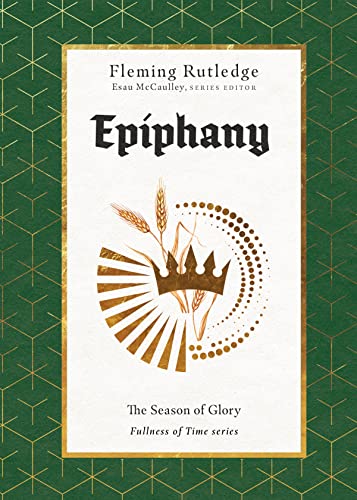
If you didn’t know anything about Fleming Rutledge before you began her tome on Epiphany, you would certainly quickly ascertain for yourself that she is a theological scholar. One of the first women to be ordained by the Episcopal church, she has spent her life studying the Bible and serving as a priest. As an author she has written many books and is known as an expert on the works of Tolkien. There is no fluff to be found in Epiphany: The Season of Glory.
Epiphany is celebrated on January 6 as the day the Magi brought their gifts to the Christ child, manifesting the glory of God and acknowledging the inclusion of Gentiles in the worship of Jesus. The day in many churches is extended into a season which celebrates other events in which the glory of God is preeminent: the baptism of Jesus by John the Baptist, the miracle of wine at Cana, and the transfiguration on the mountain top.
This book explains why we celebrate the day and season of Epiphany. It is a deep study which answers many questions for the reader and may well initiate many new questions. It is a work that requires time, careful reading, and thought. As other theological books, there are footnotes at the end. Many are reference sources for ideas and quotes in the book. Rutledge’s footnotes, however, include expansions on the various topics within and enlarge the experience for the reader. They are as interesting and thought provoking as the main body of the book.
Epiphany: The Season of Glory is part of the Fullness of Time Series which seeks to explain the liturgical calendar of many churches such as Anglican, Episcopal, and Lutheran. Many other churches are also finding renewal through experiencing the traditional seasons. As the editor of the series states “We want readers to understand how the church is forming them in the likeness of Christ through the church calendar.” The six books in the series are by different authors and can be read as standalones. This book is more intellectually challenging than the other books in the series, but they are all worthy reads.
Rating: 5/5
Category: Nonfiction, Christian, Religion
Notes: standalone, but part of the Fullness of Time Series
Publication: 2023—InterVarsity Press
Memorable Lines:
There will always be those who do not recognize him, but they will nevertheless be in his sight and have a part in his eternal plan (see Romans 11). The church, however, in its observance of Epiphany, is to take care of its calling, to point to Christ’s glory, and let his glory take care of itself.
Telling stories about Jesus, what he said and what he did, is an essential part of spreading the gospel. But without the doxa, the glory of the only Son from the Father, it is an incomplete gospel.
The season teaches us to value the entire fellowship of believers, because Jesus calls persons to himself without regard to their station, reputation, accreditation, or accomplishments—and we see how we can begin to be transformed by the action of his Hoy Spirit working through the unearned and undeserved gifts that he bestows.
The Alto Wore Tweed–unpretentious protagonist
The Alto Wore Tweed
by Mark Schweizer
This is a very funny mystery and probably different from all other mysteries you have read. The protagonist of The Alto Wore Tweed is Hayden Konig, a man who wears several hats, but is predominantly chief of police and the only detective in St. Germaine, North Carolina, as well as choir master for the Episcopal church. He is highly qualified for both jobs, and music is his passion. He dates Meg, an investment counselor, who lives with and takes care of her aging mother. Hayden also has visions of being a mystery writer in the style of Raymond Chandler. He has several million in investments from the sale of a patent, but lives simply.
Hayden is a nice guy but is not one to butter people up or try to stay on everyone’s good side—especially the new rector at the Episcopal church, Mother Ryan, a woman who holds a “wimmym’s” retreat where the celebrants “ReImagine God in our own feminine image” and suggest new names for God such as Sophia, Moon Mother, and Wanda. The literally explosive, untimely ending to their retreat is hysterically funny.
The janitor at the church is found dead, and much of the book focuses on discovering how he died and who murdered him. Hayden and his staff of two are good at following clues, and I was convinced several times that I knew the identify of the killer only to have the investigation go in a different direction. The method the killer used was uncommon.
The style of writing is humorous, replete with puns and tongue in cheek repartee. The author inserts Hayden’s attempts at mystery writing throughout in a manual typewriter font. His reading audience is the choir as he inserts new chapters in their choir folders weekly for them to read when the service is boring.
The reader watches a Christmas disaster as the Rotary Club and Kiwanis Club create competing creche displays in subfreezing temperatures. What could go wrong when you have live animals, a bagpipe player, and a dromedary who thinks he hears his mating call? This book is the first in a series of 15 books with a distinctive kind of humor.
In discussing this with my book club, I discovered a variety of responses to The Alto Wore Tweed. I think we all agreed that the insertion of the Chandler style mystery was not done well and immediately became a distraction rather than an enhancement. I know I have a quirky sense of humor, and that was confirmed as some members did not find the book nearly as funny as I did. The characters are portrayed by caricatures; across the board almost no one is given a realistic depiction and therein lies the humor for me. There are MANY classical music references, most of which probably had significance which escaped me. If I had not spent some time in Episcopal and Anglican churches with a formal liturgy, I’m not sure I would have understood the format of the services. In conclusion, The Alto Wore Tweed is unconventional and innovative. Its plot is worth following with a complicated mode of murder. I certainly did not determine the killer correctly before the conclusion. Some may consider it irreverent, but it pokes fun at those who think too highly of themselves. Eccentric characters rule the day.
Rating: 4/5
Category: Mystery, Humor
Publication: 2002—SJMP Books
Memorable Lines:
“Oh man,” I said, suddenly remembering everything I had forgotten to bring with me. “Nancy, did you bring any gloves? Mine are in the truck.” “Right here, boss,” she said producing a box of physician’s disposable latex wear and a baggie from her purse. “What a babe!” I said. Then, remembering my PC rules, quickly changed to “I mean, thank you Officer.” Nancy snorted in good-natured disgust and handed me the box.
“On Friday, a woman came into the station and complained to Nancy that the night clerk at the Roadway had sold her baking powder instead of cocaine. She wanted to file a complaint. She even gave Nancy the baggie of powder.” Meg looked at me in disbelief. “Was it baking powder?” “Nope. It was cocaine all right. We drove her down to Boone. Told her she needed to file her complaint from the courthouse. About halfway there, she started getting scared and told us she’d decided not to press charges. Anyway, they booked her on possession and locked her up.”
“Bourbon?” he asked, as soon as I walked in. I may have been becoming a little too predictable. “Sheesh, Kent. It’s ten in the morning. At least we can pretend that we’re being civilized. Pour mine into this coffee.” I pushed his espresso across the desk to him and he poured a couple of fingers into both cups….I stirred my coffee with the end of my pen, wiped it on my jacket and waited for Kent to peruse the file.
Liturgy of the Ordinary: sacred practices in everyday life
Liturgy of the Ordinary
by Tish Harrison Warren

Liturgy is the form or pattern that a church service follows. It may be a general and loose sequence or it may be highly structured as followed by Anglicans and other denominations that use The Book of Common Prayer. In Liturgy of the Ordinary, Tish Harrison Warren connects our daily routines to the rituals and patterns of the Christian life from our waking in the morning to our rest at the end of the day. Along the way she examines our search for lost objects and ties it into confession and repentance. She discusses quarrels within the family and how as Christians we are called to extend peace or shalom. Warren dissects how we look at time and at community. She suggests savoring the good gifts of God in our everyday life, but discourages overindulgence in pleasure lest it become an addiction, trapping us in the cycle of wanting more.
Liturgy of the Ordinary is a wonderful book for individual enjoyment and study or for sharing with a group. It is a book that takes simple concepts and invites a deeper dive. Warren is an excellent writer. The book is full of wisdom from both Warren and those she has studied. She invites the reader to look at everyday routines in a new way. The book is replete with anecdotes and quotes. Above all, Warren is open and honest; readers will see themselves in her struggles and her revelations. She makes the mystery of living out the Christian life in this broken world both real and accessible.
Rating: 5/5
Category: Christian, Nonfiction
Notes: Includes Discussion Questions, Practices, and a Bibliography
Publication: 2016—InterVarsity Press
Memorable Lines:
Waiting, therefore, is an act of faith in that it is oriented toward the future. Yet our assurance of hope is rooted in the past, in the person of Jesus of Nazareth and in his promises and resurrection. In this way, waiting, like time itself, centers on Christ—the fulcrum of time.
Christian friendships are call-and-response friendships. We tell each other over and over, back and forth, the truth of who we are and who God is…My best friendships are with people who are willing to get in the muck with me, who see me as I am, and who speak to me of our hope in Christ in the midst of it. These friends’ lives become a sermon to me.
The words of the liturgy felt like a mother rocking me, singing over me, speaking words of blessing again and again. I was relaxing into the church like an overtired child collapsing on her mom. When my husband and I would get into the car after church each week and talk about the service, I would say to him, “It feels like chamomile tea.”
 education pathways