Home » Posts tagged 'liberation'
Tag Archives: liberation
Into the Forest–A Holocaust Story of Survival, Triumph, and Love
Into the Forest
by Rebecca Frankel
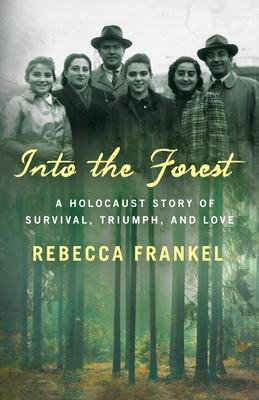
So many books have been written about World War II and, more recently, about the Nazi treatment of Polish Jews. Rebecca Frankel adds Into the Forest to the collection. It is nonfiction that in many parts the reader would wish it to be fiction, that the torture, annihilation, and deprivation should not really have happened. It is the story of the Rabinowitz family, of the many Jews who died, of the love that persisted through two years of living on the move in the cold forests, of digging holes in the ground to hide from Nazis. It is the story of survival, of triumph as the lives of some of the people in the book intersect years and thousands of miles later.
This book was emotionally difficult to read, knowing it is nonfiction, and thus was a slow read for me. The author knew first hand some of the people she wrote about. She spent five years researching and interviewing. There is a huge section of copious notes detailing where her information came from for each chapter.
The Prologue ties the tale together and is worth rereading at the conclusion of the book. There are two chapters that set the stage of what life was like in the little Polish village of Zhetel before the invasion of the Russians, followed by the occupation of the Germans. Then the focus lands on the German-created Jewish Ghetto, the Polish Resistance, and the various “selections” in which laborers and those destined for the mass graves were chosen. The “lucky” escaped to a huge forest, but many died there as hunted animals before the liberation came. The Rabinowitz family had their eyes set on a future in Palestine, but they had many more moves in their future and were caught up in the growing prosperity of the 1950’s. Into the Forest is a challenging book worth reading. It shows Jewish life and customs in the midst of both tribulation and good times. The book thankfully ends on positivity as the author stresses the various types of love woven into the book.
I received a complimentary copy of this book in exchange for an honest review. Opinions expressed in this review are completely my own.
Rating: 5/5
Category: History, Nonfiction, Memoir
Publication: September 7, 2021—St. Martin’s Press
Memorable Lines:
The forest, however, would not be exempt from the war’s brutalities or the bare-knuckled survival required to endure it. Nor would it provide ample shield for the Jews or the partisans—Russian and Jewish alike—who had taken shelter here and set up their outposts in its wilds, no matter how dark or deep. The farther they went and the safer they were, the more determined their killers became to root them out.
In some areas, the advertised reward for information on the partisans or hiding Jews was a single cup of sugar. Which was either a reflection of the paltry value of a Jewish life, or the peasants’ depth of desperation.
But Moscow’s successful onslaught had made the retreating Nazis more dangerous and, however unimaginably, even more murderous. Himmler issued an order to those in the path of the fast-moving Soviet troops: destroy all evidence.
When We Were Young and Brave–kindness in the midst of despair
When We Were Young and Brave
by Hazel Gaynor
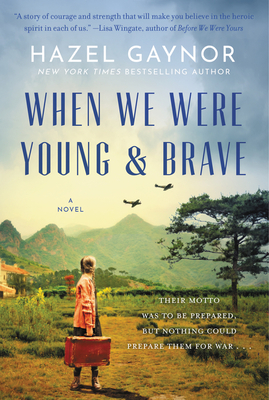
During our current tumultuous times, When We Were Young and Brave was somewhat of a difficult read for me, but I’m glad it is now a part of my personal reading journey. Hazel Gaynor’s latest book relates a fictional version of the events following Japan’s bombing of Pearl Harbor as they play out for the students and teachers at the China Inland Mission School in Chefoo, China. With Japan’s invasion of China, the Japanese seize and occupy the school, later interning the residents in the much larger prison camp known as the Weihsien Civilian Assembly Center where sanitation facilities are disgusting and meals are meager, nutritionally inadequate for growing children, and almost inedible. Despite the harsh conditions, the teachers protect the children as best they can while rallying them with insistence on routines, cleanliness, and a hearty “chin up” attitude. Of particular note is the role of their Girl Guide troop and standards that help the students in maintaining a positive outlook.
The last sections of the book, “Liberation” and “Remembrance,” are remarkable in the beauty of the skillful writing that describes the impact of the American liberation on the camp residents. They gain relief from the fears that haunted them daily, but endure the substitution of new anxieties and questions for the future. Where will they go and what will they do? Is anyone waiting for them at home?
The story is told by alternating narrators. Elspeth is a competent, well-organized, and kind teacher who has a special motherly feeling for Nancy, the daughter of missionaries in China. Their relationship is always teacher and student, but as months of internment become years, Elspeth takes on increasingly more of the commitment for safe care that she made to Nancy’s mother as they departed by boat to sail to the school, both as first-timers. We view their ordeals from both Elspeth’s and Nancy’s points of view.
There are a lot of themes in the book including resilience, relationships, releasing the past, and looking to the future. Symbolism is also important in the kingfisher that becomes the emblem of the new Girl Guide patrol and the sunflower which holds a special meaning for teacher and students.
The characters emerge as three dimensional figures as they are well developed. Realism comes into play with descriptions of the harsh conditions; no one’s story is fairytale like or even positive. The setting is well-executed with vivid word pictures. As the Chinese workers slosh through the camp, the odor of the filth of “honey-pot” buckets they pull from the latrines makes an unforgettable olfactory experience. There are also more pleasant descriptions of the beauty outside the camp, but glimpses are rare for those interned. The last two sections make the book a winner for me, but the first sections are also well written and essential to the success of this historical novel.
Rating: 5/5
Category: Historical Fiction
Notes: There is a very informative section at the end of the book that describes the author’s research and thought processes and some historical background. The author has also included a brief history of the Girl Guides as that organization plays an important role in the girls’ lives. Other additions are a list of books and websites for further reading, including original source documents found at weihsien-paintings.org, and some questions for discussion.
Publication: October 6, 2020—Harper Collins
Memorable Lines:
When she was cross, Miss Kent spoke in a way that reminded me of brittle twigs snapping underfoot on autumn walks. I felt my cheeks go red. Without giving me a ticking-off, she’d done exactly that.
I knew the smile she gave us that morning was the sort of “we must be brave” smile adults use when they’re trying to pretend something awful isn’t happening.
But, as I’d come to realize about life during a war, nothing stayed the same for long. Just when you thought you’d adjusted and adapted and found a way to cope, the situation changed.
 education pathways